
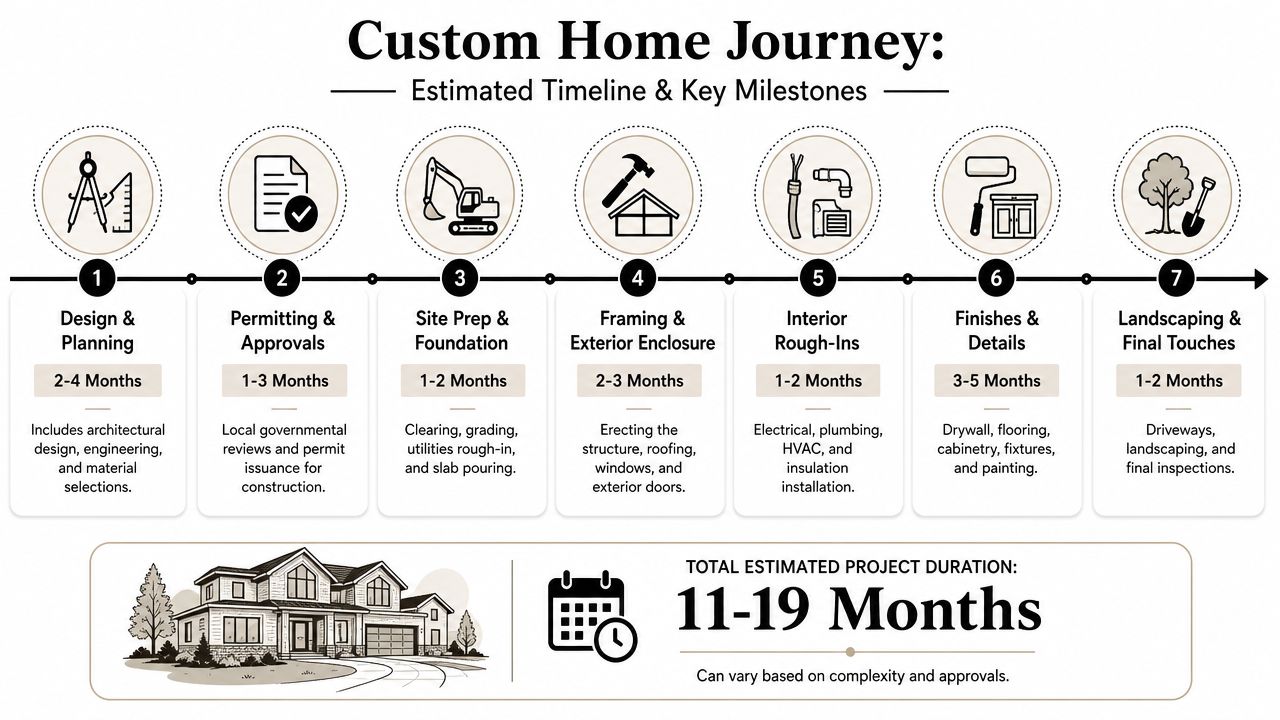
A luxury custom home builders schedule in Jacksonville typically runs eighteen to thirty months from first design meeting to certificate of occupancy, and only about half of that is construction. The rest is design, engineering, permitting, and procurement — the phases owners consistently underestimate because nothing visible is happening on the lot. Understanding where the real time goes is what separates an owner who plans around the schedule from one who is surprised by it every quarter.
The Luxury Custom Home Builders Schedule, Milestone by Milestone
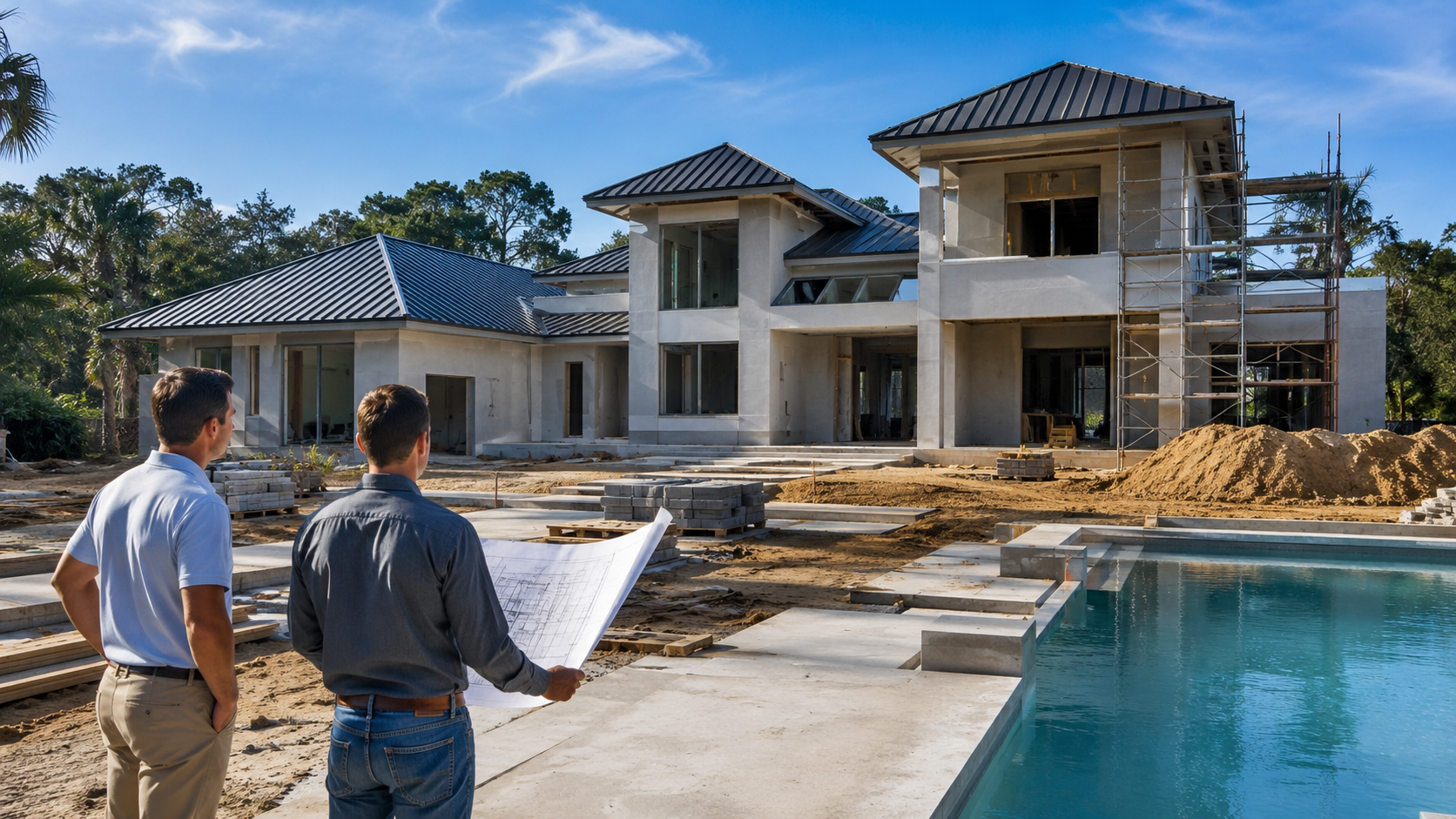
Every high-end build in Northeast Florida moves through the same eight milestones. The durations below are realistic ranges for a genuinely custom home in the 4,000 to 8,000 square foot range, not production-builder figures.
- Feasibility and pre-construction (4–10 weeks). Site analysis, survey, soil boring, zoning and covenant confirmation, and a preliminary budget tied to a real program rather than a price per square foot.
- Architectural design and engineering (4–9 months). Schematic design, design development, then construction documents with structural, mechanical, and civil engineering. This is the longest single phase on most luxury projects and the one most sensitive to owner decision speed.
- Permitting (1–4 months). Building permit review, plus any architectural review board approval, environmental or wetland review, and coastal or flood requirements. These can run in parallel; treating them as sequential adds months for no reason.
- Site work and foundation (3–8 weeks). Clearing, fill and compaction, utilities, then footings and slab or stem wall. Wet season and soil conditions drive the variance here.
- Framing and dry-in (2–4 months). Structure up, roof on, windows and doors set. Dry-in is the milestone that ends weather exposure, and it is the one worth protecting above all others.
- MEP rough and inspections (6–10 weeks). Electrical, plumbing, mechanical, and low-voltage systems roughed in and inspected, then insulation and drywall. Luxury homes carry far more systems here — automation, audio, security, lighting control, generators — and coordination density is what slows this phase.
- Interior finishes (4–8 months). Millwork, tile and stone, flooring, cabinetry, specialty plaster, and fixtures. Custom millwork and stone fabrication are shop-fabricated to field measurements, so this phase cannot be compressed by adding labor.
- Punch, commissioning, and certificate of occupancy (3–6 weeks). Final inspections, systems commissioning, punch list, and closeout documentation.
What Actually Moves the Date
Four variables account for most schedule variance on luxury projects in this market, and three of them are within the owner’s control.
Selection timing. Every finish decision has a lead time attached, and lead times run backward from installation. Custom steel windows, imported stone, specialty appliances, and custom cabinetry commonly carry sixteen to thirty weeks of lead time. A decision deferred by six weeks does not cost six weeks — it costs six weeks plus whatever trade sequence it displaces. Building a selection calendar during design, with hard decision-by dates tied to installation dates, is the highest-leverage schedule tool an owner has.
Change orders after permit. A change during schematic design costs a redraw. The same change after permit issuance may require revised sealed drawings, a permit revision, and demolition of completed work. The cost of a change rises roughly by an order of magnitude at each phase boundary.
Procurement. On a luxury build, long-lead items should be released for fabrication during permitting rather than after framing. Builders who wait to order until they need the item are effectively adding the lead time to the critical path instead of running it in parallel.
Weather and hurricane season. Northeast Florida’s June-through-November storm season and its summer afternoon rain pattern affect site work, foundation, and pre-dry-in framing. Sequencing a build so dry-in lands ahead of peak season is deliberate planning, not luck.
Where Permitting Fits Without Stalling the Schedule
Permitting is the phase owners most often treat as a single queue when it is really several parallel ones. Building plan review runs against the current edition of the Florida Building Code, and on a coastal or riverfront Jacksonville lot it sits alongside architectural review board approval, environmental or wetland review, and flood elevation requirements. Started together, these overlap into a one to four month window. Started one after another because each was waiting on the last, they become six months or more — a self-inflicted delay that never shows up as anyone’s fault on a schedule report.
Why the Schedule and the Draw Calendar Have to Match
If the build is financed with a construction loan, the milestone schedule and the lender’s draw schedule are the same document viewed from two directions. Draws release against completed and inspected work, so a milestone that slips does not merely delay construction — it delays funding for the trades queued behind it. Confirm before closing that the draw milestones in the loan documents match the milestones in the construction schedule, because reconciling them mid-build is slow and entirely avoidable.
Reading a Schedule Before You Sign
A credible luxury custom home builders schedule shows the critical path, names the long-lead items with their order-by dates, identifies who owns each decision, and includes float for permitting and weather. A schedule that is a list of phases with round-number durations and no dependencies is a marketing document. Ask which activities are on the critical path and what the plan is if a permit comment cycle runs long — the answer tells you whether the schedule was built or merely presented.
Ofir Engineering builds custom residences across Jacksonville and Northeast Florida as a licensed Florida general contractor, License #CGC 1540016, with milestone schedules and selection calendars issued before construction begins. Explore our luxury home builder services in Jacksonville, understand the approvals that precede the schedule in our guide to permit requirements in Duval County, and see what happens after the certificate of occupancy in our overview of warranty coverage under Florida statute.
Keep Building With Ofir Engineering
Related discussions & follow us: Facebook · Reddit
Latest & related guides: Explore more Luxury Home Builder guides →
