
Weighing home additions near me versus alternatives comes down to one number that almost nobody calculates: the cost per usable square foot of each route, including everything you have to buy along the way. In Jacksonville that number moves dramatically depending on your lot, your existing systems, and which county you are in — and the route that looks cheapest on a headline basis is frequently the most expensive once the whole picture is priced. Here is how the four options compare and where the cost cliffs sit. Ofir Engineering is a licensed Florida general contractor (License #CGC 1540016) with 15+ years serving Jacksonville, Ponte Vedra, St. Johns, and Northeast Florida.
Home Additions Near Me Versus Alternatives: Pricing the Same Outcome Four Ways
Start by defining the outcome rather than the method. Say you need roughly four hundred square feet of conditioned space with a bedroom and a bath. There are four ways to get it, and each carries a different bundle of hidden costs.
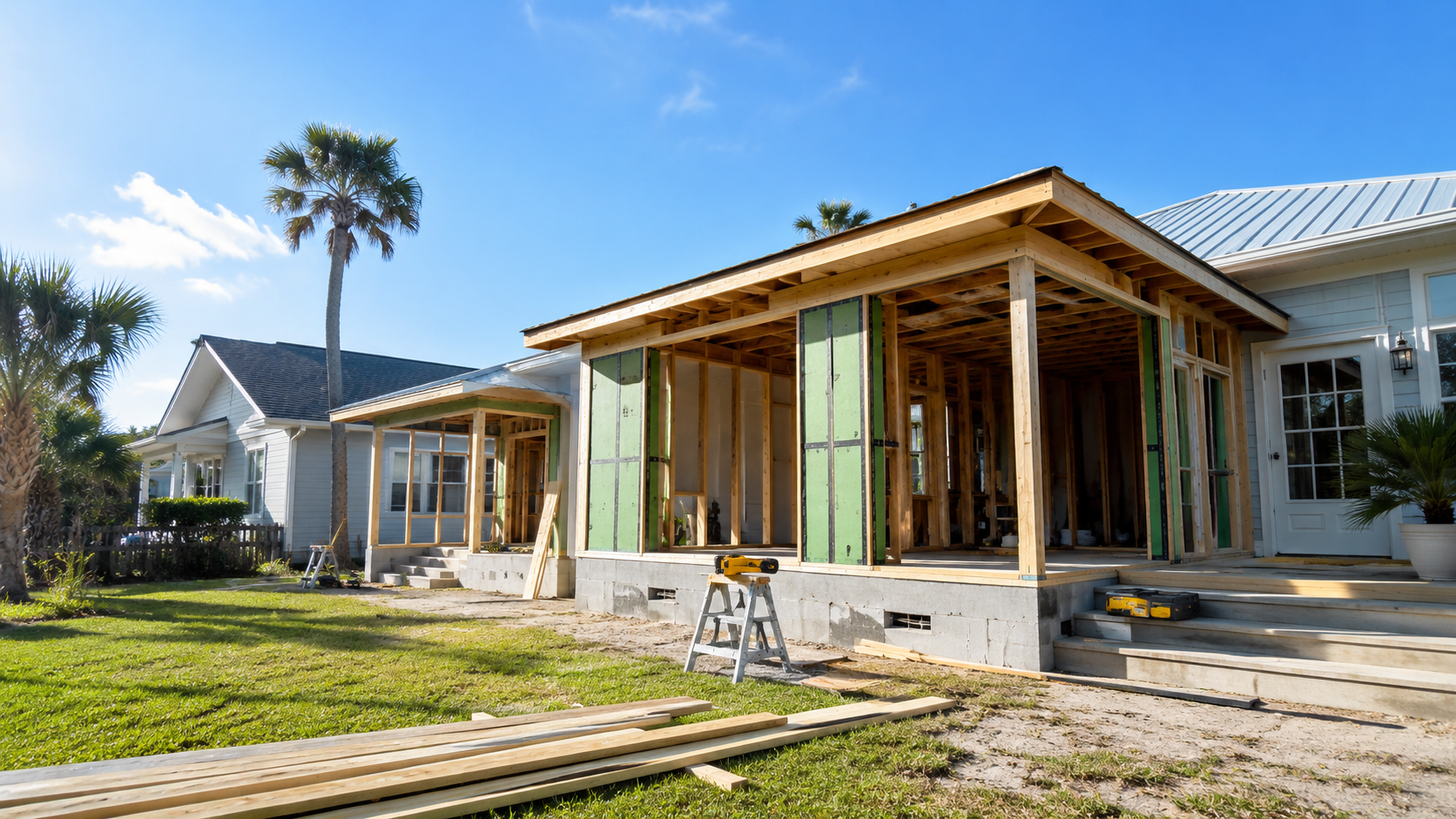
Attached addition. You pay for foundation, structure, roof, envelope, and interior finish, plus the tie-in to the existing house, plus any capacity upgrade the new load forces on your mechanical and electrical systems. The headline per-square-foot number is the highest of the four, and it is also the most complete — very little is left out.
Converting existing space. Enclosing a screened porch, finishing a bonus area over the garage, or reworking a compartmentalised plan. You skip the foundation, roof, and exterior envelope entirely, which is why cost per usable square foot is typically far lower. The ceiling is obvious: you cannot convert space that does not exist.
Detached structure. A separate building or an accessory dwelling. It avoids the tie-in risk completely, but it pays for its own foundation, roof, and utility connections, so per-square-foot cost usually lands close to or above an attached addition on a small footprint.
Buying bigger. Transaction costs on both sides, the mortgage delta at current rates, moving expenses, and whatever the new house needs on day one. This is the route people under-price most consistently, because the construction cost is zero and everything else is invisible until you add it up.
The Jacksonville-Specific Cost Cliffs
Four local factors can move an addition from the cheapest route to the most expensive, and all four are knowable before design.
Flood zone and the fifty-percent rule. In a special flood hazard area, when improvement cost reaches half the structure’s market value, the entire building can be required to meet current flood requirements including elevation. That is the largest single cliff in local addition work.
Setbacks and lot coverage. If the addition needs a variance, you have added months and uncertainty before a shovel moves. Duval, St. Johns, Clay, and Nassau each apply their own rules, and accessory-dwelling regulations in particular differ meaningfully between them.
Septic and utility capacity. Adding a bedroom can trigger septic system requirements based on occupancy, and in some areas a sewer connection requirement. This is a five-figure surprise when it is discovered late.
Mechanical and electrical headroom. New conditioned square footage adds load. If your air handler, duct system, and panel can absorb it, you are building a room. If they cannot, you are also buying a systems upgrade, and that changes the arithmetic considerably.
When Each Route Wins
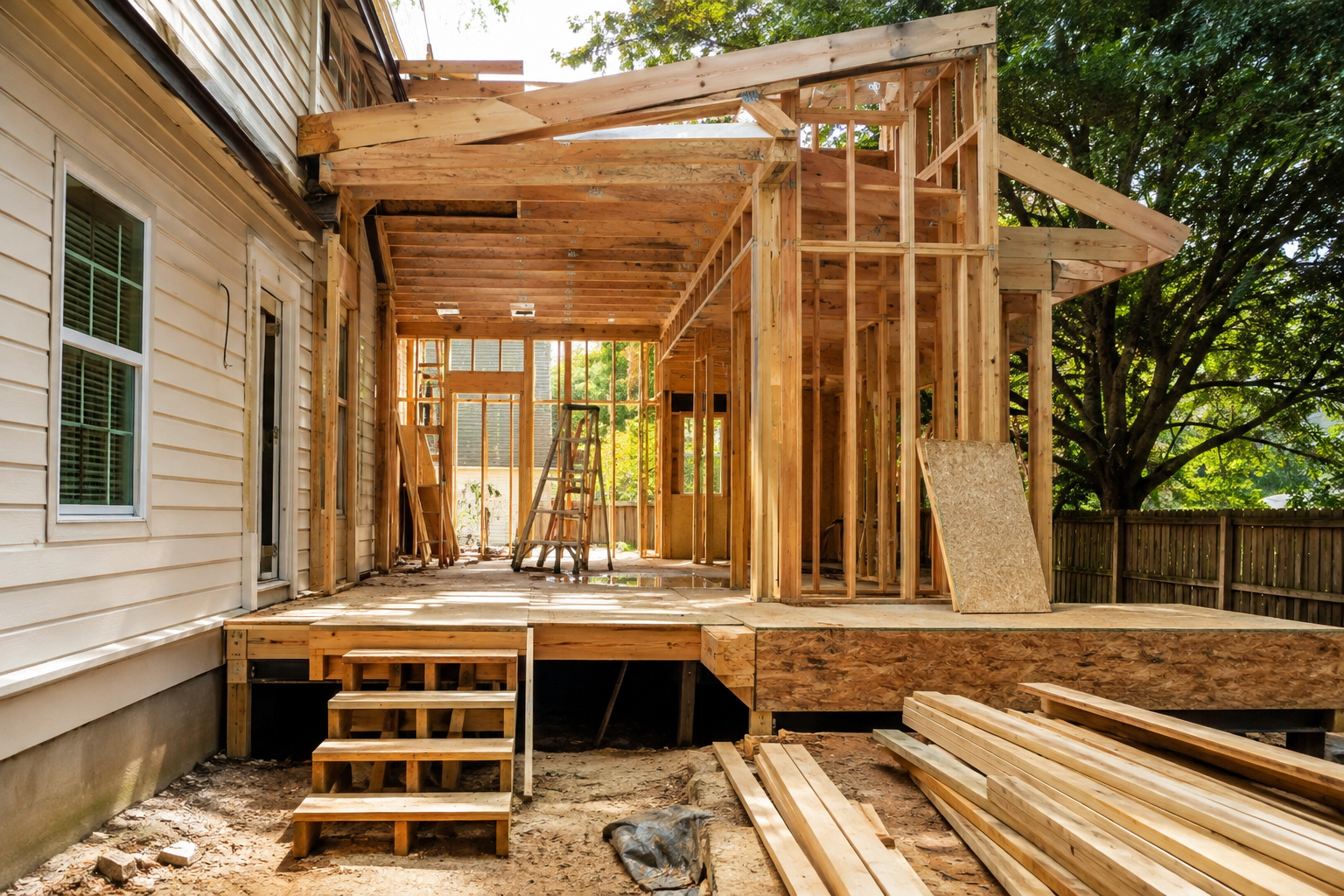
An addition wins when the lot has genuine room inside setbacks, the extension is on the same floor level away from the main plumbing stack and electrical service, and your systems have headroom. Under those conditions it is usually the cheapest way to get purpose-built space exactly where you want it, and it keeps you in a neighbourhood, school assignment, and commute you have already paid for.
Conversion wins whenever the space already exists somewhere in the house. In the housing stock common across Jacksonville — mid-century ranches and early-2000s builds — a surprising amount of usable area is trapped behind non-structural walls or sitting under a roof as an unconditioned porch or bonus space. Price this first, always.
A detached structure wins when the tie-in would be the expensive part: a house with a complex roofline, a second storey you would otherwise have to build onto, or a use that genuinely benefits from separation. Check the accessory-dwelling rules for your specific jurisdiction before you get attached to the idea.
Buying bigger wins when the real problem is the whole house rather than one missing room. An addition fixes adjacency; it cannot fix a floor plan that fundamentally does not work, and it cannot move you. When the plan is the problem, compare against a whole-house home remodeling programme or a purpose-built new construction home before assuming an addition is the answer.
The Owner-Builder Question
Some homeowners consider pulling an owner-builder permit to save the contractor fee. Structural work in Florida requires a licensed general contractor, and an owner-builder permit transfers responsibility for code compliance, inspections, subcontractor coordination, insurance, and liability to you. The savings frequently disappear into correction work, failed inspections, and schedule. Any contractor’s licence can and should be verified through the Florida Department of Business and Professional Regulation before you sign anything.
How to Decide
Run all four numbers against the same outcome, including permitting, engineering, systems capacity, and a real contingency for what gets discovered when walls open. Then check the four local cliffs — flood zone, setbacks, septic, and system headroom — because any one of them can invert the ranking. The decision usually resolves itself once everything is on the same page. For scope and process, see our home additions page, and to have the comparison run against your specific lot, contact Ofir Engineering for a feasibility review.
Frequently Asked Questions
Is adding on cheaper than moving in Jacksonville?
Often, when the lot has room inside setbacks, the addition is on the same floor level away from the main plumbing and electrical, and the existing systems can carry the new load. Once you add transaction costs and the mortgage delta, moving is more expensive than it first appears.
What is the cheapest way to add usable space?
Converting space you already own — enclosing a porch, finishing a bonus area, or opening a compartmentalised plan. You avoid a new foundation, roof, and envelope entirely, so cost per usable square foot is far lower. Price this option before any other.
Is a detached structure cheaper than an attached addition?
Usually not on a small footprint, because it pays for its own foundation, roof, and utility connections. It wins when the tie-in to the existing house would be the difficult and expensive part, or when the use genuinely benefits from separation.
What unexpected costs catch homeowners out on additions here?
Flood-zone elevation triggered by the fifty-percent rule, setback variances, septic capacity requirements triggered by adding a bedroom, and mechanical or electrical upgrades needed to serve the new space. All four are knowable before design if the contractor checks them.
Keep Building With Ofir Engineering
Related discussions & follow us: Facebook · Reddit
Latest & related guides: Explore more Home Additions guides →
