
A full house remodeling draw schedule is the agreement that decides when your renovation actually has money to spend. Florida renovation lenders do not hand over the loan at closing — they hold the funds in escrow and release them in stages as completed work is verified on site. Understanding that mechanism matters more on a remodel than on a new build, because renovation scopes change as walls open, and a draw schedule written against an optimistic scope is the fastest way to run a project out of cash mid-stream. Ofir Engineering is a licensed Florida general contractor (License #CGC 1540016) with 15+ years serving Jacksonville, Ponte Vedra, St. Johns, and Northeast Florida.

What a Full House Remodeling Draw Schedule Is
When you finance a whole-house renovation — through a renovation mortgage, a construction-to-permanent loan, or a bank’s rehab product — the lender advances money in arrears. The contractor performs a defined stage, an inspector verifies it exists, and only then are funds released to cover that stage. Nothing is prepaid.
The draw schedule is the table mapping each stage to a percentage of the renovation budget. It is negotiated before closing and it becomes a contractual document: the lender funds against it, the contractor plans cash flow around it, and you use it as a progress ledger. A draw request is a formal claim that a specific stage is complete, which makes it the natural moment to walk the site and ask questions.
Renovation draw schedules typically run tighter than new-construction ones. A whole-house remodel has more short, overlapping stages and fewer clean milestones, so lenders often use a work write-up with line-item completion percentages rather than a simple stage list.
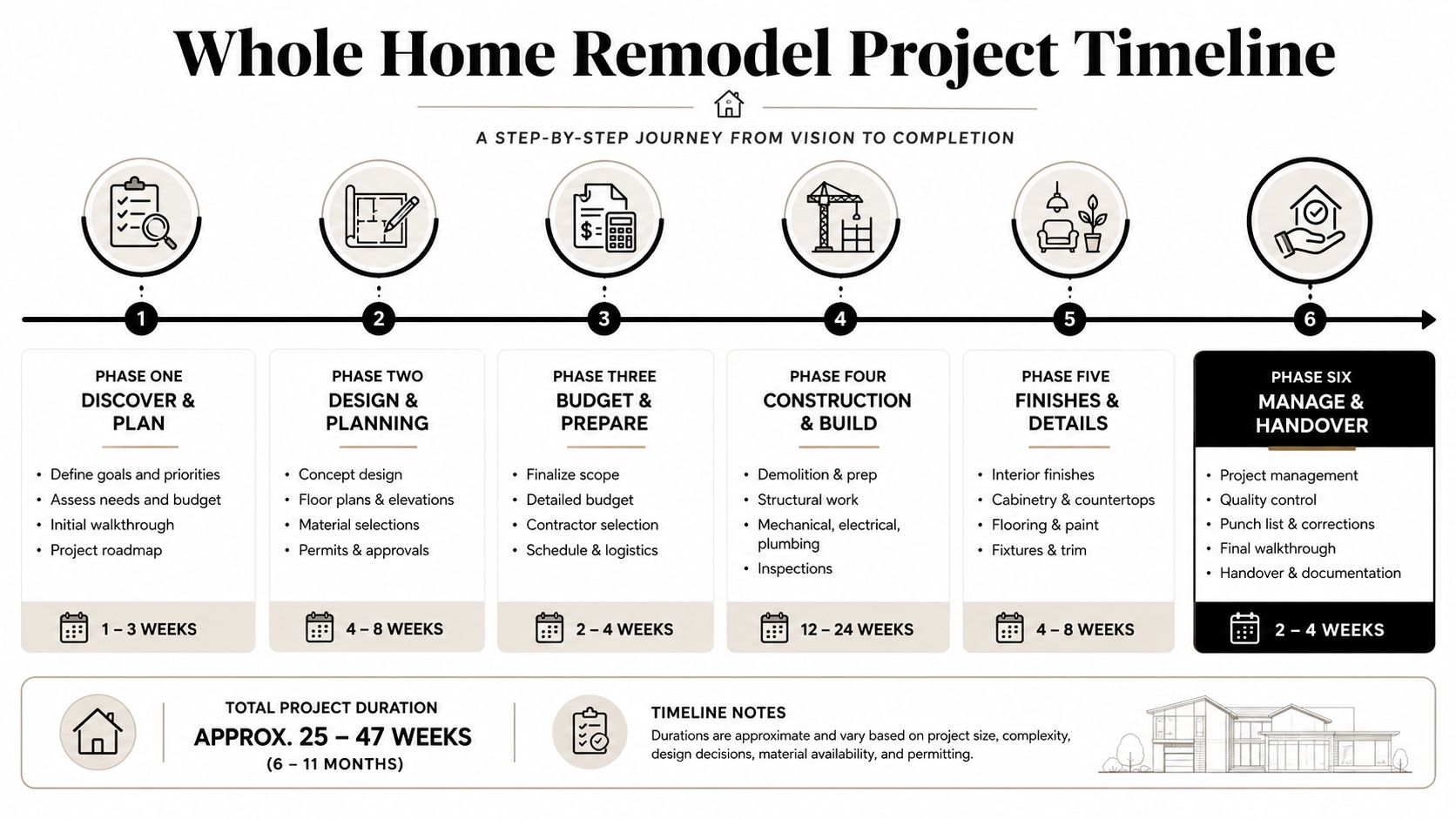
The Typical Stages on a Florida Whole-House Renovation
An initial draw at or shortly after closing usually covers permits, plans, engineering, and sometimes a mobilisation payment against material orders. Demolition and structural work follows — removals complete, any structural modifications framed and inspected, and the house stabilised.
Rough mechanical, electrical, and plumbing is often the largest interim draw, released when systems are installed and have passed rough inspection. Envelope work — roof, windows, exterior doors, and any exterior repairs — may be its own draw, and in Florida it frequently is, because insurability depends on it.
Insulation and drywall follow, then interior finishes, flooring, and cabinetry, then final trim, fixtures, and exterior completion. The final draw, commonly ten percent or more, is retained until the final inspection passes and the punch list is closed. That retention is the lender’s leverage to ensure the project is genuinely finished rather than merely habitable.
What Has to Be True Before a Draw Funds
The work is complete and in place. Materials sitting in the garage generally do not count. Some loans allow stored-material draws, but only with specific documentation and insurance, and it should be confirmed in writing before an order is placed.
An inspection confirms it. Most lenders send an independent inspector to photograph and verify completion percentages. Their report — not the contractor’s invoice — is what the lender funds against.
Lien waivers are current. Under Florida’s construction lien law anyone who supplied labour or materials can record a claim against the property, so lenders require conditional or unconditional waivers from the general contractor and every subcontractor and supplier tied to that draw. Missing waivers are, by a wide margin, the single most common reason a finished stage does not fund on time.
The remaining budget still covers the remaining work. Lenders track whether the undrawn balance can finish the job. If change orders or allowance overruns put the project underwater, the lender can require you to deposit the shortfall before releasing anything further.
What Actually Delays a Draw on a Remodel
Incomplete lien waiver packages lead the list. Inspection scheduling is second — the report is ordered after the request, and in busy periods the site visit is the bottleneck. Partial completion is third: a stage that is ninety percent done funds at ninety percent or not at all, depending on the loan product.
Then come the renovation-specific causes. Discovery is the big one — opening walls in a house built in the 1960s through the 1990s regularly reveals undersized electrical service, failed plumbing, hidden water damage, or unpermitted prior modifications. Every one of those creates a change order, and unapproved change orders create a gap between what was built and what the loan documents describe. Lenders will not fund into that gap. Title issues, including a defective notice of commencement or an intervening lien, will hold funding regardless of how finished the work is.
None of these are construction problems. The contractors who keep draws moving assemble each request as a complete package on the day the stage closes, rather than chasing signatures afterwards.
How Homeowners Should Manage the Process
Negotiate the schedule before closing. Ask how many draws the loan allows, whether there is a fee per draw, how many business days funding takes after a complete request, whether stored materials are fundable, how change orders are approved, and how much is retained until final inspection. Those answers shape your contractor’s cash flow and therefore your schedule.
Build a contingency into the loan amount rather than into your hopes. On a whole-house remodel in this housing stock, a contingency that would look generous on a new build is often merely adequate. During construction, insist on seeing the inspection report and the waiver package for each draw — it is the cheapest project control available to you. General guidance on construction and renovation lending is published by the Consumer Financial Protection Bureau, and it is worth reading before you sign rather than after.
If you want a whole-house scope mapped against a realistic draw structure before you approach a lender, review our whole home remodeling process, compare it with expanding via home additions, or contact Ofir Engineering to review scope, allowances, and milestones.
Frequently Asked Questions
How many draws does a Florida whole-house renovation loan usually have?
Commonly five to eight, though renovation products often work from a line-item work write-up with completion percentages rather than a fixed stage list. The count and the fee per draw are set in the loan documents and are worth negotiating before closing.
What most often delays a renovation draw?
Incomplete lien waivers. Florida’s construction lien law means lenders require waivers from the general contractor and every subcontractor and supplier attached to that stage, and one missing signature holds the whole release.
Will the lender fund materials I have already bought?
Usually not. Most renovation loans fund work completed and in place. Some allow stored-material draws with specific documentation and insurance, so confirm it in writing before placing a large order.
What happens when the contractor finds hidden damage?
It becomes a change order, and it has to be approved through the lender before that work can be funded. Unapproved changes create a gap between the built scope and the loan documents, and lenders will not fund into that gap — which is why a real contingency inside the loan amount matters.
Keep Building With Ofir Engineering
Related discussions & follow us: Facebook · Reddit
Latest & related guides: Explore more Whole Home Remodeling guides →
