
Full house remodeling soil and drainage conditions decide more of a Northeast Florida renovation budget than most homeowners expect, because unlike a new build on a cleared lot, a whole-home remodel inherits every drainage decision made on that property over the last forty years. The house is already sitting on the soil. Whatever that soil has done to the slab, the footings, and the water table around the foundation is now part of your scope, whether or not it appeared in the original plan. Ofir Engineering is a licensed Florida general contractor (License #CGC 1540016) with 15+ years serving Jacksonville, Ponte Vedra, St. Johns, and Northeast Florida.
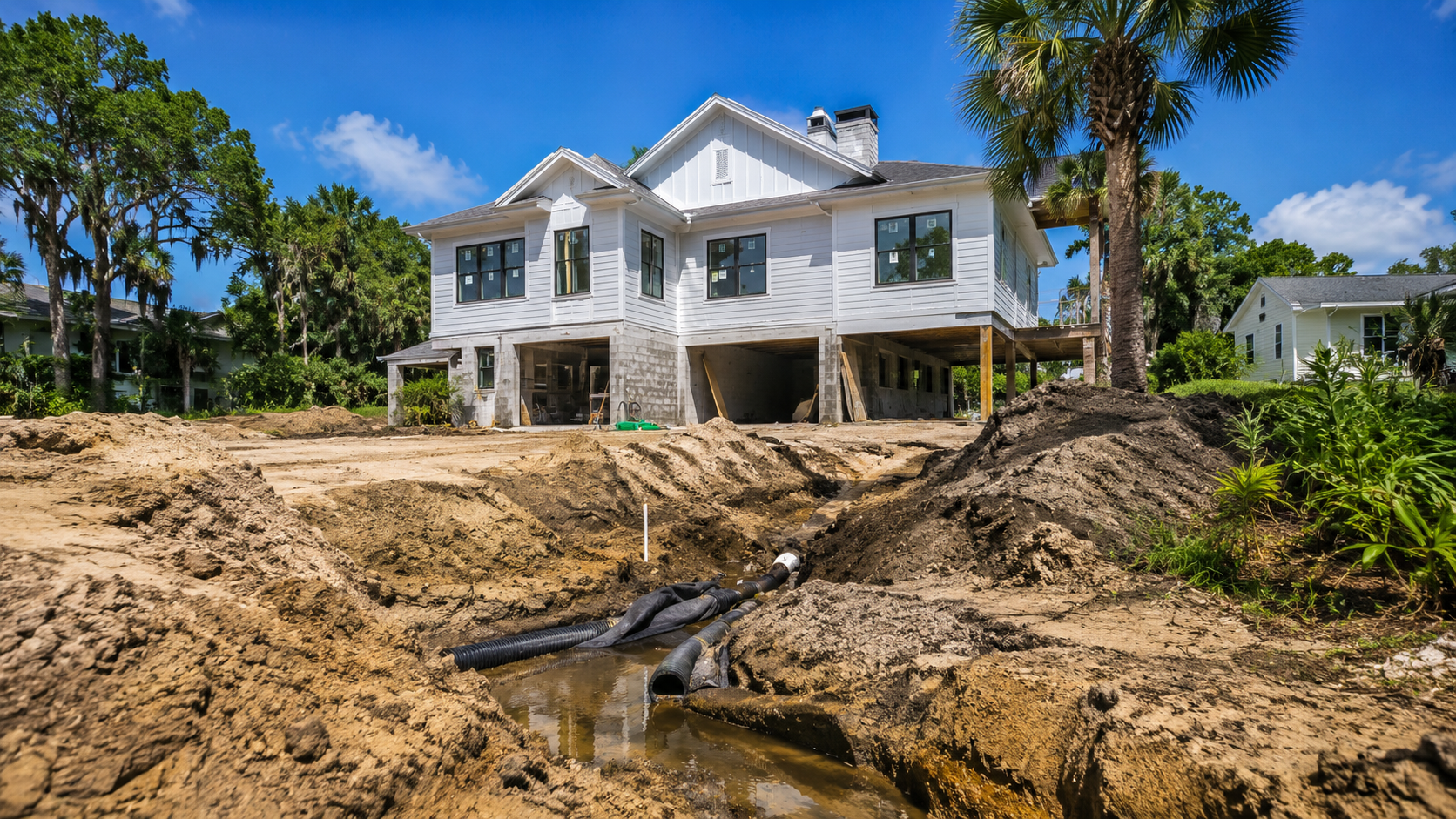
Why Full House Remodeling Soil and Drainage Issues Surface Late
Northeast Florida sits on a mix of fine sands, silty and clayey sands, organic pockets, and in places a shallow limestone layer, with a water table that can be within a few feet of the surface. Sandy soils drain quickly but carry moderate bearing capacity and move when they are saturated and then dried. Organic or muck pockets, common near creeks and former wetlands across Duval, Clay, and St. Johns, compress under load for years. A house built on top of one settles slowly and unevenly, and the evidence shows up as stair-step cracks in block, doors that stop latching, and hairline cracks running through tile.
These signs are easy to live with and easy to normalize. They typically only become a scope item at the moment a whole-home remodel starts moving walls, adding loads, or removing finishes that were hiding the movement. That is why soil and drainage belongs in pre-construction on a remodel, not in the middle of demolition when the schedule and the budget are already committed.
The Five Site Conditions That Change a Remodel Budget
Slab settlement and foundation movement. If the slab has moved, new flooring installed over it will telegraph the same problem within a year, and new cabinetry and door frames will not stay square. The remedy ranges from localized underpinning or grout injection to slab section replacement. It has to be diagnosed and corrected before finishes go in, not after.
Negative grade against the house. Decades of mulch beds, added sod, patios poured over existing grade, and settled backfill routinely leave the ground sloping toward the foundation. Every rain then drives water at the slab edge and the wall base. On a remodel, correcting the grade so it falls away from the structure, and re-establishing a clean drainage path to the street or a swale, is often the single highest-value item in the entire site scope.
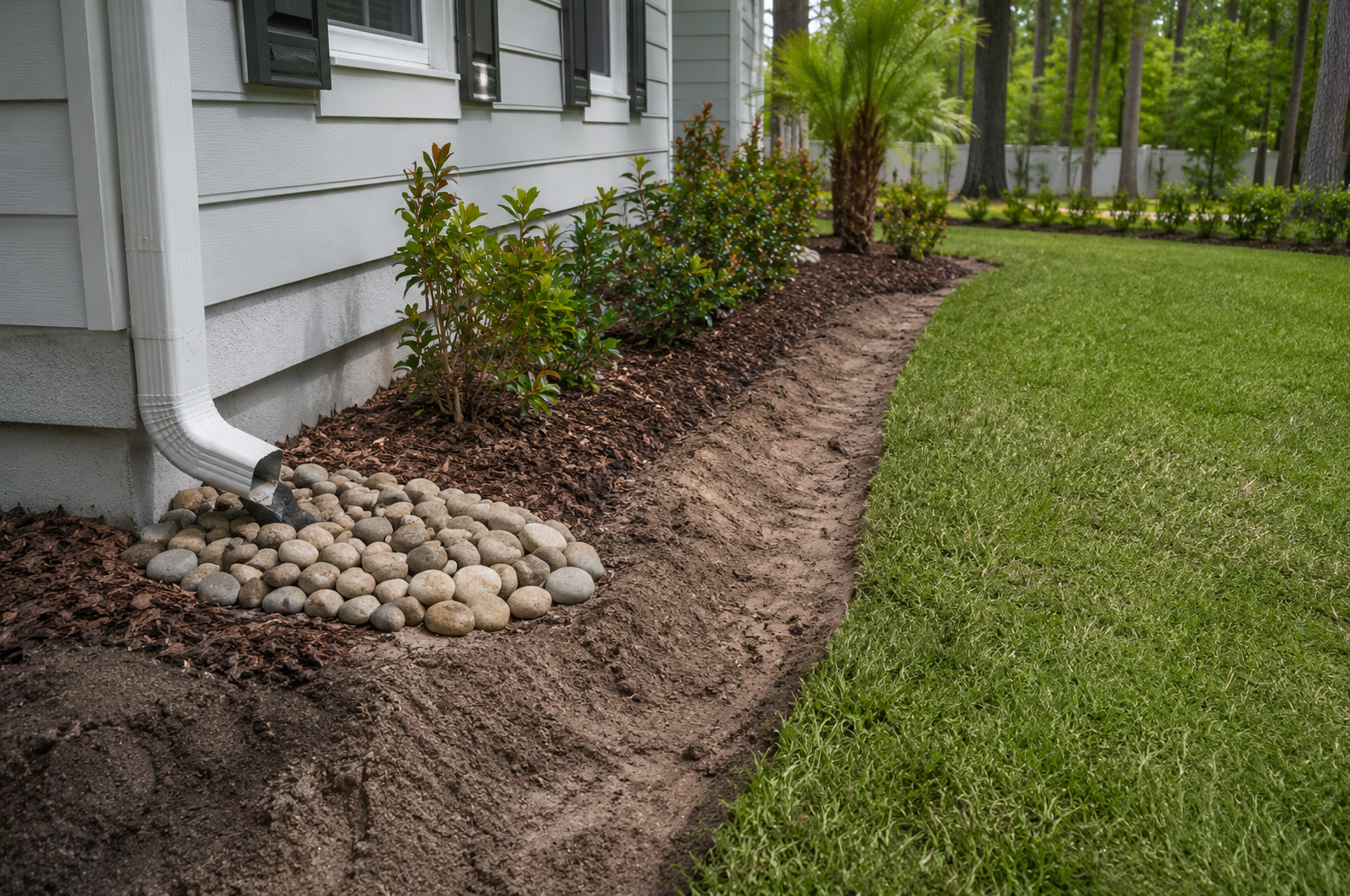
Roof drainage discharging at the foundation. Many Northeast Florida houses have partial gutters, no gutters, or downspouts dumping directly at the corner of the slab. In a summer storm that concentrates a large volume of water into one spot repeatedly. Extending discharge well away from the structure, or piping it to daylight, costs little during a remodel and prevents recurring damage to work you are about to pay for.
High water table and crawlspace moisture. Older raised-floor homes in Riverside, Springfield, Murray Hill, and the older parts of Jacksonville Beach frequently have chronic crawlspace moisture. That moisture is what causes cupped floors, musty odors, and joist and sill decay. Encapsulation, ventilation correction, and drainage improvement have to be resolved before new floors go down.
Stormwater and impervious area rules. If your renovation adds hardscape, a larger driveway, or roof area, local stormwater review can require retention or treatment. It is a permitting item as much as a construction one, and finding it late reshapes both the schedule and the site budget. Our guide to home remodeling cost in Jacksonville shows where these site items typically land in a whole-home budget.
Flood Zones and the Substantial Improvement Rule
This is the single item most capable of changing a whole-home remodel from a renovation into a rebuild decision, and it catches homeowners who have never had a claim. If the house sits in a Special Flood Hazard Area and the cost of the improvement reaches or exceeds fifty percent of the structure’s market value, floodplain regulations treat the project as substantial improvement. The whole building then has to be brought into compliance with current flood requirements, which usually means elevating the lowest floor above base flood elevation.
Two things follow. First, the threshold is measured against the structure’s value, not the land, so an older house on a valuable lot reaches fifty percent faster than owners assume. Second, the determination is made by the local floodplain administrator on the permit application, so it is knowable before you commit — check your flood zone at the FEMA Flood Map Service Center and confirm the elevation certificate early. For a whole-home project near or above the threshold, the honest analysis compares an elevated, compliant renovation against demolition and new construction. Sometimes the remodel still wins; sometimes it clearly does not.
What to Do Before You Sign a Whole-Home Contract
Order the site information first. Pull the flood zone determination and any existing elevation certificate. Walk the property during or immediately after a heavy rain and photograph where water stands and which way it moves. Get a survey with spot elevations if the grade is ambiguous. Where there is any visible sign of settlement, or where the neighborhood is known for organic soils, a geotechnical investigation is inexpensive relative to what it prevents.
Then put the findings in the contract rather than in an assumption. Site work, drainage correction, and any foundation remediation should appear as defined scope with real numbers, not as an allowance that quietly grows. A remodel contract that is silent on soil and drainage is not a lower price, it is a deferred bill. Our full house remodeling in Jacksonville overview explains how we sequence this, and the whole home remodeling service page covers the rest of the process. For a site and drainage assessment before you commit to a scope, contact Ofir Engineering.
Frequently Asked Questions
Do I need a soil test for a remodel if I am not adding square footage?
Not always, but you do if there is visible settlement, if you are adding structural load such as a second story or heavy roofing, or if the property sits near a creek or former wetland where organic soils are common. The cost of the investigation is small next to correcting finishes installed over a moving slab.
What does the fifty percent substantial improvement rule mean for my renovation?
In a Special Flood Hazard Area, if improvement cost reaches fifty percent of the structure’s market value, the entire building must be brought into current flood compliance, typically by elevating the lowest floor. The local floodplain administrator makes that call at permit, so confirm your flood zone and structure value before finalizing scope.
Can drainage problems be fixed during a whole-home remodel?
Yes, and a remodel is the cheapest time to do it. Regrading so the ground falls away from the foundation, piping roof discharge away from the slab, and adding French drains or swales where water collects are straightforward while equipment is already on site and landscaping is already disturbed.
How do sandy Northeast Florida soils affect an existing slab?
Fine sands drain fast but shift when repeatedly saturated and dried, and organic pockets compress under load over many years. The result is differential settlement, which shows up as stair-step cracking in block walls, doors that no longer latch, and cracks running through tile in a straight line.
Keep Building With Ofir Engineering
Related discussions & follow us: Facebook · Reddit
Latest & related guides: Explore more Whole Home Remodeling guides →
