The honest answer on custom built homes versus alternatives in Jacksonville is that building is cheaper in some situations and clearly more expensive in others, and the deciding factor is almost never the headline price per square foot. It is the condition of what you would otherwise be buying, the land you already own or can buy, and how far the finished house has to sit from what the local market builds by default. Homeowners who compare a build quote against a listing price alone are comparing two numbers that do not measure the same thing. Ofir Engineering is a licensed Florida general contractor (License #CGC 1540016) with 15+ years serving Jacksonville, Ponte Vedra, St. Johns, and Northeast Florida.
Custom Built Homes Versus Alternatives: The Four Real Options
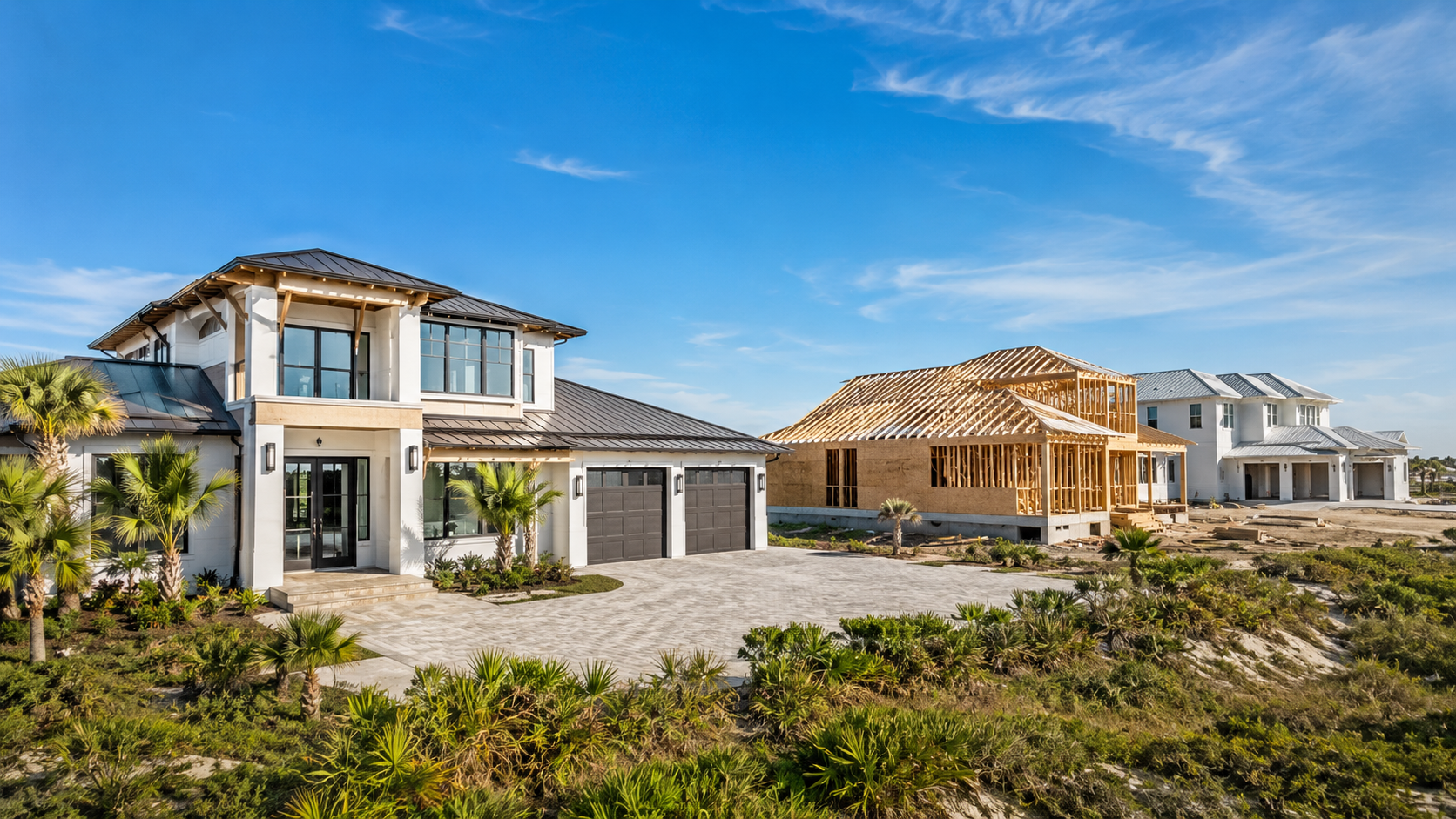
In Northeast Florida a household with a fixed budget is usually choosing between four paths, not two. The first is a custom built home on a lot you buy or already hold. The second is a production or spec home from a volume builder in a new subdivision, where the floor plan is fixed and options come from a catalog. The third is buying an existing resale home and living with it as-is. The fourth is buying an older, cheaper resale home and putting a whole-house renovation into it.
Each path buys a different mix of three things: price, control, and certainty. Production homes buy price and certainty and give up control. Resale buys speed and gives up both control and, often, condition. A custom build buys control, and whether it also buys price depends entirely on the comparison you are running. A renovation sits in the middle and carries the widest range of outcomes, because you cannot fully price it until walls are open.
When Building Is the Cheaper Choice
When you already own the land. Land is frequently a third of the delivered cost of a home in desirable parts of Duval and St. Johns. If a lot came to you through family, was bought years ago, or was purchased separately at a good basis, the build comparison starts with that cost already sunk. Against a resale home in the same neighborhood carrying today’s land value in its price, a build can win outright.
When the resale stock does not match what you need. If you require a single-story layout with wide doors and a zero-threshold entry, a true multi-generational suite, a workshop-free oversized garage with a specific ceiling height, or a floor plan built around a home business, resale inventory usually forces a large renovation to get there. Buying a compromise and then reworking it costs more than drawing the space correctly once.
When the alternative is a gut renovation of a pre-1980 house. A house of that vintage often needs a new roof, new electrical service and branch wiring, new plumbing supply lines, new mechanical equipment and ducts, new windows, and insulation brought to current code — before a single visible finish is installed. In that scenario a large share of the renovation budget buys nothing a buyer can see. New construction spends the same dollars on systems that start at zero years old and carry warranties.
When you plan to hold the house 15 years or more. A new house in Florida starts its ownership period with no deferred maintenance, a code-current envelope, and mechanical equipment with a full service life ahead of it. Over a long hold, the avoided roof replacement, HVAC replacement, and re-pipe are real money, and the insurance treatment of a new build compounds the difference every year. Our custom built homes cost guide for Jacksonville breaks those line items down.
When Building Is the More Expensive Choice
When the local market builds exactly what you want. If a production builder in your target area already offers a plan you genuinely like, in the school zone you want, at a volume price, a custom build will almost always cost more per square foot. Volume builders buy materials, labor, and permits at a scale a single-house project cannot match. Paying a premium for custom design only makes sense when you are actually using the design freedom.
When your timeline is short. A custom home is a design, permitting, and construction sequence measured in many months from first meeting to certificate of occupancy. If you are relocating on a deadline, carrying a lease or a sold house in the meantime, the carrying cost of that timeline is a real and often overlooked line item. Resale closes in weeks. That difference has a dollar value that belongs in the comparison.
When the lot fights you. A cheap lot can be cheap for a reason. Low elevation, poor soils, wetlands, a required lift station, long utility runs, or heavy tree canopy can add substantial site cost before the foundation is poured. Northeast Florida has plenty of lots where the site work costs more than the lot did. Never treat a lot price as the land cost; treat it as a deposit against a number a geotechnical report and a survey will give you.
How to Run the Comparison Honestly
Build both sides of the ledger on a delivered-cost basis. On the build side that means land, site work, soft costs, design, permits and impact fees, construction, landscaping and driveway, and carrying cost through the build. On the resale side it means purchase price, closing costs, immediate repairs, insurance treatment for the roof and systems as they exist, and the renovation you would actually do in the first three years rather than the one you tell yourself you would skip. Only then are the two numbers measuring the same house.
Two further checks separate a good decision from a hopeful one. First, look at what finished homes comparable to your build actually sell for in that specific neighborhood, because a house can be worth building and still be worth less than it cost if it overshoots its street. Second, verify any builder’s license and history before you rely on their number — the Florida DBPR license portal makes that a two-minute check. A quote from an unlicensed or thinly capitalized builder is not a comparison point, it is a risk.
If you are weighing a build against buying, our comparison of new construction versus an existing home in Jacksonville covers the resale side in more depth, and the custom home construction service page explains how we price a build before you commit. To have both sides of the ledger built for your specific lot and shortlist, contact Ofir Engineering.
Frequently Asked Questions
Is it cheaper to build or buy in Jacksonville right now?
It depends on whether you already hold land and how much work the resale you would buy actually needs. If you own a buildable lot, or the realistic alternative is a full gut renovation of an older house, building often wins. If a volume builder already offers a plan you like in your target area, buying is usually cheaper.
Does a custom home appraise for what it costs to build?
Not automatically. An appraisal reflects comparable sales in that neighborhood, so a house that is much larger or more finished than its street can cost more to build than it appraises for. Checking comparable finished values before you finalize a design protects both your equity and your construction loan.
How much does the lot really add to a custom build?
Land in desirable parts of Duval and St. Johns often represents around a third of delivered cost, and the purchase price is only part of it. Clearing, fill, stormwater, utility runs, and any required soil work can add materially, which is why a geotechnical report and a survey should precede any firm build budget.
Is renovating an older Jacksonville home cheaper than building new?
Sometimes, and it turns on structure and systems. A sound house needing finishes and layout changes renovates economically. A pre-1980 house needing roof, wiring, plumbing, mechanical, windows, and insulation spends most of its budget on invisible work, which is where new construction closes the gap and often passes it.
Keep Building With Ofir Engineering
Related discussions & follow us: Facebook · Reddit
Latest & related guides: Explore more Custom Home Construction guides →
