
Build to rent builder inspection failures behave differently from failures on a one-off custom home, and the difference is repetition. A rental community builds the same details dozens of times, which means a single misunderstood connection or a wrong fastener schedule is not one correction — it is the same correction replicated across every unit built before anyone caught it. On a build-to-rent site the cost of an inspection failure is measured in multiples. Ofir Engineering is a licensed Florida general contractor (License #CGC 1540016) delivering rental and investment communities across Jacksonville and Northeast Florida.
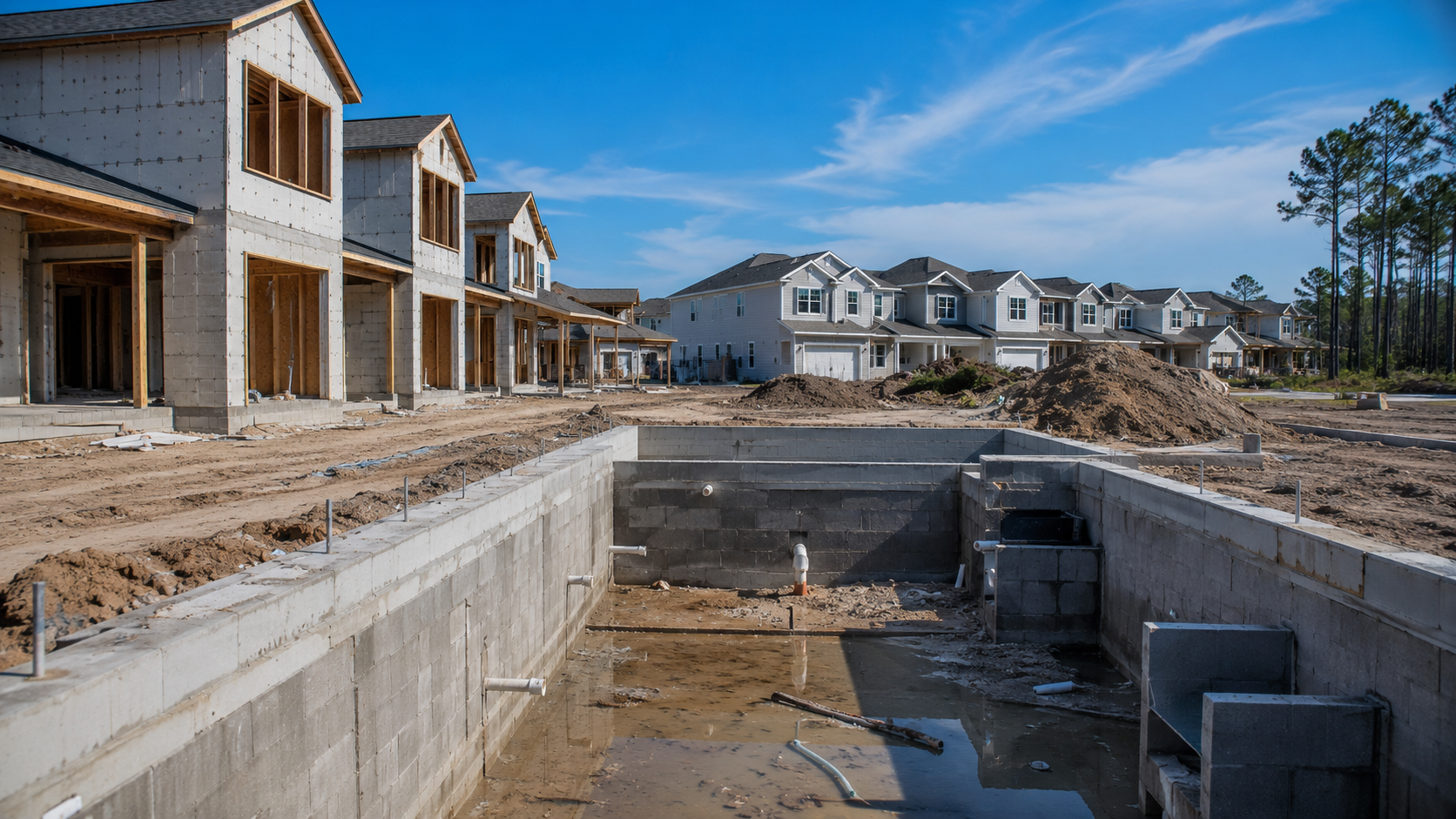
Why Build to Rent Builder Inspection Failures Multiply
Three structural features of build-to-rent create the pattern.
Repetition amplifies error. On a custom home, a framing crew learns the details once for one building. On a rental community, a crew installs the same detail on unit after unit. If the strap schedule was misread on the first building, it is wrong on every building erected before the first framing inspection — which is why the timing of that inspection relative to production is a scheduling decision with real financial consequences.
Crew turnover breaks continuity. Production sites run larger, more fluid trade crews than custom work. The person who attended the preconstruction meeting is frequently not the person installing the work in month five, so knowledge that lives in someone’s head rather than on the drawing or in a checklist evaporates.
Schedule pressure invites covering. Rental communities are financed against a lease-up date. That pressure pushes crews to keep moving and to close up assemblies before inspection, which converts a cheap correction into demolition — the most avoidable and most expensive category of failure on these sites.
The Inspections That Most Often Fail
Site, utilities, and stormwater
Before vertical construction is even inspected, horizontal work generates failures: stormwater systems not built to the permitted design, retention areas at the wrong elevation, erosion and sediment controls not maintained, and utility separations that do not match the approved drawings. These are unforgiving because correcting a stormwater elevation after paving is a genuine reconstruction. Environmental resource permitting is administered by the St. Johns River Water Management District, and its approved design is the standard the work is measured against.
Foundation and slab
Recurring findings include reinforcement placement and cover, embeds and anchor bolts missing or misplaced, under-slab plumbing not matching the plan, vapour barrier damage, and compaction that was never documented. Anchor bolt placement is the classic repetitive error: wrong on one building, wrong on twenty.
Framing and the wind load path
This is the highest-volume failure category in Florida. Inspectors verify a continuous load path from roof to foundation, and the findings repeat: missing or partially driven hurricane straps, wrong connector for the condition, nailing patterns at shear walls that do not match the schedule, and hold-downs omitted or installed without the specified anchorage. Because uplift resistance is entirely dependent on connections, a partially fastened connector provides a fraction of its rated capacity.
Rough-in trades
Electrical failures concentrate in box fill, missing AFCI or GFCI protection, and grounding and bonding. Plumbing failures concentrate in venting configuration and failed pressure tests. Mechanical failures concentrate in duct support and sealing, combustion air, and clearances. The repetitive character means these are also the easiest to systematise — a checklist that survives one inspection usually survives all of them.
Energy, insulation, and envelope
Air sealing that does not match the submitted energy calculation, insulation gaps at difficult junctions, and duct leakage beyond the allowable threshold are common. Where blower door or duct testing applies, it produces a number that either passes or does not — there is no interpretive room.
Fire separation and life safety
On attached or higher-density configurations, fire-rated assembly failures are frequent and serious: penetrations through rated assemblies without proper firestopping, rated assemblies not built to the tested listing, and draftstopping omitted in attics. Firestopping at every penetration is a detail that must be verified building by building.
Accessibility and final
Where accessibility standards apply to units or common areas, route slopes, clearances, and mounting heights are measured, and small tolerance misses fail. Finals gather the rest: address numbers, alarms, egress hardware, guardrail spacing, and site items such as lighting and striping.

The Process Controls That Pass the First Time
Builders who run clean inspections on repetitive sites rely on process rather than vigilance.
First-article inspection is the highest-leverage control available. Build the first unit, then inspect it exhaustively against the approved drawings — internally and, where the department will engage, with the inspector — before releasing the detail into production. It converts a repeated defect into a single correction.
Mock-ups for critical assemblies — the wall section, the fire-rated assembly, the roof-to-wall connection — give every crew a physical reference that outlasts a meeting.
Self-inspection checklists per building, completed and signed by the superintendent before the inspection is called, catch the missing strap while it is still visible. Photo documentation before cover, filed by building and date, resolves disputes without demolition.
Trade partner onboarding that repeats matters because crews change; the detail review cannot be a single meeting at mobilisation. Sequencing that respects inspection timing — not letting production run so far ahead of the first framing inspection that a correction becomes a portfolio-wide event — is a scheduling discipline, not a construction one. And a pre-application conversation with the building department on unusual assemblies resolves interpretation before it becomes a correction notice.
Investors can review how we deliver repetitive residential work on our commercial construction page, compare it with ground-up single-family delivery under custom home construction, or contact Ofir Engineering to discuss a Jacksonville build-to-rent site.
Frequently Asked Questions
Which inspection fails most often on build to rent projects in Florida?
Framing, specifically the wind load path. Missing or partially driven hurricane connectors, incorrect connectors for the condition, shear wall nailing that does not match the schedule, and omitted hold-downs are the recurring findings.
Why is a failed inspection worse on a rental community than on one house?
Because of repetition. The same crews install the same details across many buildings, so an error found at the first framing inspection has usually already been replicated in every unit erected to that point, turning one correction into many.
What is a first-article inspection?
Building the first unit and inspecting it exhaustively against the approved drawings before the detail is released into full production. It is the most effective control available on repetitive sites because it isolates errors to a single building.
What makes an inspection failure expensive rather than routine?
Covering the work before it is inspected. A visible correction is usually quick and cheap; the same correction behind drywall, under a slab, or beneath paving requires demolition, which is why schedule pressure to close assemblies early is the costliest habit on a build-to-rent site.
Keep Building With Ofir Engineering
Related discussions & follow us: Facebook · Reddit
Latest & related guides: Explore more Commercial Construction guides →