Ofir Engineering is a licensed Florida general contractor (License #CGC 1540016) serving homeowners and investors across Jacksonville and Northeast Florida.
Minor upgrades in Jacksonville can yield over 200% return on investment, yet the majority of homeowners remodel for reasons that have nothing to do with money. That gap between financial logic and human motivation is exactly what makes home remodeling such a nuanced decision. This article walks Jacksonville homeowners through the real reasons people remodel, how specific projects affect livability and property value, what local regulations require, and how to plan a project that delivers both personal satisfaction and measurable financial returns.
Table of Contents for Home Boost
- Understanding why homeowners remodel
- How remodeling enhances livability and satisfaction
- Remodeling for value: ROI and cost recovery in Jacksonville
- Jacksonville-specific considerations: Regulations, climate, and planning
- Expert tips: Maximizing your remodel in Jacksonville
- What most guides miss: Remodeling for joy, not just ROI
- Ready to remodel? Get expert guidance in Jacksonville
- Frequently asked questions
Key Takeaways
| Point | Details |
|---|---|
| Lifestyle improvement matters | Remodeling delivers lasting enjoyment, not just resale value. |
| Minor upgrades deliver ROI | Projects like kitchen and garage doors yield the best returns. |
| Permitting is essential | Jacksonville remodels require permits for main systems. |
| Material durability is critical | Moisture-resistant materials protect homes in Jacksonville’s climate. |
| Plan and layer projects | Strategically sequencing remodels maximizes hassle savings and property value. |
Understanding why homeowners remodel
The assumption that most people remodel to increase resale value is, statistically, incorrect. According to NAR’s 2025 data, homeowners remodel primarily to upgrade worn-out surfaces (27%), improve energy efficiency (19%), for a change (18%), or to prepare to sell (18%). Housing affordability motivates only 9% of remodeling decisions. That means the vast majority of projects are driven by lifestyle, not necessity or financial strategy.
This distinction matters for Jacksonville homeowners specifically. The city’s older housing stock, combined with a humid subtropical climate that accelerates wear on surfaces and systems, creates genuine functional reasons to remodel well before any plan to sell arises. Kitchens become outdated. Bathrooms show moisture damage. HVAC systems age out. Remodeling in this context is less about flipping value and more about maintaining a home that functions well and feels comfortable.
There is also a strong community-based case for remodeling rather than moving. Relocating to a newer home involves real estate commissions, moving costs, higher mortgage rates on a new purchase, and the loss of established neighborhood relationships. Remodeling preserves all of that while still delivering the updated living environment you want.
Key motivators for remodeling, ranked by frequency:
- Worn-out surfaces and finishes (27% of homeowners)
- Energy efficiency improvements (19%)
- Desire for a change (18%)
- Preparing to sell (18%)
- Housing affordability (9%)
Understanding your home remodeling reasons before selecting a project is the single most important step in the planning process. A homeowner who wants to stay for 15 more years should prioritize very differently than one who plans to list in 18 months.
Pro Tip: Write down your primary motivation before contacting a contractor. Are you remodeling for comfort, function, energy savings, or resale? That answer should drive every project decision that follows.
How remodeling enhances livability and satisfaction
Beyond the financial case, remodeling delivers measurable improvements to how homeowners experience their daily lives. The NAR’s research shows that remodeling improves functionality and livability for 28% of homeowners, durability for 23%, and aesthetics for 23%. These are not abstract benefits. They translate into homes that are easier to clean, more comfortable to live in, and more durable against Jacksonville’s heat and humidity.
The same research introduces a useful metric called the “Joy Score,” which rates homeowner happiness after completing a remodel on a scale of 1 to 10. The average Joy Score across all projects is 8.2 out of 10, a remarkably high figure that reflects genuine satisfaction rather than buyer’s remorse. Projects like primary suite renovations, full kitchen upgrades, and new roofing consistently score a perfect 10.
“64% of homeowners report wanting to spend more time at home after completing a remodel, and 46% say they enjoy their home more as a result.”
That statistic reframes the entire value proposition of remodeling. When you invest in your kitchen, you are not just adding square footage or updating appliances. You are creating a space where family meals happen more often, where entertaining becomes easier, and where daily routines feel less like chores. For Jacksonville homeowners who spend significant time indoors during summer heat, that quality-of-life improvement is substantial.
Specific projects that consistently improve livability include:
- Kitchen upgrades: Better workflow, modern surfaces, improved storage
- Bathroom renovations: Moisture-resistant finishes, updated fixtures, improved ventilation
- Flooring replacement: Durability, easier maintenance, visual cohesion
- Lighting improvements: Natural light additions, LED upgrades, improved ambiance
- HVAC modernization: Energy efficiency, consistent temperature control, reduced humidity
Thoughtful planning tips for Jacksonville homes emphasize sequencing these improvements logically so that each project builds on the last without creating redundant work or unnecessary disruption. Pairing flooring replacement with a kitchen upgrade, for example, avoids having to protect new floors during a later cabinet installation. Creative interior ideas can also help homeowners visualize how material choices affect both aesthetics and long-term durability in Florida’s climate.
Remodeling for value: ROI and cost recovery in Jacksonville
Not all remodeling projects are created equal when it comes to financial return. The data on this is clear and somewhat counterintuitive: minor upgrades consistently outperform major renovations in terms of return on investment. A minor kitchen remodel delivers 96 to 113% ROI nationally, while an upscale kitchen remodel returns only 38 to 59%. The difference lies in the cost baseline. A $15,000 minor kitchen refresh adds proportionally more value than a $75,000 full gut renovation.

The top-performing projects by ROI are often exterior improvements, which directly affect curb appeal and buyer first impressions:
| Project | Estimated Cost | ROI Range |
|---|---|---|
| Garage door replacement | $4,000 to $6,000 | 194% to 268% |
| Steel entry door replacement | $2,500 to $4,500 | 188% to 216% |
| Minor kitchen remodel | $12,000 to $20,000 | 96% to 113% |
| Upscale kitchen remodel | $60,000 to $90,000 | 38% to 59% |
| Primary suite addition | $100,000 to $150,000 | 40% to 55% |
These figures reflect national averages, but Jacksonville’s competitive real estate market and strong buyer demand for move-in-ready homes make exterior and kitchen upgrades particularly effective locally. Buyers in Jacksonville frequently compare multiple listings, and curb appeal is often the deciding factor in whether a showing is scheduled at all.
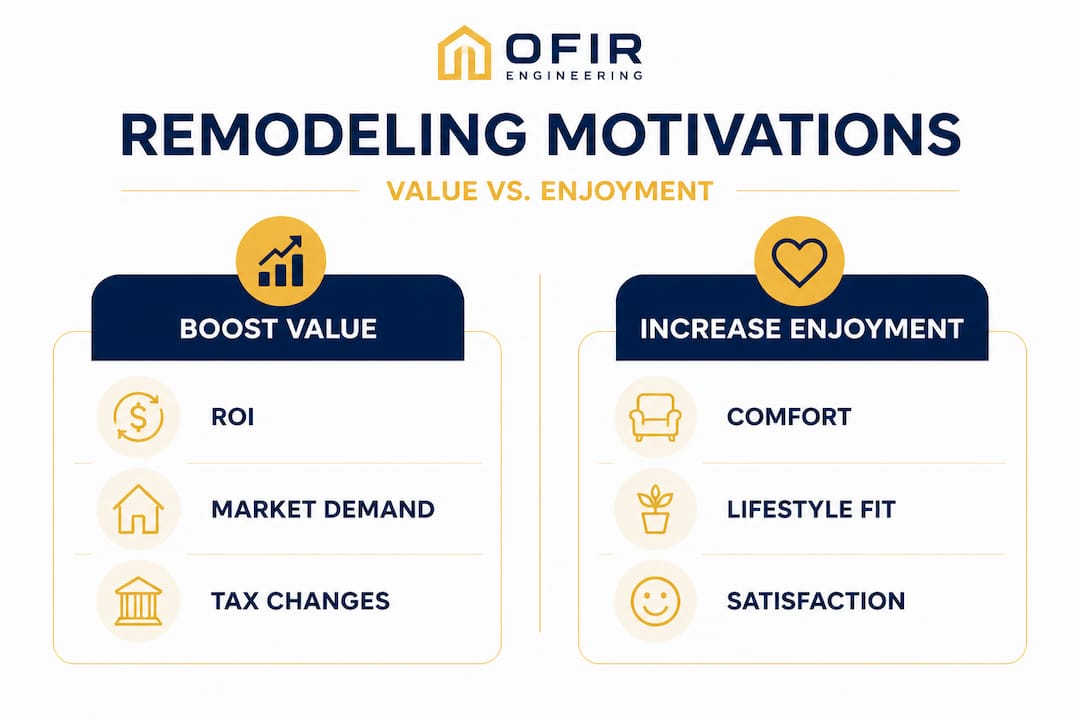
One important financial consideration that many homeowners overlook: major remodels can raise property taxes in Florida. Additions, pools, and upscale kitchen renovations can trigger a reassessment of your property’s value, which increases your annual tax burden. This does not mean avoiding major projects, but it does mean factoring that ongoing cost into your total return calculation.
For construction ROI insights specific to Jacksonville, understanding the interplay between project scope, material quality, and local market conditions is essential to making decisions that hold up financially over time.
Pro Tip: Budget a 10 to 20% contingency on top of your project estimate. Jacksonville’s older homes frequently reveal subfloor damage, outdated wiring, or corroded plumbing once walls are opened. A contingency fund prevents these discoveries from derailing the entire project.
Jacksonville-specific considerations: Regulations, climate, and planning
Jacksonville homeowners face a specific set of regulatory and environmental conditions that directly affect how remodeling projects must be planned and executed. Understanding these requirements early prevents costly delays and ensures that completed work passes inspection.
Permitting requirements are non-negotiable for most meaningful remodeling work. Structural, plumbing, and electrical work all require permits in Jacksonville, consistent with Florida’s statewide building code requirements. Unpermitted work creates serious problems at resale, as buyers’ inspectors routinely flag it, and lenders may refuse to finance homes with open permit violations.
The general permit application process for Jacksonville residential remodeling follows these steps:
- Define the full scope of work and identify which trades are involved (structural, electrical, plumbing, mechanical)
- Prepare or commission construction drawings that meet Florida Building Code requirements
- Submit permit applications through the City of Jacksonville’s online permitting portal
- Await plan review, which typically takes 5 to 15 business days depending on project complexity
- Receive permit approval and post the permit on-site before work begins
- Schedule required inspections at each phase of construction (rough-in, framing, final)
- Obtain a Certificate of Completion once all inspections are passed
Climate-specific material selection is equally critical. Jacksonville’s coastal humidity accelerates mold growth, wood rot, and corrosion in ways that homeowners from drier climates may not anticipate. The table below outlines common upgrades and the material specifications that perform best in Jacksonville’s environment:
| Upgrade | Recommended Material | Reason |
|---|---|---|
| Exterior siding | Fiber cement or engineered wood | Moisture resistance, dimensional stability |
| Subfloor | Pressure-treated or moisture-resistant panels | Prevents rot in humid conditions |
| Bathroom walls | Cement board substrate | Resists moisture penetration behind tile |
| Roofing | Impact-resistant shingles or metal | Hurricane wind resistance, longevity |
| Window frames | Vinyl or fiberglass | No corrosion, low maintenance |
Older Jacksonville homes, particularly those built before 1980, frequently require system upgrades before cosmetic remodeling can proceed safely. Electrical panels may need to be brought up to current amperage standards. Galvanized plumbing may need replacement. HVAC systems may be undersized for modern insulation levels. Addressing these systems first, before installing new cabinetry or flooring, prevents having to tear out finished work later.
Trade sequencing is a discipline in itself. The correct order is always mechanical systems first (electrical, plumbing, HVAC rough-in), then insulation, then drywall, then finishes. Deviating from this sequence creates rework and added cost. Reviewing Jacksonville renovation steps in detail before breaking ground helps homeowners understand the process well enough to hold contractors accountable. Familiarity with construction terminology also helps homeowners communicate effectively with their project teams.
Expert tips: Maximizing your remodel in Jacksonville
Experienced contractors and real estate professionals in Jacksonville consistently point to a few strategies that separate successful remodeling projects from frustrating ones.
Layer projects strategically. When multiple upgrades are planned, scheduling them together reduces the total disruption to your household and often lowers overall cost. Replacing kitchen cabinets, countertops, and flooring simultaneously eliminates the need to protect new floors during a later cabinet installation and allows contractors to coordinate work more efficiently. Layering projects like this maximizes what experts call the “hassle factor” value, meaning you absorb one period of disruption rather than several.
Finance strategically. 54% of homeowners finance remodeling projects through a Home Equity Line of Credit (HELOC). This approach leverages existing equity at relatively favorable interest rates and keeps the project budget separate from household cash flow. For larger projects, a HELOC also provides flexibility to draw funds as work progresses rather than committing the full amount upfront.
Prioritize curb appeal for resale. In Jacksonville’s competitive real estate market, exterior improvements deliver disproportionate value because they influence buyer perception before a single interior room is seen. Fresh exterior paint, a new garage door, updated landscaping, and a steel entry door replacement are among the highest-ROI exterior upgrades available to Jacksonville homeowners.
Key expert recommendations for Jacksonville remodeling:
- Minor before major: Prioritize kitchen and bathroom refreshes over full gut renovations for maximum ROI
- Exteriors first for resale: Curb appeal drives buyer interest in Florida’s competitive market
- Full remodels for long-term stays: If you plan to remain in the home for 10 or more years, invest in the upgrades that improve daily living
- Material durability over aesthetics alone: In Jacksonville’s climate, a beautiful finish that degrades in two years is a poor investment
- Document everything: Maintain records of all permits, contractor agreements, and material specifications for future resale disclosure
For detailed Jacksonville construction planning guidance, working with a licensed local contractor who understands Florida Building Code requirements and regional material performance is the most reliable way to protect your investment.
Pro Tip: Always plan a contingency fund of at least 15% for unexpected repairs. Jacksonville’s humid climate means that opening walls in older homes frequently reveals moisture damage, outdated wiring, or corroded pipes that must be addressed before finishing work can proceed.
What most guides miss: Remodeling for joy, not just ROI
Most remodeling articles focus almost exclusively on return on investment, presenting home improvement as a purely financial exercise. That framing is incomplete, and in many cases, it leads homeowners to make decisions that optimize for resale value while neglecting the years of daily living that occur before any sale takes place.
The data supports a different priority. 89% of homeowners remodel for enjoyment and function, not financial return. That is not a rounding error. It reflects a fundamental truth about why people invest in their homes: they want to live better, not just sell higher.
“89% of homeowners remodel for enjoyment and function, not pure ROI.”
Jacksonville’s lifestyle reinforces this perspective. The city’s outdoor culture, strong neighborhood identity, and year-round livability mean that homes are genuinely lived in, not just held as assets. A kitchen that makes cooking enjoyable, a bathroom that feels like a retreat, or a covered outdoor space that extends usable living area into the mild winter months, these improvements deliver value every single day. That cumulative benefit over a decade of ownership often exceeds what any resale premium could provide.
The most thoughtful approach to Jacksonville lifestyle planning treats ROI as one input among several, not the only metric that matters. Financial return is important, particularly for homeowners who may sell within five years. But for those who plan to stay, the quality of daily life inside a well-designed, well-maintained home is the most meaningful return on any remodeling investment.
Ready to remodel? Get expert guidance in Jacksonville
Translating remodeling goals into a well-executed project requires local knowledge, regulatory expertise, and a contractor who understands both the financial and lifestyle dimensions of residential renovation.
Ofir Engineering brings over 15 years of licensed residential construction experience to Jacksonville homeowners, with a track record of precision planning and meticulous execution across projects ranging from targeted upgrades to full-home renovations. Whether your goal is to boost home value before listing or to improve the functionality and comfort of a home you plan to enjoy for years, the team at Ofir Engineering provides reliable guidance at every stage. Explore what Jacksonville remodeling experts can deliver for your specific goals, or review the renovation step-by-step process to understand exactly what your project will involve from permit application through final inspection.
Frequently asked questions
What remodeling projects offer the best ROI in Jacksonville?
Garage door replacements and steel entry doors lead with 194 to 268% and 188 to 216% ROI respectively, followed by minor kitchen remodels at 96 to 113%. These exterior and entry upgrades deliver the strongest returns because they directly influence buyer first impressions.
Do I need permits for a home remodel in Jacksonville?
Yes. Structural, plumbing, and electrical work all require permits under Florida Building Code, and unpermitted work can create significant complications at resale or during refinancing.
Will a major remodel raise my property taxes?
Major remodels including additions, pools, and upscale kitchen renovations can trigger a property reassessment in Florida, resulting in a higher annual tax bill that should be factored into the total cost of the project.
What materials are best for Jacksonville’s humid climate?
Moisture-resistant materials such as fiber cement siding, cement board substrates, vinyl or fiberglass window frames, and pressure-treated subfloor panels are essential for preventing mold, rot, and structural degradation in Jacksonville’s coastal humidity.
How should I finance a home remodel?
HELOCs are used by 54% of remodeling homeowners and offer flexible draw schedules and competitive rates for those with sufficient home equity, making them well-suited for phased or larger-scale renovation projects.
Recommended
- Residential Remodeling: Boost Home Value in Jacksonville
- Home Remodeling Jacksonville FL | Ofir Engineering
- What is home renovation? Complete guide for Jacksonville homeowners
- What is a construction upgrade? Homeowner guide & ROI insights
Related guides: Smart Home Remodel Ideas on a Budget: Maximize ROI
