

Garage door replacement delivers a 194% return on investment nationally, yet many Jacksonville homeowners spend their budgets on interior overhauls that return far less. The confusion often starts with the terminology itself. Home renovation is the process of improving, repairing, or updating existing residential structures, including cosmetic updates, functional enhancements, or structural changes that enhance livability and value. Many property owners use renovation and remodeling interchangeably, but the distinction carries real financial consequences. In Jacksonville’s humid, coastal environment, choosing the wrong project type, contractor, or materials can erode value rather than build it. This guide clarifies what home renovation truly means and how to approach it strategically.
Table of Contents
- Defining home renovation: What it is and why it matters
- Key phases of a home renovation project
- Costs, returns, and how to maximize value in Jacksonville
- Expert tips and risk management for successful renovations
- Our hard-won perspective: What most guides miss about home renovation
- Ready to renovate? Jacksonville’s experts are here to help
- Frequently asked questions
Key Takeaways
| Point | Details |
|---|---|
| Renovation vs. remodeling | Renovation updates or repairs existing spaces, while remodeling changes the structure or layout. |
| Step-by-step process | Successful renovations follow clear phases from initial planning through final inspection. |
| ROI and local factors | Maximize value by focusing on high-return projects and Jacksonville-specific requirements. |
| Budget for surprises | Always add a 20% contingency to avoid financial shocks and project delays. |
| Mitigate renovation risks | Vetting contractors and planning for code compliance are essential to a safe, successful renovation. |
Defining home renovation: What it is and why it matters
Now that we’ve established why understanding home renovation matters, let’s clarify exactly what it means and how it stands apart from remodeling.
Home renovation focuses on improving, repairing, or updating existing structures. It does not necessarily change the home’s fundamental layout or structural configuration. Remodeling, by contrast, alters the structure itself, moving walls, reconfiguring floor plans, or changing the purpose of a space. The distinction may seem subtle, but it directly shapes permitting requirements, cost estimates, and the complexity of contractor coordination.
The difference between renovation and remodeling affects permits, costs, and ROI in ways that catch unprepared homeowners off guard. A bathroom renovation might mean replacing tile, fixtures, and vanity without touching the plumbing layout. A bathroom remodel might involve relocating plumbing, requiring structural permits and a licensed engineer’s sign-off. In Jacksonville, where coastal building codes and Duval County ordinances apply specific moisture and wind-resistance standards, the classification of your project determines the permit pathway and inspection schedule.
Common misunderstandings homeowners encounter:
- Assuming cosmetic updates never require permits (some do, depending on scope)
- Believing a remodel will cost the same as a renovation of similar square footage
- Overlooking the impact of Jacksonville’s humidity on material selection and long-term performance
- Underestimating the code compliance requirements unique to Florida’s coastal zones
| Feature | Renovation | Remodeling |
|---|---|---|
| Scope | Repairs, updates, cosmetic changes | Structural or layout changes |
| Permits required | Often minimal | Frequently extensive |
| Typical cost | Lower | Higher |
| ROI timeline | Shorter | Longer |
| Engineering involvement | Rarely needed | Often required |
Properly classifying your project before breaking ground is not just good practice, it is the foundation of accurate budgeting, realistic timelines, and compliant construction in any jurisdiction, especially one with Jacksonville’s specific climate and code requirements.
For homeowners and investors considering remodeling projects in Jacksonville, understanding this distinction upfront prevents cost overruns and permitting delays that derail timelines and eat into returns.
Key phases of a home renovation project
With the definition and value clarified, let’s explore the step-by-step flow of a renovation project, so you know what to expect from start to finish.
Most successful renovations follow a defined sequence. Skipping phases or compressing timelines rarely saves money and frequently creates expensive rework. According to whole home renovation phases, the process moves through project initiation, existing conditions analysis, design, construction, and finalization. Each phase builds on the previous one, and decisions made early lock in outcomes downstream.
Typical renovation sequence:
- Project initiation: Define scope, establish budget, assemble the project team (contractor, designer, engineer if needed), and set a realistic timeline.
- Existing conditions analysis: Assess the current state of the structure, mechanical systems, and finishes. This is where hidden issues like moisture damage or outdated wiring surface.
- Initial and final design: Develop drawings, specify materials, and finalize selections. In Jacksonville, moisture-resistant and impact-rated materials should be a specification priority, not an afterthought.
- Construction: Structural work first, followed by mechanical rough-ins (plumbing, electrical, HVAC), then insulation and finishes. The construction sequence is enforced by inspections under the International Residential Code (IRC) for alterations.
- Finalization: Punch list completion, final inspections, certificate of occupancy if applicable, and project turnover with all warranties documented.
| Phase | Key deliverable | Jacksonville-specific consideration |
|---|---|---|
| Initiation | Scope and budget | Coastal permit pathway confirmed |
| Conditions analysis | Inspection report | Moisture and mold assessment |
| Design | Permitted drawings | Wind and flood zone compliance |
| Construction | Built-out space | Material moisture resistance |
| Finalization | Punch list and warranties | Final inspection sign-off |
Pro Tip: Never schedule finish trades (tile, cabinetry, painting) before all rough-in inspections are approved. Jacksonville’s inspection queue can create delays, and installing finishes before inspection sign-off often requires costly removal.
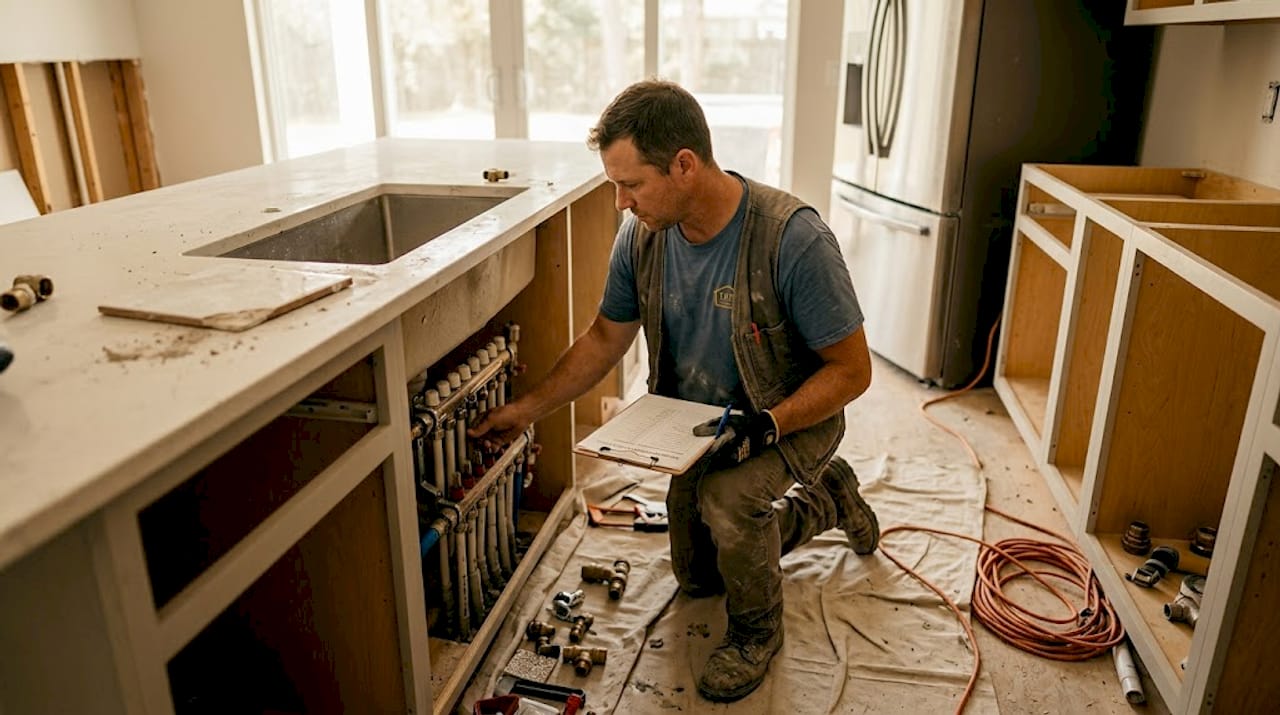
For a clear understanding of how professional firms structure their construction services sequence, reviewing the full scope of deliverables at each phase helps homeowners ask better questions and hold contractors accountable.
Costs, returns, and how to maximize value in Jacksonville
After understanding the process, it’s critical to weigh real costs, returns, and Jacksonville factors driving value.
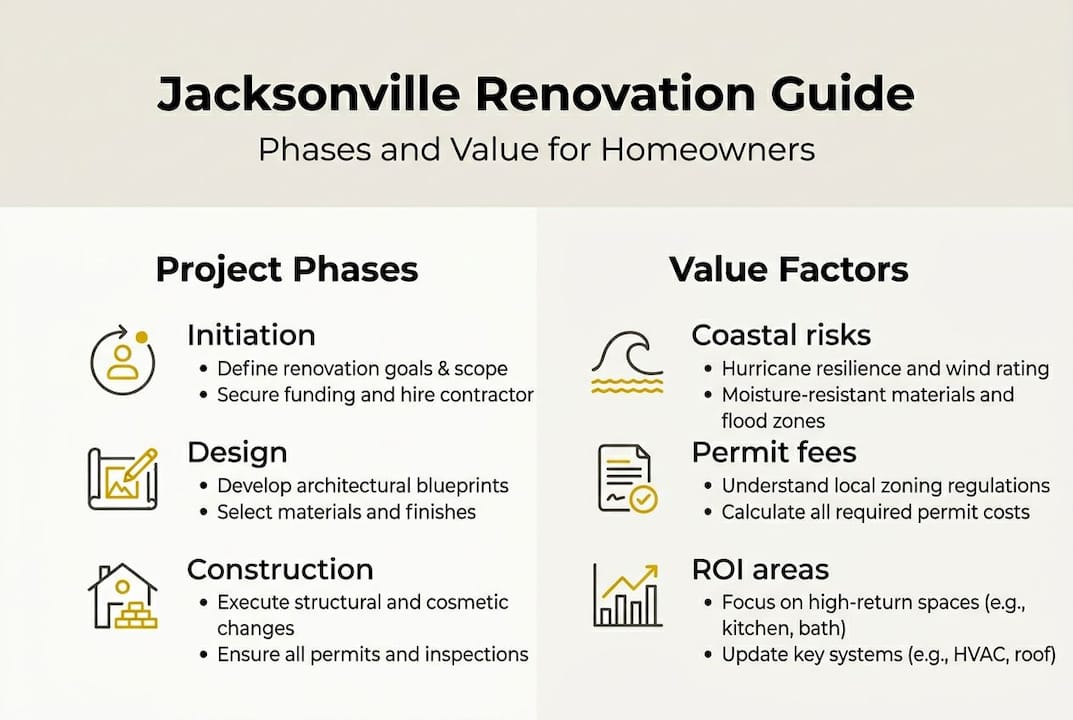
Not all renovation dollars are equal. National cost vs value data reveals that garage door replacement yields a 194% ROI, while minor kitchen remodels return approximately 96% nationally. These figures shift in Jacksonville’s market based on neighborhood comparables, buyer preferences, and the condition of surrounding inventory. Exterior improvements consistently outperform major interior overhauls because curb appeal drives first impressions and appraisal values.
High-ROI renovation categories for Jacksonville properties:
- Exterior upgrades: Garage doors, entry doors, siding, and roofing offer strong returns and protect against Florida’s weather exposure.
- Minor kitchen remodels: Refacing cabinets, replacing countertops, and updating fixtures deliver measurable ROI without the cost of full structural changes.
- Bathroom refreshes: New vanities, tile, and fixtures in existing layouts return more than full bath reconfigurations in most Jacksonville submarkets.
- Energy efficiency upgrades: Impact windows, improved insulation, and efficient HVAC systems command premiums with Jacksonville buyers and reduce ongoing operating costs.
For investors, prioritizing high-ROI exteriors over major interior work is the discipline that separates profitable flips from budget-draining projects. The Jacksonville market rewards properties that look well-maintained and meet current code standards.
Hidden costs are among the most damaging surprises in any renovation. Permit fees, utility connection charges, material escalation, and discovery of prior unpermitted work add up quickly. Experts recommend allocating a 20% contingency beyond your base budget to absorb these realities without stalling construction.
Pro Tip: Investors executing phased renovations on occupied properties should factor carrying costs into each phase’s ROI calculation. A delayed second phase means continued mortgage and insurance expenses that erode projected returns. For deeper analysis, maximizing renovation profits requires understanding cash flow timing as much as material costs.
Expert tips and risk management for successful renovations
With an understanding of the financial impact, let’s focus on protecting your investment with proven expert strategies.
Risk management in renovation begins with contractor vetting. A licensed, insured contractor with verifiable Jacksonville references is not optional. It is the minimum acceptable standard. Before signing any agreement, confirm the contractor holds an active Florida license, carries general liability and workers’ compensation insurance, and can provide a detailed written scope of work.
Renovation risk checklist:
- Verify contractor license and insurance before any contract is signed.
- Require a complete, finalized design before construction begins to minimize change orders.
- Confirm all required permits are pulled before work starts, not after.
- Get written warranties on both labor and materials, specifying coverage periods.
- Schedule independent inspections at key milestones, particularly for structural and mechanical work.
Homes built before 1978 present a specific risk. EPA lead-safe practices are legally required during renovation work in these properties, and failing to comply exposes both homeowners and contractors to significant liability. Load-bearing wall removal requires engineering review, structural drawings, and permits regardless of how straightforward the work appears visually.
Starting construction without a complete design and a fully executed contract is the single most avoidable cause of cost overruns and contractor disputes in residential renovation. Renovation mistakes are almost always traceable to decisions made before a single nail is driven.
In Jacksonville specifically, hurricane code compliance is non-negotiable. Any renovation touching the building envelope, roofing, windows, or exterior walls must meet current Florida Building Code wind load requirements. Moisture barriers, impact-rated openings, and proper flashing details are not premium upgrades in this climate. They are code requirements.
For reference on avoiding common renovation mistakes and understanding where structural decisions demand professional input, reviewing detailed project guides before committing to a scope of work is time well spent. When creative structural upgrades are part of your renovation vision, engineering involvement from the planning stage prevents expensive mid-project corrections.
Our hard-won perspective: What most guides miss about home renovation
Beyond best practices and checklists, here’s what truly makes the difference in real Jacksonville renovations.
Most renovation guides present a clean, linear process. Real projects rarely unfold that way. The homeowners and investors who come out ahead are the ones who plan for friction, not just best-case scenarios. Over-renovating relative to the neighborhood is a persistent, expensive mistake. A $120,000 kitchen remodel in a neighborhood where comparable homes sell for $280,000 will not recoup its cost, regardless of quality. Neighborhood-specific appraisal data should drive scope decisions before any design work begins.
Jacksonville’s climate adds complexity that inland markets simply do not face. Moisture intrusion discovered mid-renovation, supply chain delays on impact-rated materials, and inspection scheduling gaps during peak construction seasons are predictable disruptions that demand flexible project plans and realistic contingency reserves.
The most undervalued skill in renovation management is proactive issue identification in older homes, not reactive problem-solving after walls are open. Experienced contractors working in Jacksonville’s older housing stock know to probe for hidden moisture damage, assess electrical panel capacity early, and flag foundation concerns before they become cost crises. Engaging the right construction and steel services team means working with professionals who treat pre-construction due diligence as a core deliverable, not a preliminary formality.
Ready to renovate? Jacksonville’s experts are here to help
Armed with both foundational knowledge and insider perspective, here’s how you can take the next confident step in your Jacksonville renovation.
Planning a renovation in Jacksonville requires more than a good idea and a contractor referral. It demands local expertise in permitting, climate-appropriate material selection, and construction sequencing that meets Florida Building Code requirements.
Ofir Engineering (license CHC1540016) brings over 15 years of residential construction experience to every project, from targeted upgrades to full-home transformations. Whether you are preparing for home remodeling in Jacksonville or need a partner for a complete renovation from design through construction, the team provides detailed scoping, transparent cost planning, and meticulous on-site execution. Explore the full range of full-service construction offerings and contact Ofir Engineering for a site visit or custom project quote.
Frequently asked questions
What is the main difference between home renovation and remodeling?
Renovation focuses on improving existing spaces through repairs and updates, while remodeling changes the home’s structure or layout, requiring more extensive permitting and engineering oversight.
How do I maximize ROI on a home renovation in Jacksonville?
Prioritize high-ROI exteriors such as garage door replacement, which delivers a 194% national ROI, along with minor kitchen and bathroom updates that meet local climate and code standards.
What is the typical process for renovating a home?
Most renovations follow key phases: define scope and budget, analyze existing conditions, complete design, execute construction starting with structural work and moving through mechanical rough-ins to finishes, then conduct a final walkthrough and inspection.
How much extra should I budget for surprises or overruns?
Experts recommend a 20% contingency added to your renovation budget to cover unforeseen costs without disrupting project completion.
Are there special risks for older homes in Jacksonville?
Yes. Homes built before 1978 require EPA lead-safe practices during any renovation work, and structural modifications such as load-bearing wall removal require engineering review and full code compliance under Florida Building Code standards.
Recommended
- Home Remodeling Jacksonville FL | Ofir Engineering
- Service – Ofir Engineering
- 8 Costly Mistakes to Avoid When Building a Light-Gauge Steel Home in Jacksonville – Ofir Engineering
- 8 Creative Interior Ideas to Customize Steel Frame Homes in Jacksonville, FL – Ofir Engineering
- Home Tile Renovation Guide 2026: 30% Less Edge Chipping– SurfacesGalore
