
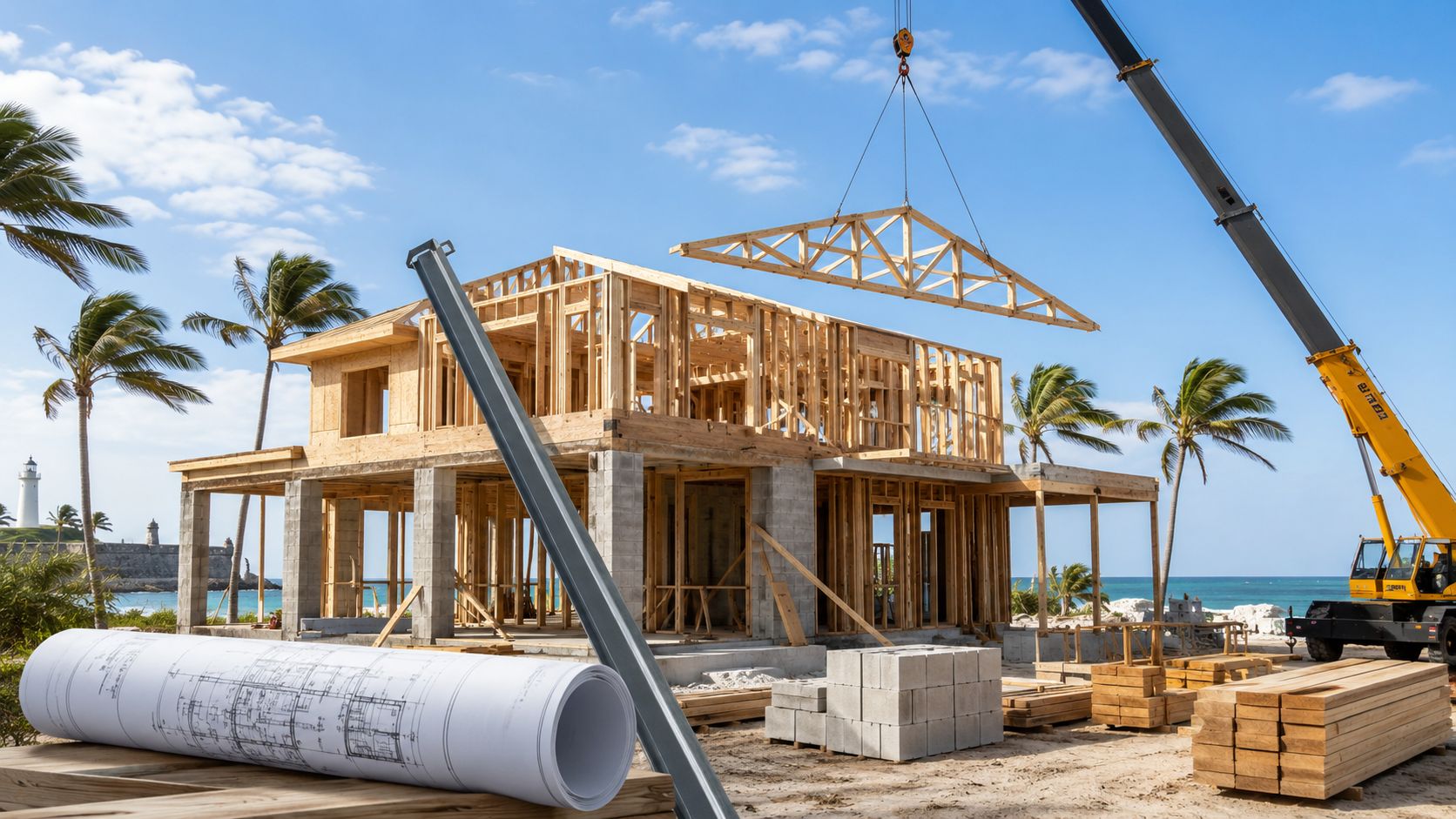
If you're looking at new home construction in St. Augustine Florida, you're probably in one of two places right now. You either love the idea of getting exactly the house you want instead of settling for resale compromises, or you're trying to decide whether building new will produce better long-term value than buying an existing property and renovating it. Both are valid reasons to build. Both can also go sideways fast if the budget only reflects the advertised base price and not the actual all-in cost.
Ofir Engineering is a fully licensed Jacksonville general contractor (License #CGC 1540016) trusted by homeowners and real estate investors throughout Northeast Florida.In Northeast Florida, and especially around St. Augustine, good results come from disciplined planning long before crews show up on site. Lot selection, permitting, structural system, upgrades, site work, and schedule control all affect ROI. That matters whether you're a homeowner planning a long-term residence or an investor focused on resale, hold strategy, or build quality that reduces future maintenance.
Table of Contents
- Your Guide to New Home Construction in St Augustine Florida
- Understanding the St Augustine New Construction Market
- The Pre-Construction Phase From Vision to Blueprint
- Decoding the True Cost of Building a New Home in St Augustine
- Building for Florida Durability Light Gauge Steel vs Wood Frame
- New Construction Timeline and Key Milestones
- How to Choose the Right St Augustine Builder and Project Manager
- Frequently Asked Questions About New Construction in St Augustine
Your Guide to New Home Construction in St Augustine Florida
St. Augustine attracts people for obvious reasons. You get historic character, access to the coast, strong appeal across Northeast Florida, and a wide range of neighborhoods and growth corridors. For many buyers, building new feels like the cleanest way to avoid old-roof problems, outdated floor plans, and expensive surprises hidden behind a resale inspection report.
That part is true. New construction gives you control.
It also puts more responsibility on the owner. Every early decision carries downstream cost consequences, and some of the biggest ones happen before the slab, foundation system, framing package, or finish selections are finalized. A plan that looks efficient on paper can become expensive once site conditions, code requirements, and finish changes enter the job.
For homeowners, the key question is usually whether the house will support the way you want to live for years. For investors, the question is sharper. Will the final product justify the full cost basis, carry well, and stay competitive if the resale window takes longer than expected?
Practical rule: In St. Augustine, the most expensive mistake usually isn't choosing the wrong tile or countertop. It's approving a project without a complete pre-construction plan.
The strongest new construction projects in this market usually have a few things in common:
- A clear end use. Primary residence, second home, rental hold, or resale.
- A realistic all-in budget. Not just builder pricing, but site work, approvals, selections, and contingencies.
- A structural strategy that fits Florida conditions. Material choice affects durability, insurance conversations, maintenance, and long-term ownership.
- A management process. Someone has to coordinate trades, track decisions, and keep the job moving when conditions change.
Understanding the St Augustine New Construction Market
St. Augustine isn't a one-note new construction market. It includes planned communities, private-lot custom homes, attached product, rental-focused development, and high-end estate inventory. If you treat it like a simple list of neighborhoods, you'll miss the crucial decision. You need to know which segment you're committing to.
What the current inventory tells you
By local standards, the active pipeline is meaningful. Realtor.com's St. Augustine new construction listings showed 1,093 new construction homes for sale, with a median listing price of $567,000 and an average of 103 days on market. That combination matters. It points to real inventory depth and a selling cycle that isn't purely speed-driven.
For a homeowner, that means you may have more room to compare locations, plans, and finish levels instead of rushing into the first available release. For an investor, it means absorption can't be treated as automatic. Product positioning, lot quality, and finish discipline still matter.
The same market view also reflects nearby growth corridors and adjacent areas including 32137, 32164, Saint Johns, and Palm Coast. That's useful because many buyers start with “St. Augustine” as the target and then realize their budget, lot preferences, or timeline fit better a little outside the historic core.
Where buyers and investors get tripped up
The market is also getting more segmented. Some supply is moving toward income-qualified rental product, while other supply is clearly aimed at larger-lot luxury buyers. If you don't define your lane early, you'll compare properties that have very different economics.
A practical way to think about it is this:
- Community production homes usually offer easier decision-making, but less flexibility and more exposure to upgrade-driven budget creep.
- Custom or semi-custom builds on private lots give you more control, but land due diligence and site development become a much bigger deal.
- Higher-end product can support strong long-term lifestyle value, but buyers need to be careful not to overbuild for the exact micro-location.
- Investor-oriented opportunities depend heavily on entry basis, holding costs, and how the finished product sits against competing inventory.
Buyers often focus on the floor plan first. The better move is to evaluate the submarket, lot constraints, and likely all-in cost before falling in love with a plan.
In the Jacksonville and Northeast Florida region, this matters even more because buyers can shift between nearby submarkets quickly. If a project in St. Augustine starts to stretch beyond budget, many shoppers will compare it against options in Saint Johns or Palm Coast rather than paying more.
The Pre-Construction Phase From Vision to Blueprint
A clean build starts before design drawings are complete. Pre-construction is where budget control, code compliance, schedule stability, and resale logic get built into the job. If this phase is rushed, construction becomes expensive problem-solving.
Start with goals before drawings
The first step isn't selecting finishes. It's defining the purpose of the house.
For an owner-occupant, that usually means clarifying how long you'll keep the property, whether aging-in-place features matter, how much storage you need, and whether the plan should prioritize daily living or future resale. For an investor, the checklist is different. You need a target buyer or tenant profile, a finish level that supports that profile, and a scope that avoids spending where the market won't pay you back.
That early discussion should also settle a few essential points:
- Lot strategy. Community lot, infill lot, or larger private parcel.
- Home size and complexity. Simple footprints are usually easier to price and execute than highly articulated plans.
- Structural system. This affects engineering, procurement, and long-term ownership.
- Decision authority. One person should control approvals to prevent slowdowns and conflicting direction.
Due diligence before you finalize plans
A lot can look great and still create expensive headaches. Site slope, drainage behavior, utility access, setbacks, and soil conditions all shape the cost to build. Foundation choice matters here too, and owners who want a deeper understanding of slab and support considerations can review this breakdown of concrete foundation types before final engineering.
This is also where many people underestimate the value of coordination. The design needs to be buildable, not just attractive.
When owners want a single-source process for planning and residential execution in Northeast Florida, Custom Home Building Jacksonville is one example of a service model that includes construction planning, contractor management, scheduling, and residential build coordination. That kind of structure can be useful when the goal is reducing handoff problems between design and field execution.
Permitting works best when the design team coordinates early
The City of St. Augustine Planning and Building Department enforces local development codes, which means the project needs to be code-compliant from the beginning. Structural, energy, and site plans need to line up early so the permit package doesn't become a back-and-forth cycle of revisions.
The following often works:
- Architect, engineer, and builder align before permit submission. That reduces conflicting details.
- Site constraints are incorporated into the design. Don't force-fit a standard plan onto a difficult lot.
- Allowances are narrowed early. Vague finish assumptions create change orders later.
- Owner decisions are made on schedule. Delayed selections slow permitting and procurement.
Early coordination saves more money than late-stage “value engineering.” Once drawings, approvals, and trade pricing are in motion, every revision carries more cost.
Decoding the True Cost of Building a New Home in St Augustine
The fastest way to misread a new construction deal is to anchor on the advertised starting price. In this market, that number often functions as a marketing entry point, not a realistic project budget.
Base price is rarely the real number
A major gap in St. Augustine new construction content is the difference between base price and true affordability. A local example highlighted that buyers need to factor in lot, upgrades, and floor plan choices, and broader listing data shows a median new-construction price of $567,000, which points to a much higher real-world all-in budget than many headline price points suggest, as discussed in this local affordability discussion.
That doesn't mean new construction is a bad value. It means buyers need to budget like builders, not like ad copy.
The cost categories that shape your real budget
Most final budgets are built from several layers, not one number:
- Land or lot premium. A better lot usually costs more, but the wrong lot can be even more expensive if it creates site complications.
- Site preparation. Clearing, grading, drainage planning, and utility coordination often change the budget more than expected.
- Permits and approvals. These are part of the full cost of getting to construction, not optional add-ons.
- Hard construction costs. Labor, materials, framing system, windows, roofing, mechanical systems, and finishes.
- Soft costs. Design, engineering, surveys, financing, and project oversight.
- Community-related costs. HOA rules can influence what you build and how much flexibility you have.
- Upgrades and plan changes. Many budgets lose discipline here.
A practical mistake I see often is treating allowances as if they're fixed prices. They aren't. If the owner upgrades flooring, changes windows, reworks cabinetry, or expands the lanai after pricing is underway, the entire budget shifts with it.
What protects ROI and what destroys it
For homeowners, ROI isn't just resale. It's also lower maintenance exposure, fewer early-life repairs, and a house that fits your use case without immediate remodeling.
For investors, ROI starts with a clean pro forma and a disciplined scope. The build has to match the buyer pool. Over-improving a house beyond the local demand profile can hurt returns even if the work itself is high quality.
What tends to protect value:
- Simple massing and efficient layouts
- Finish packages aligned with the submarket
- Front-loaded planning on utilities, drainage, and approvals
- Material choices that reduce maintenance burden over time
What usually hurts value:
- Late structural changes
- Too many customizations without resale logic
- Ignoring community restrictions until late in the process
- Assuming the base price includes the finished home you want
If you're comparing builders, ask for the budget category that usually grows the most between contract and completion. The answer tells you a lot about how transparent the process really is.
Building for Florida Durability Light Gauge Steel vs Wood Frame
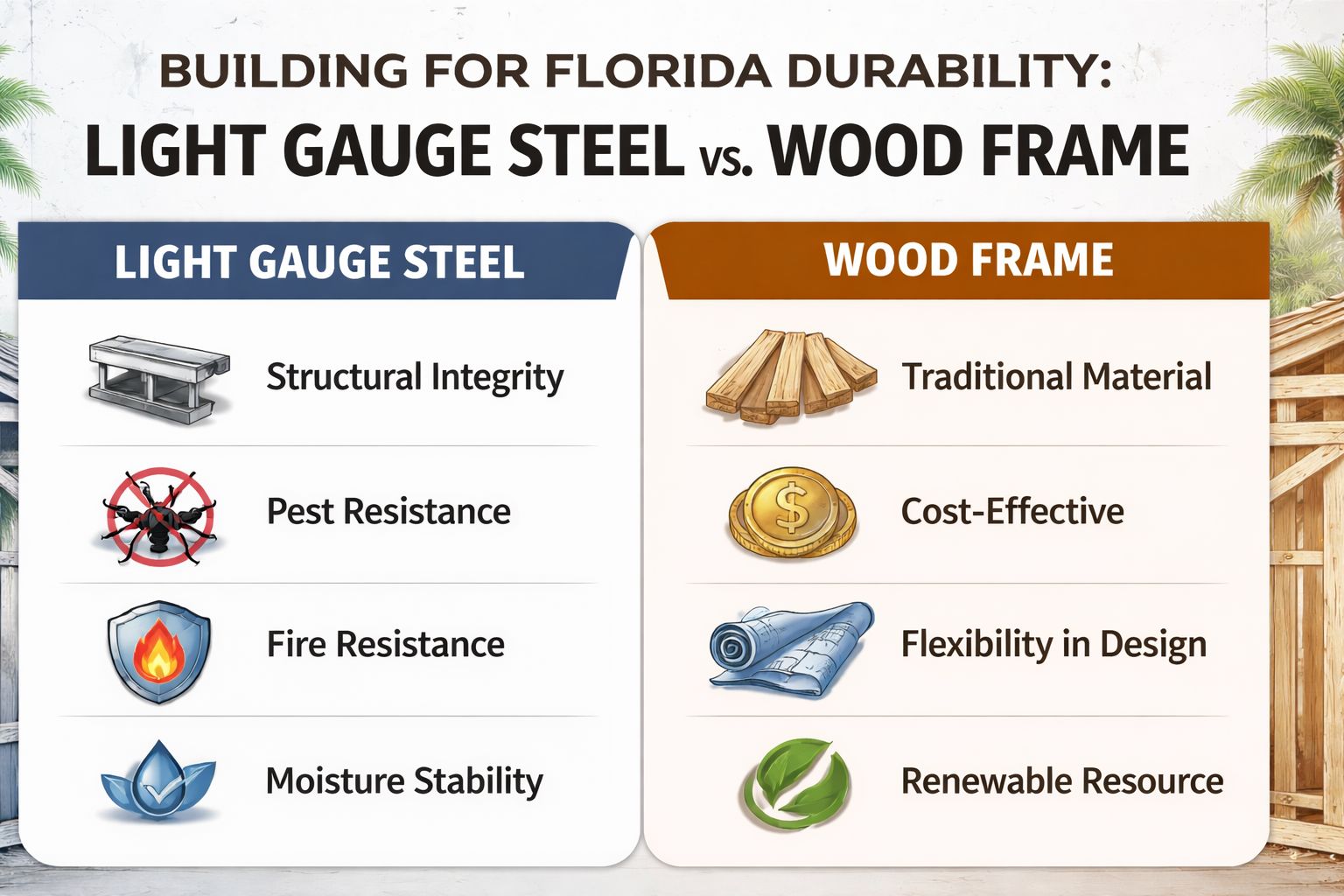
Material choice isn't just a construction detail. In Florida, it affects durability, maintenance, engineering approach, and how the home performs in heat, moisture, and pest-prone conditions. Both light gauge steel and wood frame can work. The right choice depends on priorities.
How the two systems perform in real Florida conditions
Light gauge steel usually appeals to buyers who want a structure that doesn't bring the same termite and moisture sensitivity as wood. It's also attractive when the owner values dimensional consistency and is thinking long-term about resilience.
Wood frame remains common for a reason. It's familiar to many trades, flexible in design, and often easier for owners to understand because it's the traditional system in residential construction. In the right application, it can be a very practical choice.
For either system, the foundation and site interface still matter. Owners comparing structural approaches may also find Firm Foundations' guide useful because it explains how foundation decisions support the rest of the build.
If you want a Florida-specific side-by-side look at framing considerations, this comparison of steel frame vs wood frame construction for Florida homes is a relevant internal resource.
Light Gauge Steel vs. Wood Frame for Florida Homes
| Feature | Light Gauge Steel (LGS) | Traditional Wood Frame |
|---|---|---|
| Moisture behavior | Doesn't absorb moisture the way wood can | More sensitive to prolonged moisture exposure |
| Pest resistance | Not a food source for termites | Requires stronger attention to termite risk |
| Fire characteristics | Often chosen for noncombustible structural qualities | Traditional material, but different fire considerations apply |
| Dimensional stability | Consistent, with less concern about warping or shrinking from organic movement | Can expand, contract, or move with environmental conditions |
| Trade familiarity | Requires crews and planning familiar with steel framing details | Broadly familiar across residential trades |
| Design flexibility | Works well when engineered and coordinated properly | Widely adaptable for many home designs |
| Owner mindset | Often chosen for durability-focused builds | Often chosen for familiarity and straightforward residential execution |
The wrong way to make this decision is to ask which system is “better” in the abstract. The better question is which system fits your lot, design, budget discipline, trade availability, and ownership horizon.
New Construction Timeline and Key Milestones
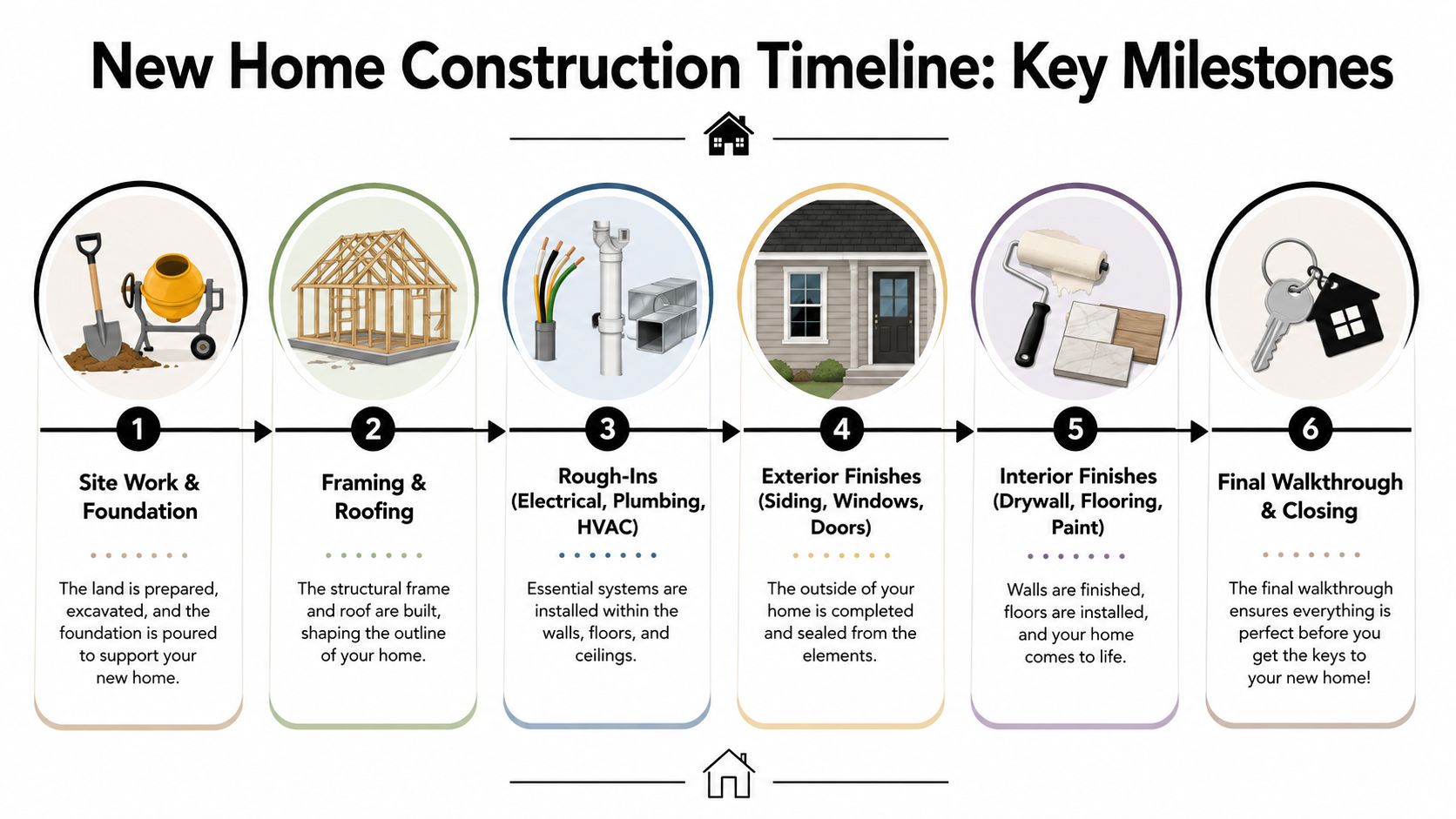
Most owners don't need a perfect day-by-day forecast. They need a realistic understanding of sequence, dependencies, and where delays usually enter the job. Construction moves in stages, and each stage depends on decisions made earlier.
What happens in each stage
A typical sequence looks like this:
Site work and foundation
The lot gets prepared, elevations are confirmed, utilities are coordinated, and the foundation system is installed.Framing and roofing
The structure goes up, roof framing is completed, and the building starts to take weather-protected shape.Rough-ins
Plumbing, electrical, HVAC, and other behind-the-wall systems are installed before insulation and wall closure.Exterior finishes
Windows, doors, exterior cladding, and weather-resistive details get completed.Interior finishes
Drywall, cabinetry, flooring, trim, paint, and fixture installation move the house toward completion.Final walkthrough and closeout
Inspections, punch work, documentation, and owner orientation finish the process.
Owners who want a broad consumer-facing overview can compare this against Blue Gas Express's guide for residential construction projects, which is useful as a basic reference. For a more direct internal planning resource, this home construction timeline guide can help frame the sequencing conversation.
Where timelines usually slip
Schedule problems usually come from coordination failures, not just bad luck.
Common causes include:
- Owner selection delays. Cabinets, tile, windows, and fixtures need lead time.
- Permit or inspection friction. Missing details upstream create bottlenecks later.
- Weather exposure. Northeast Florida jobs need realistic planning around rain and site conditions.
- Trade stacking. One delayed subcontractor can hold up multiple downstream activities.
- Field changes. Last-minute revisions almost always ripple through schedule and cost.
A realistic timeline isn't a pessimistic one. It's the schedule that accounts for dependencies, approvals, procurement, and inspections before they become surprises.
How to Choose the Right St Augustine Builder and Project Manager
A builder can produce the house. A project manager protects the process. Sometimes one firm handles both well. Sometimes it doesn't. That's why vetting matters.
What to verify before you sign anything
Florida's pipeline for new housing remained active in early 2026. HBWeekly reported 4,889 total new residential permits in January 2026, representing more than $1.65 billion in total construction value, according to HBWeekly's Florida new-home construction overview. In a busy market, organized contractors stand out.
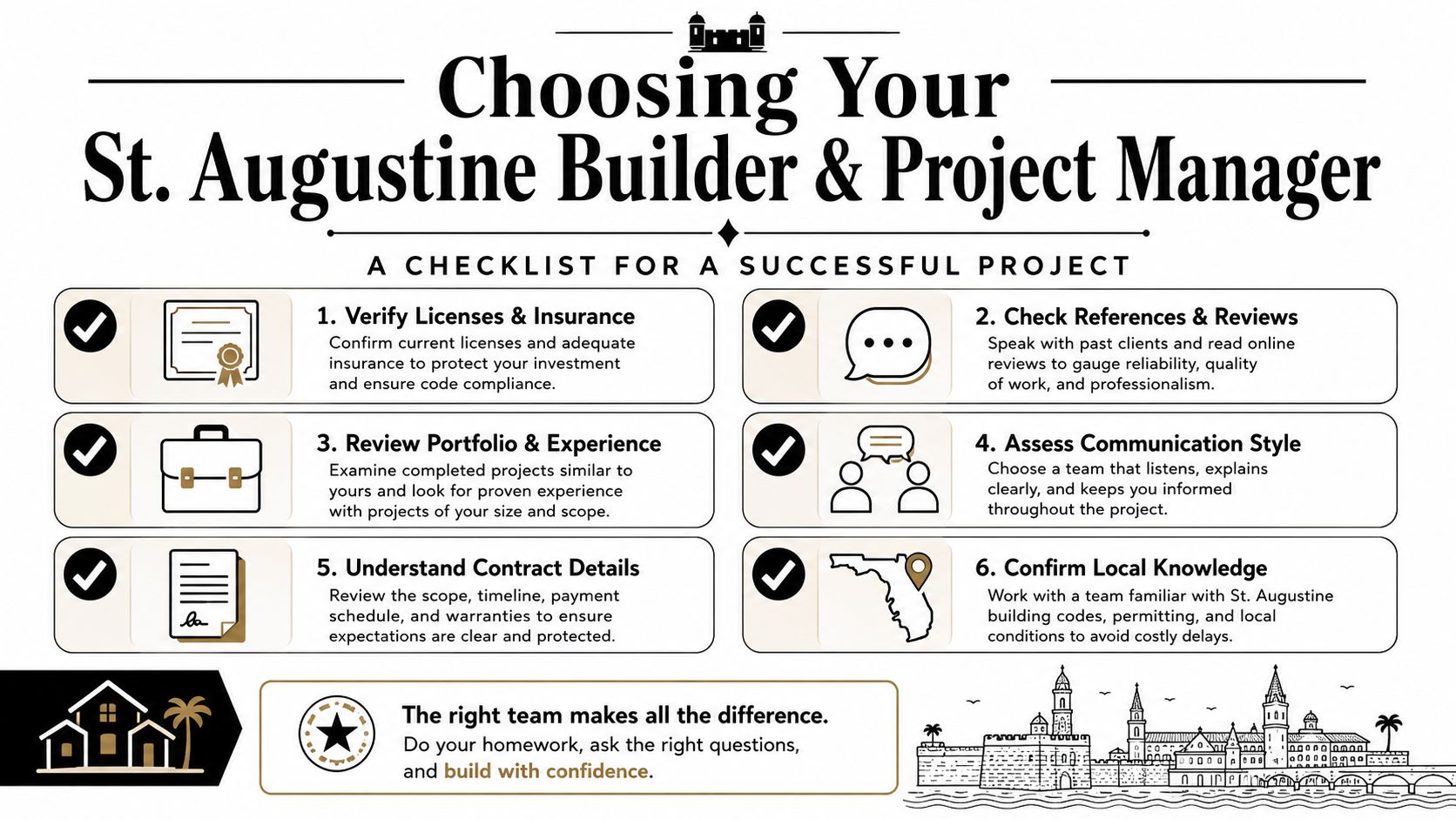
Check these basics first:
- Licensing and insurance. Verify them directly and make sure they fit the work being proposed.
- Local code familiarity. St. Augustine and the surrounding Northeast Florida jurisdictions reward teams that know how local approvals operate.
- Recent project relevance. A contractor can be competent and still be the wrong fit for your type of home or lot.
- Scope clarity. If the proposal is vague, budget disputes usually follow.
- Communication system. Ask how decisions, change orders, schedules, and owner updates are handled.
Business discipline matters too. Owners who want to understand why contractor financial systems affect scheduling, billing clarity, and job control can skim this piece on boosting construction company profits. It's useful context because poorly managed back-office operations often show up on the jobsite.
Questions that reveal how a builder really operates
Ask direct questions. The answers usually tell you more than the portfolio does.
- Who manages the schedule day to day?
- Who approves trade work before the next phase begins?
- How are allowances tracked and updated?
- How are owner changes priced and documented?
- What happens when material lead times change?
- How often do I receive budget and progress updates?
For owners who need oversight rather than just labor execution, Construction Project Management refers to a service structure that includes contractor coordination, budgeting, scheduling, renovation oversight, and construction supervision in Jacksonville for homeowners and investors.
The best fit is usually the team that communicates clearly, prices fairly, understands local conditions, and doesn't treat project management as an afterthought.
Frequently Asked Questions About New Construction in St Augustine
| FAQs | |
|---|---|
| Should I buy a lot first or choose a builder first? | It depends on your experience level. If you already understand setbacks, utilities, drainage, and site risk, buying first can work. Most buyers benefit from having a builder or project manager involved before the lot is finalized. |
| Is building new always better than buying and remodeling? | No. New construction gives you control and reduced early-life maintenance risk, but it also requires more upfront planning and a larger decision load. In some cases, a well-bought existing home with a disciplined renovation plan is the better financial move. |
| How much customization is too much? | Customization becomes a problem when it hurts resale or creates expensive complexity without improving how the house lives. If the feature only matters to a very narrow future buyer, think carefully before spending on it. |
| What should I lock down early? | Lot feasibility, floor plan, structural system, window and door package, major mechanical decisions, and any finish categories with long lead times. These choices affect both budget and schedule. |
| Are HOA rules a big deal in new construction communities? | Yes. They can affect exterior materials, colors, fences, landscape plans, and even practical details like driveway configuration. Review those rules before finalizing design decisions. |
| What matters most for long-term value in Northeast Florida? | Durable construction, a sensible layout, strong moisture management, good site drainage, code-compliant execution, and finish choices that fit the local buyer profile. Those decisions usually matter more than flashy upgrades. |
If you're weighing new home construction in St. Augustine Florida and want a practical view of cost, planning, structural options, or project oversight, Ofir Engineering works with homeowners and investors in Jacksonville and across Northeast Florida on new construction, renovations, and project management. A consultation can help you evaluate lot feasibility, scope, budgeting, and the decisions that affect long-term value before you commit to the build.
