
Most new single-family homes in the Jacksonville area land in a 9 to 14 month total timeline, with that schedule split between pre-construction and active construction. In practice, the biggest mistake isn't underestimating the build itself. It's underestimating everything that has to happen before the crew can even break ground. Backed by Florida general contractor license CGC 1540016, the Ofir Engineering team serves clients across Jacksonville, St. Johns, and Clay County.
If you're planning a build in Jacksonville or Saint Johns, you're probably trying to answer three questions at once. How long will it take, how much carrying cost can you absorb, and what can derail the schedule after you commit capital. Those questions matter just as much to a homeowner building a primary residence as they do to an investor watching financing, insurance, taxes, and lease-up or resale timing.
A realistic home construction timeline isn't a single number. It's a chain of approvals, procurement decisions, trade sequencing, inspections, weather windows, and site conditions. In Northeast Florida, that chain gets tighter because local permitting, flood-zone review, sandy soils, humidity, and storm season all affect how a job should be scheduled if you want to protect budget and ROI.
Table of Contents
- Understanding the Complete Home Construction Timeline
- Pre-Construction The Hidden Half of Your Timeline
- The Active Construction Timeline Phase by Phase
- How Florida Factors Impact Your Jacksonville Construction Timeline
- Timeline Risks That Erode Investor ROI
- Frequently Asked Questions About Construction Timelines
- How long does it usually take to build a house in Jacksonville?
- What part of the home construction timeline gets underestimated most often?
- Are custom homes slower than more standardized builds?
- Can Light Gauge Steel shorten the schedule?
- What delays projects more, weather or owner changes?
- Does professional project management really make a difference?
- Take Control of Your Project Timeline with Expert Management
Understanding the Complete Home Construction Timeline
The home construction timeline only makes sense when you split it into two large phases. First comes pre-construction, where design, engineering, financing, pricing, permitting, and municipal review happen. Then comes active construction, where the site work, structure, systems, finishes, inspections, and turnover happen.
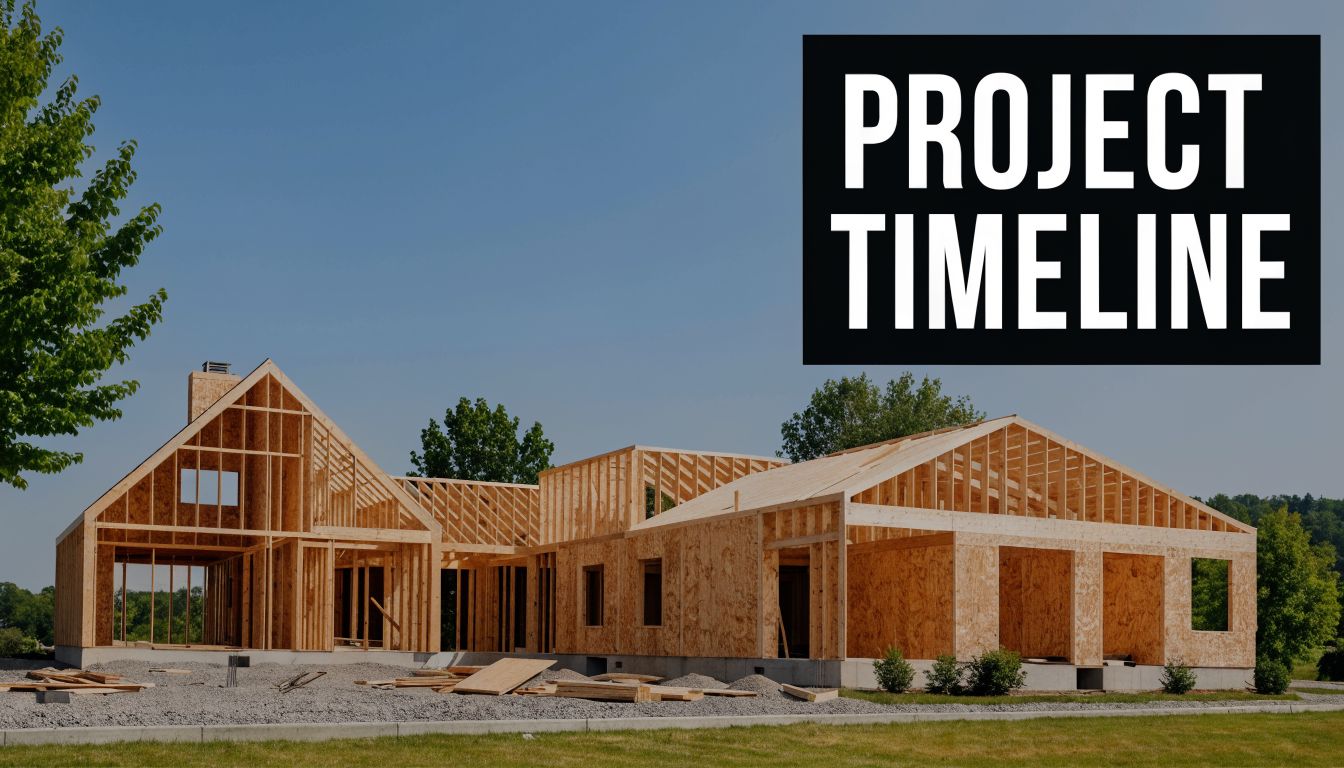
Most owners focus on the visible phase because that's when they see trucks, framing lumber, concrete, and progress photos. But schedule control usually starts much earlier. If the drawings aren't coordinated, the site conditions aren't understood, or the permit package is weak, the job starts late and stays late.
A good house construction timeline guide is useful because it frames the process as a sequence, not a mystery. That mindset matters in Jacksonville. When you treat the schedule like a managed system instead of a rough estimate, you make better decisions on plan selection, procurement, inspections, and financing.
Practical rule: The earlier you identify approvals, long-lead materials, and site constraints, the fewer “surprises” show up later as delays.
Pre-Construction The Hidden Half of Your Timeline
Before a slab is poured or a frame goes up, a large share of the home construction timeline is already in motion. Owners often treat pre-construction like paperwork. It isn't. It's where schedule risk either gets reduced or baked into the job.
For a Jacksonville investor, this phase drives holding period assumptions. For a homeowner, it determines how realistic a move-in target really is. Nationally, the average time to complete a single-family home built by a contractor is 10.6 months, while owner-built projects extend to 13.7 months. In the South, including Florida, the average is the nation's shortest at about 7 months for the construction phase alone, according to Saluda Grade's home-building timeline analysis.
What happens before construction starts
Pre-construction usually includes several moving parts that need to line up:
- Plan development and engineering. Custom homes take longer because each structural, architectural, and code issue has to be resolved on that specific design.
- Site due diligence. Survey, setbacks, drainage questions, access, utilities, and lot-specific constraints need answers before pricing is dependable.
- Financing and scope alignment. Lenders, owners, and builders need the same understanding of what's being built and what's excluded.
- Permit submission and review. Incomplete packages often lead to avoidable rejections and comment cycles.
A lot of clients assume a permit is a simple filing. It isn't, especially in Florida. Review comments, missing engineering details, flood and wind-load requirements, and municipal backlogs can all add time before physical work begins.
Custom design versus speed to market
If speed matters, fully custom isn't always the right play. A custom plan gives you flexibility, but it also creates more coordination work and more opportunities for revisions. Investors usually do better with a semi-custom approach that limits design churn and gets the permit package out faster.
That's one reason permit guides from other cities can still be helpful as process references. A resource like this Phoenix building permit guide shows the broader reality that permit timelines depend on local requirements, submission quality, and review sequencing, not just on when paperwork is filed.
Rushing pre-construction doesn't save time. It moves unresolved problems into the field, where fixes cost more and slow down every trade behind them.
What works is front-loading decisions. Lock the scope. Resolve structural questions early. Confirm the site. Submit a complete permit package. That's how you create a construction schedule you can trust.
The Active Construction Timeline Phase by Phase
Once permits are approved, the visible part of the home construction timeline begins. This is the phase most owners picture, but it only runs well when the sequence is respected. Crews cannot, by "working harder", overcome trade dependencies, failed inspections, or missing materials.
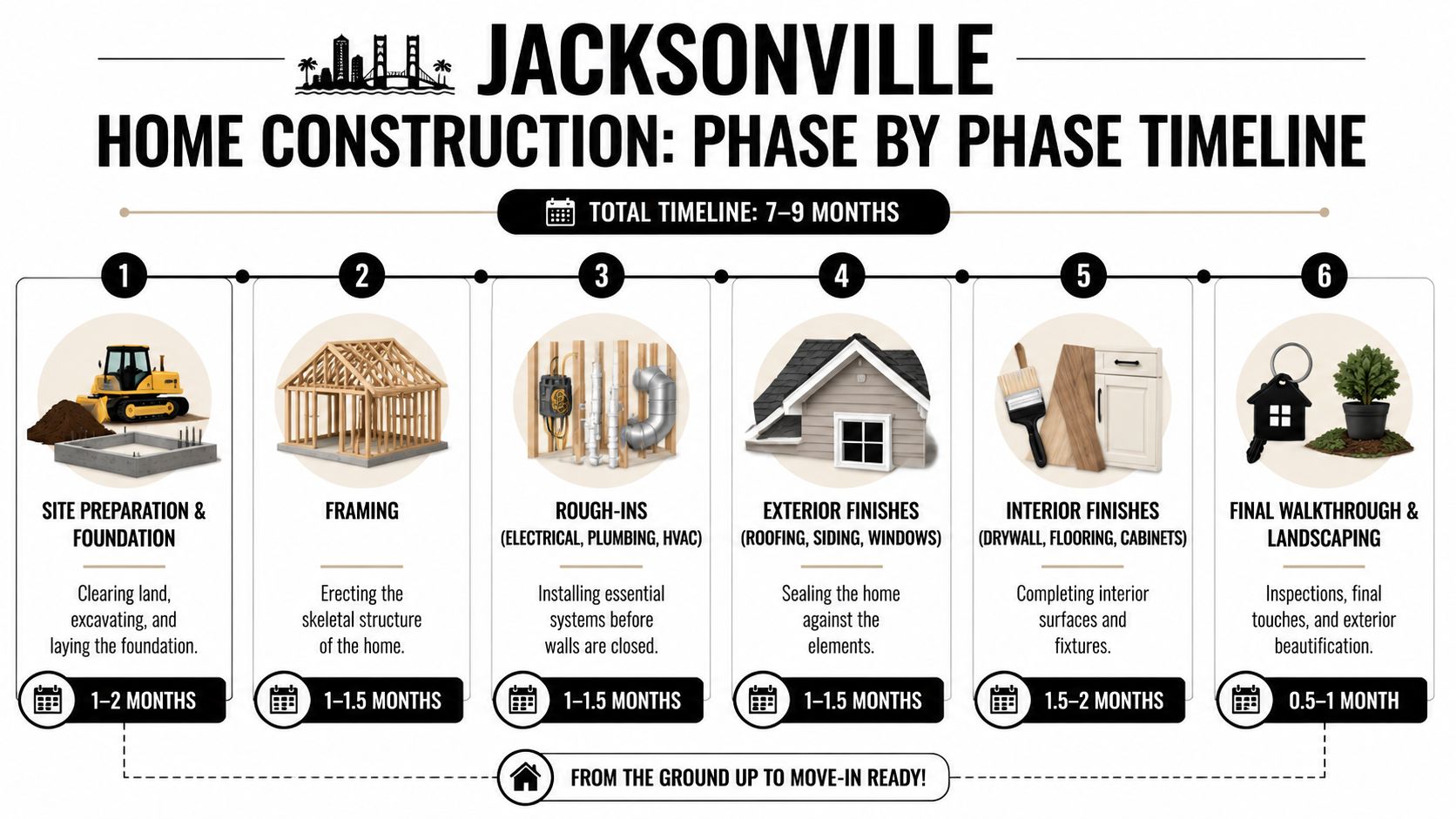
The schedule below reflects a practical Jacksonville-style workflow. Some phases overlap at the edges, but the order matters because each stage sets up the next one.
Typical New Home Construction Phase Durations
| Phase | Typical Duration |
|---|---|
| Site preparation and foundation | 1-2 months |
| Framing | 1-2 months |
| Mechanical rough-ins | 1 month |
| Interior and exterior finishing | 4-6 months |
| Final inspections and handover | 1 month |
For a broader view of how these stages connect from planning through close-out, this construction project lifecycle for Jacksonville homes is a useful reference point.
Site prep and foundation
This phase starts with clearing, layout, excavation, and foundation work. In Northeast Florida, sandy soils can help with drainage in some cases, but they can also expose grading and compaction issues that need attention before concrete placement.
Foundation work tends to look straightforward from the outside. It rarely is. The slab or foundation system has to match the site conditions, drainage plan, structural loads, and municipal requirements. If the site wasn't properly evaluated during pre-construction, delays often emerge at this stage.
Framing and dry-in
Framing gives owners the first visible sense of progress. Walls go up, roof structure takes shape, and the home starts to read like a finished floor plan. This phase usually moves well when labor and materials are lined up in advance.
The next milestone is dry-in. Roofing, sheathing, windows, and exterior protection need to happen in the right order so interior trades can work in a more controlled environment. In Florida, getting the structure protected from rain and humidity quickly matters for both schedule and material condition.
This video gives a useful visual overview of how the build sequence unfolds on a real residential project:
Rough-ins and inspections
Once the structure is ready, plumbing, electrical, and HVAC rough-ins move in. These trades have to coordinate tightly. If one crew runs late or installs out of sequence, inspections get pushed and downstream work stalls.
This is also the point where owner changes become expensive. Moving a plumbing wall, shifting lighting layouts, or changing mechanical requirements after rough-in planning has started affects multiple trades at once.
If you want schedule certainty, make layout and finish decisions before rough-ins begin. Late decisions don't just add work. They break sequence.
Finishes and close-out
Finishing is where many jobs slow down. It feels like the project should be close to done, but this stage is detail-heavy and trade-dense. According to MyBuilderCares' custom home timeline analysis, interior and exterior finishing is often the longest single stage, taking 4 to 6 months in custom homes, and supply chain lags for items like windows and appliances can cause 20 to 30% timeline extensions in high-demand markets like Florida.
That aligns with what happens on real jobs. Finish carpentry, cabinets, flooring, paint, countertops, fixtures, punch work, and final corrections all stack on top of one another. One delayed item can idle multiple crews.
The jobs that close cleanly usually share the same traits:
- Selections were finalized early. Late cabinet, tile, lighting, and appliance decisions slow procurement and create resequencing.
- Inspections were prepared, not hoped for. Clean rough-ins and organized documentation reduce rework.
- Punch lists stayed small. Projects drift when quality control is postponed until the end.
How Florida Factors Impact Your Jacksonville Construction Timeline
A generic schedule from another market won't tell you much about building in Northeast Florida. The home construction timeline here is shaped by local code review, storm exposure, humidity, and ground conditions. If those factors aren't built into the schedule from day one, the timeline on paper won't match the timeline in the field.
Permitting is not a formality
National averages for permitting often sound manageable until you hit Florida-specific review requirements. In high-growth areas like Jacksonville, municipal approval processes involving FEMA flood zone compliance and hurricane code certifications can average 3 to 6 months. Duval County permitting for single-family homes averaged 4.2 months in 2025, according to Block Renovation's permitting and timeline guide.
That reality changes how you should plan:
- Land carry gets longer when the permit package isn't complete.
- Construction financing gets tighter if draws are timed off an unrealistic start date.
- Investor ROI shrinks when resale or occupancy assumptions ignore municipal review time.
A weak permit submission is one of the easiest ways to lose weeks. Missing engineering notes, unclear product approvals, or incomplete site information can push the file back into another review cycle.
Weather and site conditions change sequencing
Florida weather doesn't just cause random delays. It changes how smart builders sequence the work. Roofing, exterior dry-in, concrete operations, and material deliveries all need to be planned with storm season and high humidity in mind.
Soil and drainage matter too. Jacksonville-area lots can look build-ready while still requiring closer attention to grading, compaction, water movement, and foundation preparation. That's why the best schedules are built around the actual lot, not a generic template from a subdivision in another state.
In Florida, the schedule has to match the site and the season. If it doesn't, crews spend time reacting instead of building.
The practical takeaway is simple. A realistic Jacksonville schedule should assume local permit complexity, weather exposure, and lot-specific engineering from the start. Anything else is a hopeful estimate.
Timeline Risks That Erode Investor ROI
For investors, timeline control is financial control. Every delay pushes revenue farther out while carrying costs keep running. For homeowners, the pain shows up differently. Extended temporary housing, loan extensions, duplicated payments, and decision fatigue all become more expensive when the job drifts.
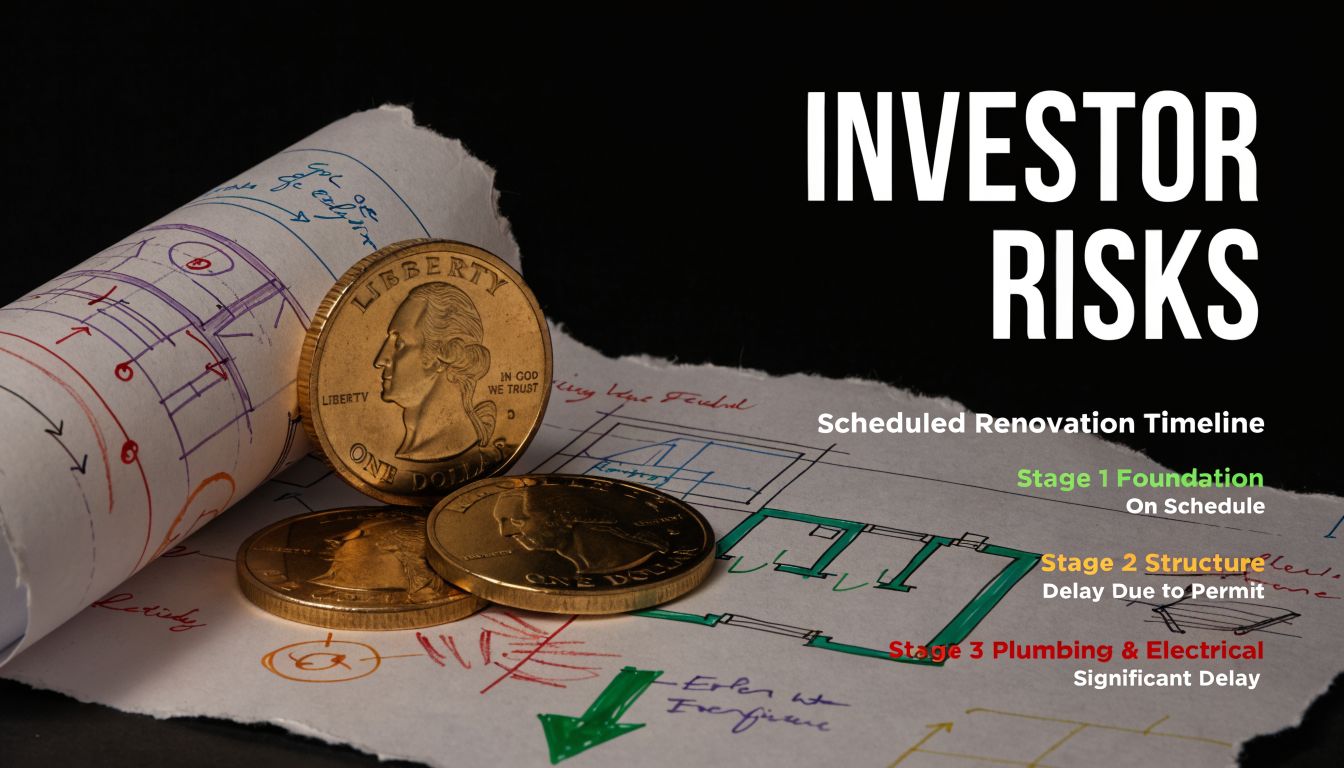
The broader market has already shown how fragile schedules can become. Historical data shows national average construction times rose from 6.8 months in 2020 to 7.7 months in 2024 due to labor shortages and material delays, according to Statista's analysis of single-family home construction timelines.
New construction versus major remodels
Investors often ask whether a gut remodel is faster than ground-up construction. Sometimes it is. Sometimes it isn't.
New construction has a cleaner sequence. You start with known drawings, known structure, and a planned workflow. Major remodels add demolition, hidden conditions, and existing-system conflicts. Once walls are opened, crews may find framing damage, old mechanical layouts, moisture issues, or code upgrades that weren't obvious during the initial walk-through.
That's why remodel timelines often feel less predictable, even when the square footage is smaller.
What actually causes schedule slippage
The biggest schedule killers are rarely dramatic. They're usually management problems that stack up imperceptibly:
- Late selections. Cabinets, windows, doors, tile, and appliances need to be committed early.
- Trade stacking. Too many subs trying to work in the same space slows everyone down.
- Weak supervision. If nobody is checking quality daily, rework appears at inspection time.
- Scope creep. Mid-project layout changes and finish upgrades rarely stay confined to one line item.
Process triumphs over optimism. Owners who want fewer delays need a documented schedule, procurement tracking, inspection prep, and a strict change-order discipline. For clients considering steel framing, this article on costly mistakes to avoid when building a light gauge steel home in Jacksonville is worth reviewing because material choice changes sequencing, labor planning, and inspection expectations.
What doesn't work is assuming the field team will “figure it out.” Jobs stay on track when someone is actively coordinating trades, reviewing readiness, and making decisions before delays spread.
Frequently Asked Questions About Construction Timelines
How long does it usually take to build a house in Jacksonville?
A practical expectation is 9 to 14 months total for many Jacksonville-area single-family homes when you include pre-construction plus the active build. The lower end is usually tied to simpler scopes, cleaner permit packages, and fewer owner changes. The longer end shows up with custom plans, more review complexity, weather interruptions, and finish-stage procurement delays.
What part of the home construction timeline gets underestimated most often?
Pre-construction. Owners tend to focus on the visible building stage and forget that design coordination, engineering, municipal review, and financing work can consume months before site work starts. That's especially true in Florida where permitting is more involved than many first-time builders expect.
Are custom homes slower than more standardized builds?
Yes, in most cases. Custom homes involve more decisions, more review points, and more opportunities for revisions. Standardized or semi-custom plans usually move faster because the design has already been resolved to a greater degree before submittal and procurement.
Can Light Gauge Steel shorten the schedule?
In many cases, yes. Recent data indicates homes built with Light Gauge Steel can be completed 15 to 25% faster than traditional wood-frame builds, and the use of prefabricated panels can reduce the on-site framing phase from 10 to 12 weeks for wood to 6 to 8 weeks for LGS, according to TXRAC's home construction time comparison.
That matters in Florida because less on-site framing time can reduce exposure to weather disruption. It can also create a more controlled installation sequence when the design and fabrication are coordinated properly.
What delays projects more, weather or owner changes?
Both can be serious, but owner changes are often more avoidable. Weather is part of the planning environment in Florida, so good schedules should already account for seasonality and exterior sequencing. Owner-driven changes after procurement or rough-in tend to be more damaging because they ripple across trades, inspections, and material orders.
Does professional project management really make a difference?
Yes. A managed project doesn't eliminate all delay risk, but it does reduce preventable delay. Teams that track submittals, procurement, inspections, trade handoffs, and scope changes make faster corrections and protect the schedule better than loosely coordinated jobs.
Take Control of Your Project Timeline with Expert Management
A realistic home construction timeline in Jacksonville starts with one assumption. The schedule won't protect itself. It has to be built, monitored, corrected, and defended from permit issues, weather shifts, procurement problems, and scope changes.
For investors, that discipline protects ROI by reducing drift between capital deployment and occupancy, resale, or refinance. For homeowners, it protects the budget and makes the process much more manageable. The difference between a stressful build and a controlled one usually comes down to planning depth, decision timing, and field coordination.
Strong project management isn't abstract. It means the permit package is organized before submission. It means finish selections are locked before they become schedule problems. It means inspections are prepared for, not reacted to. It also means someone is responsible for pushing every trade toward the next milestone.
One practical resource is this construction project management checklist for Jacksonville, which outlines the kind of planning and oversight that helps keep residential projects moving. Ofir Engineering provides project management, new construction, remodeling, and investor-focused construction services in Northeast Florida, including coordination from pre-construction through final handover.
If you're planning a new build, major remodel, or investor project in Jacksonville or Saint Johns, start with the schedule before you start with finishes. That's where budget control begins.
If you want a realistic construction schedule for your property, contact Ofir Engineering. The team works with homeowners, investors, and property owners in Jacksonville and Northeast Florida on new construction, remodeling, and project management with a focus on budget control, timeline discipline, and code-compliant delivery.
