
The metal frame homes insurance impact in Florida is real but frequently misunderstood: steel framing does not automatically lower your homeowners premium, and in some carrier models it does not move the base rate at all. What actually reduces a Florida premium is the wind mitigation features documented on your inspection form, and steel framing makes several of those features easier and more durable to achieve. Understanding which mechanism does the work is what turns a construction decision into an insurance outcome. Ofir Engineering is a licensed Florida general contractor (License #CGC 1540016) with 15+ years serving Jacksonville, Ponte Vedra, St. Johns, and Northeast Florida.
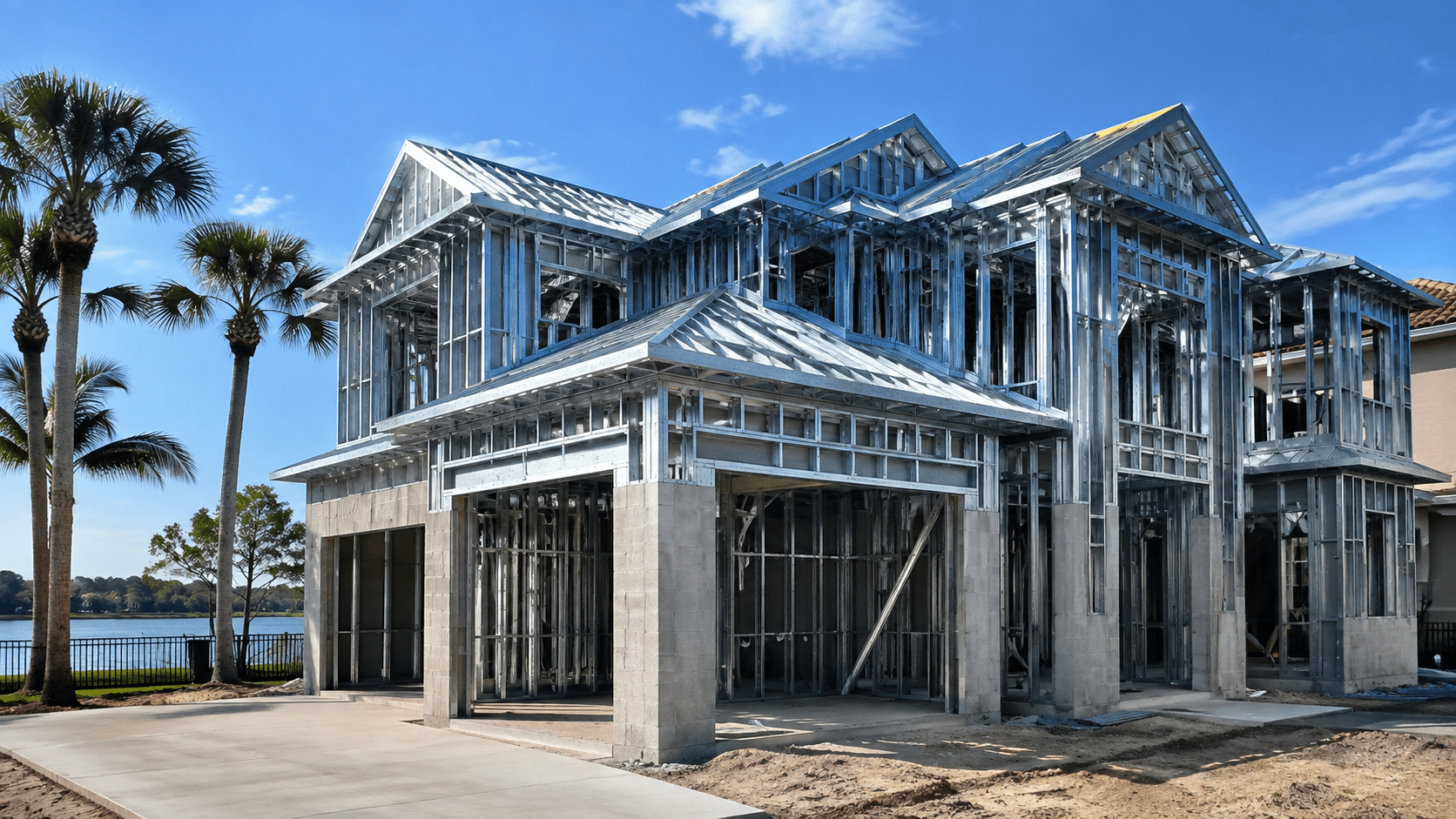
Understanding the Metal Frame Homes Insurance Impact on a Florida Policy
A Florida homeowners premium is built from a small number of inputs: location and wind exposure, construction class, roof characteristics, opening protection, year built, replacement cost, deductibles, and claims history. Wind is the dominant peril in this state, and wind rating is where the largest swings live.
Steel framing touches four of those inputs. It affects construction classification, it makes strong roof-to-wall and roof-deck connections straightforward, it is non-combustible, and it is immune to termites and rot. Two of those move premium substantially, one moves it modestly, and one is a claims-frequency benefit that shows up over time rather than on your first declarations page.
The Classification Surprise: Frame Versus Masonry
This is the point most owners get wrong, so take it directly. Many Florida carriers rate residential construction in two broad buckets, masonry and frame, and masonry generally rates better for wind. Light gauge steel framing is very often classified as frame, not masonry — the same bucket as wood.
The practical consequence is that a light gauge steel home is not automatically cheaper to insure than a concrete block home of the same size in the same zip code. Some carriers have a distinct non-combustible or steel-frame class that rates better than wood; many do not, and default to frame. This is a carrier-by-carrier question, not a code question, and it should be asked of an agent before you finalize a structural system rather than after. Our comparison of steel frame versus concrete block homes in Florida covers the structural side of that same decision.
Where Steel Framing Genuinely Earns Premium Credit: Wind Mitigation
Florida’s uniform mitigation verification inspection is where documented premium reduction actually happens. The inspection reports a defined set of features, and each one maps to a rating credit. The categories that carry the most weight are roof covering compliance, roof deck attachment, roof-to-wall connection, roof geometry, secondary water resistance, and opening protection.
Steel framing helps materially on roof-to-wall connection and roof deck attachment. Engineered steel connections — clips, straps and screwed connections designed to the calculated uplift load — reliably achieve the strongest reported categories, and unlike nailed wood connections they do not depend on a framer hitting the right nail pattern by hand on a hot afternoon. Consistency is the advantage. Steel also holds fastener values over time in a way that wood does not as it dries, checks and ages in Florida humidity.
Opening protection is the other heavyweight credit, and it is independent of framing material: it is a function of impact-rated windows, doors and shutters. A steel-framed house with unprotected openings will rate worse than a wood-framed house with a full impact-rated envelope. Our guide to impact windows and hurricane hardening explains why that single line item so often dominates the mitigation form.
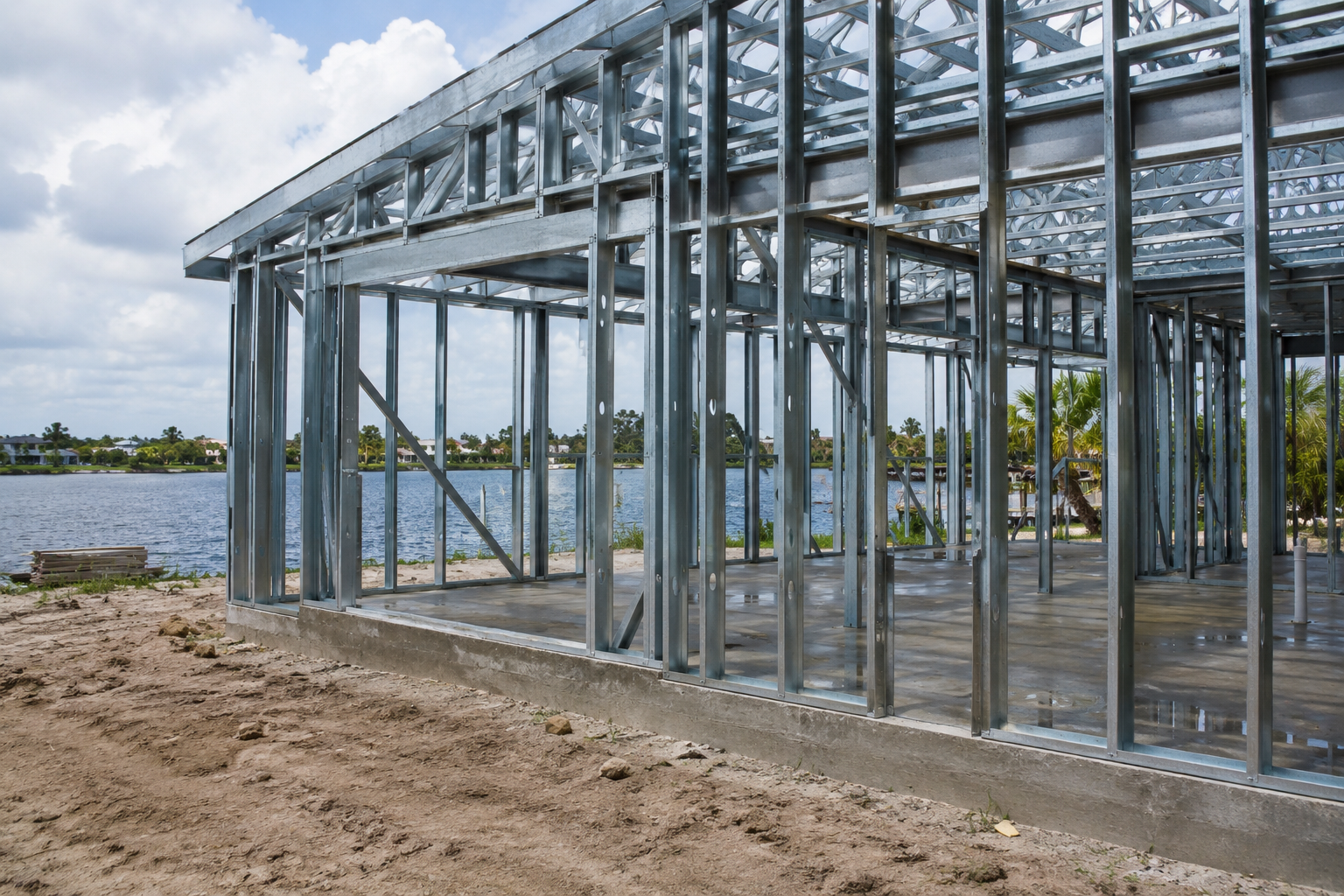
Non-Combustibility, Termites and the Claims You Do Not File
Steel does not burn. That matters for fire rating, though on a detached single-family home in Florida it moves premium less than owners expect, because fire is not the peril driving Florida rates. On attached, multifamily and mixed-use structures, non-combustible construction carries more weight.
Termite and rot immunity is a different kind of benefit. Termite damage is broadly excluded from homeowners policies as a maintenance issue, so it does not reduce your premium directly. What it does is remove an entire category of expensive, uninsured repair from your ownership costs, and it eliminates the structural deterioration that eventually shows up as a water-damage claim. Fewer claims means better renewal pricing and continued eligibility, which in the current Florida market is worth more than a small rate difference. See termite-proof steel framing and whether steel frame homes rust in Florida humidity for the durability detail behind that claim.
What Actually Raises a Premium on a Metal Frame Home
Three things, and none of them are the steel. An undocumented build is the first: if your wind mitigation inspection is not performed and filed, none of the engineering you paid for reaches your rate. Carriers rate what is documented, not what exists. The second is replacement cost. Steel-framed homes are frequently specified above the neighborhood average, and a higher replacement cost means a higher dwelling limit and a higher premium — that is correct pricing for a better house, not a penalty. The third is flood, which is a separate policy entirely and is priced on elevation and flood zone regardless of what the walls are made of.
Corrosion protection deserves a mention as an underwriting question. Properly galvanized light gauge steel, detailed with the correct capillary break at the slab and a sealed envelope, is a long-life system. Poorly detailed steel in a coastal salt-air environment is not. Underwriters increasingly ask about coastal detailing on waterfront properties, and a builder who can produce the specification and inspection record answers that question in one email.
How to Actually Capture the Savings
Order the wind mitigation inspection as soon as the certificate of occupancy issues and file it with your carrier immediately — do not wait for renewal. Keep the engineered connection details, the roof deck fastening schedule and the product approval numbers for windows and doors in a closeout binder. Ask your agent directly how that specific carrier classifies light gauge steel, and shop at least three carriers, because the classification varies more between companies than most owners realize.
Rate filings and consumer resources for Florida property insurance are published by the Florida Office of Insurance Regulation. For the construction side, our steel frame home insurance savings article and our steel framing wind code compliance guide cover what has to be built and documented. To discuss a specific build, see our steel frame construction service or contact us.
Frequently Asked Questions
Do metal frame homes automatically cost less to insure in Florida?
No. Many carriers classify light gauge steel as frame construction rather than masonry, so the base rate may not improve on its own. Documented wind mitigation features — roof-to-wall connection, roof deck attachment and opening protection — are what actually reduce the premium.
Which wind mitigation credits does steel framing help earn?
Primarily roof-to-wall connection and roof deck attachment, because engineered steel connections consistently achieve the strongest reported categories. Opening protection, which carries similar weight, depends on impact-rated windows and doors rather than on the framing material.
Does termite resistance lower my homeowners premium?
Not directly, since termite damage is generally excluded from homeowners policies as a maintenance issue. The benefit is indirect but real: it removes a large uninsured repair category and prevents deterioration that later becomes a water-damage claim, which supports better renewal pricing.
What should I do at closeout to capture the insurance benefit?
Order the wind mitigation inspection as soon as the certificate of occupancy issues, file it with your carrier right away rather than waiting for renewal, keep engineered connection details and window product approvals in a closeout binder, and compare at least three carriers because steel classification varies between companies.
Keep Building With Ofir Engineering
Related discussions & follow us: Facebook · Reddit
Latest & related guides: Explore more Steel Frame Construction guides →
