
Luxury custom home builders resale value in Northeast Florida is not a single percentage, and any figure quoted as one should be treated with suspicion. Resale on a custom build is governed by three things: the ceiling that comparable sales set in that specific submarket, how much of your spend lands in categories an appraiser can actually credit, and how long you hold the property. A well-sited custom home built at or below its neighborhood ceiling typically holds its value well and can appraise at or above cost. The same house built twenty percent above what its street supports will not, no matter how good the construction is.
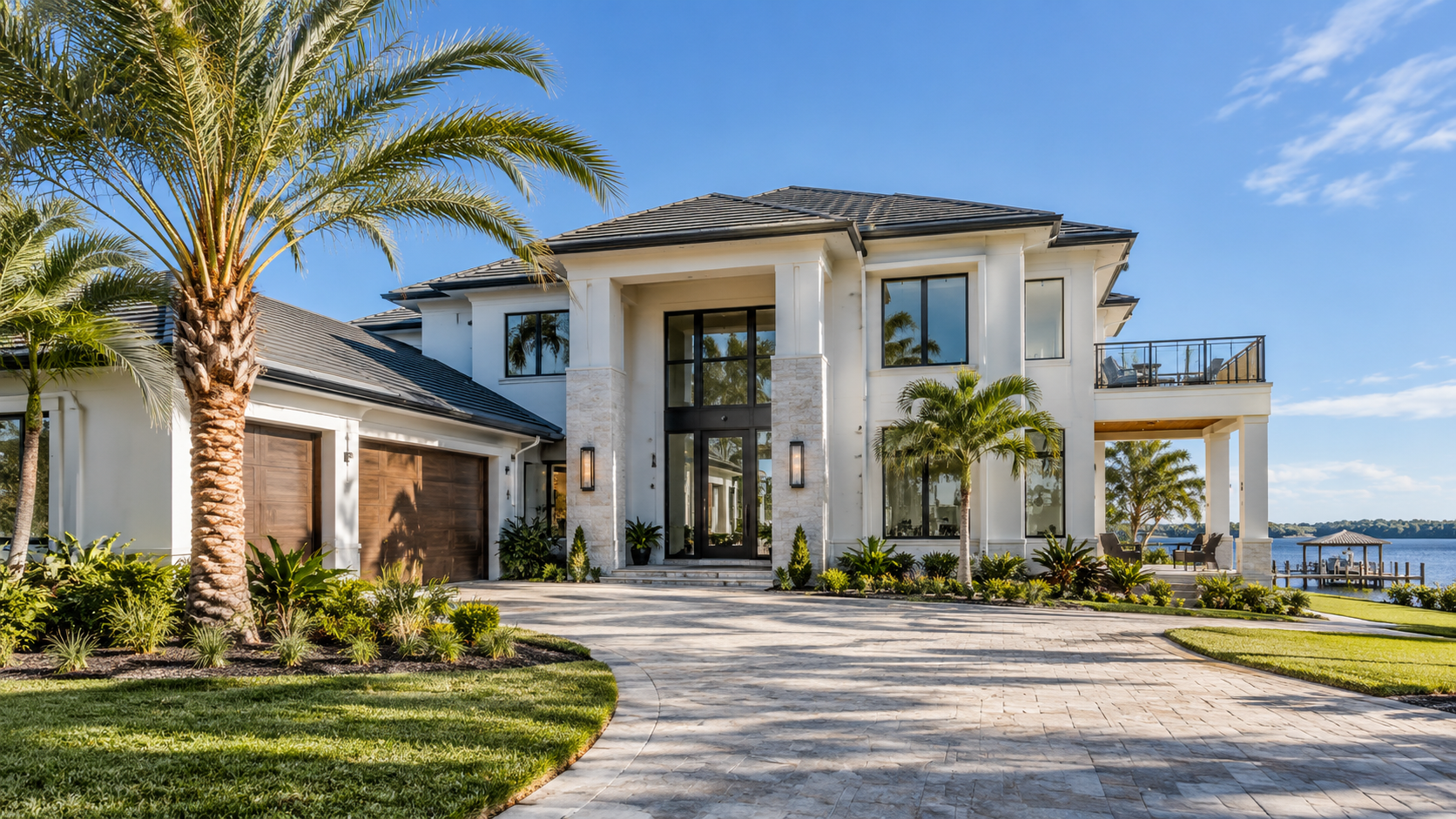
What Drives Luxury Custom Home Builders Resale Value
Appraisers value a custom home the same way they value any other home: by comparing it to recent sales of similar properties nearby, then adjusting. That single mechanic explains most of what follows. The factors that move resale, in rough order of weight:
- Location and lot. The largest single driver and the only one that cannot be changed later. A lot on deep water, on a preserve, or inside a top-rated school zone carries value the structure never will.
- Gross living area and bedroom count. Conditioned square footage and a functional bed and bath count are the primary comparison units.
- Quality grade and condition. Appraisers rate construction quality on a graded scale. Moving from average to good grade is credited; the distance from good to exceptional is credited far less generously than it costs.
- Structural resilience and insurability. In coastal Northeast Florida this is increasingly a value factor, not just a code requirement.
- Energy and mechanical performance. Lower operating cost supports a higher price at the margin, particularly for buyers financing at the top of their range.
- Finish and design specificity. The category owners spend the most on and the one that returns the least, because taste does not transfer between buyers.
The Neighborhood Ceiling Is the Constraint That Matters Most
Every submarket has a price above which buyers stop paying regardless of what a house offers, because at that point they buy in a different submarket instead. Northeast Florida has sharply different ceilings within short distances — Ponte Vedra Beach, Nocatee, Amelia Island, San Marco, Ortega, and the St. Johns County corridor each price differently, and a custom home priced above its own street competes against better-located inventory rather than against its neighbors.
The practical rule is to establish the ceiling before design, not after. Pull the highest recent sales within a tight radius of the lot, subtract a realistic land value, and what remains is roughly the improvement budget the market will support. Building meaningfully past that number is a lifestyle decision, which is entirely legitimate — but it should be made knowingly, not discovered at appraisal.
This is also why the same construction spend produces different resale outcomes on different lots. Overbuilding is not a construction-quality problem; it is a siting problem.
Which Decisions Appraise and Which Do Not
Spending on a custom build separates cleanly into three groups.
Reliably credited: conditioned square footage, additional full bathrooms, a functional and enclosed garage, a well-executed primary suite, impact-rated windows and doors, a durable roof assembly, and a covered outdoor living space. These are the categories that appear in appraisal adjustment grids and that buyers price directly.
Partially credited: high-end appliance packages, upgraded flooring, elevated trim and millwork, spa-grade bathrooms, and pools. These support the top of a price range and can shorten time on market, but they rarely return their full cost as a line item. A pool in Northeast Florida is closer to a marketability requirement at the luxury tier than a value-add.
Rarely credited: highly personalized rooms, elaborate proprietary automation systems, bespoke color and material schemes, and anything a second owner would want to remove. The more specific a feature is to one household, the more likely it reads as neutral or negative to the next buyer.
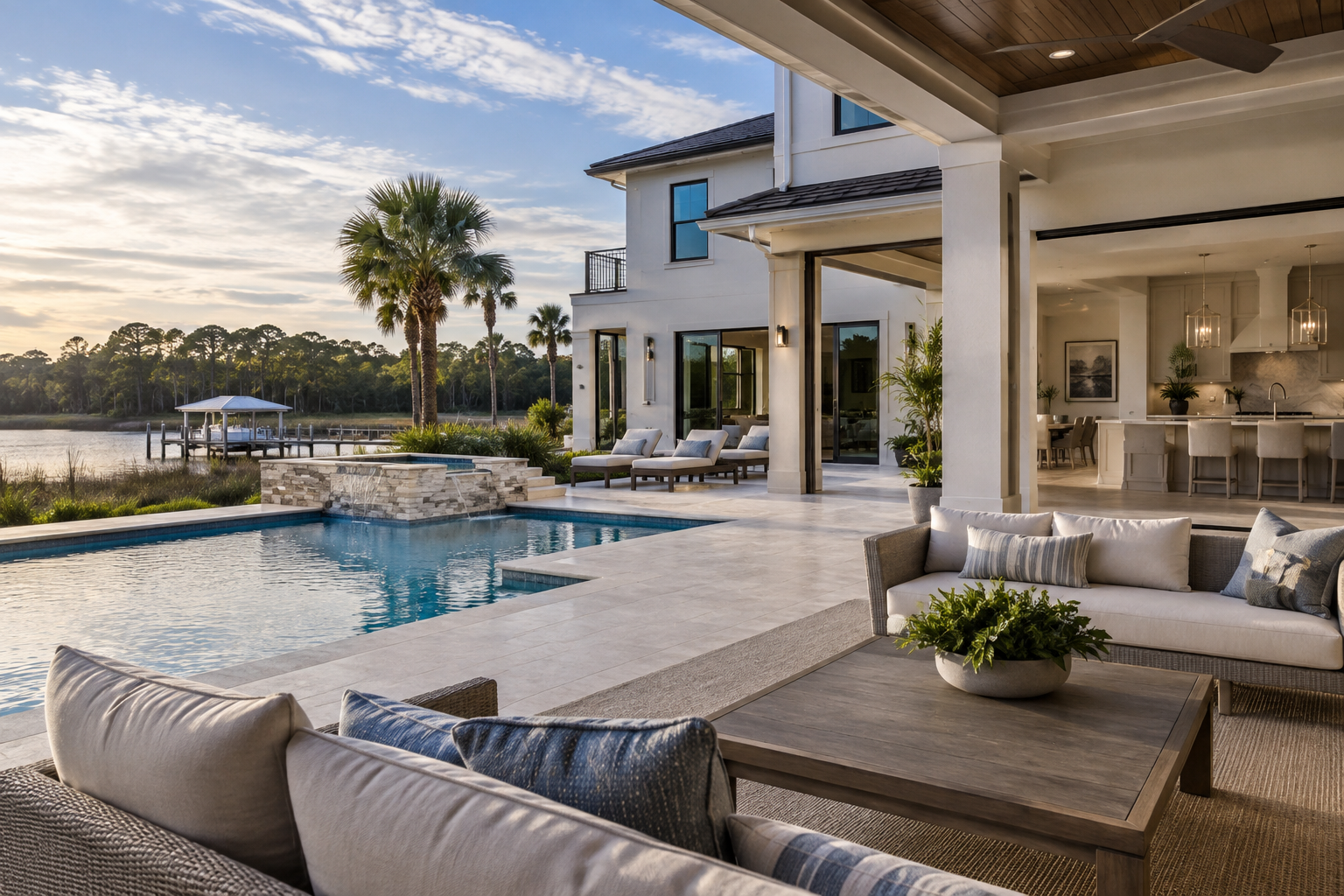
Resilience and Insurability Are Now Resale Factors
In coastal Northeast Florida, what a home costs to insure has become part of what it is worth. Wind mitigation features — a hip roof geometry, secondary water resistance, impact-rated openings, and documented roof-to-wall connections — generate insurance credits that reduce the buyer’s carrying cost every year they own it. A buyer comparing two similar homes where one carries several thousand dollars less in annual premium is comparing two different monthly payments.
The documentation matters as much as the construction. A wind mitigation inspection report, product approval records for windows and roofing, and a complete permit history are the evidence that converts good building into a lower premium. Custom homes lose this advantage regularly, not because the work was not done, but because the paperwork was never assembled and handed over at closing.
Elevation is the other resilience factor with direct financial consequence. Where a home sits relative to base flood elevation drives flood insurance cost and, on resale, buyer willingness. Building above the minimum is one of the few upgrades whose benefit compounds annually rather than depreciating.
Hold Period Changes the Answer Entirely
A custom home is a poor short-horizon asset and a reasonable long-horizon one. Sold within two or three years, a custom build usually underperforms its cost, because the owner absorbs land acquisition, construction financing, and transaction costs on both ends with little time for appreciation to work. Held seven to ten years or more, the picture changes: the land appreciates, the construction premium is amortized across a longer period, and the structure is still modern relative to the surrounding stock.
There is also a quality effect that only appears over time. A house built with a properly detailed envelope, correctly sized mechanical systems, and durable exterior materials avoids the major capital events — roof replacement, moisture remediation, early HVAC failure — that erode value in Florida’s humidity and salt air. That avoided cost is real return, and it never shows up in a cost-versus-value table.
How to Build for Resale Without Building a Generic House
The approach that protects value is straightforward: spend generously on what cannot be changed later and moderately on what can. Lot, orientation, structure, envelope, window quality, roof assembly, mechanical design, and floor plan logic are permanent. Finishes, fixtures, color, and appliances are replaceable by the next owner and should carry the personalization.
Keep the floor plan legible. Five bedrooms with an office reads to a wider buyer pool than four bedrooms with a single-purpose specialty room of the same square footage. Keep the ceiling in view throughout design, and revisit the comparable sales when the budget moves, because budgets move.
Guidance on residential valuation methodology and appraisal standards is published by The Appraisal Institute, and it is worth understanding how the adjustment process works before finalizing a program.
Ofir Engineering is a licensed Florida general contractor, License #CGC 1540016, and we build custom and luxury homes across Jacksonville, Ponte Vedra, Nocatee, and Northeast Florida — feasibility and budget alignment, design coordination, engineering, permitting, and construction. See the full scope of our luxury home builder services in Northeast Florida, review our approach to ground-up work on the new construction page, or read our related guide on the luxury custom home build schedule. The most valuable conversation an owner can have happens before design starts, when the ceiling, the lot, and the budget can still be aligned with each other.
Keep Building With Ofir Engineering
Related discussions & follow us: Facebook · Reddit
Latest & related guides: Explore more Luxury Home Builder guides →
