
Build to rent builder long term maintenance is the part of a rental community that decides whether year six looks anything like year one. In Northeast Florida the two forces that age a building fastest are humidity and salt air, and both work quietly for years before they surface as a repair invoice. A build to rent builder who hands over a genuine maintenance program — not a folder of warranty cards and a box of touch-up paint — is handing the owner the difference between a predictable operating budget and a capital surprise. Ofir Engineering is a licensed Florida general contractor (License #CGC 1540016) delivering rental and commercial projects across Jacksonville, Ponte Vedra, St. Johns County, and Northeast Florida.
Why Build to Rent Builder Long Term Maintenance Differs From For-Sale Housing
When a builder sells a house, the maintenance burden transfers to an owner who lives in it and notices things. In build to rent, the owner is rarely on site, the occupant has no incentive to report slow deterioration, and the same failure repeats across dozens of identical units. That changes the maintenance question from “what broke” to “what is quietly degrading in every building at the same rate.”
That repetition cuts both ways. A detail specified poorly appears everywhere at once. A detail specified well, and maintained on schedule, is also cheap to maintain everywhere at once because crews standardise the work. The handover document is what converts one into the other.
Salt Air: What It Actually Attacks
Airborne chloride does not need beachfront exposure to matter. It carries inland on the prevailing wind, and coastal Duval, Nassau, and St. Johns County sites sit well within the range where it shortens the service life of exposed metal. The targets, in rough order of cost when neglected:
Fasteners and connectors. Hurricane straps, screws, hangers, railing anchors, and gate hardware corrode long before the material they hold. Corrosion at a connector is a structural issue disguised as a cosmetic one, which is why it belongs in a scheduled inspection rather than a complaint queue.
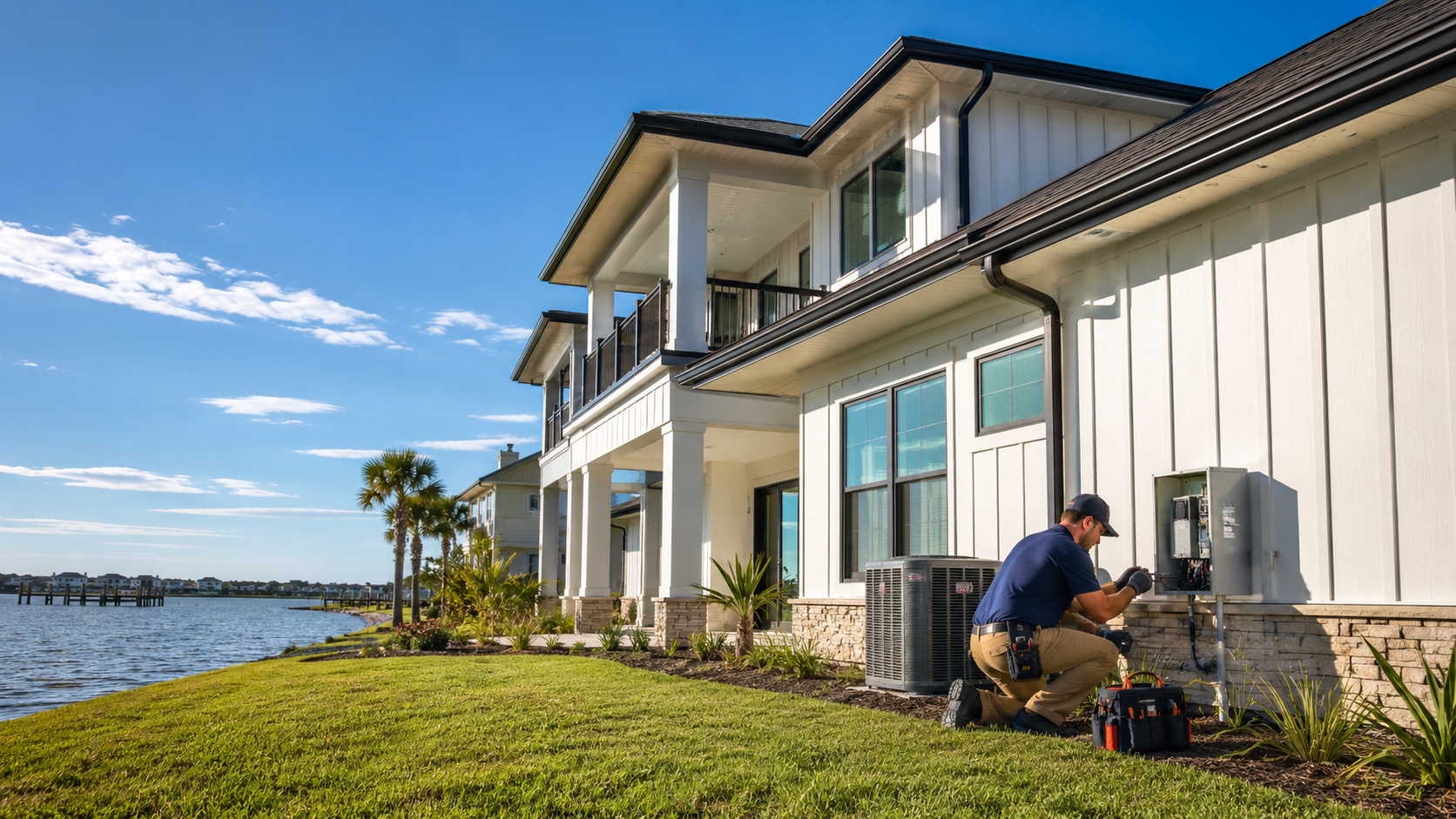
Mechanical equipment. Condenser coils and cabinets are the single most expensive salt-air casualty in a rental portfolio. Coated coils on coastal sites, plus routine rinsing of the coil with clean water, materially extends equipment life for a trivial labour cost.
Exposed metal trim and railings. Aluminium and galvanised components chalk, pit, and stain. Regular rinsing removes the chloride film before it establishes.
Light fixtures, hinges, and locksets. Small items, high unit count. Specifying corrosion-rated hardware at construction is far cheaper than replacing it across a community in year four.
Humidity: The Slower and More Expensive Problem
Salt air corrodes what you can see. Humidity damages what you cannot. Northeast Florida runs high dew points for much of the year, and a rental unit that is cooled aggressively while a door is left open, or that sits vacant with the system off, will find its dew point somewhere inside the wall assembly.
The recurring failure modes are consistent: condensate drains that clog and overflow into a ceiling; bath and laundry exhaust fans that vent into an attic instead of outside; equipment oversized for the load, which cools quickly, cycles off, and never runs long enough to dehumidify; and vacant units left unconditioned between tenancies. Every one of these is a maintenance and operating decision rather than a construction defect, which is exactly why it must be written into the handover.
What a Real Maintenance Handover Package Contains
A maintenance handover that an operator can actually run against includes an as-built record of what was installed and where the shutoffs, panels, and cleanouts are; the full equipment schedule with model numbers, capacities, filter sizes, and warranty terms; the manufacturer maintenance requirements that keep those warranties valid; a written schedule of tasks by interval; the specification for consumables so a site crew does not substitute the wrong sealant or filter; and the subcontractor and supplier contact list.
The warranty point deserves emphasis. Most manufacturer warranties on roofing, coatings, and mechanical equipment are conditional on documented maintenance. An operator who does not know that requirement exists will discover it at the moment of the claim, which is the worst possible time. Owners can confirm any contractor’s licence status directly through the Florida Department of Business and Professional Regulation before signing a construction or service agreement.
A Year One to Year Ten Maintenance Calendar
Quarterly. Change or inspect air filters. Flush condensate lines and confirm the safety switch works. Rinse condenser coils on coastal sites. Check exterior sealant at penetrations. Clear gutters and confirm downspouts still discharge away from the foundation.
Twice yearly. Rinse exposed metal, railings, and hardware to remove chloride film. Inspect the roof from the ground and at any accessible penetration. Confirm bath and laundry exhaust fans actually move air to the exterior. Test water heater relief valves and check for corrosion at connections.
Annually. Full mechanical service by a licensed technician, including refrigerant charge and coil condition. Inspect attic connectors and straps for corrosion. Inspect and re-seal exterior joints as needed. Check indoor humidity readings across a sample of units — a unit sitting persistently high is telling you something before the drywall does.
Every three to five years. Exterior wash and coating assessment. Detailed roof inspection by a roofing contractor. Re-caulk windows and doors. Review whether equipment is reaching the end of its realistic coastal service life, which is often shorter than the inland rating.
Every seven to ten years. Plan for exterior repainting, staged mechanical replacement, and water heater replacement. In build to rent, these should be funded reserves on a schedule rather than emergencies, and the builder’s handover is what makes that schedule credible.
The Builder’s Role Does Not End at the Certificate of Occupancy
The specification decisions that determine maintenance cost are made during construction, not after it. Corrosion-rated fasteners and hardware, coated coils on coastal sites, equipment sized by an honest load calculation rather than a rule of thumb, exhaust fans ducted properly to the exterior, and accessible cleanouts and shutoffs cost very little at the time and save repeatedly across a rental holding period. A build to rent builder who is thinking about year ten specifies differently from one thinking about the closing date.
You can see how we approach multi-unit and rental work on our commercial construction page, review the ground-up process under new construction, or contact Ofir Engineering to discuss a maintenance handover for a project already in design.
Frequently Asked Questions
How far inland does salt air actually cause damage in Northeast Florida?
Further than most owners expect. Chloride carries on the prevailing wind, so coastal Duval, Nassau, and St. Johns County sites well back from the water still see accelerated corrosion on fasteners, mechanical equipment, and exposed hardware. Treat proximity as a spectrum rather than a line, and specify corrosion-rated components accordingly.
What is the single highest-value maintenance task on a Florida rental?
Keeping condensate drains clear and the mechanical system serviced. Clogged condensate lines cause interior water damage that is expensive, disruptive to occupancy, and almost entirely preventable with a quarterly flush that takes minutes per unit.
Should vacant units be left with the air conditioning off?
No. An unconditioned unit in a Florida summer accumulates humidity that damages finishes and encourages microbial growth. Set the system to hold a reasonable temperature and humidity level between tenancies rather than switching it off entirely.
Does skipping maintenance really void manufacturer warranties?
It frequently does. Roofing, coating, and mechanical warranties commonly require documented maintenance at stated intervals. Without records, a manufacturer can decline a claim, which is why the handover package should include both the requirement and a log format for recording compliance.
Keep Building With Ofir Engineering
Related discussions & follow us: Facebook · Reddit
Latest & related guides: Explore more Commercial Construction guides →
