If you're trying to decide whether to build or buy a house in Jacksonville or Northeast Florida, you're probably already seeing the same problem most buyers and investors run into. The sticker price only tells part of the story. The true decision sits in the details: land, permitting, insurance pressure, renovation exposure, hurricane resilience, timeline risk, and whether the property supports your long-term plan.
Ofir Engineering — a licensed Florida general contractor (CGC 1540016) based in Jacksonville — pairs real construction experience with investor-focused project management.In this market, I don't advise clients to treat this as a simple custom-home-versus-resale question. A family moving to Saint Johns has a different risk profile than an investor evaluating a Jacksonville fix-and-flip. An older house in a strong location may look cheaper on day one, but hidden repairs, code upgrades, and storm-related vulnerabilities can change that fast. A new build may cost more upfront, but it can also reduce maintenance surprises and give you more control over layout, systems, and performance.
Table of Contents
- The Build or Buy Dilemma in Northeast Florida
- A Side-by-Side Comparison Build vs Buy
- Financial Deep Dive Cost to Build vs Buy in Jacksonville
- The Timeline From Decision to Move-In Day
- How Florida Weather and Codes Impact Your Decision
- The Real Estate Investor's ROI Calculation
- Ready to Make Your Move? A Final Checklist and Your Next Step
- Frequently Asked Questions
- Is it cheaper to build or buy a house in Jacksonville?
- Is buying an older home riskier in Florida?
- Does building a house take much longer than buying?
- Is building better for long-term ownership?
- What usually works better for investors in Jacksonville?
- Should I buy and renovate instead of building from scratch?
- What should I prepare before deciding?
The Build or Buy Dilemma in Northeast Florida
Jacksonville buyers don't just choose between two houses. They choose between two risk models.
One path is buying an existing home in an established neighborhood. That usually means faster occupancy, a more familiar financing process, and clearer comparable sales. The other path is building, which gives you more control over layout, materials, and resilience, but adds more moving parts before you ever get the keys.
In Northeast Florida, that choice gets sharper because local conditions matter. Lot availability changes from one submarket to another. Soil conditions can affect site work. Insurance concerns push buyers to look harder at roof age, openings, drainage, and flood exposure. Investors also have to account for holding time, renovation uncertainty, and resale positioning.
Why the answer is rarely just about price
A house can be affordable to purchase and still expensive to own. I see that most often when buyers focus on list price and underwrite everything else too lightly. An older house may need electrical work, moisture remediation, window replacement, roof upgrades, or layout changes before it performs the way the buyer expects.
A new build shifts the uncertainty. Instead of hidden conditions inside an old structure, you manage design decisions, permitting, contractor coordination, and site development.
Practical rule: In Jacksonville, the right answer usually comes from matching the property to your timeline, risk tolerance, and ownership strategy, not from chasing the lowest entry number.
For homeowners, that means asking whether speed or control matters more. For investors, it means deciding whether the better play is buying imperfect product and improving it, or building a cleaner asset with fewer legacy issues.
A Side-by-Side Comparison Build vs Buy
A quick comparison helps sort the decision before you get buried in details. Most clients can eliminate one path early by looking at five factors: total cost, time, customization, location, and long-term maintenance.
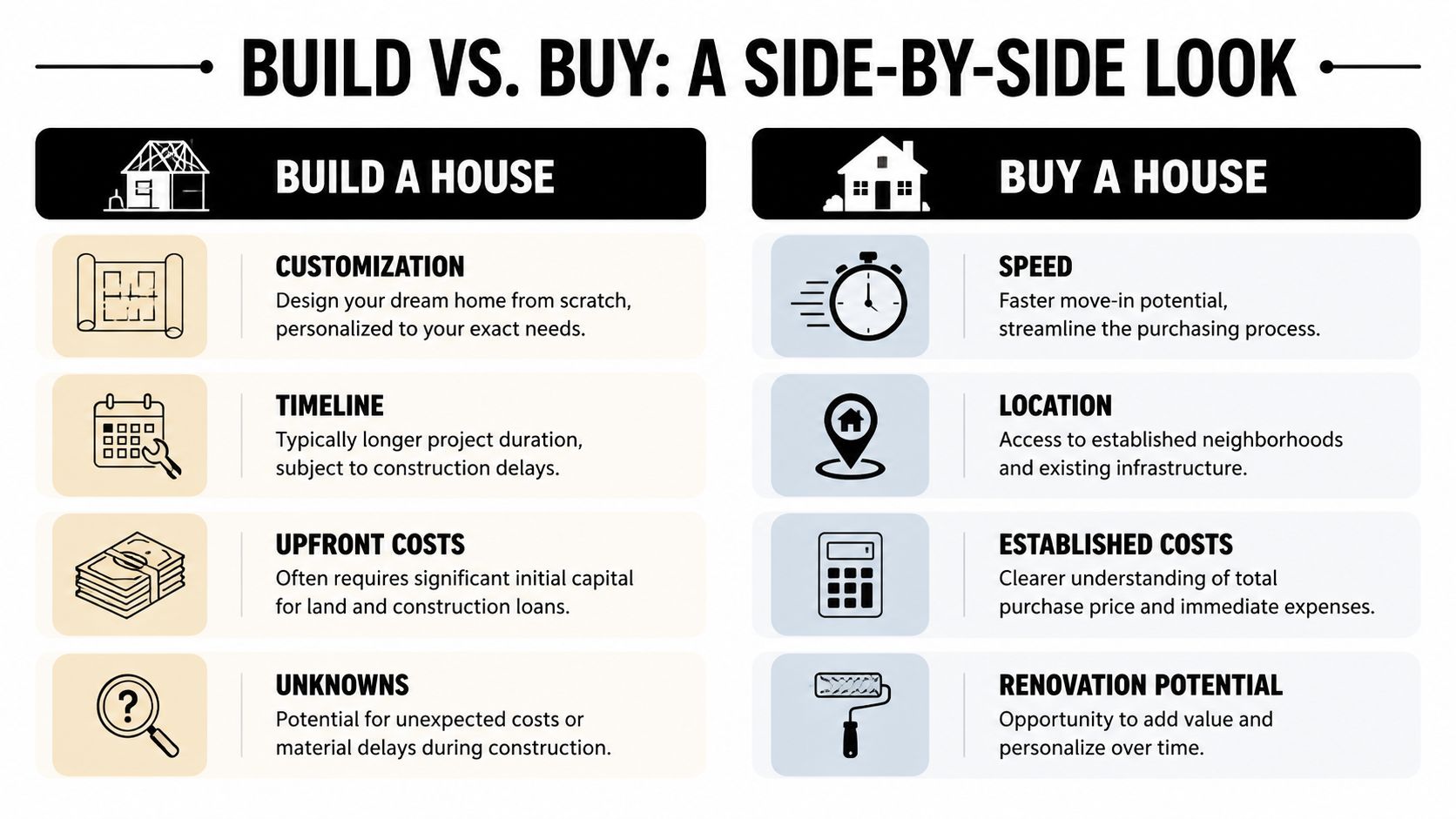
Build vs. Buy at a Glance
| Factor | Building a New House | Buying an Existing House |
|---|---|---|
| Total Cost | More variables. Land, site prep, permits, utilities, and finish selections can change the final number. | Usually easier to underwrite upfront. Purchase price is known earlier, but repairs and upgrades can appear after inspection. |
| Time to Move-In | Slower. Design, approvals, and construction all add time. | Faster. Once you find the right property, the path to closing is more standardized. |
| Customization Level | Highest control over floor plan, structure, finishes, and systems. | Limited at purchase. Personalization often happens through renovation after closing. |
| Location Availability | Depends on buildable lots, zoning, and site constraints. | Better access to established neighborhoods, schools, and mature infrastructure. |
| Long-Term Maintenance | New systems and code-compliant assemblies can reduce early maintenance pressure. | Older homes may bring deferred maintenance, aging roofs, moisture issues, or outdated layouts. |
What usually pushes the decision one way or the other
For a homeowner, building often makes sense when the family has a specific location target and can't find the right floor plan or condition level in the resale market. For an investor, buying often makes sense when there's enough spread between acquisition cost and post-renovation value to justify the rehab risk.
A separate factor is execution. Custom Home Building Jacksonville covers construction planning, contractor management, scheduling, and residential build delivery in Jacksonville. That kind of support matters because building isn't only a design choice. It's a management problem from day one.
Buy if you value speed, established neighborhoods, and a clearer upfront transaction. Build if control, resilience, and long-term fit matter more than immediate occupancy.
In Northeast Florida, I'd also weigh neighborhood character carefully. Some buyers want mature tree cover and infill locations. Others want a house designed around current code, current lifestyle, and current maintenance expectations. Neither is automatically better. The better option is the one that leaves fewer expensive surprises after closing or completion.
Financial Deep Dive Cost to Build vs Buy in Jacksonville
A Jacksonville buyer can sign for a resale home at one price, then spend the first 12 months replacing a roof, updating electrical panels for insurance, and correcting drainage that never showed up in the listing photos. A new build can go the other direction. The base contract looks manageable until lot prep, utility connections, fill dirt, and wind-load upgrades push the total well past the early estimate.
That is why the key comparison in Northeast Florida is total cost of ownership, not sticker price.
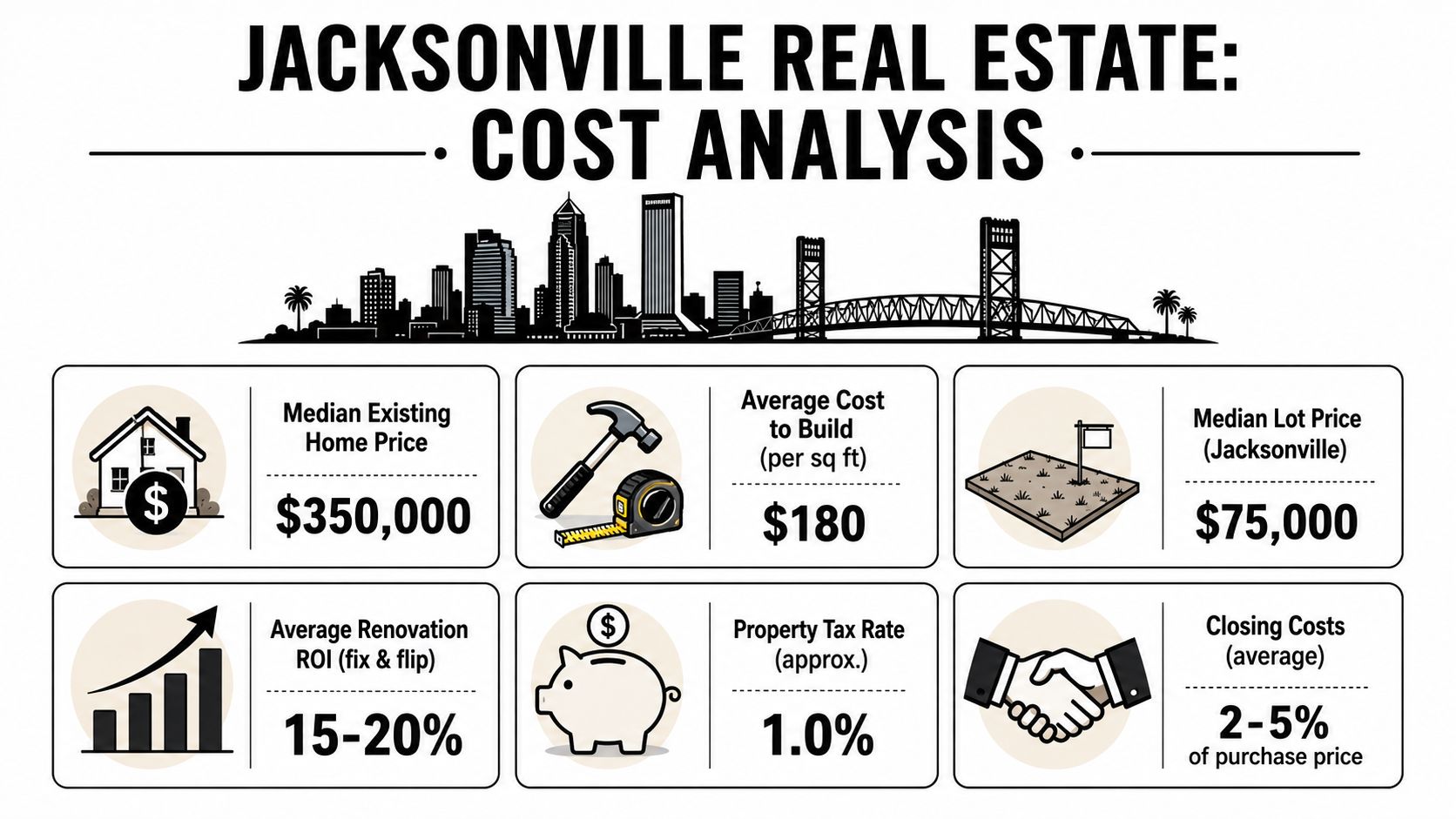
Why the first number is rarely the real number
National averages do not help much once you are buying or building in Jacksonville. Here, the expensive mistakes usually come from local conditions. Insurance carriers care about roof age, opening protection, flood exposure, and prior claims. Builders have to price for current wind requirements, site drainage, and soil behavior. Investors also have to price carrying costs correctly, because a deal that works on paper can lose its spread fast once rehab, vacancy, or permit delays show up.
For an existing home, the actual budget usually includes the contract price, inspections, lender and closing costs, insurance binders, and the first round of repairs needed to make the property financeable, insurable, and functional.
For new construction, the true budget starts with land and keeps going. Survey, geotechnical review when needed, clearing, fill, impact fees, utility access, stormwater handling, driveway, permitting, and finish selections all matter. In parts of Northeast Florida, one lot drains cleanly and builds cleanly. The lot next door may need imported fill, grading adjustments, or a different foundation approach.
Before a build starts, owners and investors should also review project risk exposure during construction. Resources on insurance for Florida contractors help clarify how builders risk coverage fits into the numbers.
Jacksonville cost pressure points that change the decision
In this market, three categories swing the build-versus-buy math more than buyers expect.
First is insurance. An older home with an aging roof, older plumbing, or outdated electrical service may be cheaper to acquire and harder to insure at a reasonable premium. A new home often carries a higher initial cost but can perform better with insurers because the roof, openings, and systems meet current code.
Second is site risk. New construction budgets in Northeast Florida often move because of drainage, fill requirements, tree removal, utility runs, and foundation design. Those are not cosmetic upgrades. They are cost items tied directly to whether the house performs well in heavy rain and storm conditions.
Third is deferred maintenance. On resale properties, investors and homeowners often underestimate what it takes to get to stable occupancy. Moisture intrusion, HVAC replacement, cast iron plumbing, window failures, or old soffit and fascia work can change the first-year ownership cost in a hurry.
A disciplined estimating process reduces surprises. Ofir Engineering's guide to smart cost control in construction is useful because it focuses on scope definition, budget tracking, and controlling change during active projects.
A quick walkthrough can help frame the discussion visually:
How I would underwrite each option
I advise clients to run both choices like investment models, even if the property is a primary residence.
- For buying: underwrite purchase price, inspection findings, immediate capex, insurance-driven repairs, and a reserve for work that appears in the first year.
- For building: underwrite land, design and engineering, permits, site work, utility connections, stormwater and drainage needs, financing carry, and finish selections at the level you intend to install.
- For either path: test the numbers against resale value, insurance cost, maintenance exposure, and how long you expect to hold the property.
That last point matters. If the plan is a short hold, buying below market and renovating efficiently may produce the better return. If the plan is a long hold in a high-wind, high-moisture region, a code-current house with lower maintenance and fewer insurance problems can justify a higher upfront cost.
In Jacksonville, the better financial decision is usually the one with fewer expensive surprises over the next five to ten years, not the one with the lowest entry price.
The Timeline From Decision to Move-In Day
A Jacksonville buyer can be under contract this month and moved in before the next school term. A custom build on a raw or lightly improved lot may still be in permitting while that buyer is unpacking boxes. That timing gap has a real cost.
Schedule affects more than convenience. It affects interest carry, rent overlap, rate-lock risk, storage, temporary housing, and, for investors, how long capital sits idle before the property starts producing income. In Northeast Florida, weather delays, utility coordination, and municipal review times can widen that gap fast.
Buying timeline
Buying usually gives you the shorter path to occupancy. The process is straightforward on paper. Search, offer, inspection, financing, title, closing. In practice, the schedule moves or stalls based on inspection findings, insurance questions, appraisal issues, and seller concessions.
The inspection period is where many resale deals either stay efficient or get expensive. Roof age, HVAC condition, moisture intrusion, prior unpermitted work, and drainage problems can all change the closing timeline and the first-year cash requirement. A practical checklist on Michigan's Choice property inspection advice is useful because it outlines what buyers and sellers should expect during a residential inspection and how that stage shapes repair negotiations.
In this market, that matters. A house can close quickly and still become a slow project after closing if inspection issues were underestimated.
Building timeline
Building takes longer because each phase depends on the one before it. Lot selection and feasibility come first. Then design, engineering, pricing, financing approval, permitting, site work, foundation, framing, rough-ins, inspections, finishes, punch work, and final turnover.
On Jacksonville-area projects, the early phases often decide whether the schedule stays realistic. Soil conditions, flood considerations, drainage design, utility availability, and jurisdiction-specific permit review can add weeks or months before vertical construction even starts. Clients who want a clearer view of that sequence should review a home construction timeline for residential projects.
Field coordination also matters once construction begins. Construction Project Management covers contractor coordination, budgeting, scheduling, renovation oversight, and construction supervision in Jacksonville. That structure helps keep trades, inspections, and material deliveries aligned when the job has multiple handoffs.
The faster option is usually buying. The option with more control over condition, layout, and long-term maintenance exposure is often building.
If your move-in date is fixed, buying usually carries less schedule risk. If you can absorb a longer runway and want to reduce surprise repairs, deferred maintenance, and insurance-related upgrades over the next several years, building can justify the extra time.
How Florida Weather and Codes Impact Your Decision
In Northeast Florida, the build-or-buy decision should be filtered through one question first. Which property gives you the lower long-term exposure to weather, repairs, and disruption?
That's a more useful lens than asking which option looks cheaper on day one. For climate-exposed markets like Florida, the better decision often comes down to resilience and total ownership risk rather than purchase price alone, as discussed in the Center for American Progress housing analysis.
Older homes can carry hidden resilience costs
A resale home in Jacksonville can offer great location value. It may also come with older assemblies and systems that weren't built around today's expectations for wind resistance, moisture control, or energy performance. That doesn't mean older homes are bad assets. It means buyers need to inspect them with discipline.
Common pressure points in this region include:
- Roof condition: Older roof systems can affect durability, insurability, and near-term capital needs.
- Openings and envelope: Windows, doors, flashing, and exterior transitions matter more in wind-driven rain conditions than many buyers assume.
- Drainage and moisture: Flat lots, poor grading, and long-term humidity exposure can show up later as rot, mold, or repeated repairs.
- Mechanical performance: Older systems may work, but they may not deliver the comfort, efficiency, or reliability owners expect in Florida heat.
If you buy an older house mainly because it looks like the cheaper option, those items can erase the savings.
New construction gives you more control over risk
Building new gives you the chance to align structure, materials, and layout with current code and current use. That's valuable in hurricane-prone regions because resilience isn't one feature. It's a chain of decisions across framing, roof systems, openings, drainage, and detailing.
The same principle applies to energy performance. In Florida, comfort and operating stability depend on air sealing, insulation strategy, HVAC sizing, moisture management, and envelope detailing. A new build lets you coordinate those systems from the start instead of trying to retrofit them later.
For owners who want to understand the compliance side better, energy code compliance in Florida construction is a helpful reference because it explains how code-driven decisions affect performance and project planning.
In Jacksonville, resilience is not a luxury upgrade. It's part of the asset's financial profile.
That matters for owner-occupants who want fewer disruptive repairs, and for investors who need predictable operating costs and fewer ugly surprises between acquisition and exit.
The Real Estate Investor's ROI Calculation
Investors should strip emotion out of the build-or-buy debate and start with return mechanics. The question isn't which path sounds more impressive. The question is which path produces a cleaner result after financing, construction risk, holding time, and exit strategy are accounted for.
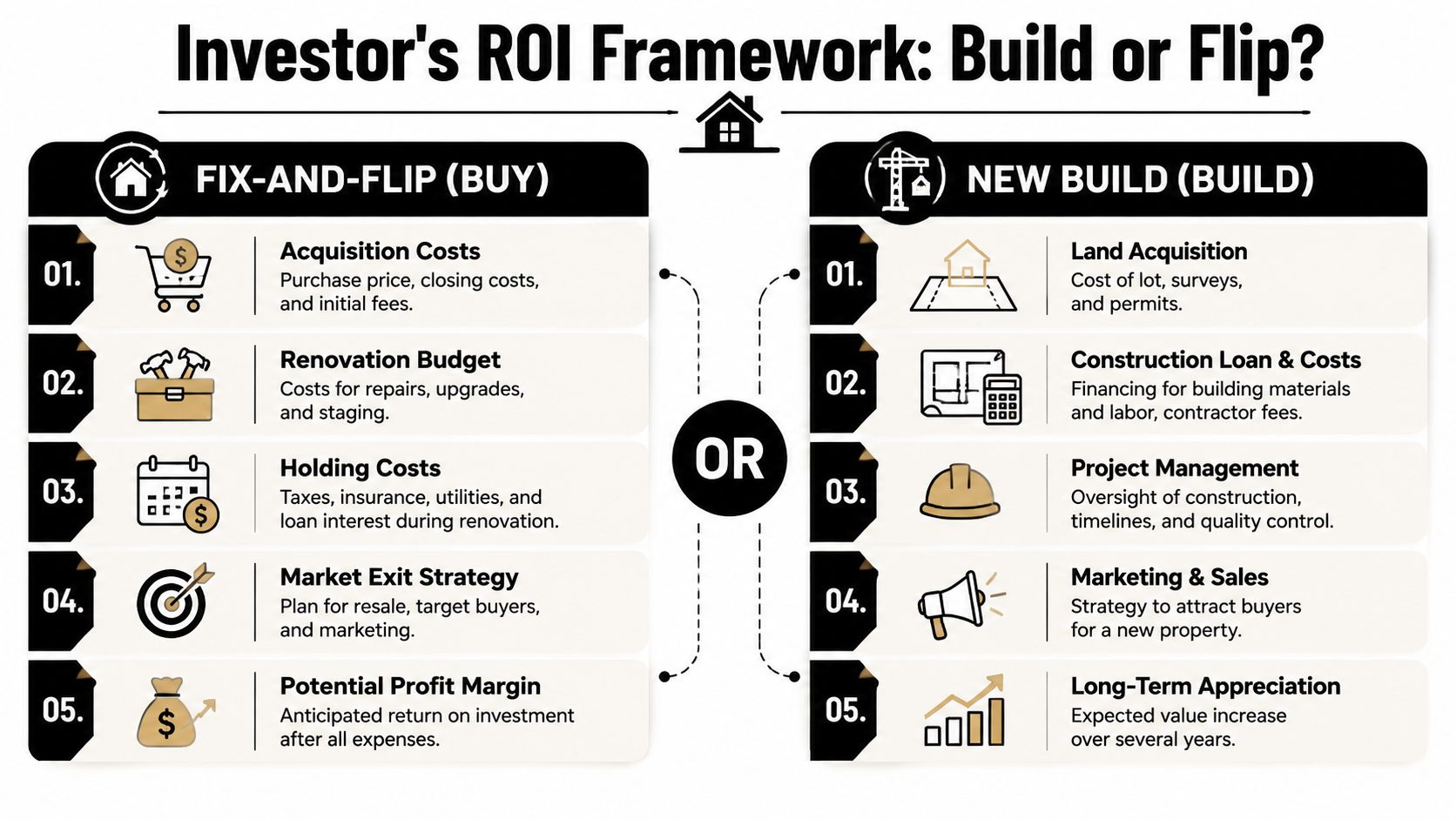
When buying wins for investors
Buying an existing property often wins when the investor can solve clear problems quickly. That might mean layout correction, finish modernization, deferred maintenance, or targeted improvements that reposition the home for resale or rental.
This path tends to work better when:
- The acquisition is right: You're buying enough imperfection to create upside.
- The scope is controlled: The rehab is meaningful but not structurally chaotic.
- The exit is obvious: The finished product fits actual neighborhood demand.
For a fix-and-flip, speed and scope discipline matter more than ambition. For a rental, maintenance predictability matters just as much as cosmetic appeal.
When building makes more sense
Ground-up construction can make sense when existing inventory doesn't fit the target product or when the investor wants a cleaner asset with less legacy risk. It can also fit a build-to-rent strategy where standardization, lower early maintenance exposure, and modern layouts matter more than immediate speed.
The biggest issue is usually financing. HUD-focused guidance notes that a major underserved angle in this discussion is affordable financing for custom construction, because the feasibility of building often depends less on sticker price than on loan structure, local fees, and the overall lending environment, as reflected in HUD's homebuying guidance.
That point matters in Jacksonville. A project can look rational on paper and still fail if financing terms, lot costs, and local approvals don't leave enough room for risk.
Investors make better decisions when they underwrite build versus buy as two different business models, not two versions of the same purchase.
If you're flipping, ask how quickly the property can be stabilized and sold. If you're building, ask whether the completed asset will command enough value or rental strength to justify the longer path and more complex capital stack.
Ready to Make Your Move? A Final Checklist and Your Next Step
The best build-or-buy decision usually becomes obvious when you pressure test the assumptions.
Use this short checklist before you commit:
- Timeline pressure: Do you need to move quickly, or can you tolerate a longer path to get the right product?
- Control versus convenience: Is customization worth more to you than a standard closing process?
- Condition tolerance: Are you comfortable inheriting an older structure and managing repairs?
- Risk profile: Would you rather manage permitting and construction, or inspection findings and renovation surprises?
- Location goals: Is your preferred neighborhood mostly resale inventory, or are buildable lots still realistic?
- Ownership horizon: Are you planning to hold long enough for resilience, layout, and lower maintenance exposure to matter more?
- Investor math: Does the project still work after holding costs, insurance pressure, and scope creep are stress-tested?
For many Jacksonville and Saint Johns clients, the right answer isn't pure build or pure buy. It's buying a house with a renovation plan, or building only after confirming that lot conditions, financing, and intended use all line up.
A clear decision starts with a realistic scope, a realistic budget, and a realistic timeline. If any of those three are fuzzy, the project is not ready yet.
Frequently Asked Questions
Is it cheaper to build or buy a house in Jacksonville?
It depends on what you mean by cheaper. Buying is often cheaper upfront, especially when you compare purchase price alone. Building can look competitive in some markets at the purchase-price level, but total project cost still depends on land, site work, permits, utilities, and finish level. In Northeast Florida, I'd compare total cost of ownership, not just acquisition cost.
Is buying an older home riskier in Florida?
It can be, especially if the house has deferred maintenance or outdated components that affect storm resilience, moisture control, or insurability. Risk doesn't come from age by itself. It comes from condition, previous repairs, and how well the property fits Florida weather realities.
Does building a house take much longer than buying?
Yes, in most cases. Buying follows a more standardized path. Building adds design, approvals, financing coordination, site preparation, and the full construction process before move-in.
Is building better for long-term ownership?
Often, yes, if you value layout control, lower early maintenance pressure, and the ability to align the house with current code and performance expectations. That advantage matters more when you plan to hold the property for years.
What usually works better for investors in Jacksonville?
It depends on the strategy. A fix-and-flip can work well when the purchase is strong and the rehab scope is controlled. A new build can work when the investor wants a cleaner asset, a more standardized product, or a long-term hold with fewer inherited issues.
Should I buy and renovate instead of building from scratch?
That's often a smart middle path. If the location is strong and the structure is sound, buying and renovating can reduce timeline risk while still letting you improve function, condition, and value. In established Northeast Florida neighborhoods, that approach is often more practical than waiting for the perfect vacant lot.
What should I prepare before deciding?
Have your financing, target areas, occupancy timeline, and risk tolerance defined before you shop seriously. If you're moving households, relocation planning matters too. Even though it's written for a different market, Emmanuel Transport's moving guide is a useful example of the kind of checklist people often forget during a transition from one property to another.
If you're weighing whether to build or buy a house in Jacksonville, Saint Johns, or Northeast Florida, Ofir Engineering can help you evaluate the decision from a construction, budgeting, and project management perspective. The firm handles investor-focused renovations, remodeling, new construction, and project oversight, so you can assess the trade-offs before committing to a lot, a purchase contract, or a renovation scope.
