
A home additions near me draw schedule only exists if you are financing the project with a loan that funds in stages, and that distinction decides how your addition is paid for. Cash and home equity lines put the money in your control up front. Renovation and construction loans do not — they release funds in milestones after the work is verified in place, with inspections and lien waivers attached to each release. Choosing between those two structures before you sign a contract is what determines whether payments follow your schedule or your lender’s. Ofir Engineering is a licensed Florida general contractor (License #CGC 1540016) with 15+ years serving Jacksonville, Ponte Vedra, St. Johns, and Northeast Florida.

Which Financing Uses a Home Additions Near Me Draw Schedule
Four financing routes are common for an addition in Northeast Florida, and only two of them involve draws.
Cash or a home equity line of credit. A HELOC is a revolving line secured by your equity. You draw on it whenever you choose, so the “draw schedule” is entirely your own — typically tied to the payment schedule in your construction contract rather than to a lender’s inspection. This is the simplest structure and the fastest to close, and it is why many mid-sized additions use it.
A cash-out refinance. Funds arrive as a lump sum at closing. There is no draw process at all, though you are refinancing your entire mortgage to get there, which may or may not make sense depending on your existing rate.
A renovation loan. These lend against the home’s value after improvement rather than its current value, which is what makes them useful when equity is thin. They do use draws, and they add lender-side requirements: the contractor is approved by the lender, the scope of work and budget are submitted and fixed, and funds are released in stages as work is completed and inspected.
A construction loan. Used for large or second-storey additions that function like new construction. These fund in arrears through a formal draw schedule tied to construction milestones, and convert or are refinanced at completion.
The Draw Stages on a Financed Addition
Where draws apply, the milestone sequence follows construction rather than the calendar. An initial release usually covers permits, engineering, and plans already paid for. The next follows site work and foundation, confirmed against the footing and slab inspections.
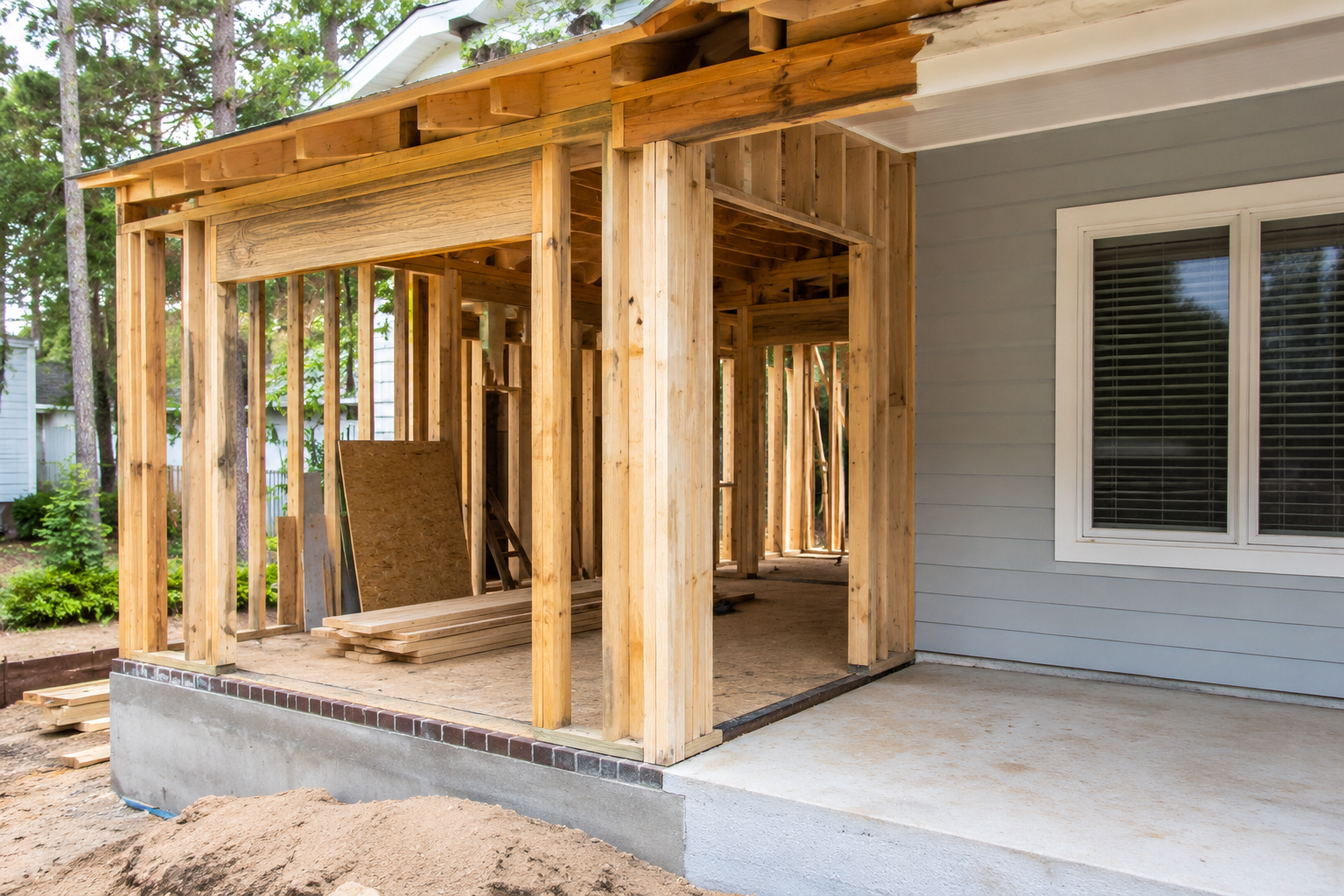
Framing and roof structure is generally the largest release, followed by dry-in when the addition is weather-tight — a milestone that matters especially in Florida, and one that should be reached before the existing exterior wall is opened for the tie-in. Rough mechanical, electrical, and plumbing releases after those systems pass rough inspection, then insulation and drywall, then interior finishes.
The final release is held until the final inspections pass and the punch list is closed. That retention, commonly around ten percent, is the lender’s leverage to ensure the addition is genuinely finished rather than merely usable — and it is worth understanding before you agree to a payment schedule with your contractor, because it affects when the builder receives the last payment.
What Has to Be True Before a Draw Funds
Three conditions dominate. The work has to be complete and installed — materials sitting on site generally do not count unless the loan has a specific stored-materials provision. An inspection has to confirm it, usually by an independent inspector whose report, not the contractor’s invoice, is what the lender funds against.
And lien waivers have to be current. Under Florida’s construction lien law, anyone who supplied labour or materials to your property can record a claim against it, so lenders require conditional or unconditional waivers from the general contractor and every subcontractor and supplier tied to that stage. This is the most common cause of a delayed release, and it is administrative rather than physical — the work is done, the paperwork is not.
Lenders also check that the undrawn balance still covers the remaining scope. If a change order or an overrun puts the project short, they may require you to deposit the difference before releasing further funds, which is why unapproved changes are a financing problem and not only a budget one.
What Delays a Draw on an Addition Specifically
Additions have one failure mode that new construction does not: discovery at the tie-in. When the existing exterior wall is opened and the two structures are joined, conditions in the original house become visible for the first time — undersized headers, wiring or plumbing routed through the wall, or framing that does not align with the new structure.
Each of those becomes a change order. On a cash or HELOC-funded project you approve it and continue. On a lender-funded project the change has to be documented and, depending on the loan, approved before the affected draw will release. Sequencing matters here too: reaching a weather-tight addition before opening the wall keeps rain out of the occupied house and keeps the dry-in milestone clean.
The other recurring delays are ordinary — inspection scheduling, partially complete milestones that fund partially or not at all, and title or notice of commencement issues that hold funding regardless of how finished the work is. General guidance on home improvement lending and closing documents is published by the Consumer Financial Protection Bureau.
Aligning the Draw Schedule With the Contract
The mistake to avoid is a contract payment schedule that does not match the loan’s draw schedule. If the contract calls for a payment at a point the lender does not recognise as a milestone, the contractor is funding that gap out of pocket, and that is a conversation better had before signing than during framing.
Ask the lender four questions up front: how many draws are allowed, whether there is a fee per draw, how long funding takes after a complete request, and how much is retained until final inspection. Then have the construction contract’s milestones written to match. See the full scope of work on our home additions page, compare against whole-house scope under home remodeling, or contact Ofir Engineering to align a milestone schedule with your financing before work begins.
Frequently Asked Questions
Does every home addition loan use a draw schedule?
No. Cash, a home equity line of credit, and a cash-out refinance put funds in your control without lender draws. Renovation loans and construction loans release funds in stages after the work is verified in place.
What is the most common reason an addition draw is delayed?
Missing lien waivers. Florida’s construction lien law means lenders require waivers from the general contractor and every subcontractor and supplier tied to that stage, and one outstanding signature holds the whole release even when the work is finished.
How does the tie-in affect financing?
Opening the existing exterior wall is where hidden conditions in the original house appear, and each one becomes a change order. On a lender-funded project those changes must be documented and often approved before the affected draw releases, so discovery costs schedule as well as money.
Should my contract payment schedule match the lender’s draws?
Yes. If the contract calls for payment at a point the lender does not treat as a fundable milestone, the contractor carries that gap. Align the milestones in writing before signing rather than resolving it mid-construction.
Keep Building With Ofir Engineering
Related discussions & follow us: Facebook · Reddit
Latest & related guides: Explore more Home Additions guides →
