
Metal frame homes warranty coverage in Florida comes from three separate sources that most owners assume are one: the builder’s written workmanship warranty, the manufacturers’ warranties on the steel and its coatings, and the warranties Florida law implies into the sale of a new home whether or not anyone wrote them down. They have different durations, different claim processes and different limits, and knowing which one applies is what determines whether a defect gets fixed. This is general information rather than legal advice — a Florida construction attorney should review your specific documents. Ofir Engineering is a licensed Florida general contractor (License #CGC 1540016) with 15+ years serving Jacksonville, Ponte Vedra, St. Johns, and Northeast Florida. Planning to build? See our new home building in Jacksonville.
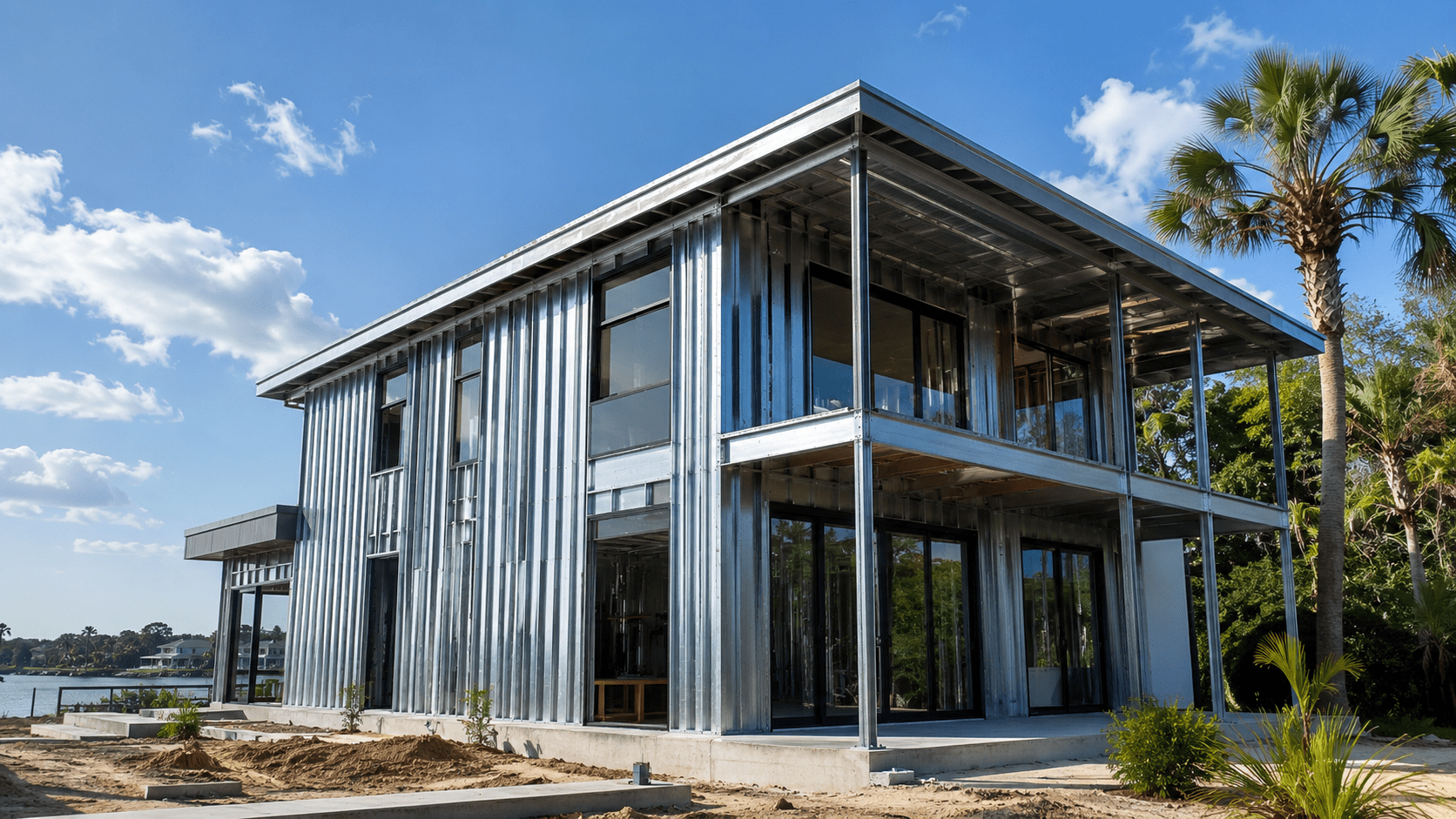
The Three Layers of Metal Frame Homes Warranty Coverage
The builder’s express warranty. This is the written workmanship warranty in your contract, typically covering defects in materials and workmanship for a defined period after completion. It is the warranty you will use most, and it is entirely a product of negotiation — its length, what it excludes and how a claim is made are all set by the document you sign.
Manufacturer warranties. Steel framing members, galvanised or coated finishes, fasteners, roofing, windows and mechanical equipment each carry their own manufacturer warranty, often far longer than the builder’s. These should be passed through to you at closeout as a documented package, with model numbers and installation dates, because a manufacturer claim years later is difficult without them.
Warranties implied by Florida law. Florida courts have long recognised implied warranties in the sale of a new residence by a builder-vendor — broadly, that the home is constructed in a workmanlike manner and is fit for habitation. These attach without being written and cannot simply be assumed away, though the law around waiver and disclaimer is technical. They matter most when the express warranty has expired or excludes the problem you have found.
How Long the Clock Actually Runs
Two separate limits apply to construction defect claims in Florida, and owners frequently confuse them.
The first is the statute of limitations — the window in which you must bring a claim, counted from the point the law treats the improvement as complete or, for a hidden defect, from when it was or should have been discovered. The second is the statute of repose, an outer deadline that runs from completion regardless of when a defect appears. A defect discovered after the repose period has run may have no remedy at all, no matter how serious.
Florida has revised these periods in recent years, shortening them and changing how the start date is calculated. That is the single most important practical point for a homeowner: the deadlines are shorter than they used to be, and they are strict. Do not sit on a suspected structural or water-intrusion problem while you decide what to do. Current statutory text is published through the Florida Legislature’s online statutes, and the applicable dates should be confirmed with counsel for your specific completion date.

What Is Specific to a Steel-Framed House
Steel framing changes which defects are plausible, and therefore which warranty terms deserve attention.
Corrosion and coating. Light-gauge framing is galvanised, and the coating is what protects it. Coating warranties are typically conditional on the environment and the detailing — coastal salt exposure, contact with dissimilar metals, unsealed cut edges and prolonged wetting are common exclusions. Ask specifically whether the coating warranty applies at your distance from the coast, and require that cut ends and field-modified members are treated. Our guide on whether steel frame homes rust in Florida humidity covers the detailing that keeps this from becoming a claim.
Connections and the load path. Steel performs through engineered connections rather than mass, so the warranty conversation is about fasteners, clips and hold-downs installed to the engineer’s drawings. Ask that inspection records and the engineer’s structural observation reports are included in your closeout package — they are your evidence if a connection issue emerges later.
Thermal movement and finish cracking. Steel expands and contracts, and drywall cracking at joints is frequently excluded as cosmetic. Read that exclusion carefully; a defined cosmetic-crack allowance is reasonable, an open-ended exclusion of all finish cracking is not.
Termite and rot. Here the owner benefits: steel does not feed termites or rot, which removes two of the most common Florida residential defect categories entirely. See our overview of termite-proof steel framing.
The Claim Process and How to Preserve It
Florida requires a pre-suit notice and opportunity-to-repair process for most residential construction defect claims. In practice that means notifying the builder in writing, describing the defect with reasonable particularity, and allowing an inspection and a response before litigation. Skipping that step can derail an otherwise valid claim, so the first move on discovering a problem is a dated written notice — not a phone call.
Preserve the claim by documenting from the start: photograph the condition, keep every contract, change order, permit, inspection record and warranty document, and keep proof that maintenance the warranty requires was actually performed. Report promptly, because most express warranties require notice within the warranty period and many require it within a period after discovery. And keep the closed permit record — an unclosed permit undermines both a defect position and a future sale. For the contract-stage protections that make all of this easier, see our guide to metal frame homes contract terms and owner protections, and our steel frame construction service page for how we document a build.
Frequently Asked Questions
Does Florida law give a new home an implied warranty?
Yes. Florida recognises implied warranties in the sale of a new residence by a builder-vendor — broadly that the home was built in a workmanlike manner and is fit for habitation. They apply without being written into the contract, though the rules on disclaimer and waiver are technical and worth reviewing with an attorney.
How long do I have to bring a construction defect claim in Florida?
Two limits apply: a statute of limitations measured from completion or from discovery of a hidden defect, and an outer statute of repose measured from completion. Both have been shortened by recent revisions, so confirm the periods that apply to your completion date with counsel and act promptly.
Are steel framing corrosion warranties unconditional?
No. Coating warranties are typically conditional on exposure and detailing, with common exclusions for coastal salt environments, contact with dissimilar metals, unsealed cut edges and prolonged wetting. Ask whether the warranty applies at your specific location before relying on it.
What should I do first when I find a defect?
Send dated written notice to the builder describing the problem, and photograph the condition. Florida requires a pre-suit notice and opportunity-to-repair process for most residential defect claims, and a phone call does not satisfy it.
Document the Build, Not Just the Warranty
The strongest warranty position is a well-documented build: engineered connections inspected, permits closed, manufacturer warranties handed over. If you are planning a steel-framed home in Jacksonville or Northeast Florida, contact Ofir Engineering to review the warranty terms and the closeout documentation you should expect.
Keep Building With Ofir Engineering
Related discussions & follow us: Facebook · Reddit
Latest & related guides: Explore more Steel Frame Construction guides →
