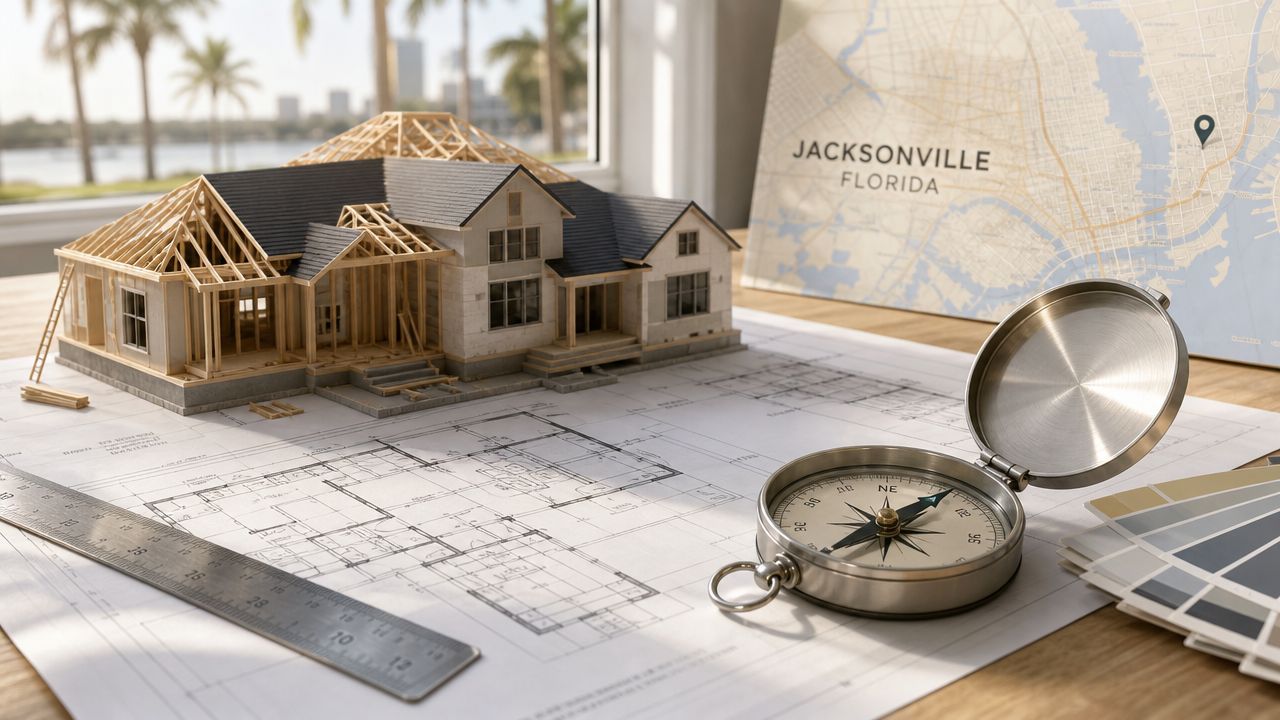
If you're looking at land in Jacksonville or Northeast Florida right now, you're probably balancing two competing goals. You want a home that fits the lot, the lifestyle, and the long-term plan. You also don't want a project that drifts off schedule, burns through budget, or creates preventable insurance and maintenance problems later.
Ofir Engineering is a licensed Florida general contractor (License #CGC 1540016) serving homeowners and investors across Jacksonville and Northeast Florida.That's where most advice about Jacksonville Florida custom home builders falls short. A lot of content talks about finishes, floor plans, and inspiration photos. Much less talks about builder vetting, site risk, framing choices, permit timing, and the difference between a smart upgrade and an expensive distraction. In this market, those practical decisions matter more than the mood board.
Jacksonville supports real depth in custom construction. Zillow's Jacksonville builder directory lists 455 spec homes, including 426 move-in ready and 29 under construction, and Houzz's Jacksonville directory shows 1,319 local new and custom home builders (Zillow Jacksonville builder directory). That level of activity gives buyers and investors options, but it also means you need a disciplined process to choose well.
Table of Contents
- What Building a Custom Home in Jacksonville Entails
- Your Custom Home Roadmap From Vision to Keys
- Decoding Costs and Timelines for Jacksonville Builds
- Building for Florida LGS vs Wood and Climate Resilience
- How to Choose and Vet Your Jacksonville Custom Home Builder
- Maximizing ROI An Investor's Guide to Custom Builds
- Frequently Asked Questions About Custom Home Building
What Building a Custom Home in Jacksonville Entails
A buyer signs a contract on a riverfront lot, falls in love with a floor plan online, and expects the two to fit together with minor edits. Then the survey comes back, the flood requirements tighten, drainage becomes a design issue, and the house that looked affordable on paper starts picking up engineering, elevation, and foundation costs. That is the point where the difference between custom, semi-custom, and spec stops being marketing language and starts affecting risk, schedule, and return.
A custom home is designed for a specific lot, a specific owner, and a specific performance target. A spec home is built on the builder's assumptions, with the plan, structure, and finishes largely decided before the buyer shows up. A semi-custom home sits in the middle. You start with an existing plan, then adjust room layouts, exterior details, and selections within a narrower lane.
In Jacksonville, those categories matter because site conditions change fast across the market. A build in a newer master-planned community with straightforward soils and utility access is a different job from an infill lot in Riverside, a marsh-adjacent parcel in Intracoastal West, or a home site closer to the beaches where wind exposure and corrosion resistance deserve more attention. The City of Jacksonville's permitting system reflects that reality, with separate reviews for building, zoning, utilities, and floodplain issues depending on the property and scope (City of Jacksonville building inspection division).
That is why a true custom build gives you control in the places that move the outcome:
- Site response: The house can be laid out around setbacks, drainage flow, tree protection, access limits, and flood or elevation requirements.
- Capital allocation: Money can go toward structure, envelope, mechanical systems, and insurance-sensitive decisions instead of being swallowed by finishes that do little for durability or resale.
- Build strategy: Foundation type, framing approach, window package, moisture control details, and backup power planning can match the lot and your hold period.
The trade-off is straightforward. Custom gives you better alignment between the asset and the site, but it also demands tighter decision-making, better preconstruction work, and a builder who can price uncertainty before it turns into change orders.
Semi-custom works well when the lot is predictable and the buyer wants some personalization without paying for a full design process. Spec can make sense when speed matters more than control, or when the buyer is comfortable accepting the builder's assumptions on layout, materials, and performance. A fully custom process earns its keep when the property has constraints, the budget needs active management, or the build is being evaluated as a long-term asset rather than a short-term purchase.
That last point gets missed. In Northeast Florida, a custom home is not only a design exercise. It is a capital project exposed to weather, permitting, insurance pressure, labor availability, and material selection risk. The owner who treats it that way usually gets a better house and a cleaner financial outcome.
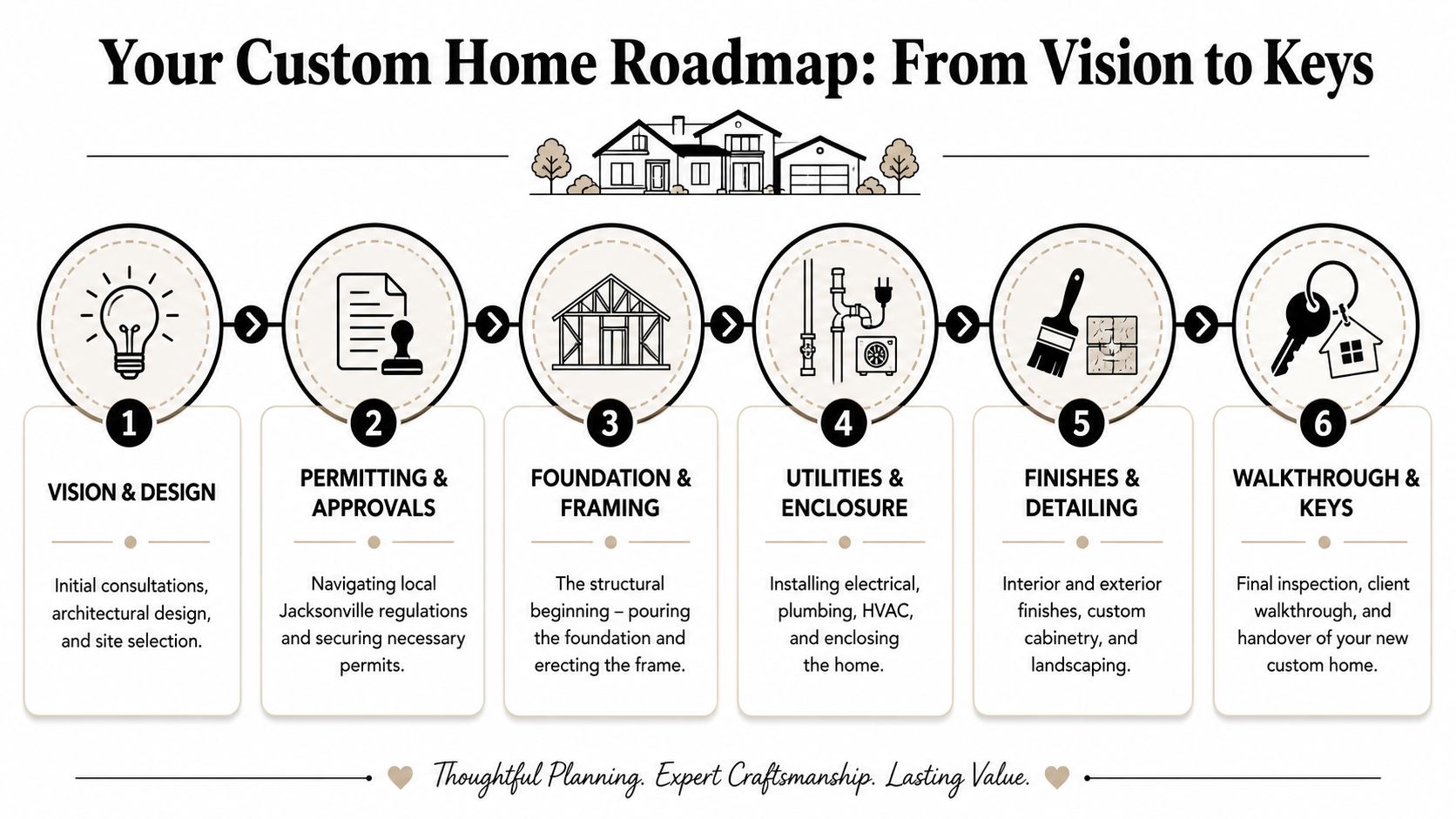
Your Custom Home Roadmap From Vision to Keys
A Jacksonville custom build usually goes off course the same way. The owner buys a lot, approves a floor plan, and assumes the rest is scheduling. Then significant pressure emerges. Drainage comments from the city, utility conflicts, long-lead windows, insurance-driven structural upgrades, and finish decisions that arrive before pricing is settled.
The clean projects are built differently. They follow a sequence, and each phase closes risk before the next one starts.
Start with lot due diligence and a buildable budget
Before design gets too far, the team needs to answer a basic question. What can this lot support without forcing expensive corrections later?
That review should cover access for equipment, utility availability, drainage patterns, setbacks, easements, finished floor elevation, and any restrictions that affect structure or roof geometry. In Jacksonville, those factors can change foundation cost, framing strategy, window requirements, and even whether the home remains attractive from an insurance standpoint.
At the same time, define the financial objective. A primary residence, a long-term hold, and a resale-oriented build do not get the same budget treatment. Owners who stay disciplined here usually protect value better than owners who spend early on cosmetic upgrades and leave structural, envelope, or mechanical decisions underfunded.
Three decisions should be settled early:
Project intent
Decide whether the house is meant for long-term living, asset preservation, or resale. That choice affects where the money should go.Scope boundaries
Separate required items from upgrades that can wait. That keeps allowances and change orders from spreading through the job.Approval authority
Assign one person to approve selections, pricing changes, and schedule decisions. Split authority slows procurement and creates field confusion.
A formal management process helps control that preconstruction work. Construction Project Management covers budgeting, contractor coordination, schedule control, supervision, and owner-side decision tracking. On a custom home, that structure protects the budget before any concrete is poured.
Get the drawings and permit set fully coordinated
Permitting is not paperwork. It is the first hard test of whether the project has been thought through.
Architectural plans, structural engineering, site information, and mechanical layouts need to agree with each other and with the actual lot. If they do not, the city review process slows down and the field team inherits problems that should have been solved on paper. A rushed permit set often looks fine until review comments expose missing information, conflicts between trades, or product selections that were never resolved.
The permit package should clearly show:
- Structural intent: foundation, framing, and load paths that fit the lot and design
- Trade coordination: plumbing, HVAC, and electrical routes that work with beams, ceiling heights, and openings
- Selection commitment: enough owner decisions made early to avoid redesign during review
- Site response: drainage, elevation, and access considerations accounted for before mobilization
Owners should also ask for a stage-by-stage schedule during this phase. A realistic home construction timeline for custom residential builds helps identify procurement risk, inspection dependencies, and decision deadlines before the field crew is waiting on answers.
Build in controlled phases, not as one long event
Construction runs better when the owner understands the checkpoints that matter. The visible progress is satisfying, but the hidden decisions carry more financial weight.
Site work, foundation, and framing
The first phase sets the house on the lot and creates the structural base for everything that follows. Layout errors, poor compaction, drainage mistakes, and framing corrections are expensive because later work stacks on top of them. Good builders check dimensions, elevations, anchor details, and structural alignment before pushing the schedule.
Rough-ins and dry-in
Once the shell is up, the project shifts into plumbing, electrical, HVAC, roofing, windows, and exterior doors. This stage determines how well the house handles water, air movement, and service access over time. If sequencing slips here, trades start working over each other, and rework becomes common.
In Northeast Florida, this is also where climate resilience starts showing up in real terms. Window installation quality, flashing details, roof execution, and moisture control are tied directly to durability, maintenance exposure, and long-term holding cost.
Interior finishes and closeout
Finishes create the highest volume of owner input. They also create the easiest path to budget drift. Cabinet revisions, tile layout changes, lighting moves, and late hardware decisions look small in isolation, but they add labor, lead time, and coordination pressure.
A controlled finish phase includes:
- Selection tracking: every finish approved with model numbers, quantities, and lead times
- Change order control: pricing approved before the work changes
- System startup: HVAC, plumbing, electrical devices, controls, and appliances tested
- Punch list completion: functional and cosmetic corrections documented and closed
- Closeout documents: warranties, manuals, approved plans, and subcontractor information transferred to the owner
The handover should be orderly. Keys are the last step, not the first moment anyone checks whether the paperwork, warranties, and final corrections are in order.
Decoding Costs and Timelines for Jacksonville Builds
A Jacksonville custom home can look on budget on day one and still miss the target by six figures if the lot, scope, and procurement plan were not vetted early. The clients who protect capital best do not start with price per square foot. They start with exposure: site work, structural demands, permitting risk, insurance implications, and how many decisions are still unsettled before the first permit set goes in.
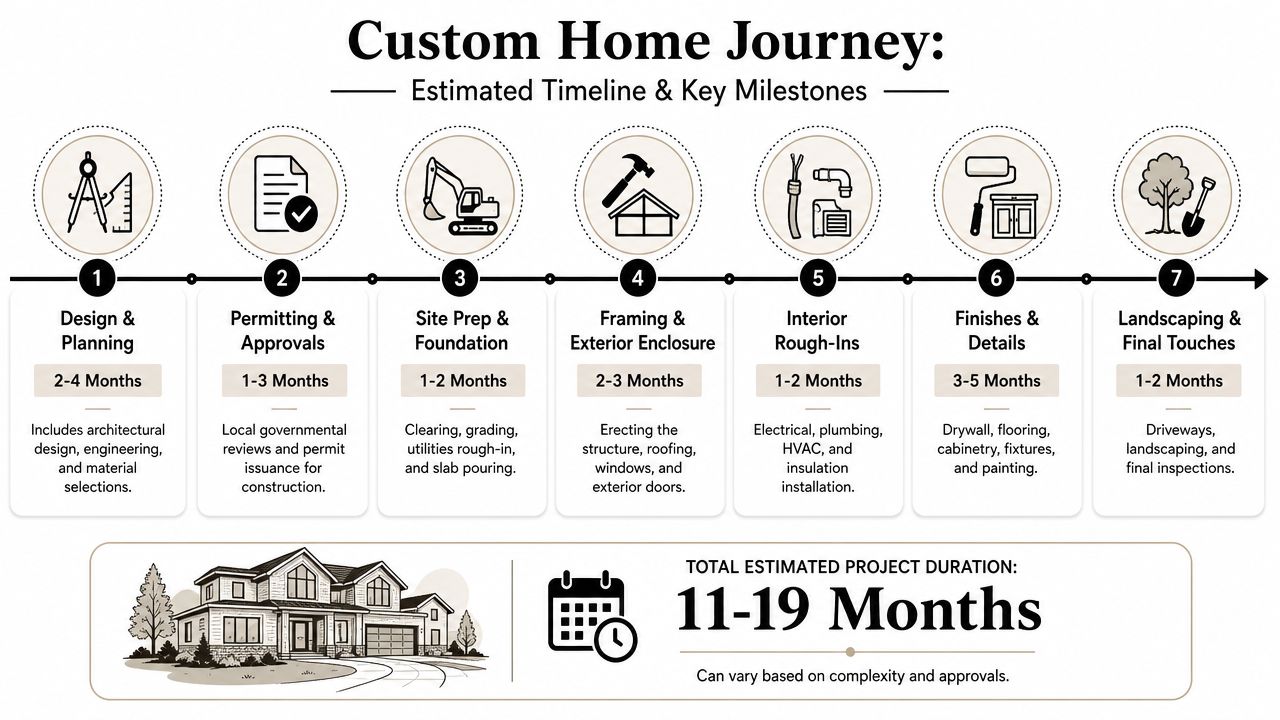
In Jacksonville, the full path from concept to certificate of occupancy often stretches well beyond the active build itself. Pre-construction alone can take months because surveys, engineering, product selections, utility coordination, and permit comments all affect what the final construction contract should include. Projects with waterfront conditions, complicated drainage, or higher wind-design requirements usually carry more schedule risk than a similar house on a straightforward inland lot. Block Renovation notes that Jacksonville custom builds commonly run from roughly 14 to 24 months depending on complexity and local conditions (Jacksonville custom build guide).
Where custom home budgets usually get stressed
The biggest cost problems rarely come from one bad bid. They come from scope gaps that were accepted too early, then corrected after labor and materials were already committed.
A working Jacksonville budget should break out four categories clearly:
- Land and site costs: clearing, fill, grading, drainage, utility runs, tree issues, access constraints, and foundation requirements tied to the actual lot
- Soft costs: architecture, structural engineering, civil work, surveys, permitting, inspections, and consultant fees
- Hard construction costs: labor, framing, exterior envelope, mechanical systems, interior finishes, and exterior completion
- Change exposure: owner revisions, allowance overages, product substitutions, and design updates after purchasing starts
I tell clients to watch allowances and exclusions as closely as the base contract number. A low initial proposal can hide risk in unfinished site assumptions, undersized allowances, or broad language around what happens if engineering or permitting changes the job.
Timeline control and budget control are tied together. A clear home construction timeline in Jacksonville helps owners see where long-lead items, trade sequencing, and approval deadlines can turn into real cost. Once windows, cabinets, specialty doors, or structural hardware are delayed, crews get pushed, rescheduling fees show up, and carrying costs increase.
If you're comparing firms that handle both field execution and project oversight, New Construction Jacksonville outlines licensed contractor services for custom home building, construction management, scheduling, supervision, and quality control.
Why timelines move and how to protect them
Schedule loss usually starts before the slab is poured. I see the same four pressure points on custom builds across Northeast Florida.
| Pressure point | What causes it | What works |
|---|---|---|
| Pre-construction delay | Unfinished selections, late engineering input, permit revisions | Lock core decisions before permit submission |
| Site complexity | Poor soil assumptions, drainage conflicts, limited access, waterfront constraints | Investigate the lot before final budgeting and scheduling |
| Trade availability | Gaps between key subs, overloaded local crews, long-lead specialty items | Build the schedule around actual subcontractor capacity and procurement dates |
| Scope drift | Plan changes during framing, MEP rough-in, or finishes | Require written change approvals with updated price and time impact |
Budget discipline: The cheapest allowance sheet often produces the highest final cost.
The safest projects are usually the ones with fewer open questions at contract signing. Flexibility has a price, and in custom building that price shows up in rework, idle labor, reordered materials, and extended loan carry. Owners and investors do better when they decide early which items must stay open for design reasons and which ones need to be fixed in place to protect schedule, quality, and return.
Building for Florida LGS vs Wood and Climate Resilience
A Jacksonville custom home can look great at closing and still become an expensive problem in year three if the structure, lot strategy, and moisture control were treated like secondary decisions. I tell clients to judge this part of the build the way an insurer or investor would. Ask what fails first, what costs the most to repair, and what choices hold value in a humid, high-wind coastal market.
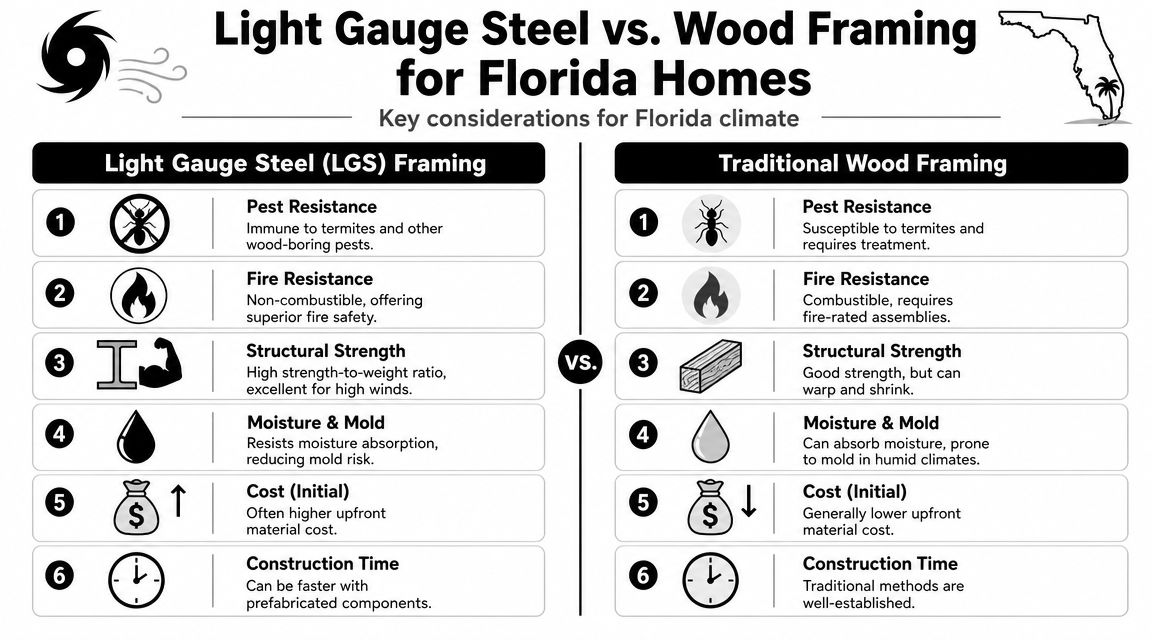
LGS and wood solve different problems
In Northeast Florida, light gauge steel and wood framing can both produce a strong house. The wrong decision usually comes from matching the framing system to price alone instead of matching it to the lot, the design, the trade team, and the owner's long-term risk tolerance.
Here is the practical comparison:
| Attribute | Light Gauge Steel | Wood Framing |
|---|---|---|
| Moisture response | Does not absorb moisture like wood | Can swell, rot, or degrade if water control fails |
| Pest exposure | Not a termite food source | Requires treatment, inspection, and ongoing vigilance |
| Fire behavior | Non-combustible framing material | Combustible framing that depends on proper assembly detailing |
| Trade familiarity | Needs framers, hangers, and MEP trades who know the system | Easier to staff in conventional residential builds |
| Upfront cost profile | Can cost more depending on engineering, design, and supply | Usually simpler to estimate and source locally |
Light gauge steel can reduce some of the risk tied to termites and moisture exposure, but it does not excuse poor envelope work. Wood remains the more common option in Jacksonville because crews, suppliers, and pricing are generally easier to line up. A badly detailed house fails in either system.
If you want a technical side-by-side before selecting a structural package, this guide on steel frame vs wood frame construction for Florida homes explains where each system fits.
The primary trade-off is execution risk. If the builder and subs are strong with wood and weak with steel, steel is not the safer choice on that project. If the house sits in a higher-exposure location and the team has real LGS experience, paying more upfront can make sense.
Climate resilience starts below the finished floor
The strongest return on investment in a Florida custom home usually comes from decisions buyers do not show off in listing photos. Elevation, drainage, flashing details, foundation design, and equipment placement affect durability, maintenance cost, and insurability far more than upgraded decorative finishes.
On Jacksonville and St. Johns County projects, I look at resilience in this order:
- Lot elevation and water flow: Water needs a clear path away from the house, the garage, and hardscape areas.
- Foundation type: Slab, stem wall, or raised construction should fit the site conditions and exposure.
- Roof and wall detailing: Transitions, underlayments, flashing, and penetrations need field-tested detailing, not assumptions.
- Window and door installation: Openings are common failure points if they are rushed or value-engineered incorrectly.
- Mechanical location: HVAC equipment, water heaters, and electrical components should be placed for service access and storm protection.
- Finish selection by exposure: Use moisture-sensitive materials where they can survive, not just where they look good in a showroom.
Insurance also affects the math. Owners should ask early how framing type, roof assembly, opening protection, and flood exposure may affect underwriting and operating cost. This overview of commercial insurance for Florida contractors gives useful context on how builders and risk professionals evaluate construction exposure.
A beautiful house with weak water management turns into a repair cycle. A simpler house with disciplined structural and envelope decisions usually holds up better, costs less to maintain, and protects resale value more effectively.
Clients ask me which upgrades pay back. The best answers are boring. Spend first on structure, drainage, moisture management, wind resistance, and serviceability. Those choices reduce failure points, protect the budget after move-in, and make the home easier to insure and easier to sell.
How to Choose and Vet Your Jacksonville Custom Home Builder
A custom build in Jacksonville can go off track long before framing starts. I usually see the same pattern. The wrong builder gets selected on a polished proposal, an aggressive price, or a floor plan portfolio that says nothing about job costing, site supervision, or contract discipline.
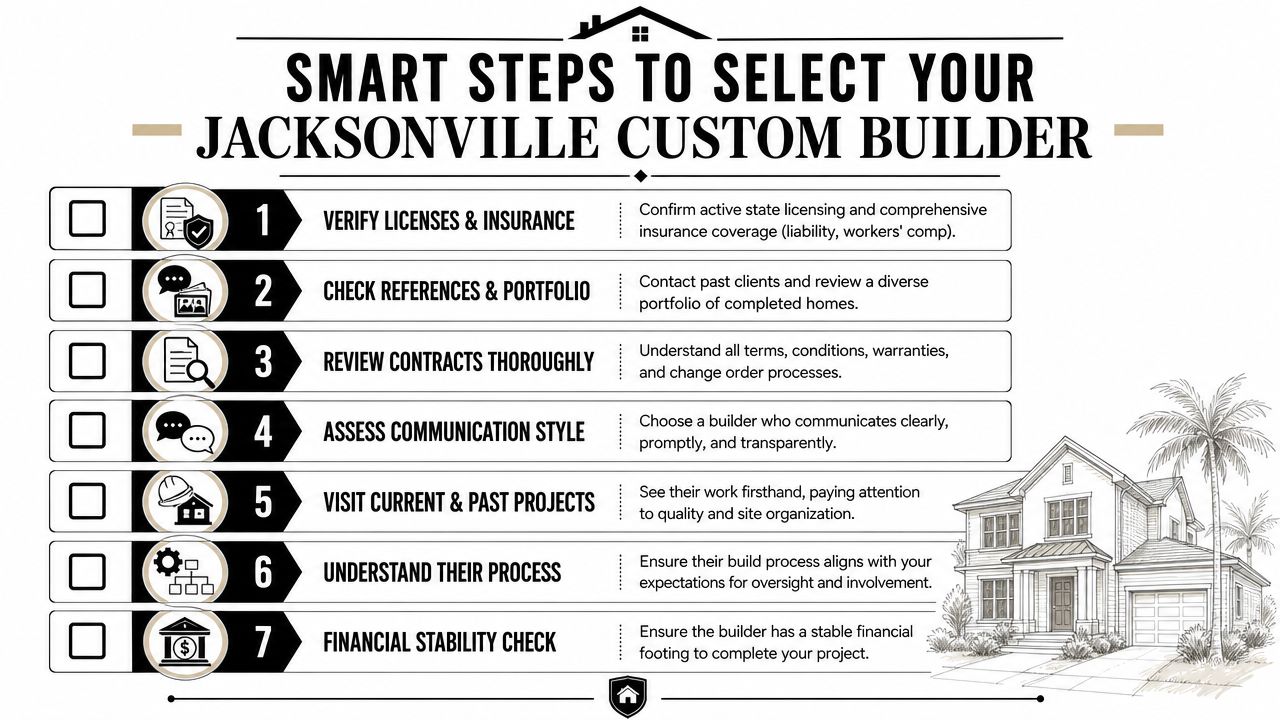
What to verify before you compare bids
Start with risk, not finishes.
A Jacksonville builder should be checked the same way you would check any operator handling a seven-figure asset. Confirm license status. Confirm active insurance. Confirm who is signing the contract and supervising the work. If you want a plain-language overview of policy categories and why they matter, this primer on commercial insurance for Florida contractors is a useful reference.
Then look at operating history in Northeast Florida. Years in business matter less than stable local execution. A builder who regularly works through Duval, St. Johns, and Nassau permitting, understands local inspection patterns, and has established trade relationships usually controls surprises better than a newcomer with a strong social media presence.
Ask direct questions about financial control. Do they run detailed estimates or broad allowances? How do they buy out trades after permit plans are complete? What happens if lumber, concrete, or mechanical pricing shifts before procurement? Builders who stay organized in preconstruction usually stay organized when the job gets expensive.
Questions that show how a builder manages risk
The interview should test process discipline.
Ask who owns preconstruction and whether that person stays involved after contract signing. Ask who updates the budget when selections change. Ask who is responsible for schedule recovery after rain delays, trade stacking, or late owner decisions. On a custom home, those roles cannot be vague.
These questions get useful answers fast:
How do you build the budget before contract?
Look for line-item thinking, realistic allowances, and a method for reconciling plans, specifications, and selections before pricing is finalized.Who manages the project day to day?
You need the name of the superintendent or project manager, not a generic promise that the team will handle it.How are change orders documented?
The builder should price them in writing, show schedule impact, and require approval before proceeding.What does your draw schedule look like?
Payment timing should match completed work and stored materials, not the builder's cash flow problem.Can you show me a current jobsite and a recently completed home?
An active site shows supervision habits. A finished home shows closeout quality.How do you handle site-specific issues such as fill, drainage, setbacks, or utility conflicts?
Jacksonville lots vary more than buyers expect, especially on infill parcels and marsh-adjacent properties.
Before you start interviews, review this guide on how to hire a general contractor. It gives owners a practical screening framework for contracts, scope review, and contractor accountability.
Red flags in bids and contracts
Low pricing by itself means very little.
A cheap bid can hide thin allowances, missing scope, weak supervision, or a builder trying to get the job under contract before the true number shows up in change orders. I tell clients to compare what is excluded before they compare totals. That is where budget trouble usually starts.
Watch for vague language around permitting, engineering coordination, site work, utility connections, allowance overruns, and owner-supplied items. Those gaps turn into disputes because each side assumes something different. The contract should state who is responsible, when decisions are due, and how cost adjustments are handled.
Pressure is another warning sign. If a builder pushes for a deposit before plans, specifications, and scope are coordinated, slow the process down. Good builders want clean documents because clean documents protect margin, schedule, and client trust.
The strongest Jacksonville Florida custom home builders do more than build attractive houses. They control paperwork, trade sequencing, field quality, and financial exposure well enough to deliver a home that holds its value and avoids preventable repair and budget problems.
Maximizing ROI An Investor's Guide to Custom Builds
An investor buys a Jacksonville infill lot at a fair price, then gives back margin through avoidable decisions: oversized square footage, weak drainage planning, upgrade-heavy selections that do not raise rent or resale, and late plan changes after framing starts. I see that pattern more often than bad land buys. Profit is usually lost in execution.
Custom building works when the project is treated like a capital deployment decision. The questions are straightforward. Who is the likely end user. What features hold value in that submarket. Which construction choices reduce insurance, maintenance, vacancy risk, and future repair exposure in Florida conditions.
In Jacksonville, custom can beat finished inventory when the lot solves a market problem that resale homes do not solve well. That may mean a narrow urban lot, a high-value infill location, a product aimed at a clear buyer segment, or a plan that uses outdoor space, parking, and storage better than nearby comps. Returns improve when the house fits the site and the submarket instead of chasing every upgrade trend.
The strongest investor projects stay disciplined in four areas:
- Market fit: Build for the buyer or tenant pool that exists in that zip code
- Scope control: Keep square footage, rooflines, structural spans, and finish packages aligned with local ceiling value
- Durability: Use assemblies and materials that hold up to heat, humidity, wind, and bulk water
- Operational planning: Account for access control, turnover, maintenance, and ownership costs after completion
Overbuilding is a common mistake. A showpiece kitchen and imported finishes can look good during a walk-through, but they do not always improve appraisal support or lease velocity. In many Jacksonville neighborhoods, a better return comes from smart plan flow, strong storage, covered outdoor living, durable windows and doors, and mechanical systems sized and installed correctly.
Margin protection during construction is less about squeezing trade pricing and more about preventing expensive surprises. Early engineering coordination, realistic allowances, limited owner revisions, and disciplined procurement do more for ROI than chasing the lowest initial number. Every change order should answer one question: does this improve value, reduce risk, or both?
Investors who plan to hold the asset should also think past the certificate of occupancy. Entry management, vendor access, and building-use oversight affect operating friction after delivery. Resources like Discover Nimbio building entry can help owners evaluate how they want to manage access and daily building operations.
If the project is being underwritten as an investment property rather than a personal residence, Construction Services For Investors outlines Jacksonville and Northeast Florida services focused on renovation oversight, project coordination, budget control, and return-driven construction planning.
Frequently Asked Questions About Custom Home Building
How long does a custom home take in Jacksonville?
A typical Jacksonville custom home takes 14 to 20 months from design start to completion, and pre-construction often consumes 4 to 6 months for design, engineering, and permitting. More difficult sites and resilience requirements can push the total longer, as noted earlier.
Is a custom home better than buying a spec home?
It depends on the lot, your goals, and how much control you need. A spec home can be the simpler path if the layout, location, and performance level already fit. A custom home is usually the better fit when the lot is unique, the design needs are specific, or long-term durability decisions matter more than immediate move-in speed.
What matters most when comparing builders?
Look at licensing, insurance, contract clarity, local experience, site organization, and how they handle schedule control. Portfolio photos matter less than communication systems and documentation quality.
Should I worry about climate resilience during design?
Yes. In Northeast Florida, resilience decisions belong at the front of the project. Foundation approach, drainage, wind exposure, moisture management, and material selection affect durability, insurability, and future maintenance far more than decorative upgrades do.
Is custom building a good strategy for investors?
It can be, but only when the project has a clear market position. Investors should stay disciplined about layout, durability, buyer appeal, and timing. The goal isn't maximum customization. It's a build that supports resale or hold performance without unnecessary capital tied up in low-value upgrades.
If you're planning a custom home, evaluating a lot, or trying to control risk on a Jacksonville build, Ofir Engineering can help you approach the project with clear budgeting, practical construction planning, and disciplined project management. The company works with homeowners and investors in Jacksonville and Northeast Florida on renovations, new construction, and construction oversight that prioritizes quality, schedule control, and long-term value.
Meta title: Jacksonville Florida Custom Home Builders Guide for Owners and Investors
Meta description: Learn how Jacksonville Florida custom home builders handle design, permits, timelines, builder vetting, climate resilience, and ROI-focused custom home planning.
Focus keyword: Jacksonville Florida custom home builders
Suggested internal linking opportunities:
- Project Management
- New Construction
- Investors
- How to Hire a General Contractor
- Steel Frame vs Wood Frame Construction Florida Homes
- Home Construction Timeline
Suggested image ideas and alt text
Hero image filename: jacksonville-florida-custom-home-builders-hero-1731×909.jpg
Alt text: Jacksonville Florida custom home builders planning a new custom home project
Description: A professional custom home construction scene in Jacksonville with plans, framing, and a residential lotImage filename: custom-home-roadmap-jacksonville-1731×909.jpg
Alt text: Custom home building roadmap in Jacksonville Florida from design to keys
Description: A visual overview of the custom home process for Jacksonville homeowners and investorsImage filename: florida-custom-home-framing-comparison-1731×909.jpg
Alt text: Light gauge steel vs wood framing for Jacksonville Florida custom homes
Description: Side-by-side comparison of framing choices for climate resilience and long-term durabilityImage filename: vetting-jacksonville-custom-home-builder-1731×909.jpg
Alt text: Checklist for choosing Jacksonville Florida custom home builders
Description: Builder selection checklist focused on licensing, insurance, contracts, and project management
