When it comes to commercial construction in Jacksonville, FL, working with a licensed general contractor makes the difference. Commercial Buildout Cost in Jacksonville is easier with the right licensed general contractor on your side. Ofir Engineering is a licensed Florida general contractor (License #CGC 1540016) serving homeowners and investors across Jacksonville and Northeast Florida.
Commercial construction is not simply a scaled-up version of home building. The materials, codes, inspections, and trade coordination involved are fundamentally different, and commercial construction differs from residential in ways that catch many Jacksonville homeowners and property investors off guard. Whether you are considering a small tenant build-out, adding retail space to an existing property, or converting a structure for mixed use, understanding these distinctions before you commit to a project can save significant time and money. This guide covers definitions, project phases, local Jacksonville requirements, realistic costs, and practical tips to help you move forward with confidence.
Table of Contents
- What is commercial construction? Definition, types, and Jacksonville context
- Key phases of a commercial construction project
- Local requirements for commercial construction in Jacksonville
- Costs, timelines, and ROI: What to expect in Jacksonville
- Tips for successful small-scale commercial projects
- Our take: What most miss about commercial construction in Jacksonville
- Kickstart your commercial project with trusted Jacksonville expertise
- Frequently asked questions
Key Takeaways
| Point | Details |
|---|---|
| Commercial vs. residential | Commercial construction in Jacksonville has stricter codes, materials, and complexity compared to residential building. |
| Local requirements | Jacksonville projects need licensed contractors, strict zoning, permits, and hurricane/ADA compliance—no shortcuts. |
| Higher costs, ROI potential | Commercial builds cost more and take longer but can unlock new income or property value when done right. |
| Stepwise project phases | Every project follows planning, approval, building, and closeout phases—skipping steps risks delays or violations. |
| Expert help pays off | Getting local pros for planning and compliance prevents costly mistakes in Jacksonville’s strict market. |
What is commercial construction? Definition, types, and Jacksonville context
Commercial construction refers to the design and construction of structures intended for business, retail, office, medical, hospitality, or mixed-use purposes. It is governed by the International Building Code (IBC) rather than the International Residential Code (IRC) that applies to single-family homes, and that distinction carries real consequences for planning, materials, and budget.
In Jacksonville, the most common small-scale commercial project types include:
- Tenant build-outs: Finishing or reconfiguring interior space for a new business occupant
- Retail additions: Adding commercial square footage to an existing property
- Light office or medical suites: Constructing or converting space for professional use
- Small hotels or short-term rental facilities: Projects that cross from residential into hospitality classification
- Adaptive reuse: Converting older residential or industrial buildings into commercial use
The structural and code differences are significant. Commercial projects require durable materials such as structural steel and concrete, strict ADA compliance, fire-rated assemblies, and coordination across multiple licensed trades. Residential wood-frame construction, by contrast, involves fewer mandatory inspections and simpler mechanical, electrical, and plumbing (MEP) systems.
Cost benchmarks reflect this complexity. National commercial construction costs range widely by project type and region, with Florida figures running higher than the national average due to hurricane-resistance mandates. All commercial work in Jacksonville, regardless of scale, must be permitted and comply with the Florida Building Code. Reviewing permits and local construction regulations before finalizing any design is a non-negotiable first step.
Key fact: Even a modest interior renovation of a commercial space in Jacksonville requires a full building permit, engineer-sealed drawings, and licensed contractor oversight.
Pro Tip: Do not assume that because a project is small, it falls under residential rules. Square footage does not determine code classification; intended use does.
Key phases of a commercial construction project
Understanding what’s involved starts with the steps. Here is how a commercial project typically unfolds from first idea to final walk-through.
Commercial project phases follow a structured sequence that is more layered than residential construction:
- Preconstruction and feasibility: Site analysis, zoning verification, conceptual budgeting, and owner-contractor alignment on scope
- Design and engineering: Architect and engineer produce permit-ready drawings, including structural, MEP, and life safety plans
- Permitting: Submission to the City of Jacksonville, plan review, and approval before any ground is broken
- Site work: Clearing, grading, utility connections, and foundation preparation
- Structural framing: Steel, concrete, or wood framing erected per engineer-sealed plans
- Building enclosure: Roofing, exterior walls, windows, and doors installed to meet Florida wind and water-intrusion standards
- MEP rough-in: Mechanical, electrical, and plumbing systems installed and inspected before walls are closed
- Finishes and fit-out: Interior finishes, fixtures, flooring, and tenant-specific improvements
- Commissioning and closeout: Final inspections, certificate of occupancy, and punch-list completion
| Phase | Commercial | Residential |
|---|---|---|
| Design documents | Engineer-sealed, IBC-compliant | Architect or designer, IRC-compliant |
| Permit complexity | High, multi-department review | Moderate, single department |
| Inspections | Multiple mandatory hold points | Standard milestone inspections |
| Trade coordination | Licensed GC required | Owner-builder option available |
| Closeout | Certificate of occupancy required | Certificate of completion |
Two primary delivery methods exist: Design-Bid-Build (sequential phases with separate contracts) and Design-Build (single entity manages design and construction). Design-Build can compress timelines, but it is not a shortcut. Explore project phase examples to understand how each method applies to real Jacksonville builds.
Pro Tip: In Jacksonville, the permit review phase alone can take four to twelve weeks for commercial projects. Build this into your timeline from day one.
Local requirements for commercial construction in Jacksonville
With a clear project roadmap, the next big hurdle is complying with Jacksonville’s rules. Here is what you need to know before breaking ground.
Jacksonville operates under the Florida Building Code, Commercial Volume, which adopts IBC standards with Florida-specific amendments. The requirements that most often surprise first-time commercial project owners include:
- Contractor licensing: All commercial construction must be performed by a licensed General Contractor (CGC) or Building Contractor (CBC). There is no owner-builder exemption for commercial work.
- JaxEPICS portal: Jacksonville requires zoning checks and permit submissions through the city’s JaxEPICS online portal, which also handles concurrency reviews for traffic and utility capacity.
- ADA compliance: Any new construction or substantial renovation must meet Americans with Disabilities Act standards for accessible routes, restrooms, parking, and entrances.
- Hurricane-resistance standards: Jacksonville sits in a high-wind zone. Commercial structures must meet ASCE 7 wind load requirements, including impact-resistant glazing and reinforced connections.
- Fire safety systems: Sprinkler systems, fire-rated corridors, and alarm systems are mandatory for most commercial occupancy types.
- Impact fees: New commercial construction triggers transportation and school impact fees that can add meaningful cost to a project budget.
| Requirement | Residential | Commercial |
|---|---|---|
| Contractor license | Owner-builder allowed | CGC/CBC required |
| Code standard | IRC | IBC/Florida Building Code |
| ADA compliance | Not required | Mandatory |
| Wind load design | Standard | ASCE 7, enhanced |
| Permit portal | City of Jacksonville | JaxEPICS |
Review Jacksonville commercial project guidelines to understand how these requirements apply to specific project types before committing to a site or design.
Pro Tip: Conduct a zoning feasibility check through JaxEPICS before purchasing a property for commercial use. Zoning restrictions can make an otherwise attractive site unbuildable for your intended purpose.
Costs, timelines, and ROI: What to expect in Jacksonville
Once you know the rules, it all comes down to dollars and days. Here is what you can realistically expect in Jacksonville for budgeting and returns.
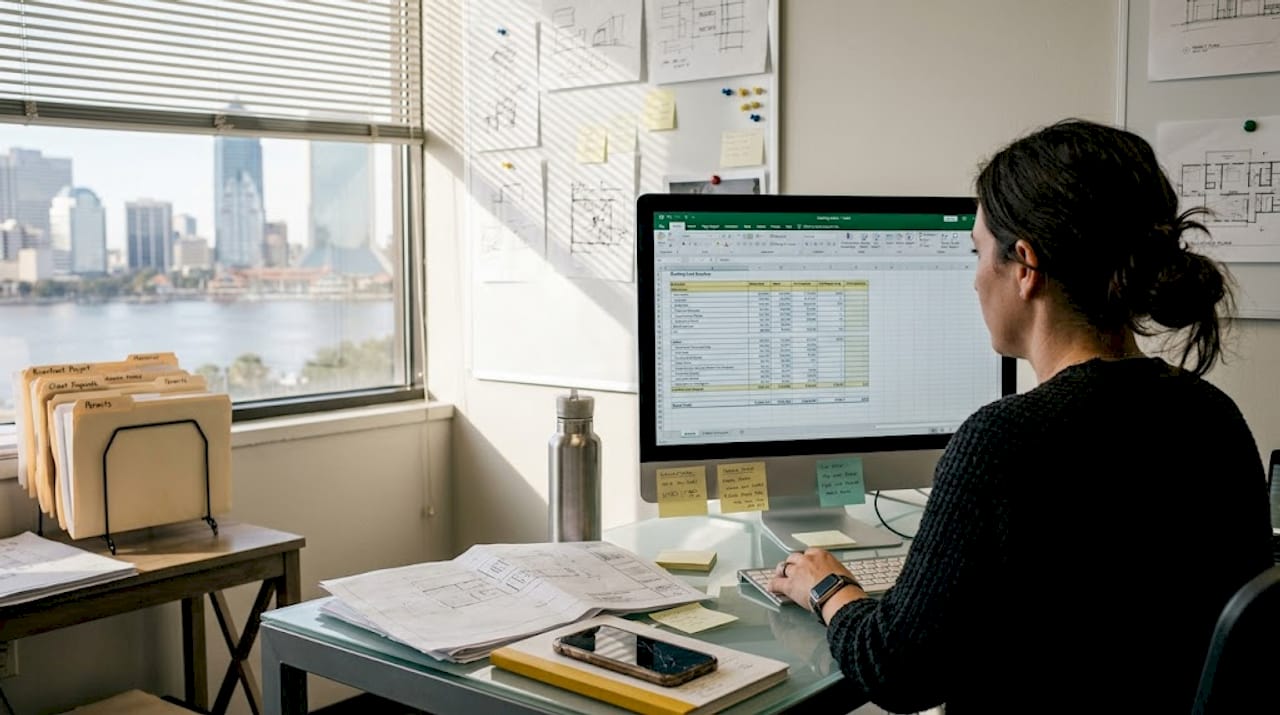
Florida commercial construction costs vary significantly by project type. Based on current data, Florida tilt-wall industrial shells run $85 to $130 per square foot, fit-outs range from $150 to $210 per square foot, and tenant improvements fall between $60 and $110 per square foot. General contractor fees typically add 10 to 26 percent to total project costs.
Key cost drivers specific to Jacksonville include:
- Hurricane-resistance upgrades: Impact glazing, reinforced roof connections, and wind-rated assemblies can add $10 to $25 per square foot to base construction costs
- ADA retrofits: Bringing an older building into ADA compliance for a change of use can cost $15,000 to $60,000 depending on scope
- Permitting and impact fees: Budget $5,000 to $20,000 or more for permit fees, plan review, and impact fees on small commercial projects
- MEP complexity: Commercial mechanical and electrical systems are more robust than residential, adding cost per square foot
- Specialized labor: Structural steel erection and fire-rated assembly installation require licensed specialty contractors
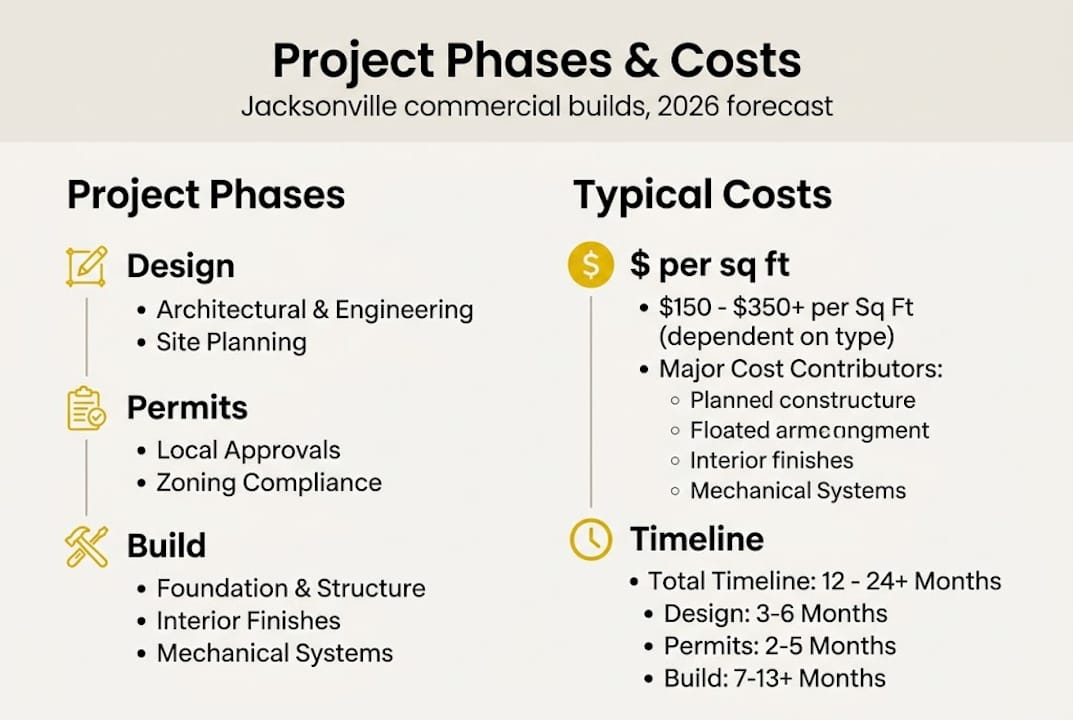
Timelines for small retail or office projects in Jacksonville typically range from 12 to 24 months from initial design through certificate of occupancy, compared to 6 to 12 months for a comparable residential build. The extended timeline reflects permit review, multi-trade coordination, and mandatory inspection hold points.
For investors, the ROI potential is real. Adding a tenant improvement project to an existing property can generate lease income that significantly outperforms residential rental yields in high-demand Jacksonville corridors.
Tips for successful small-scale commercial projects
With numbers in hand, here is how to actually get your project off the ground without costly missteps.
Even modest commercial build-outs require full permits, ADA compliance, and fire safety measures, so preparation is essential. Follow these steps to protect your investment:
- Conduct a zoning feasibility check first: Before buying a site or commissioning design work, verify that the property’s zoning classification permits your intended use through JaxEPICS.
- Engage a licensed engineer early: Engineer-sealed plans are required for permit submission. Bringing an engineer into the design phase, rather than after, prevents costly redesigns.
- Select an experienced licensed GC: A contractor with demonstrated commercial experience in Jacksonville will navigate permit submissions, inspection scheduling, and trade coordination more efficiently than a residential-only builder.
- Do not skip ADA or fire safety requirements: These are not optional items to value-engineer out. Non-compliance can result in stop-work orders, fines, and mandatory demolition of non-compliant work.
- Account for concurrency review: Jacksonville’s concurrency management system evaluates whether existing infrastructure (roads, utilities) can support a new commercial use. Surprises here can delay or kill a project.
- Align design choices with tenant appeal: Durable finishes, accessible layouts, and flexible floor plans attract quality tenants and reduce long-term maintenance costs, directly supporting ROI.
Reviewing local adaptive reuse examples can provide practical insight into how these steps play out on real Jacksonville projects.
Pro Tip: Budget a 15 to 20 percent contingency on top of your base construction estimate for commercial projects. Code-required changes discovered during plan review are common and rarely inexpensive.
Our take: What most miss about commercial construction in Jacksonville
Even with all the facts laid out, the real challenges and opportunities of commercial construction in Jacksonville can surprise even seasoned investors. The most common mistake is underestimating how similar the regulatory burden is for small projects compared to large ones. A 2,000-square-foot tenant build-out faces nearly the same permitting, ADA, fire safety, and trade licensing requirements as a 20,000-square-foot office building. The overhead does not scale down proportionally.
Many first-time investors focus intensely on projected ROI while overlooking zoning feasibility, concurrency review, and the time cost of city approvals. These factors can add months and tens of thousands of dollars to a project before a single nail is driven.
Design-Build delivery is often promoted as a faster path, and it can be, but only when the owner invests serious time in upfront planning and selects a contractor with genuine local expertise. Jacksonville’s storm codes, adaptive reuse policies, and city approval processes reward those who understand the local environment. Exploring steel frame methods as a structural approach, for example, can offer both code compliance advantages and long-term durability benefits that generic guidance rarely addresses. Local knowledge is not a luxury. It is a cost-control strategy.
Kickstart your commercial project with trusted Jacksonville expertise
Ready to put your knowledge to work? Local expertise makes all the difference when navigating Jacksonville’s permitting, zoning, and code requirements.
Ofir Engineering brings over 15 years of hands-on experience to Jacksonville commercial construction, from feasibility assessment through certificate of occupancy. The team handles permitting, engineer-sealed plans, trade coordination, and full compliance with Florida Building Code requirements, so you do not have to manage those complexities alone. Whether you are planning a tenant build-out, a mixed-use addition, or an adaptive reuse project, explore the full range of construction and steel services available and schedule a consultation to assess your project’s feasibility, costs, and local zoning requirements before committing to a site or design.
Frequently asked questions
What is considered a commercial construction project in Jacksonville?
Any build or renovation used for business, retail, office, or mixed-use purposes counts as commercial in Jacksonville, including small tenant improvements that require full permits and compliance.
Can homeowners act as their own builder for commercial projects in Jacksonville?
No. Jacksonville requires CGC/CBC licensing for all commercial construction, and there is no owner-builder exemption available for commercial work.
How long does a small commercial construction project usually take?
Commercial construction timelines for small Jacksonville projects typically run 12 to 36 months, longer than residential builds due to multi-department permit review and mandatory inspection hold points.
What are common cost drivers for commercial projects in Jacksonville?
Major cost drivers include hurricane-resistant features and code-mandated upgrades, ADA compliance retrofits, permitting and impact fees, and specialized licensed labor for structural and MEP systems.
Recommended
- Commercial Construction – Ofir Engineering
- Service – Ofir Engineering
- 8 Costly Mistakes to Avoid When Building a Light-Gauge Steel Home in Jacksonville – Ofir Engineering
- Home Remodeling Jacksonville FL | Ofir Engineering
Article generated by BabyLoveGrowth
Commercial Buildout Cost: What Jacksonville Property Owners Should Know
Getting commercial buildout cost right starts with an experienced, licensed team. Ofir Engineering is a fully licensed Florida general contractor (License #CGC 1540016) serving Jacksonville, Duval County, St. Johns County, and Northeast Florida. We handle commercial buildout cost from initial planning and budgeting through permitting, construction, and final inspection, keeping the project on schedule and on budget.
Every commercial buildout cost project is different, which is why we start with a clear scope and a realistic estimate before any work begins. If you are comparing options or planning a build in the Jacksonville area, our team is happy to review your goals and outline the smartest path forward. Reach out for a free, no-obligation consultation on your commercial buildout cost project.
See our main guide: Commercial Permitting Jacksonville.
See our main guide: Jacksonville Buildout Process Explained.
