
Apartment builder long term maintenance is the part of a multifamily handover that determines whether year eight of the operating budget resembles year one. Unlike a single house, an apartment community fails at scale: the same detail exists in every unit, the same roof covers dozens of them, and nobody living in the building has any incentive to report slow deterioration. In Northeast Florida, humidity and salt air do that deterioration quietly for years before it becomes a capital item. Ofir Engineering is a licensed Florida general contractor (License #CGC 1540016) serving Jacksonville, Ponte Vedra, St. Johns County, and Northeast Florida.
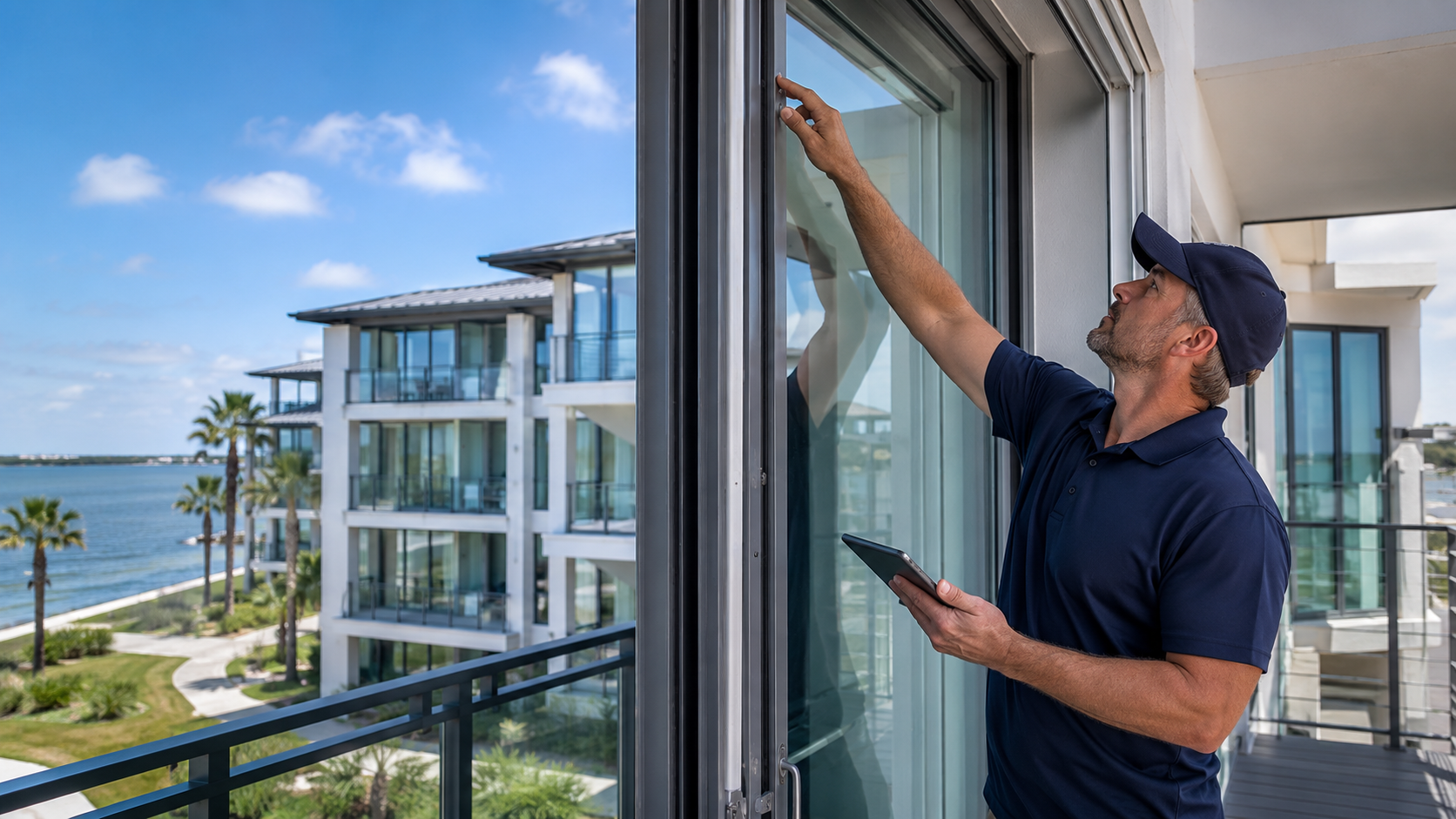
Why Apartment Builder Long Term Maintenance Is a Different Problem
Three characteristics separate apartment maintenance from house maintenance. First, repetition: a detail specified poorly appears in every unit at once, so a small unit-level cost becomes a large portfolio-level cost. Second, shared systems: roofs, corridors, breezeways, stair assemblies, stacked plumbing, common water heating, amenity spaces, and site drainage are nobody’s individual responsibility and therefore go unreported. Third, turnover: units are refreshed on a lease cycle, which creates a natural inspection opportunity that most operators waste by treating the turn as paint and carpet rather than as a scheduled condition survey.
The handover package is what converts these characteristics from liabilities into a manageable program. It is also the difference between a reserve schedule an owner can defend to a lender and a guess.
What Salt Air Attacks Across a Community
Structural connectors and fasteners. Hurricane straps, screws, joist hangers, railing anchors, and stair connections corrode before the material they hold. On breezeway and exterior-corridor buildings these are exposed continuously, and corrosion at a stair or railing connection is a life-safety issue rather than a cosmetic one.
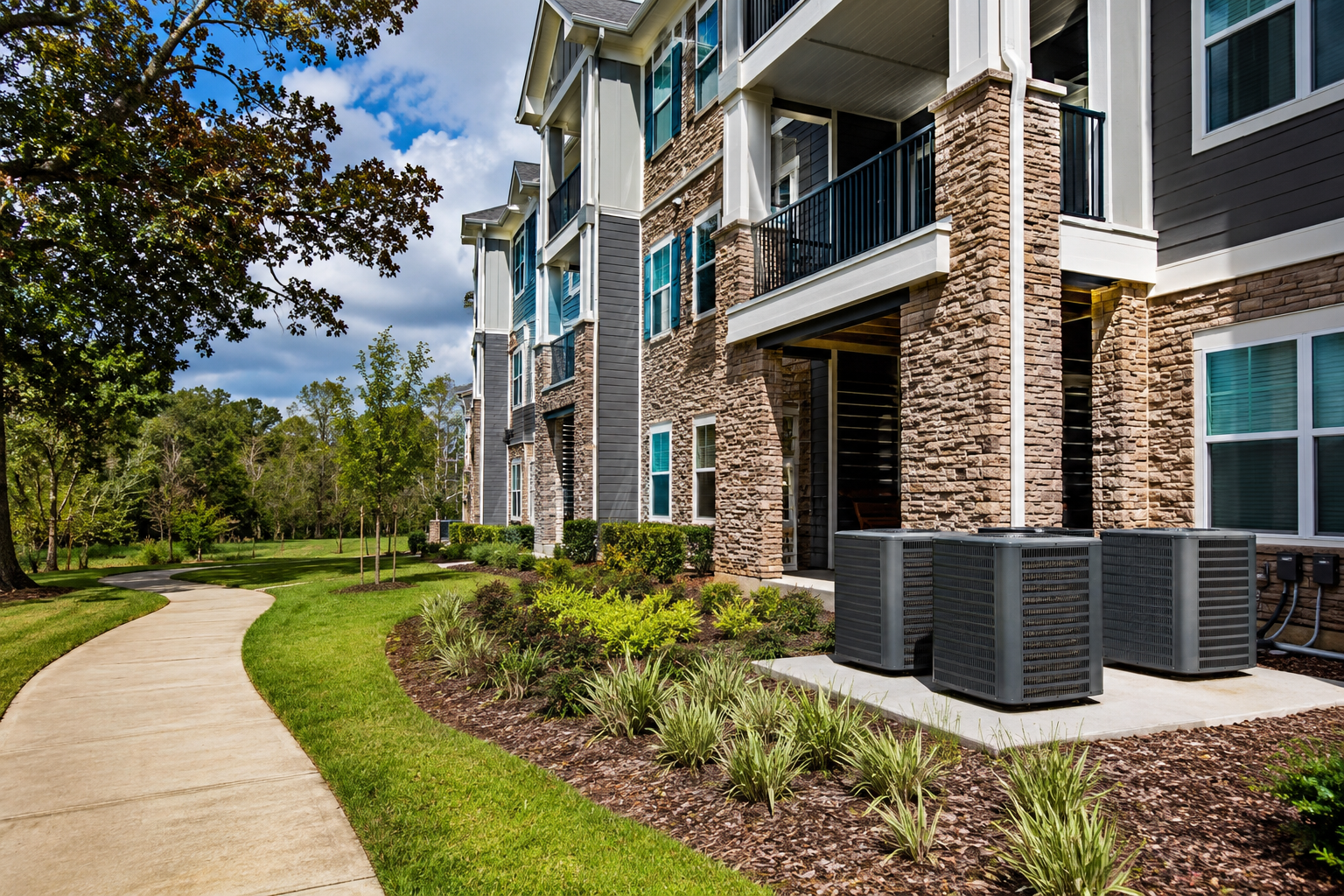
Mechanical equipment. Condensers are the largest single salt-air cost in a rental portfolio because there are so many of them. Coated coils on coastal sites and a routine freshwater coil rinse extend service life across the whole community for a trivial labour cost.
Railings, gates, and exterior metal. High unit count, constant exposure, and visible to every prospective renter who tours the property.
Hardware, hinges, and light fixtures. Individually small, collectively significant. Specifying corrosion-rated hardware at construction costs little; replacing it community-wide in year four does not.
What Humidity Damages Inside the Buildings
The recurring failures are consistent across Northeast Florida multifamily: condensate drains that clog and overflow into the unit below, which in a stacked building means a single clog damages two apartments; bath and laundry exhaust fans that vent into an attic or a chase instead of to the exterior; equipment oversized for the unit load that short-cycles and never dehumidifies; corridors and stairwells that are pressurised or ventilated incorrectly, pushing humid air into units; and vacant units left unconditioned between tenancies during a Florida summer.
That last item is the most common and the most expensive relative to how easy it is to prevent. An unconditioned unit in August accumulates moisture that damages finishes and encourages microbial growth, and the cost of holding a reasonable setpoint is a fraction of the remediation.
What the Handover Package Must Contain
An operator can only run against what they were given. A complete apartment handover includes as-built records showing where shutoffs, panels, cleanouts, and shared system routing actually are; the full equipment schedule with model numbers, capacities, filter sizes, and warranty terms by building; manufacturer maintenance requirements that keep those warranties valid; a written task schedule by interval and by responsible party; consumable specifications so a site crew does not substitute the wrong sealant, filter, or coating; the subcontractor and supplier contact list; and a condition-survey format for use at unit turns.
The warranty point is not academic. Roofing, coating, and mechanical warranties on a multifamily asset are commonly conditional on documented maintenance at stated intervals, and the sums involved are large. An operator who learns about the requirement at the moment of a roof claim has effectively lost the warranty. Owners can verify a contractor’s licence and record through the Florida Department of Business and Professional Regulation before signing a construction or service agreement.
A Maintenance Calendar an Operator Can Actually Run
Quarterly. Filters changed across all units. Condensate lines flushed and safety switches verified. Condenser coils rinsed on coastal sites. Site drainage and gutters cleared. Exterior sealant spot-checked at penetrations.
Twice yearly. Exposed metal, railings, stair connections, and hardware rinsed and inspected for corrosion. Roof inspected at penetrations and drains. Exhaust fans confirmed to move air to the exterior. Water heater connections checked. Corridor and breezeway lighting and egress items verified.
Annually. Full mechanical service by a licensed technician per unit. Structural connector and strap inspection in attics and at exterior stairs. Exterior joint sealant assessed and re-sealed as needed. Fire and life-safety systems tested and documented. Indoor humidity sampled across a set of units to catch a systemic problem early.
Every three to five years. Exterior wash and coating assessment. Detailed roof inspection by a roofing contractor. Windows and doors re-caulked. Equipment service life reassessed against the coastal rating rather than the inland one.
Every seven to ten years. Funded reserves for exterior repainting, staged mechanical replacement, water heater replacement, and roof planning. In a rental asset these should be scheduled events in a reserve study, not emergencies.
The Builder Decisions That Set the Operating Cost
Almost everything above is decided during construction. Corrosion-rated connectors and hardware, coated coils, honest load calculations per unit, exhaust ducted properly to the exterior, accessible cleanouts and shutoffs, and drainage that actually moves water away from the buildings cost very little at the time and repeat their savings across every unit for the life of the asset. An apartment builder thinking about year ten specifies differently from one thinking about the certificate of occupancy.
See how we deliver ground-up residential and multi-unit work on our new construction page, review multi-unit and income-property delivery under commercial construction, or contact Ofir Engineering to discuss a maintenance handover for a project in design.
Frequently Asked Questions
What is the most expensive maintenance failure in a Florida apartment community?
Condensate overflow in stacked buildings, because one clogged line damages the unit it serves and the unit below it, and the same failure repeats across the property. It is prevented by a quarterly flush that takes minutes per unit.
Should vacant apartment units be left unconditioned between tenancies?
No. An unconditioned unit through a Florida summer accumulates humidity that damages finishes and encourages microbial growth. Hold a reasonable temperature and humidity setpoint between tenancies rather than switching the system off.
How far inland does salt air affect an apartment community?
Considerably further than most owners assume. Chloride carries on the prevailing wind, so communities well back from the water in Duval, Nassau, and St. Johns County still see accelerated corrosion on connectors, railings, stair assemblies, and mechanical equipment.
Can a unit turn be used as a maintenance inspection?
It should be. The turn is the only routine opportunity to see inside every unit. Adding a short condition survey — condensate, exhaust airflow, humidity, sealant, hardware — to the turn checklist catches systemic problems while they are still cheap.
Keep Building With Ofir Engineering
Related discussions & follow us: Facebook · Reddit
Latest & related guides: Explore more Custom Home Construction guides →
