A Jacksonville investor buys a house that looks straightforward on paper. Paint, flooring, a kitchen refresh, maybe a bathroom update, then list it. The schedule looks tight but manageable, and the budget still leaves room for profit. Ofir Engineering is a licensed Florida general contractor (License #CGC 1540016) serving homeowners and investors across Jacksonville and Northeast Florida.
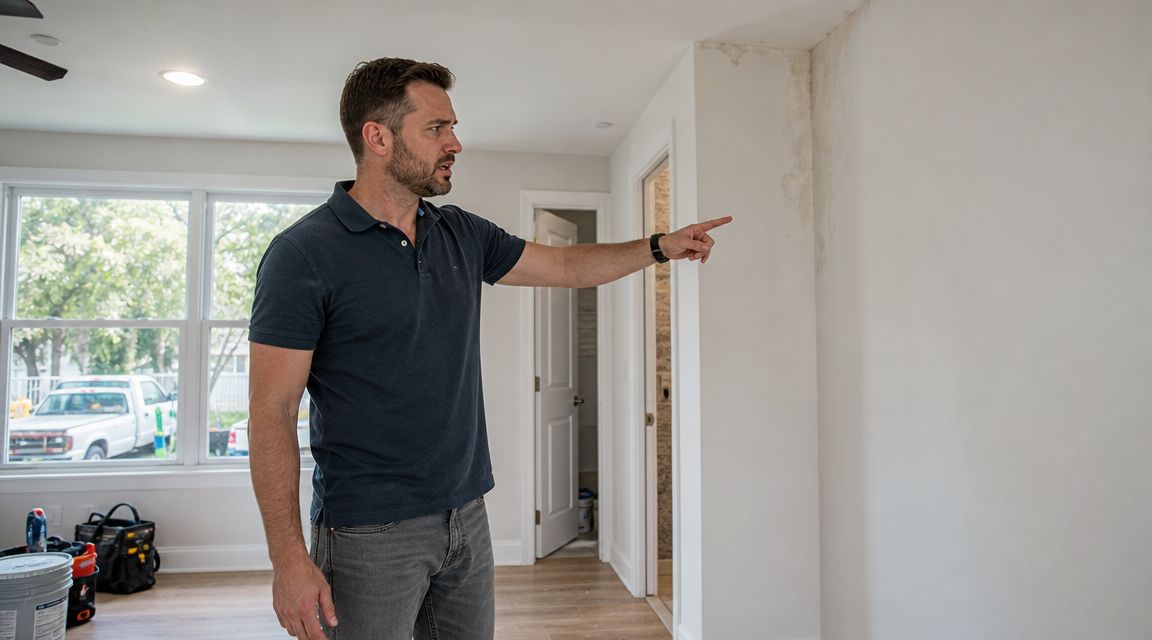
Then a small leak shows up after paint. Someone opens the wall and finds damage that should have been caught earlier. Drywall comes back down, drying and cleanup start, other trades get pushed, and the project loses momentum at exactly the point when it should be moving toward closeout. In Northeast Florida, that kind of miss can also bring moisture concerns that spread beyond a cosmetic repair.
That's why construction quality control matters. It isn't paperwork for its own sake. It's the field discipline that protects your budget, timeline, and resale plan by catching bad work, incomplete work, and hidden risk before those problems get buried.
For homeowners, that means fewer callbacks and fewer surprises after move-in. For real estate investors, it means protecting margin. For property managers, it means avoiding avoidable downtime and turnover delays. In Jacksonville, where renovation work often involves older homes, active occupancy, humidity, storms, and code-sensitive upgrades, quality control has to be practical, consistent, and tied to real field conditions.
Table of Contents
- Introduction Why Every Dollar of Your Investment Depends on Quality
- Understanding Quality Control vs Quality Assurance
- The Core Process of Effective Construction Quality Control
- Key Roles and Responsibilities in Quality Management
- Special Quality Control Needs for Renovations and Fix-and-Flips
- Florida-Specific Standards and Local Jacksonville Codes
- Modern Tools and Metrics for Measuring Quality
- Frequently Asked Questions About Construction Quality Control
Introduction Why Every Dollar of Your Investment Depends on Quality
Most problem jobs don't fail because of one dramatic mistake. They fail because several small misses stack up. A shower pan isn't checked carefully. A window flashing detail gets rushed. A plumbing repair is assumed to be fine because the wall is about to be closed. On a Jacksonville remodel, those misses can turn into water damage, mold concerns, rework, and schedule drift fast.
Owners often think quality means the project looks good at the final walkthrough. That's only part of it. Real construction quality control checks the work while crews can still fix it without tearing finished areas apart. It protects the hidden parts of the project, not just the visible ones.
In investor work, that difference is huge. A rental turn, fix-and-flip, or value-add renovation only works when scope, timing, and execution stay aligned. If a project slips because rough-in work wasn't verified or materials were installed wrong the first time, your carrying costs, leasing plan, or sale timeline all take the hit.
Practical rule: Quality control should reduce uncertainty before it becomes rework.
That's especially true in Northeast Florida. Older housing stock, moisture exposure, storm resilience, repairs tied to permitting, and occupied renovation conditions all create more decision points in the field. Good teams don't rely on a final punch list to catch major issues. They build a process that checks critical work at the right moment.
A strong quality process does three things well:
- Defines acceptance clearly: Everyone knows what acceptable work looks like before installation starts.
- Checks hidden work at the right time: Rough-ins, waterproofing, framing, and tie-ins get reviewed before concealment.
- Documents what happened: Photos, notes, and inspection records protect the owner if questions come up later.
Understanding Quality Control vs Quality Assurance
A lot of owners use QA and QC as if they mean the same thing. On a jobsite, they don't. If you want better project outcomes, it helps to separate them.
What quality control actually means on a jobsite
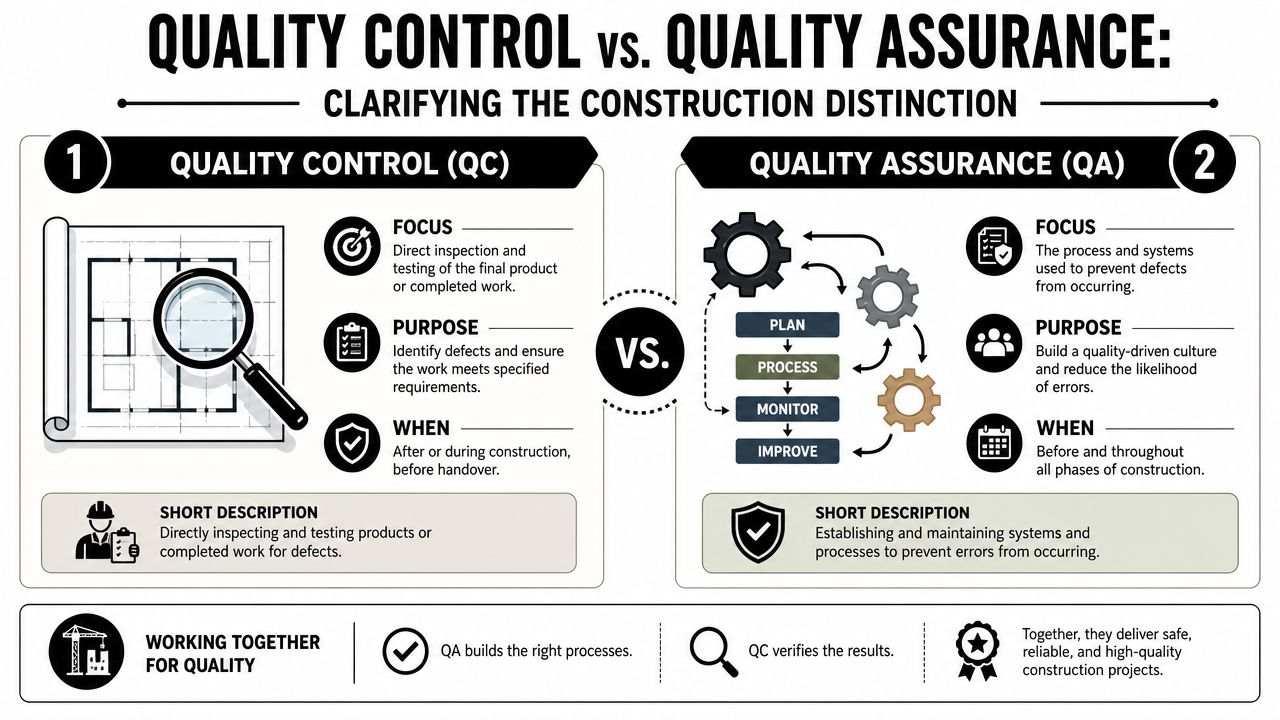
Quality control is the hands-on part. It's the inspection, verification, testing, and field review that checks whether the work installed matches the plans, scope, and expected standard.
That includes things like:
- Rough-in verification: Confirming plumbing, electrical, and HVAC work is correctly placed before walls close.
- Material checks: Making sure the crew installs the specified product, not a substitute that creates downstream issues.
- Finish review: Looking at alignment, operation, fit, and workmanship before the owner inherits the result.
- Correction tracking: Recording deficiencies and confirming they were fixed.
QC is where a superintendent, project manager, foreman, or inspector catches the problem in real time.
How quality assurance supports quality control
Quality assurance is the system behind the field checks. It creates the process that makes quality more likely from the start. That includes the scope review, trade sequencing, standards, approval workflows, and communication rules that shape how the job runs.
A useful way to think about it is this. QA builds the recipe. QC tastes the food while it's being cooked.
If you want a broader operational view beyond construction, this guide to QA for operations managers explains the process mindset well. The same logic applies on a renovation project. Clear workflows prevent confusion, and field verification catches what still slips through.
A simple way to tell the difference
Here's the practical distinction owners should remember:
| Function | Main purpose | Typical timing | What it looks like |
|---|---|---|---|
| Quality assurance | Prevent defects | Before and throughout the project | Standards, workflows, approvals, planning |
| Quality control | Find and correct defects | During and after installation | Inspections, testing, punch review, documentation |
QA without QC becomes theory. QC without QA becomes chaos.
Quality assurance sets the conditions for success. Quality control proves the work actually met the standard.
For investors and homeowners, the takeaway is simple. Don't just ask whether a contractor “cares about quality.” Ask how they plan for it, when they inspect it, and who signs off on critical work.
The Core Process of Effective Construction Quality Control
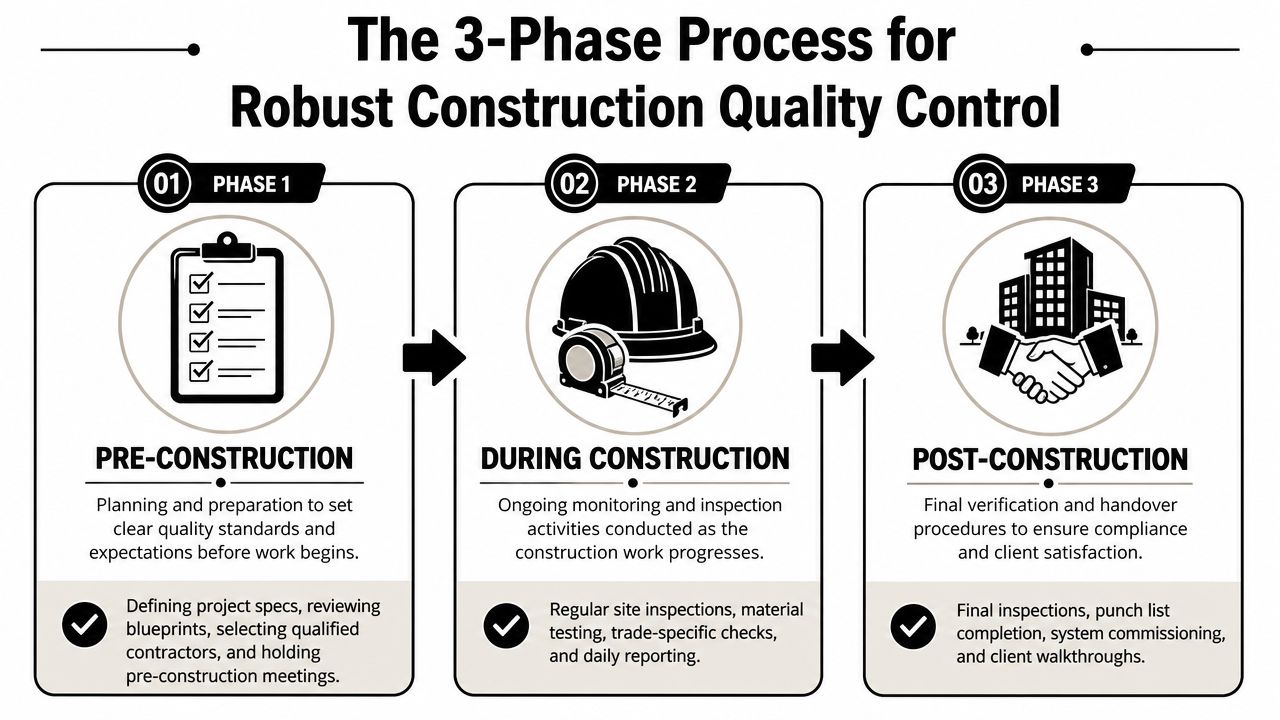
Reliable construction quality control follows a sequence. It doesn't depend on memory, good intentions, or a rushed final walkthrough. The process starts before work begins, gets enforced while the work is open, and finishes with a disciplined closeout.
Pre-construction sets the standard
Quality problems often start before demo or framing. If the team hasn't defined what acceptable work looks like, field crews will fill in the blanks on their own. That usually leads to inconsistent results.
Pre-construction QC should lock down a few basic items:
- Scope clarity: Drawings, finish selections, and performance expectations must match.
- Trade coordination: Mechanical, electrical, plumbing, framing, and finish sequences need to be realistic.
- Inspection planning: The team should know which tasks require review before the next trade proceeds.
- Benchmark installs: On repetitive work, the first completed example should establish the standard for the rest.
This is also the right stage to align everyone around documentation. Photos, field notes, and approval records only help if the team captures them consistently.
A practical reference for owners managing larger scopes is this construction project management guide for Jacksonville homes, which ties planning decisions to execution risk.
In-progress inspections are where projects are won or lost
The field phase is where most quality value gets created. According to the Federal Highway Administration, a robust QC program is built around hold points and first-work inspections, and quality plans should define measurable acceptance criteria and identify inspection points before work is covered up because defects are cheapest to fix while the work is still exposed (FHWA guidance on hold points and inspection timing).
That principle applies just as much to a Jacksonville kitchen remodel as it does to major infrastructure. Once tile, drywall, stucco, flooring, or trim covers a problem, correction gets slower, more expensive, and more disruptive.
A good in-progress QC routine usually includes:
Hold points
Work stops until a critical inspection happens. Think waterproofing before tile, rough plumbing before insulation, or framing corrections before drywall.First-work inspections
The crew completes the first example of a repeated task, then leadership checks it carefully. One window install, one shower assembly, one cabinet run. If that first one is wrong, the team fixes the method before the same mistake spreads.Daily follow-up
Standards drift when supervision drifts. Ongoing spot checks keep the approved method in place.
Here's a useful visual overview of the process in practice.
Post-construction closes gaps before turnover
Closeout isn't just about paint touch-ups. It's the last chance to verify function, completeness, and owner expectations before the property turns over to a buyer, tenant, or occupant.
The best closeout reviews check more than appearance:
- System operation: Doors latch, fixtures function, drains flow, equipment starts and stops correctly.
- Remaining deficiencies: Punch items are tracked to completion, not just listed.
- Documentation handoff: Warranties, manuals, product info, and final records are organized.
- Owner walkthrough: The client sees the finished work with open items clearly identified.
If the project team waited until this stage to discover major defects, the QC process failed earlier. Post-construction should refine and confirm. It shouldn't rescue the job.
Key Roles and Responsibilities in Quality Management
Quality only works when responsibility is clear. If everyone is “watching quality,” nobody really owns it. On renovation and new construction work, the strongest projects define who decides, who checks, who documents, and who corrects.
What the owner or investor should own
The owner doesn't need to inspect every screw or stand over each trade. But the owner should define success clearly. That means setting expectations for scope, finish level, budget priorities, and timeline pressures before the work gets moving.
Owners also need to avoid one common mistake. If you push only for speed, crews will hear that speed matters more than verification. That usually shows up later as callbacks, unfinished details, or concealed defects that cost more to correct.
A smart owner should insist on:
- Clear standards: What level of finish and durability is expected
- Decision discipline: Selections made in time so crews aren't forced to improvise
- Accountability: One party coordinates the work and reports issues plainly
What subcontractors must control
Each trade is responsible for its own workmanship. Electricians, plumbers, framers, roofers, tile installers, and painters should check their own work before asking for review from the general contractor or project manager.
That sounds obvious, but on fast jobs it often breaks down. Crews move to the next task, assuming someone else will catch the issue. Then the correction hits after another trade has already built over it.
Subcontractors should be expected to:
- Build to the approved scope and details
- Flag conflicts before installation
- Correct deficiencies in their own work
- Coordinate with adjacent trades at shared conditions
Why the project manager becomes the quality hub
The general contractor or project manager sits at the center of the quality system. That role matters because one trade's “complete” work often affects another trade's ability to succeed. A project manager coordinates those interfaces, schedules reviews, keeps records, and makes sure deficiencies don't disappear into the noise of a busy site.
On investor and residential work, this is often where hidden value gets protected. The person managing the project isn't just moving the schedule. They're deciding when work is ready for inspection, whether a correction is acceptable, and how to prevent one mistake from repeating across the property.
For projects with many moving pieces, Construction Project Management covers contractor coordination, budgeting, scheduling, renovation oversight, and construction supervision for homeowners and investors in Jacksonville, Florida. Coordination also becomes much easier when trade expectations are documented early, especially around subcontractor coordination.
A quality issue rarely stays inside one trade. Once one crew builds wrong, everyone behind them pays for it.
Special Quality Control Needs for Renovations and Fix-and-Flips
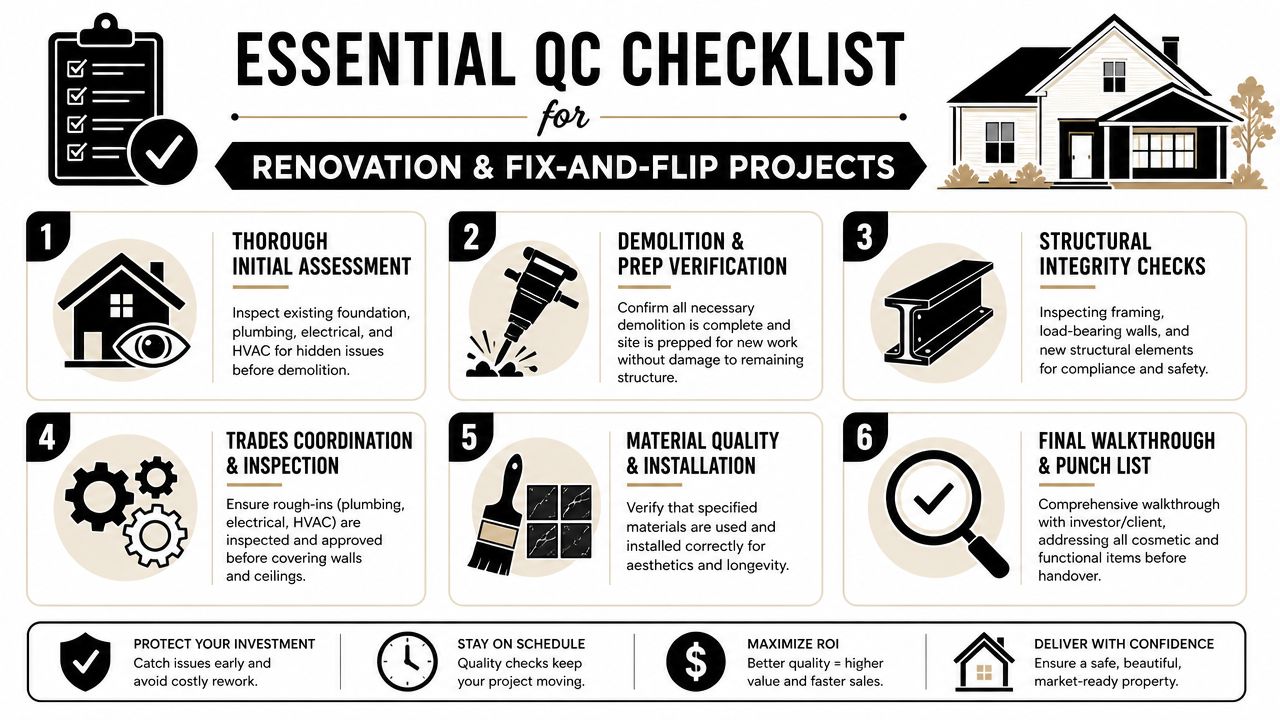
Renovation quality control is different from new construction. That's where many generic guides fall short. A new build starts with mostly known conditions. A remodel starts with assumptions, and demolition tests those assumptions fast.
Renovation quality starts after demolition opens the truth
In older Jacksonville properties, the full scope of work often appears after walls, ceilings, or flooring come out. Framing may not be straight. Prior repairs may not be code-compliant. Plumbing and electrical changes may not match what anyone expected at the walk-through stage.
That's why quality control in renovations needs an active discovery mindset. Independent guidance notes that quality control in renovations is distinct from new builds because it requires verifying hidden conditions after demolition and managing the interface between old and new work, and that failures often come from those connection points rather than the visible finish layer (Document Crunch on renovation QC challenges).
The highest-risk area is the interface between old and new work
The trouble spot usually isn't the new vanity, the new cabinet, or the fresh paint. It's where the new work connects to the old building.
Common examples include:
- New plumbing tied into old drain lines
- Fresh framing attached to existing walls that are out of plane
- Window replacement tied into an older water management assembly
- Electrical upgrades connecting to outdated or altered circuits
- HVAC changes interacting with existing insulation and ventilation conditions
That's why fix-and-flip work can fool inexperienced teams. A house may photograph well at the finish stage while still carrying hidden quality risk behind the surfaces.
In renovations, the visible finish can look perfect while the failure point sits one layer behind it.
A practical checklist for Florida investor renovations
On remodels and value-add projects, the QC plan should stay flexible enough to respond to discoveries in the field. It can't be a static checklist copied from a ground-up build.
A practical renovation-focused QC approach includes:
- Before demolition: Verify the likely risk areas, including moisture exposure, damaged framing, outdated systems, and prior patchwork repairs.
- After selective demo: Reinspect immediately. Don't let crews rush into covering conditions that just became visible.
- At rough-in stage: Confirm that new work aligns physically and functionally with existing systems.
- Before concealment: Review tie-ins, blocking, flashing, waterproofing, and penetrations carefully.
- At finish stage: Check not just appearance, but function and transitions between old and new surfaces.
- At turnover: Make sure the buyer, tenant, or owner inherits a property that operates as intended.
For local investors, Construction Services For Investors describes construction and remodeling services in Jacksonville and Northeast Florida focused on renovation management, project coordination, budget control, and maximizing investment returns.
Florida-Specific Standards and Local Jacksonville Codes
In Florida, quality isn't just a workmanship issue. It's also a durability and compliance issue. A project can look clean on the surface and still fail the ultimate test if it doesn't handle wind, water, humidity, and local inspection requirements properly.
Wind and water matter as much as finish quality
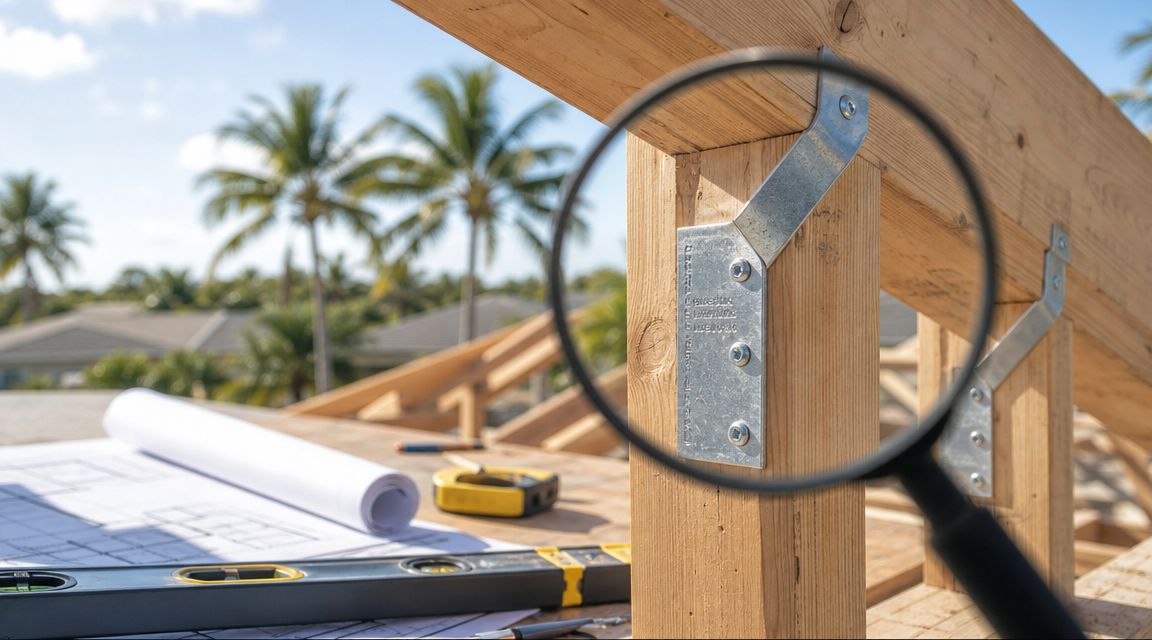
Jacksonville projects need field attention around weather-exposed details. Roof-to-wall connections, window and door installation, flashing, sealants, exterior transitions, and drainage details all deserve closer review than many investors expect.
If those details are weak, the property may still pass a casual visual check while carrying future risk. That's one reason code awareness belongs inside quality control, not outside it. Teams should verify what was installed, not assume permit drawings automatically translated into field execution.
For owners trying to understand the approval side of the process, this overview of Florida permit requirements helps frame where inspections and scope compliance affect project delivery.
Moisture control needs active field verification
Humidity changes how mistakes behave. In Northeast Florida, moisture intrusion and poor drying conditions can turn a small envelope miss into a larger interior problem. Bathrooms, laundry rooms, kitchens, exterior penetrations, window replacements, and roof transitions all need careful inspection before finishes hide them.
On occupied remodels, quality control also has to account for temporary protection. If a team exposes a structure during a phased renovation, they need a plan for weather protection, dust control, and safe sequencing around occupants.
Contractor risk management matters here too. Owners often focus on the build itself, but insurance and liability planning are part of a sound project setup. This overview of Tampa contractors general liability insurance is useful for understanding how coverage fits into contractor selection and project protection.
Documentation protects the project after the work is done
Inspections don't end when the city signs off. Good documentation protects owners when questions arise later about concealed conditions, repair responsibility, or whether work was completed as specified.
That record should include:
- Progress photos of concealed work
- Notes tied to corrections and approvals
- Material records and product information
- Final closeout items organized for future reference
In Florida, especially on investment properties, that documentation can make later maintenance, resale disclosure, insurance conversations, and tenant turnover decisions much cleaner.
Modern Tools and Metrics for Measuring Quality
A final walkthrough tells you what the project looks like at the end. It doesn't tell you whether the quality process worked along the way. That's why better teams measure quality during the job, not just after it.
The best teams track leading indicators
Industry guidance increasingly treats digital capture and analytics as part of practical QC, not just admin work. One useful summary is that data-driven quality control uses digital capture and analytics to move beyond manual checklists, and that leading indicators such as rework rate, punch-list aging, and first-pass acceptance rates help teams spot recurring problems and build a lessons-learned loop for future projects (CMiC overview of data-driven construction QC).
Those indicators matter because they show whether defects are getting caught early or pushed downstream.
A few examples:
- Rework rate: Shows whether crews are getting it right the first time or repeatedly redoing tasks.
- Punch-list aging: Shows whether closeout problems are being resolved promptly or allowed to sit.
- First-pass acceptance: Shows whether inspected work is typically ready when presented for approval.
Digital records make quality easier to verify
Paper checklists still exist, but digital tools are easier to search, share, and audit later. Mobile photo capture, location-based notes, and trade-specific checklists create a clearer record of what was inspected and when.
That also helps with portfolio-level decisions. If an investor runs multiple renovations, patterns start to emerge. One trade may repeatedly miss the same detail. One scope item may create most of the punch friction. Once those patterns are visible, the team can adjust methods earlier on the next project.
Frequently Asked Questions About Construction Quality Control
Is construction quality control only for large commercial projects
No. Small residential remodels need it just as much, and often more, because the margin for error is tighter. In a bathroom, kitchen, addition, or fix-and-flip, one missed waterproofing or rough-in issue can affect several trades at once.
What should an investor ask a contractor about quality control
Ask when critical work gets inspected, who approves it, how deficiencies are documented, and how the team handles concealed conditions on renovation projects. If the answer is basically “we look at it as we go,” that isn't a system.
Does city inspection replace private quality control
No. Municipal inspection and project quality control are different functions. City inspectors verify code-related items. Your project team still needs to verify workmanship, sequencing, scope compliance, and finish quality.
When is the most important time to inspect work
Before it gets covered. Hidden work carries the most risk because later correction usually means demolition, delay, and added cost. That's why rough-ins, waterproofing, framing corrections, and exterior weather details deserve close field attention.
How does quality control protect ROI on a Jacksonville renovation
It protects ROI by reducing avoidable rework, preventing delays from concealed defects, and helping the finished property hold up better in Florida conditions. For investors, that means fewer surprises between acquisition and sale or lease-up. For homeowners, it means a remodel that performs as well as it looks.
If you're planning a remodel, fix-and-flip, tenant improvement, or new build in Jacksonville or Northeast Florida, Ofir Engineering can help structure the job with clear oversight, contractor coordination, and practical quality control that protects budget, schedule, and long-term property value.
Meta title: Construction Quality Control for Florida Investments in Jacksonville
Meta description: Learn how construction quality control protects ROI on Jacksonville renovations, remodels, and investment projects. Practical guidance for Florida owners and investors.
Focus keyword: construction quality control
Suggested internal linking opportunities
- Investors page
- Project Management page
- Home Remodeling page
- Construction services pages
- Related blog articles on permitting, budgeting, subcontractor management, and renovation ROI
Suggested image ideas and alt text
Hero image filename: construction-quality-control-jacksonville-florida.jpg
Alt text: Construction quality control inspection on a renovation project in Jacksonville Florida
Description: Project manager reviewing renovation workmanship inside a residential property in Northeast Florida
Recommended size: 1731 x 909 pixelsSecondary image filename: renovation-qc-checklist-jacksonville-investor.jpg
Alt text: Renovation quality control checklist for Jacksonville real estate investors
Description: Clipboard, plans, and site inspection tools on an active Florida remodel
Recommended size: 1731 x 909 pixelsSecondary image filename: florida-remodel-moisture-control-inspection.jpg
Alt text: Florida remodel inspection focusing on moisture control and window flashing
Description: Close-up of field verification for exterior waterproofing details on a Jacksonville home
Recommended size: 1731 x 909 pixels
