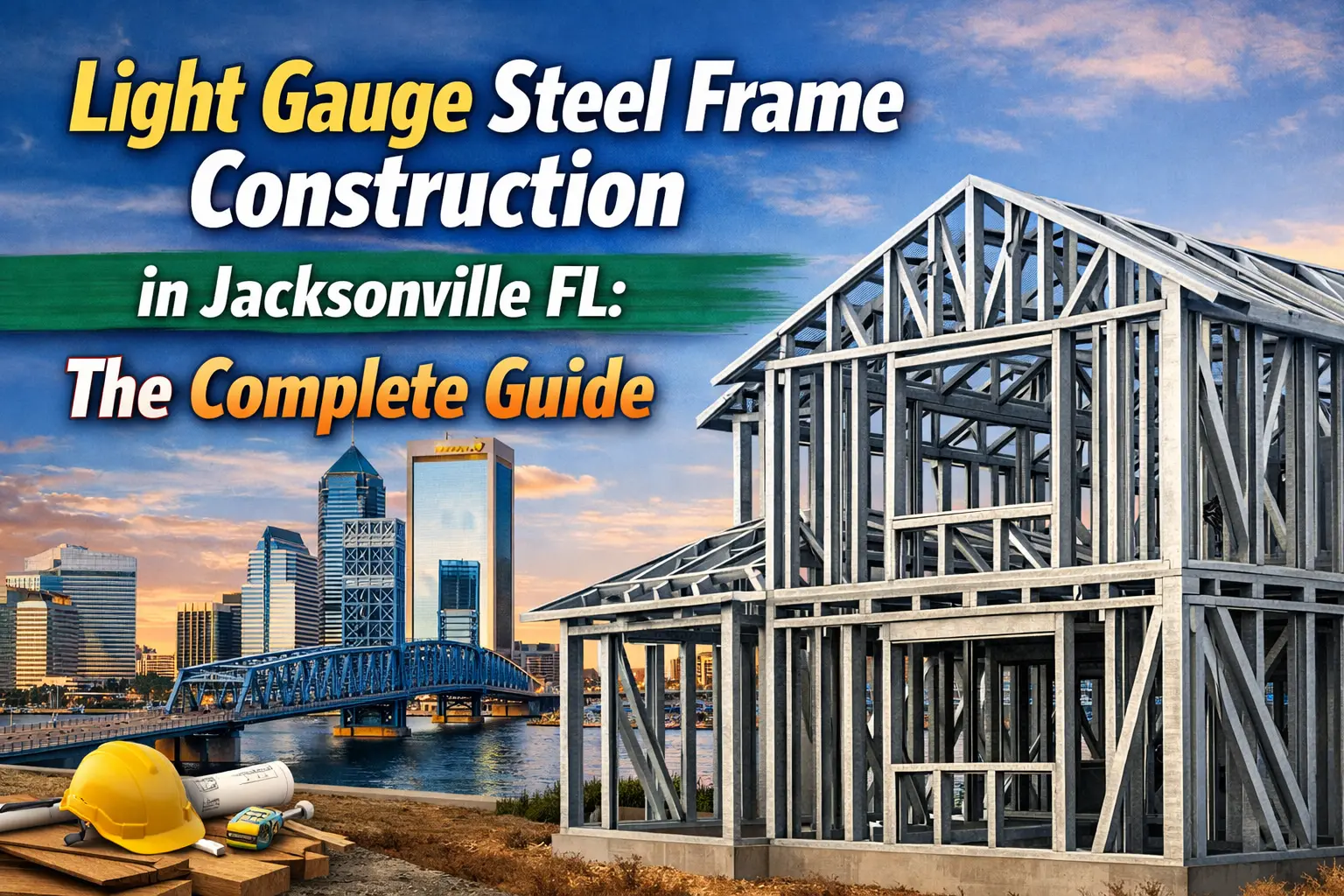
Light Gauge is an important decision for Jacksonville and Northeast Florida property owners. Ofir Engineering — a licensed Florida general contractor (CGC 1540016) based in Jacksonville — pairs real construction experience with investor-focused project management.
| Whether you are building a single-family home in Riverside, a multi-unit complex in Southside, or a commercial shell in the suburbs of Duval County, one construction method is rapidly gaining traction across Northeast Florida: light gauge steel framing. |
This guide covers everything you need to know about light gauge steel frame construction in Jacksonville — from the basics of what it is and how it works, to local cost expectations, Florida Building Code considerations, and how to find a qualified contractor who can execute the build correctly.
What Is Light Gauge Steel Frame Construction?
Light gauge steel framing (LGSF) uses thin, cold-formed steel members — channels, studs, joists, and tracks — to create the structural skeleton of a building. Unlike traditional wood framing, the steel components are roll-formed from coated steel coils at a manufacturing facility, then cut to specification and assembled on-site or in a prefabrication yard.
The term “light gauge” distinguishes it from the heavy structural steel used in high-rise construction. Residential and low-rise commercial LGSF typically uses steel with a thickness between 18 and 25 gauge, making individual members lightweight and easy to handle while delivering exceptional structural integrity when assembled as a system.
Cold-formed steel has been a staple of commercial interior construction for decades — think the metal studs used in office partition walls. What has changed in recent years is its expanding use as the primary load-bearing framing system in residential and mixed-use buildings, particularly in coastal markets like Jacksonville where the limits of wood construction are well understood.
Why Jacksonville’s Climate Makes LGSF the Smart Choice
Northeast Florida presents a building environment that stresses conventional wood framing in ways that builders in drier climates rarely encounter. Jacksonville sits in ASCE 7 wind zone territory, meaning structures must meet elevated lateral load requirements. The combination of heat, humidity, and hurricane-season wind events creates conditions that shorten the effective lifespan of untreated wood and accelerate moisture-related degradation inside wall cavities.
Light gauge steel addresses each of these challenges directly:
- Steel does not rot. In a climate where relative humidity routinely exceeds 80 percent and summer rainstorms are frequent and intense, the ability to build with a moisture-immune framing material eliminates one of the primary sources of long-term maintenance costs and structural failure.
- Steel does not provide a food source for termites or other wood-destroying insects. Subterranean termites are endemic to Duval County, and treatment and remediation costs represent a significant lifetime expense for wood-framed structures in the region.
- Cold-formed steel framing, when engineered correctly, performs exceptionally well under wind uplift and lateral loading. Buildings designed to Florida Building Code wind speed requirements benefit from steel’s strength-to-weight ratio and its ability to be connected with high-strength fasteners and clips that maintain integrity under cyclic loading.
- Steel is dimensionally stable. Unlike wood, it does not warp, shrink, or swell with seasonal humidity cycles. Doors and windows remain square; drywall cracks less; finishes last longer.
Cost of Light Gauge Steel Frame Construction in Jacksonville
One of the most common questions builders and homeowners ask is whether LGSF costs more than wood framing. The honest answer is: it depends on how you define cost.
Upfront Construction Cost
Material costs for light gauge steel framing typically run $8 to $14 per square foot for the framing package, compared to $6 to $10 per square foot for dimensional lumber in the Jacksonville market as of 2024. Labor costs are comparable or slightly higher, since LGSF requires workers familiar with self-drilling screws, track systems, and steel-specific layout techniques.
On a 2,500-square-foot home, you might see a framing cost premium of $10,000 to $20,000 for steel over wood. For a mid-size commercial shell, the premium narrows significantly as project scale allows for greater prefabrication efficiency.
Lifetime Cost
The calculation shifts substantially when you extend the analysis over the building’s lifetime. Termite treatments, wood rot remediation, moisture damage repairs, and hurricane damage to wood-framed structures represent real costs that LGSF avoids. Insurance carriers are beginning to recognize this, and some offer reduced premiums for steel-framed structures in wind exposure categories common to coastal Florida.
Additionally, energy efficiency in a well-insulated steel-framed building can reduce HVAC operating costs, which in Jacksonville’s climate is one of the largest drivers of household expenses.
Florida Building Code and Duval County Permitting
All construction in Jacksonville falls under the Florida Building Code (FBC), 8th Edition, with Duval County adopting state standards along with local amendments. Light gauge steel frame construction must comply with AISI S100, the North American Specification for the Design of Cold-Formed Steel Structural Members, which is referenced in the FBC.
Key permitting considerations for LGSF projects in Duval County include:
- Engineered drawings are required. Unlike simple wood-frame structures that can sometimes proceed with prescriptive compliance, LGSF buildings generally require stamped structural drawings from a licensed Florida Professional Engineer (PE).
- Wind speed exposure category matters. Jacksonville’s coastal proximity places much of the county in Exposure Category C or D, requiring higher design wind speeds. Your engineer must account for this in the connection schedule and stud spacing.
- Energy code compliance (FBC Energy, current edition) must be demonstrated regardless of framing material. Thermal bridging through steel studs is a real phenomenon, and continuous insulation strategies are commonly specified.
- The Duval County Building Inspection Division reviews and issues permits. Processing times vary; plan for a minimum of four to eight weeks for residential projects and longer for commercial.
Applications for LGSF in the Jacksonville Market
Light gauge steel framing is appropriate for a wide range of projects common in the Jacksonville development landscape:
- Single-family custom homes, particularly in flood-prone or coastal areas where moisture resistance is paramount
- Townhome and villa communities where repetitive framing and prefabrication economics make steel especially competitive
- Assisted living and healthcare facilities, where fire ratings, dimensional stability, and long-term maintenance costs are critical decision factors
- Retail and restaurant build-outs, including the metal stud interior framing that has been standard in commercial construction for decades
- Multi-family apartment buildings up to four stories, where LGSF provides an economical path to non-combustible construction
How to Choose a Light Gauge Steel Frame Contractor in Jacksonville
The quality of your LGSF project depends heavily on the contractor’s familiarity with the system. Cold-formed steel framing is a distinct trade from wood carpentry, and a crew experienced only in platform framing will make costly errors when transitioning to steel.
Look for contractors who can demonstrate:
- Completed LGSF projects in Northeast Florida with verifiable references
- Relationships with licensed structural engineers who specialize in cold-formed steel design
- Knowledge of AISI standards and Florida Building Code compliance requirements
- Experience coordinating with MEP (mechanical, electrical, plumbing) trades, who must adapt their rough-in methods for steel framing
| For a detailed guide on vetting contractors, evaluating bids, and avoiding common red flags, see our companion post: Steel Frame Builders in Jacksonville, Florida: How to Choose. |
Light gauge steel frame construction is not a trend — it is a durable, technically sound building methodology that is particularly well-suited to Jacksonville’s coastal climate, regulatory environment, and long-term ownership economics. Builders and developers who understand its advantages are better positioned to deliver projects that outperform wood-framed alternatives over the full life of the structure.
Frequently Asked Questions About Light Gauge Steel Framing
What is light gauge steel frame construction?
Light gauge steel framing uses thin, cold-formed steel studs and joists instead of wood to build the structural frame. It is dimensionally stable, non-combustible, termite- and rot-proof, and well suited to Florida’s humidity and wind loads.
Is steel framing more expensive than wood in Florida?
Material costs are often modestly higher than wood, but steel can offset that through durability, lower maintenance, insurance advantages, and resistance to termites, moisture, and hurricanes, making lifetime cost competitive, especially in coastal Northeast Florida.
Is light gauge steel framing good for hurricanes?
Yes. Steel’s high strength-to-weight ratio and consistent material properties make it excellent for resisting high winds when engineered and connected properly, which is a major advantage in Jacksonville and coastal Florida.
Does steel framing rust in Florida’s climate?
Modern light gauge steel is galvanized to resist corrosion, and with proper detailing, moisture control, and a well-built envelope it performs reliably in Florida’s humid, salt-air conditions for decades.
