
If you're staring at a Jacksonville property and trying to decide whether to replace the front door, rework the kitchen, or gut half the house, you're asking the right question. Home renovation ROI isn't just about what looks better after construction. It's about whether the money you put into the property comes back to you through resale value, rentability, lower operating costs, or fewer future repairs.
With Florida contractor license CGC 1540016 and deep local experience, Ofir Engineering serves Jacksonville, Ponte Vedra, and the surrounding Northeast Florida communities.That decision matters even more in Northeast Florida. In this market, buyers notice curb appeal fast, insurers care about condition and resilience, and holding costs can eat your margin if a project drifts. National data gives a useful baseline, but local execution is what separates a profitable renovation from an expensive lesson. I see that all the time with investors who overbuild for the block, choose the wrong materials for Florida humidity, or lose weeks in permitting and trade coordination.
The broader spending backdrop shows why this topic keeps growing. The National Association of REALTORS® reported that home improvement and repair spending rose from $404 billion in 2019 to $611 billion in 2022, and it was expected to remain above $600 billion through 2025. Harvard's Joint Center for Housing Studies also estimated spending increased from $328 billion in 2019 to $472 billion in 2022, with 2024 spending estimated at $485 billion (NAR remodeling data). Renovation decisions are happening inside a large, durable market. The issue isn't whether owners are spending. It's whether they're spending with discipline.
A good primer on getting money back on home renovations helps frame the basic resale side of the discussion, but the actual work starts when you apply those ideas to Jacksonville comps, permitting realities, labor sequencing, and buyer expectations.
Table of Contents
- Introduction What Is Home Renovation ROI and Why It Matters in Jacksonville
- The Simple Formula for Calculating Renovation ROI
- Which Renovations Offer the Best ROI in the Jacksonville Market
- Pro Strategies to Maximize Renovation Returns
- Real-World ROI Case Studies in Northeast Florida
- The Investor's Pre-Renovation ROI Checklist
- Frequently Asked Questions about Home Renovation ROI
- What renovation usually gives the best return in Jacksonville
- Is a major kitchen remodel worth it for investors
- How long does it take to see renovation ROI
- What hurts ROI most in Northeast Florida
- Are exterior upgrades really that important
- Should I manage the renovation myself or hire project oversight
- Does home renovation ROI matter if I'm not selling soon
Introduction What Is Home Renovation ROI and Why It Matters in Jacksonville
A Jacksonville investor buys a dated block house, budgets for cosmetic updates, then loses margin to permit delays, moisture damage behind the shower walls, and finish selections that overshoot the neighborhood. The project still gets done. The return shrinks because execution went off course.
That is home renovation ROI in practice. It is the gain you get from a renovation compared with the full cost of doing the work. For investors, that usually means resale value, time on market, rent strength, and carrying cost. For owner-occupants, it can also include lower maintenance, better function, and fewer expensive repairs later.
In this market, ROI is shaped by more than the room you choose to remodel. Jacksonville has older housing stock in neighborhoods like Riverside and Avondale, coastal exposure near the Beaches, and buyer expectations that change sharply from one ZIP code to the next. A project with the right scope can perform well. The same budget, managed poorly, can get tied up in rework, schedule drift, and upgrades the buyer never pays for.
I tell investors to treat ROI as a jobsite management problem first and a design problem second.
That means asking practical questions early. Who is the end buyer or tenant. What condition issue is dragging value today. How fast does the property need to be turned. Those answers affect finish level, scope control, and material selection. They also affect whether it makes sense to spend more upfront on durable assemblies, including options like light-gauge steel in the right application, to reduce callbacks, moisture risk, and long-term maintenance.
Good ROI work is disciplined, not flashy. A clean exterior package, a corrected layout bottleneck, or a moisture-resistant material spec often outperforms a bigger renovation with weak planning. Investors focused on getting money back on home renovations usually do better when they match the project to neighborhood comps, keep the permit path clear, and protect the schedule from day one.
In Northeast Florida, climate raises the stakes. Heat, humidity, wind exposure, and salt air punish cheap materials and rushed installs. If you are flipping, speed and resale alignment drive the numbers. If you are holding, durability and operating cost matter more. Either way, the strongest returns usually come from the same place: tight scope, smart materials, reliable trade coordination, and a plan built for Jacksonville rather than a generic national remodeling playbook.
The Simple Formula for Calculating Renovation ROI
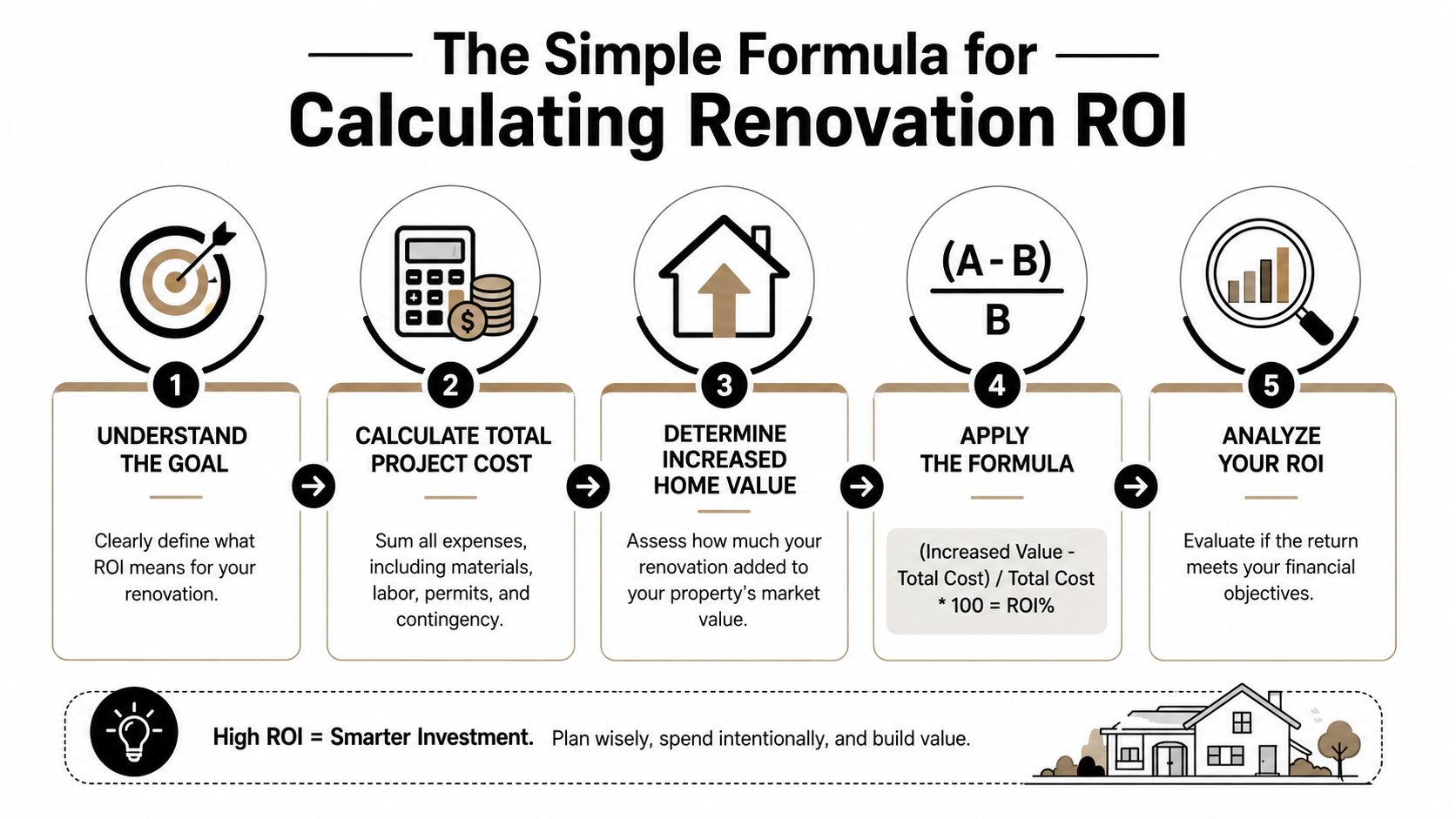
The basic formula is simple:
ROI = (Value Added – Total Project Cost) / Total Project Cost x 100
That gives you a resale-focused percentage. It works, but only if your cost number is honest and your estimate of value added is grounded in local comps.
Start with total project cost
Most owners undercount this side of the equation. They remember cabinets and flooring, then forget permit fees, design revisions, dumpster pulls, change orders, temporary weather protection, and the cost of waiting on one trade to finish before the next can start.
Your total project cost should include:
- Construction labor for every trade involved
- Materials and fixtures, including freight and waste
- Permits and inspections required by the local jurisdiction
- Project management and site supervision
- Contingency for hidden conditions once walls or finishes are opened
- Carrying costs if you're an investor holding the property during construction
If you need a more room-specific budgeting reference, this guide on cost to remodel a room in Jacksonville helps frame where scope usually expands.
For owners comparing broader renovation options, Home Remodeling Jacksonville covers the types of projects commonly managed by licensed contractors in this market, including kitchens, bathrooms, flooring, interior upgrades, and full residential renovations.
Measure value in more than one way
A lot of home renovation ROI advice stops at resale percentage. That misses an important Florida reality. A frequently missed angle in this topic is time-to-payback, not just resale ROI. A project with 60% to 70% resale ROI can still be a rational investment if it cuts utility bills or improves daily use over several years, which is especially relevant in markets with high energy costs like Florida (time-to-payback discussion).
That means you should run two lenses:
- Resale ROI for flips, refinances, or near-term sales
- Payback period for long-term holds and primary residences
If the work includes solar-related planning, this resource can help you understand solar payback and incentives before folding those assumptions into your broader renovation math.
A low resale percentage doesn't automatically make a project a bad decision. If it reduces operating costs, prevents future capital expenses, or fixes a chronic performance issue, it can still be a strong investment.
In practical terms, a Jacksonville investor should ask whether the renovation increases sale price, reduces days lost to rework, avoids future remediation, or makes the property easier to insure, lease, or maintain. That's the formula in the field.
Which Renovations Offer the Best ROI in the Jacksonville Market
An investor buys a dated Southside house, puts $70,000 into a full custom kitchen, and expects the resale price to carry the job. Then the property sits because the front elevation still looks tired, the roof age raises questions, and the finish level overshoots the neighborhood. I see that pattern more often than I should. In Jacksonville, the best ROI usually comes from matching the scope to the submarket and running the job tightly from day one.
Project type matters. Execution decides whether the return stays intact.
Across this market, smaller exterior upgrades and disciplined interior refreshes usually outperform big, design-heavy remodels. Buyers respond fast to visible condition, low future hassle, and clean presentation. That is why a garage door, entry door, facade cleanup, flooring continuity, and a modest kitchen update often produce better outcomes than a full gut renovation with premium finishes.
Here is a practical comparison for Jacksonville investors.
| Renovation Project | Estimated Cost Recouped (ROI) | Notes for Jacksonville Investors |
|---|---|---|
| Garage door replacement | High | Strong curb appeal move on suburban inventory where the garage dominates the front elevation. Fast install and limited disruption help protect holding costs. |
| Steel door replacement | High | Small scope with clear visual impact. Works well for flips, rentals getting turned, and pre-listing refreshes. |
| Manufactured stone veneer | High in the right setting | Best used selectively on homes with flat or dated facades. Easy to overdo on lower price-point properties. |
| Minor kitchen remodel | Strong | Usually the best interior value move when the layout works and the update focuses on cabinets, counters, lighting, and hardware. |
| Major kitchen remodel | Lower and less predictable | Carries higher over-improvement risk, especially in mid-market Jacksonville neighborhoods where buyers want clean and current, not custom. |
The pattern behind that table is straightforward. High-return projects tend to be easier to estimate, easier to schedule, and less exposed to change orders. Once a job involves layout changes, long-lead materials, permit revisions, or specialty finishes, the margin gets thinner.
That is the part many ROI guides skip.
A kitchen is not automatically a good investment because national summaries say kitchens sell houses. In Jacksonville, the return changes based on whether the cabinet boxes can stay, whether plumbing stays in place, whether you pick stocked materials instead of imported selections, and whether the property will compete against updated homes or against basic clean inventory. The management decisions drive the result.
For a broader local breakdown, see this guide on what renovations add the most value in Jacksonville.
Jacksonville factors that change the decision
Neighborhood fit comes first.
In Riverside, Avondale, Murray Hill, and other older areas, buyers usually want updates that respect the house. Good ROI comes from improving function without stripping out character. Reworking every finish into a glossy modern package can hurt the resale story if the architecture says something different.
In newer suburban pockets of Jacksonville and St. Johns County, the priorities shift. Clean curb appeal, durable flooring, bright interiors, neutral kitchens, and bathrooms that feel fresh usually do more for value than custom millwork or high-end tile details.
Coastal properties add another layer. Material failure shows up faster near salt air and constant moisture exposure. That affects ROI because replacement cycles shorten when the wrong products get installed. I pay close attention to exterior hardware, fasteners, door systems, trim products, and framing details in those areas. Light-gauge steel can make sense in selected scopes where moisture resistance, dimensional stability, and long-term durability matter more than lowest first cost.
A few renovation categories usually perform well in Northeast Florida when the scope matches the property and the job is managed well:
- Exterior refreshes: Front doors, garage doors, paint, trim repair, shutters, lighting, and facade cleanup improve first impressions fast.
- Minor kitchen upgrades: Cabinet replacement or refinishing, counters, sinks, fixtures, and lighting usually beat a full reconfiguration unless the layout is clearly broken.
- Bathroom improvements: Strong returns come from fixing visible wear, poor lighting, dated tile, and weak storage, not from building a spa that the neighborhood will not pay for.
- Roofing and storm-readiness work: These items reduce buyer hesitation and can keep deals together during inspection and insurance review.
- Durability upgrades: Better exterior materials, moisture-resistant assemblies, and low-maintenance selections can improve returns by cutting future repair exposure.
The common thread is buyer confidence. Jacksonville buyers and appraisers notice condition, consistency, and durability. They do not reward every dollar spent.
Buyers in Jacksonville pay for a house that looks cared for, shows cleanly, and feels low-risk to own. That usually comes from smart scope control, practical materials, and solid project management more than from expensive finishes.
Pro Strategies to Maximize Renovation Returns
A Jacksonville investor can choose the right project category and still miss the return if the job runs long, the scope drifts, or the finish package overshoots the neighborhood. I see that more often than bad project selection. ROI is usually won in preconstruction, purchasing, sequencing, and permit handling.

Control scope before demolition starts
The cleanest budgets are set before the first cabinet comes out or the first wall opens up. Once demolition starts, every surprise and every optional upgrade gets more expensive because it affects labor, schedule, and follow-on trades.
Use a simple filter for every line item:
- Fix a defect that will hurt value or inspection results
- Improve what buyers notice during a showing
- Lower future ownership risk, especially around water, wear, and maintenance
If a scope item does not do one of those jobs, it usually does not belong in an investment renovation.
That is why plain work often performs better than flashy work. Fresh paint, repaired trim, corrected lighting, working doors, clean flooring transitions, and a kitchen that looks cohesive can do more for resale than a full redesign with custom details the buyer pool will not pay for. As noted earlier, industry guidance consistently points sellers toward visible condition improvements first.
A practical outside perspective can also help. This guide offers expert advice to maximize property value with a similar emphasis on improvements buyers notice before sale.
Choose materials for Florida conditions
Material selection affects ROI twice. It affects the upfront budget, and it affects how the house performs after closing or during a rental hold period.
In Northeast Florida, cheap materials can create expensive problems. Humidity swells the wrong products. Exterior trim and doors take a beating. Salt air near the coast shortens the life of lower-grade hardware and coatings. I would rather value-engineer a finish package early than replace failing materials a year later.
A few examples matter in this market. Flooring should handle humidity, traffic, and easier turnover cleaning. Exterior products should be chosen for sun, rain, and maintenance reality, not showroom appeal alone. Cabinet boxes, paint systems, and bath finishes should be selected for service life, not just first cost. On larger renovations, Light Gauge Steel can make sense where straightness, moisture resistance, fire performance, and long-term dimensional stability affect the ownership equation.
If the work is extensive and involves multiple trades, Construction Project Management is one route owners use for contractor coordination, budgeting, scheduling, renovation oversight, and construction supervision in Jacksonville.
Good material selection is about service life, replacement risk, and fit for the target buyer. The cheapest package on bid day often costs more by the time the property sells.
Protect the schedule and the permit path
Schedule control has a direct effect on margin. Every extra week can add carrying costs, extend financing, delay leasing or resale, and create more opportunities for punch-list creep.
In Jacksonville, that starts with the permit path. Scope that triggers plan review, structural review, or multiple inspections needs to be priced and scheduled accordingly. A minor kitchen refresh that stays inside the existing layout usually moves faster than a redesign that relocates plumbing, electrical, and walls. The second option may look better on paper and still produce a weaker return after permit time, trade stacking, and holding costs are counted.
Trade sequencing matters just as much. Cabinets ordered late hold up countertops. Electrical changes can delay drywall. Roofing, windows, and exterior repairs need to be timed around interior protection and inspection windows. Strong ROI often comes from boring discipline. Clear scopes, approved selections, realistic lead times, and a superintendent or project manager who keeps trades moving in the right order.
This short video is a useful reminder that returns are often won or lost in planning, not just in design choices.
Treat project management like part of the investment strategy. In this market, the return is shaped by scope control, Florida-appropriate materials, clean permitting, and schedule discipline as much as by the room you choose to renovate.
Real-World ROI Case Studies in Northeast Florida
Case study one Riverside investor flip
An investor buys a dated Riverside house with solid bones, old finishes, and weak curb appeal. The first instinct is a full interior transformation. That would likely create a longer schedule, more permit exposure, and a higher chance of over-improving for the buyer pool.
A better strategy is tighter. The investor keeps the existing kitchen footprint, updates cabinet fronts or finishes, replaces counters and hardware, improves lighting, refinishes or replaces flooring where needed, paints the full interior, and upgrades the entry sequence outside. The facade gets cleaned up, the front door is replaced, and deferred maintenance items are handled before listing.
What drives ROI here isn't one magic room. It's disciplined alignment. The house shows well, the buyer sees condition rather than work, and the investor avoids sinking money into a custom layout the neighborhood may not reward. In older Jacksonville neighborhoods, that combination often performs better than a flashy gut remodel that wipes out margin.
Case study two St Johns owner-occupant remodel
A family in St. Johns plans to stay for years. Their primary suite and kitchen no longer work well, but resale isn't the only goal. They need better daily function, lower maintenance, and materials that hold up to Florida conditions.
Instead of chasing purely cosmetic upgrades, they phase the work. First, they handle problem areas that could become expensive later, such as moisture-prone details, worn roofing components, or poor ventilation. Then they update the kitchen within the existing general footprint and improve the bedroom suite for comfort and usability. The result is stronger livability now and better market positioning later.
Owners often misunderstand ROI. Not every smart renovation pays back immediately at sale. Some projects pay back by preventing larger repair events, reducing utility strain, or making the home function well enough that the owners avoid another move. In Northeast Florida, those practical gains are part of the return.
The strongest renovation decisions usually solve two problems at once. They improve how the property lives today and reduce the objections a future buyer will have.
The Investor's Pre-Renovation ROI Checklist
Before you approve drawings, order materials, or swing a hammer, run through this list.
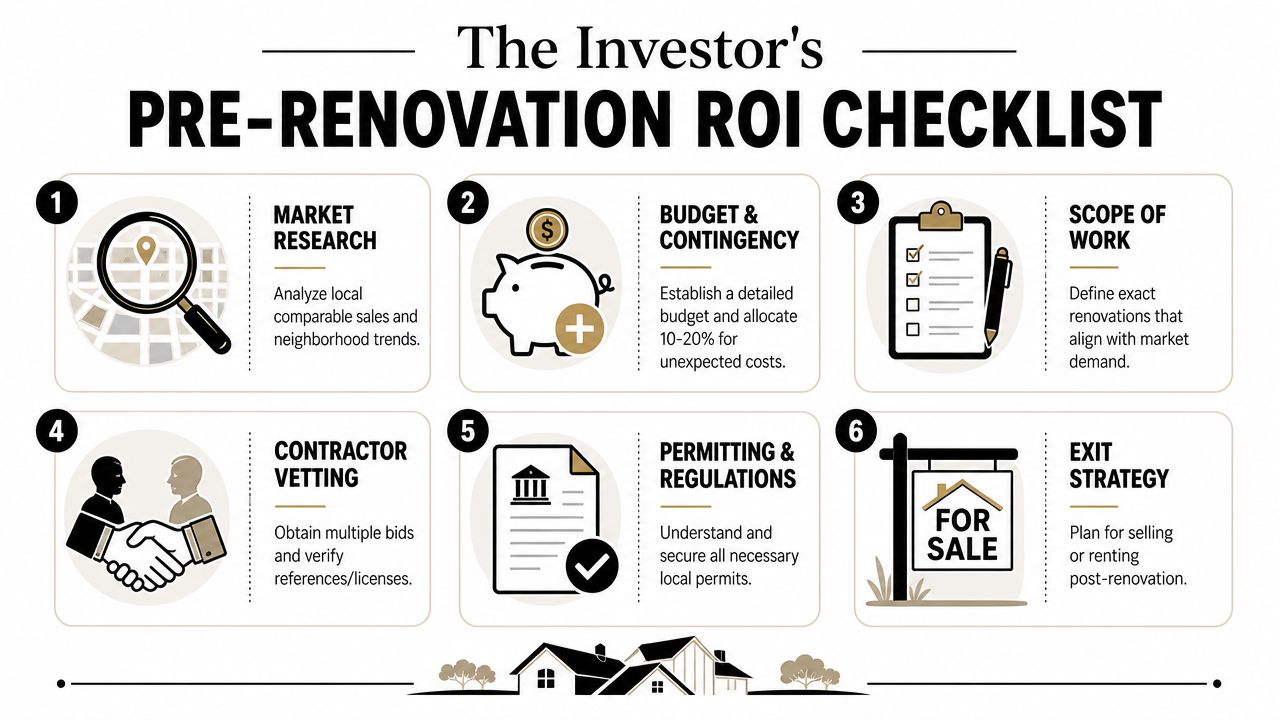
- Define the exit clearly: Are you flipping, refinancing, renting, or staying long term? Your answer changes the right scope.
- Study the neighborhood ceiling: Match the finish level to the comp set, not your personal taste.
- Build a full budget: Include labor, materials, permits, supervision, and a contingency for hidden conditions.
- Prioritize visible value: Start with the items that improve first impression, condition, and buyer confidence.
- Check the permit path early: Don't assume the scope is simple just because the finish choices are.
- Plan the schedule by dependencies: Cabinets, inspections, rough-ins, and exterior work all affect each other.
- Choose durable materials: Florida humidity, storms, and maintenance exposure should shape product selection.
- Know your funding plan: If financing is part of the equation, review options before scope expands. This guide on financing a home renovation project in Jacksonville is a good starting point.
- Decide who manages the job: DIY coordination can work on light cosmetic updates. It gets riskier when multiple trades, inspections, and timeline pressure are involved.
Frequently Asked Questions about Home Renovation ROI
What renovation usually gives the best return in Jacksonville
Targeted exterior upgrades and modest interior improvements usually make the most sense. In this market, clean curb appeal, visible maintenance, and practical kitchen or bath updates often outperform expensive customization.
Is a major kitchen remodel worth it for investors
Usually only when the existing kitchen is functionally broken or badly below market expectations. If the layout works, a minor remodel tends to protect margin better than a full overhaul.
How long does it take to see renovation ROI
It depends on the strategy. Flips pursue return at resale. Long-term holds may realize return through lower maintenance, improved tenant appeal, or reduced utility costs over time. That's why payback period matters alongside resale value.
What hurts ROI most in Northeast Florida
Three things come up often. Over-improving for the neighborhood, choosing materials that don't hold up well in Florida conditions, and losing schedule control through weak planning or permit delays.
Are exterior upgrades really that important
Yes. Buyers often form their first impression before they walk in the front door. Exterior condition also signals whether the rest of the house has been maintained well.
Should I manage the renovation myself or hire project oversight
That depends on complexity. A simple paint-and-flooring refresh is very different from a renovation involving structural work, roofing, electrical, plumbing, inspections, and multiple subs. The more moving parts involved, the more financial risk sits in coordination errors, rework, and delays.
Does home renovation ROI matter if I'm not selling soon
Yes. If you're staying put, ROI includes more than resale. It also includes avoided repairs, operating efficiency, durability, and whether the renovation solves problems that would otherwise keep costing you money or time.
If you're planning a renovation in Jacksonville or Northeast Florida and want to evaluate the scope through an investor lens, contact Ofir Engineering. The team works on investor-focused renovations, remodeling, construction oversight, and project management with attention to budgeting, scheduling, local execution, and ROI-driven decision-making.
