You found a piece of land in Jacksonville, St. Johns, or somewhere else in Northeast Florida, and now you're searching for builders that build on your own lot. That usually means you're already imagining the house, the layout, the driveway, maybe even where the back porch will sit. The problem is that the house plan is rarely the first issue. The first issue is whether the lot can support the project you have in mind without wrecking your budget or your timeline.
As a licensed Jacksonville general contractor (CGC 1540016), Ofir Engineering brings hands-on construction expertise to every project throughout Northeast Florida.That's where many on-your-lot projects go sideways. A private lot gives you control, but it also shifts more risk onto the owner and builder team. Drainage, soil conditions, utility access, zoning, setbacks, permitting, and foundation design all become lot-specific decisions. In Jacksonville and Northeast Florida, those decisions matter even more because local flood concerns, varying municipal requirements, and site conditions can change the build path early.
The demand behind owner-directed construction is real. The share of custom homes in U.S. single-family starts increased from 19.5% in 2018 to 20.2% in 2019, which supports the idea that building on land you own remains a meaningful part of the market, not a niche edge case, according to Residential Design Magazine's summary of Census Survey of Construction data.
A good on-your-lot project starts with a simple question. Is the lot build-ready? If that answer is handled correctly, the rest of the process gets clearer. If it's skipped, every later decision gets harder and more expensive.
Table of Contents
- The Critical First Step Is Your Lot Build-Ready
- How to Find and Vet On-Your-Lot Builders in Jacksonville
- Decoding the True Cost and Securing Your Financing
- Construction Methods for Florida Light Gauge Steel vs Wood
- Navigating Contracts Permits and Construction Timelines
- Frequently Asked Questions About Building on Your Own Lot
The Critical First Step Is Your Lot Build-Ready
Homebuyers often evaluate a lot by standing on it. They look at the trees, the road frontage, the neighbors, and the view. Builders that build on your own lot have to evaluate it very differently. They need to know whether the property can be permitted, serviced, drained, and built without expensive surprises.
Industry data indicates that approximately 34% of build-on-your-lot projects hit hidden lot deficits, which can add 12-18% to total cost and extend the schedule by 3-5 months, as noted in this discussion of hidden costs of building on your own lot. That's why the pre-construction phase deserves more attention than the floor plan brochure.
What a real lot review should include
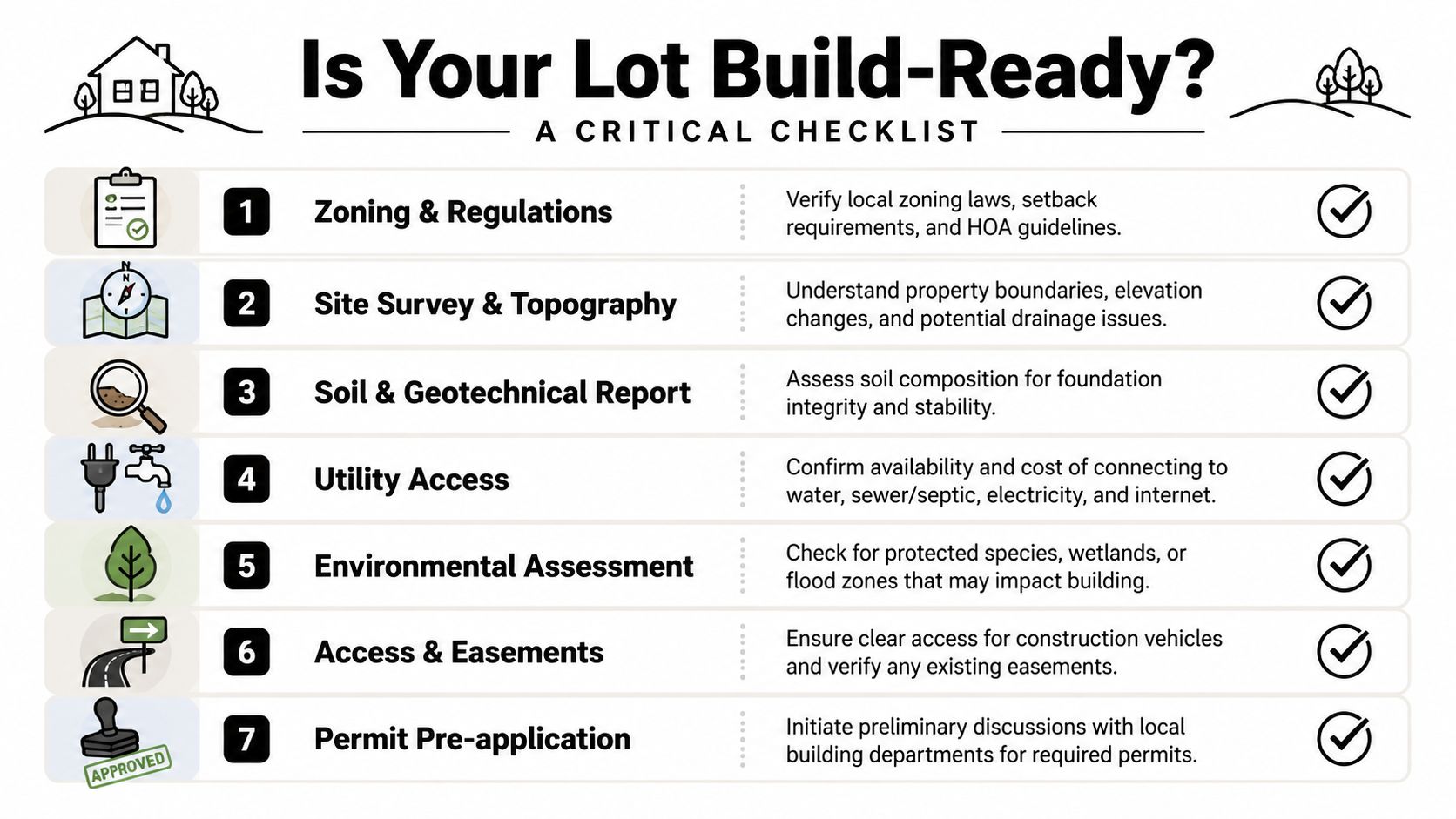
A serious lot feasibility review goes beyond a quick site walk. It should include topographic review, soil testing, utility verification, zoning checks, environmental constraints, and a permit-readiness screen.
Here's what that means in practical terms:
- Zoning and land use: The parcel must allow the type of residence you want to build. Jacksonville, unincorporated St. Johns County, and smaller jurisdictions in Northeast Florida can apply rules differently. You need to know setbacks, height limits, lot coverage limits, and whether overlays or neighborhood rules affect design.
- Survey and topography: A flat-looking lot can still have drainage conflicts or elevation issues that affect slab design, driveway placement, and finished floor height.
- Soil and foundation planning: Soil conditions drive foundation decisions. If you're comparing systems, a resource on concrete foundation types proves useful, as the lot often dictates whether a standard slab works cleanly or if engineering adjustments are necessary.
- Utility access: Water, sewer, septic, electric, and communications have to be confirmed, not assumed. Distance to connection points matters. Existing poles or nearby lines don't always mean an easy tie-in.
- Environmental limitations: Wetlands, protected trees, floodplain issues, and stormwater requirements can reshape the build area fast.
- Access and easements: Construction crews need legal and physical access. A narrow entry, utility easement, or drainage easement can interfere with site layout.
Practical rule: Don't finalize your house design until the lot review is done. The lot should shape the plan, not the other way around.
In Jacksonville and the surrounding counties, grading deserves extra scrutiny because rainfall management is rarely optional. If you want a plain-language explanation of how site contour and drainage work can affect a project, these TruTec insights on yard grading give a useful outside perspective.
Questions to ask before you hire anyone
The right builder should be able to speak clearly about lot risk before talking about finishes. Ask direct questions and listen for direct answers.
- What do you review before design starts: You want to hear about survey work, soils, utility checks, zoning, drainage, and permit pathway.
- Who verifies utility availability: If the answer is vague, expect problems later.
- How do you handle lot-specific foundation decisions: Builders with real field experience will connect this to soils, elevation, and stormwater.
- What site issues are common in Northeast Florida: The answer should sound local, not generic.
- Who owns pre-construction coordination: If no one clearly manages engineers, surveys, and municipal communication, the owner ends up doing it.
For investors, this is also where project management matters. Fix and Flip Renovation Services covers renovation budgeting, contractor management, project scheduling, and ROI-focused construction planning in Jacksonville. Even though new construction and fix-and-flip work are different scopes, the same discipline applies early. Budget control starts before construction starts.
How to Find and Vet On-Your-Lot Builders in Jacksonville
A builder can be excellent at subdivision homes and still struggle on a private lot. On-your-lot work is less repetitive. Every parcel creates its own sequence of design, permitting, and site preparation issues. That's why your vetting process should focus on problem-solving history, not just photo galleries.
What separates a real on-your-lot builder from a production builder
The first filter is licensing and scope. In Florida, verify the contractor's license status directly through the state. If a company claims general contracting authority, confirm it. If they only act as a sales operation and hand the job off, that should be clear from the start.
The second filter is project type. Ask to see projects where the builder dealt with lot-specific constraints such as drainage, utility coordination, rural or semi-rural access, or nonstandard setbacks. Finished kitchen photos won't tell you whether they can manage a difficult site.
Use questions like these during interviews:
- Tell me about a project where the lot changed the plan. Strong builders can explain what happened and how they adjusted design, budget, or sequencing.
- What site-related issues do you commonly see in Jacksonville or St. Johns County. You're listening for local familiarity with permitting culture, inspections, drainage realities, and subdivision versus private parcel differences.
- Who coordinates surveyors, engineers, and permit submissions. Fragmented responsibility creates delays.
- How do you handle allowances, change orders, and owner selections. A vague answer usually means budget creep later.
- What happens if utility work or grading turns out to be more involved than expected. This reveals whether the builder has a process or just a reaction.
A practical reference point is this guide on how to hire a general contractor, especially if you're comparing multiple firms and trying to separate good sales conversations from actual execution capacity.
The builder you want is the one who talks about risk clearly, not the one who acts like there is no risk.
A better way to check references
Most owners ask previous clients whether they liked the builder. That's too broad. Ask what happened when the project stopped being simple.
Here's a better reference checklist:
- Communication under pressure: Did the builder communicate well when an issue came up, or only when things were going smoothly?
- Budget transparency: Did the client understand what was included, excluded, and changing?
- Schedule management: Did the builder maintain momentum between trades and inspections?
- Field supervision: Was there a clear point of contact on-site?
- Closeout discipline: Were punch items handled promptly and clearly?
This is also where formal Construction Project Management can matter. The service category includes contractor coordination, budgeting, scheduling, renovation oversight, and construction supervision for homeowners and investors in Jacksonville. On a custom lot build, those responsibilities aren't optional. Someone has to own them.
Decoding the True Cost and Securing Your Financing
A Jacksonville lot can look straightforward on paper and still blow up a budget before the slab is poured. The house price is only one part of the job. The other part is getting the land to a condition where the city, the county, the utility providers, and your lender will all let construction proceed.
Site costs and house costs need separate budgets
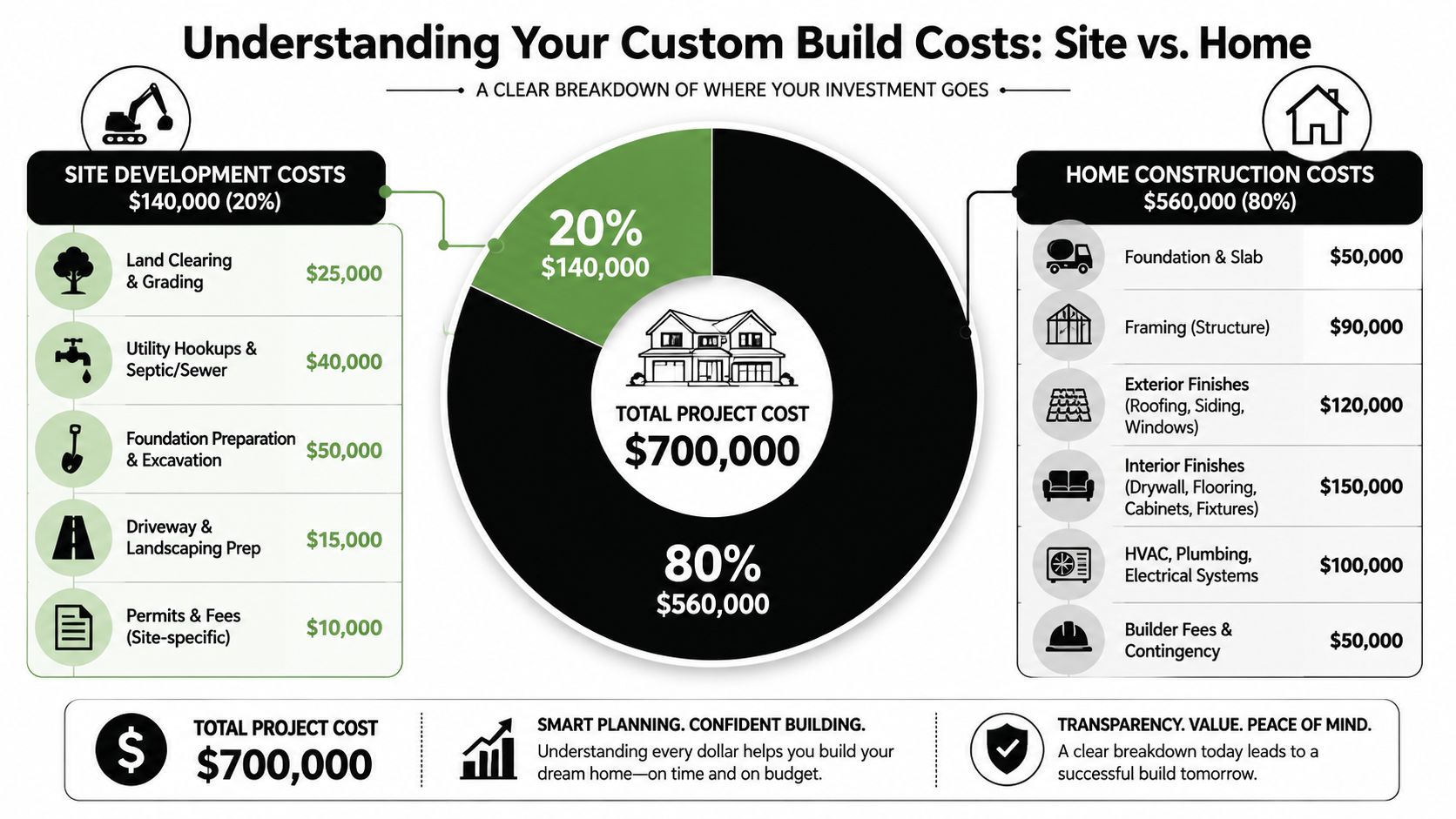
Owners get into trouble when they carry one number for the entire project. In practice, there are two budgets that interact but should never be blended.
Site work covers the costs tied to the parcel itself: clearing, fill or grading, tree issues, driveway access, stormwater handling, utility connections, septic or well work where applicable, surveys, and lot-specific engineering. House construction covers the residence: foundation, framing, roofing, windows, mechanical systems, insulation, drywall, finishes, and fixtures.
That distinction matters early, especially in Northeast Florida. A lot with poor drainage, limited frontage, old fill, wetland constraints, or a long utility run can add costs long before framing starts. I have seen owners focus on square-foot pricing and miss the fact that their parcel needed more civil work than the house needed upgrades.
If you want cleaner pricing from the start, define the scope before asking anyone for final numbers. Good pre-construction documents reduce allowance abuse, vague exclusions, and change-order arguments. This overview of bidding and negotiation services is a useful reference for understanding how owners protect themselves by tightening scope before contracts are signed.
A workable budget usually separates four categories:
- Lot preparation and approvals: Surveys, soil review if needed, clearing, grading, drainage, permitting fees, utility coordination, and any off-site requirements.
- Base house construction: The home as drawn and specified.
- Selections and owner changes: Finish upgrades, appliance changes, layout revisions, and scope added after pricing.
- Contingency: Cash reserved for conditions that were not visible during initial review, such as buried debris, unsuitable soils, or utility complications.
Financing works better when the budget is honest
Many on-your-lot builds use a construction-to-permanent loan. The lender funds the project in stages, then converts the balance into a standard mortgage after completion. To get there, the bank usually wants finalized plans, specifications, a detailed cost breakdown, builder credentials, proof of land ownership or equity, and a draw schedule tied to construction milestones.
Lenders also care about what is happening outside the house footprint. If the project still has unanswered questions about septic approval, access, drainage design, flood exposure, or utility availability, financing can slow down or require revisions. In Jacksonville and the surrounding counties, those issues are common enough that they should be treated as pre-loan planning items, not last-minute surprises.
The schedule should be handled the same way. Construction duration depends heavily on permitting, inspection flow, weather exposure, site conditions, and how complete the plans are before the first draw. A builder who promises a finish date without discussing those variables is giving you sales language, not project control.
This video gives a useful overview of the financing side and why early planning matters.
For owner-occupants, the main question is usually payment stability and total cash required before move-in. For investors, the lens is tighter. Carry costs, draw timing, permit delays, and site corrections can hurt the deal faster than upgraded finishes ever will.
The smart approach is simple. Underwrite the dirt first, then the house, then the upgrade list. That order prevents a common and expensive mistake on Florida lot builds: spending design money on a home you cannot build efficiently on the parcel you own.
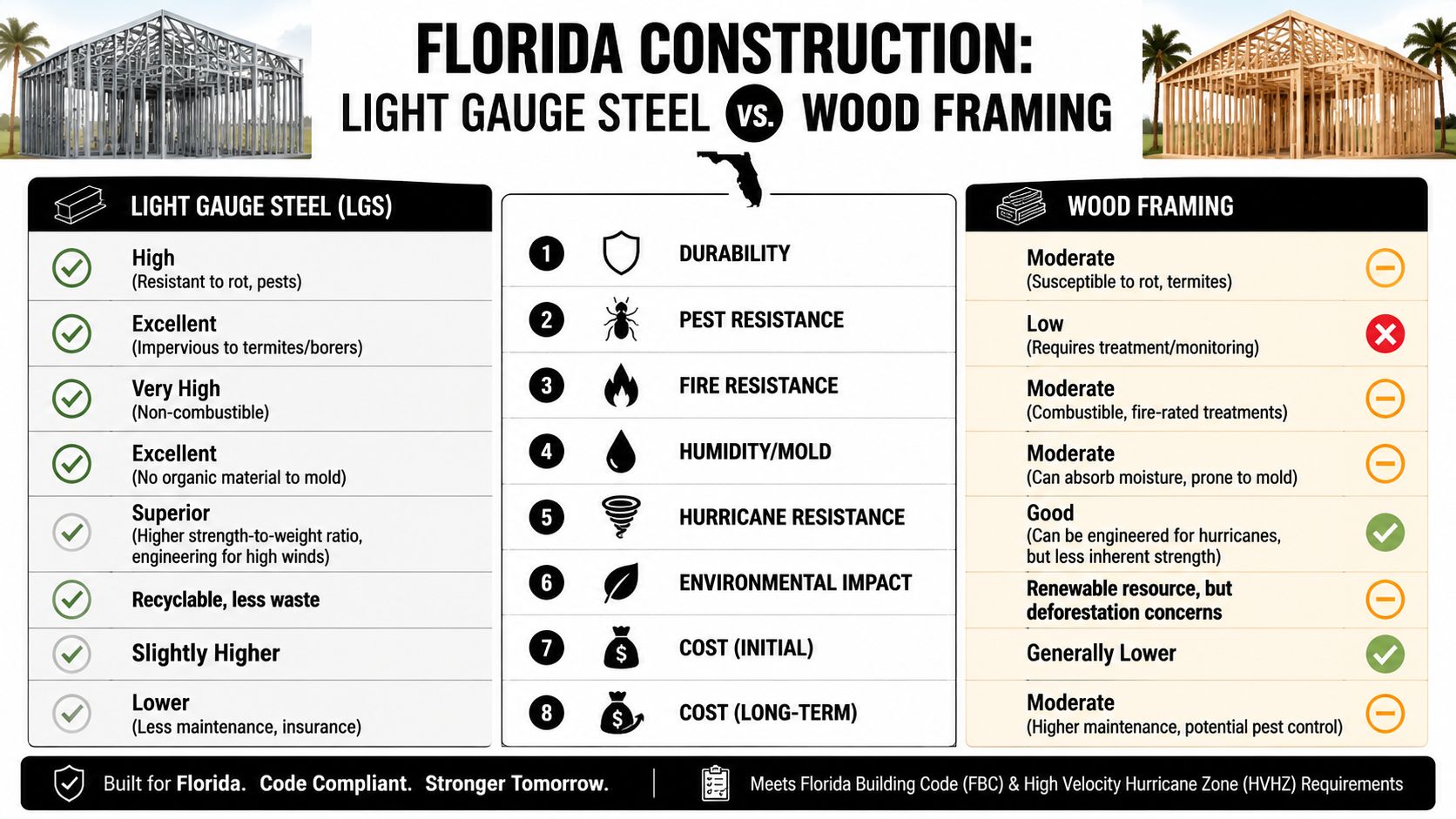
Construction Methods for Florida Light Gauge Steel vs Wood
Florida isn't a generic building environment. Humidity, storm exposure, pest pressure, and long-term maintenance all influence the framing discussion. If you're hiring builders that build on your own lot, ask them to explain framing options in the context of your parcel, your budget, and your ownership goals.
Where light gauge steel makes sense
Light gauge steel is attractive in Florida because it isn't an organic material. That changes the conversation around termites, moisture-related deterioration, and certain durability concerns. It also gives engineers a strong, predictable system for projects where performance matters more than sticking with traditional habits.
Steel framing often fits owners who prioritize:
- Pest resistance: A major concern in Northeast Florida.
- Moisture durability: Useful where humidity and long-term material stability matter.
- Fire performance: Non-combustible framing changes the risk profile.
- Precision: Manufactured components can support tighter tolerances.
That doesn't mean steel is automatically right for every project. The builder still has to coordinate design, engineering, trades, and detailing correctly. The best side-by-side explanation for Florida owners is this comparison of steel frame vs wood frame construction for Florida homes.
Where wood framing still works well
Wood remains common for good reasons. Many trades know it well. Design flexibility is familiar. Material sourcing and field modifications can be more straightforward, especially for conventional residential layouts.
Wood can still be the right choice when:
| Decision factor | Light gauge steel | Wood framing |
|---|---|---|
| Moisture and pest concerns | Strong fit | Needs more vigilance |
| Crew familiarity | More specialized | Broad trade familiarity |
| Long-term maintenance priorities | Often favorable | Depends heavily on detailing and upkeep |
| Design changes in the field | Less forgiving | Often easier to adjust |
Choose the system your builder can execute correctly on your lot. A good material handled poorly is still a bad result.
For Jacksonville and Saint Johns projects, the right answer often comes down to ownership horizon. A long-term primary residence may justify one set of priorities. An investor exit strategy may justify another. The framing system should support the project model, not just the sales pitch.
Navigating Contracts Permits and Construction Timelines
You can have a good plan, a good lot, and a good budget and still lose control of the project in pre-construction. I see that happen when an owner signs a contract before pinning down permit responsibility, utility coordination, allowance limits, and the approval path for changes. By the time framing starts, the underlying problem is already baked in.
A private-lot build is managed on paper before it is managed in the field. The contract sets scope and money. The permit set controls what the jurisdiction will approve. The schedule only holds if those two pieces are complete and coordinated.
What needs to be in the contract
A strong construction agreement should identify the plans being built, the written specifications, the payment schedule, the allowance structure, the change-order process, inspection responsibility, and exactly who is handling permits, surveys, engineering, and utility applications. If any of that is vague, the owner usually pays for the ambiguity later.
Review these items carefully:
- Scope clarity: The plan set, structural notes, finish specifications, and site work assumptions should match.
- Payment timing: Draws should tie to completed work or documented milestones, not arbitrary calendar dates.
- Allowances: Cabinets, flooring, fixtures, and other owner selections should have clear allowance amounts and a process for overages.
- Change orders: Every change should be priced and approved in writing before the work proceeds.
- Permit responsibility: The contract should state who submits, who responds to comments, and who pays for revisions if the jurisdiction rejects part of the package.
- Warranty terms: Coverage periods, exclusions, and the claim process should be written plainly.
One sentence matters more than owners expect. If the contract says site work is estimated, subject to field conditions, or excluded beyond a basic allowance, treat that as a real cost risk. In Jacksonville-area projects, drainage corrections, fill, tree issues, utility runs, and erosion-control requirements can change the job total fast.
What a realistic schedule looks like
Owners usually focus on the build duration after the slab is poured. The larger scheduling risk is earlier.
For an on-your-lot home in Jacksonville or Northeast Florida, the timeline often stretches or contracts based on pre-construction readiness: boundary and topographic survey, soil and drainage review, plan revisions, engineering, permit submission quality, jurisdiction comments, and subcontractor release timing. A clean lot with a complete permit package moves very differently than a lot with access issues, flood concerns, utility questions, or incomplete drawings.
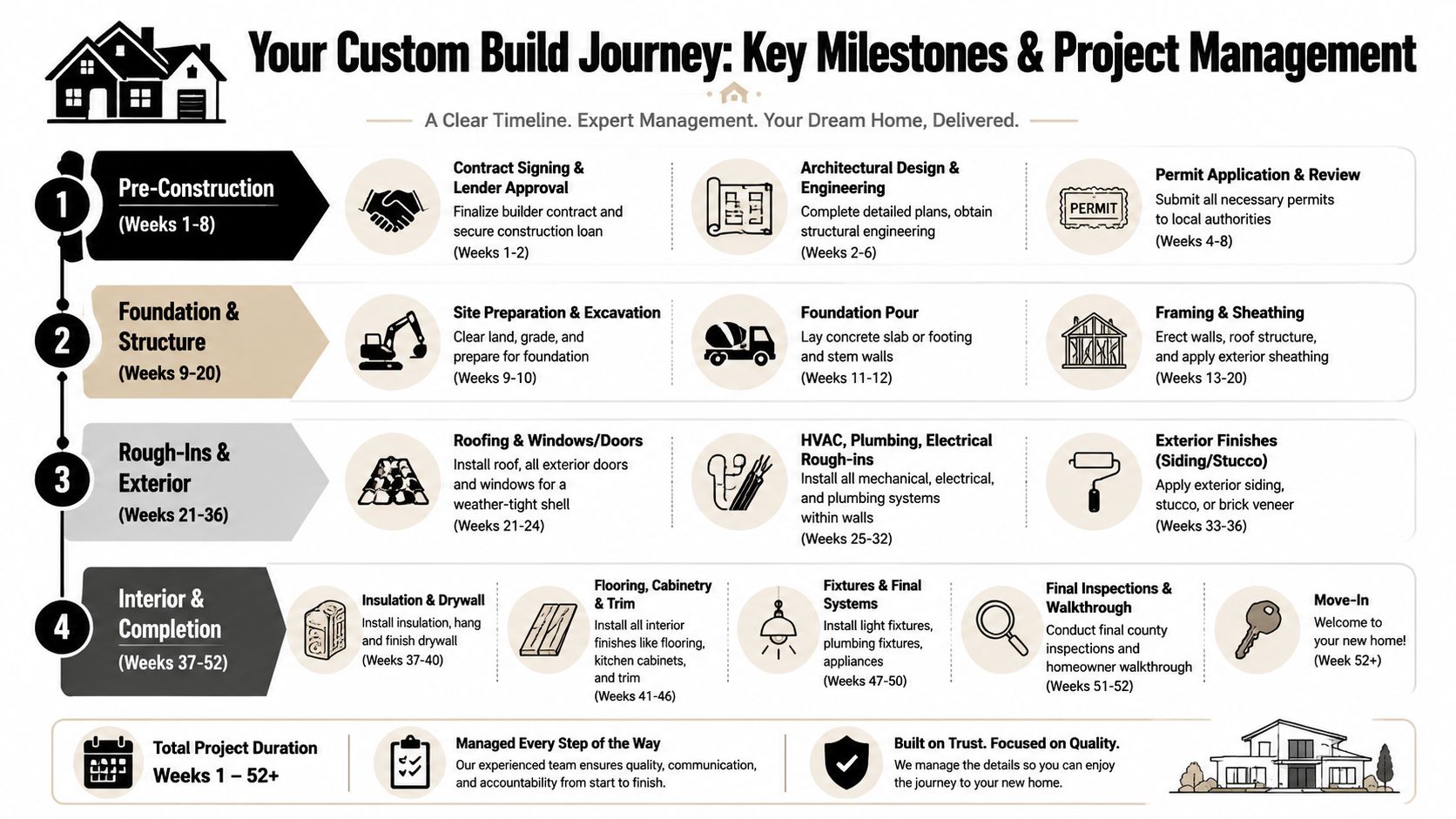
Permitting in Jacksonville, St. Johns County, and nearby jurisdictions does not move at one uniform speed. Review times depend on the municipality, the completeness of the application, whether the lot triggers additional review, and how quickly comments are answered. FEMA flood zone considerations, driveway permits, septic approvals, wetlands questions, and utility provider requirements can all add time before vertical construction starts.
That is why the best builders manage the permit set and the field schedule as one system. They coordinate architectural drawings, structural engineering, municipal comments, long-lead material decisions, and trade sequencing before the first inspection is booked. A builder who treats permitting as a clerical step usually creates downstream delays for excavation, foundation, framing, and MEP rough-ins.
A delay usually starts weeks before anyone calls it a delay. It starts when an unresolved detail gets pushed into the next phase instead of being closed out on paper.
Frequently Asked Questions About Building on Your Own Lot
What are the biggest unexpected costs when building on a private lot
Site work is the most common source of surprise. Clearing, grading, drainage corrections, septic or sewer coordination, and utility connection work can change quickly once engineering and field conditions are confirmed. The lot can look simple and still require more pre-construction work than expected.
Can I use my own architect or floor plan with an on-your-lot builder
Yes, in many cases you can. Some builders prefer to work from their own plan library, while others can build from owner-supplied plans or coordinate with your architect. The important part is making sure the plan fits the lot, local code requirements, and the selected construction method before pricing is finalized.
How does the process differ for a real estate investor versus a homeowner
The build sequence is similar, but the decision-making framework is different. Investors usually focus on schedule control, resale or rental positioning, and budget discipline. Homeowners often prioritize personal layout preferences, long-term durability, and lifestyle features. A competent builder or project manager should be able to support either path without confusing the goals.
If you're planning a home, investor build, or property improvement project in Jacksonville or Northeast Florida, Ofir Engineering can help evaluate the site, coordinate pre-construction planning, and manage the construction process with a clear focus on budgeting, scheduling, and code-compliant execution. Reach out to discuss your lot, your plans, or your renovation and project management needs.
Related service: custom home construction on your lot by Ofir Engineering, a licensed Florida general contractor (CGC 1540016) serving Jacksonville and Northeast Florida.
