
The custom built homes contract terms that matter most in Florida are rarely the ones owners read first. Price and completion date get the attention, but the clauses that decide what actually happens when a build goes sideways are quieter: how allowances are set, when and against what a draw is released, how lien releases are collected from subcontractors, what qualifies as an excusable delay, and who may terminate on what notice. Those provisions allocate risk between owner and builder before a single footing is poured, and in a state with a strict construction lien statute the details are not boilerplate. Ofir Engineering is a licensed Florida general contractor (License #CGC 1540016) with 15+ years serving Jacksonville, Ponte Vedra, St. Johns, and Northeast Florida.
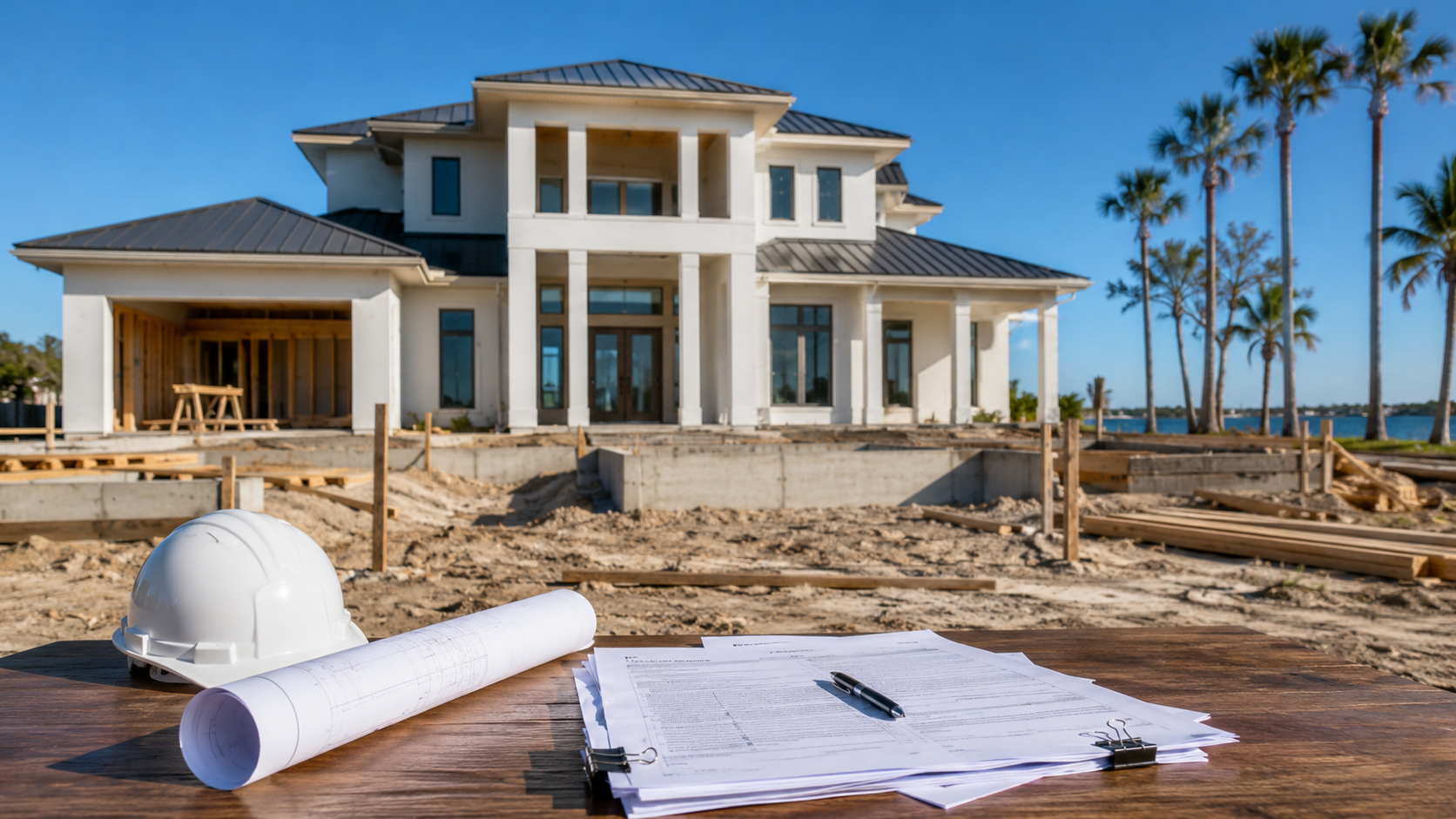
The Custom Built Homes Contract Terms That Decide Who Absorbs Risk
A residential construction agreement does three jobs: it fixes a scope, it fixes a price mechanism, and it assigns every foreseeable risk to one party or the other. Owners tend to negotiate the second and ignore the third. In practice the risk-allocation clauses — allowances, change orders, delay, lien compliance, warranty, and dispute resolution — determine whether a problem costs a conversation or a lawsuit.
Before any of that, confirm the fundamentals. The builder must hold an active Florida license appropriate to the work, and the license number belongs in the contract itself. The named contracting entity should match the licensed entity. The contract should incorporate the plans and specifications by explicit reference, dated and initialed, so that “as shown on the drawings” points to a specific set rather than a moving target.
Price Structure: Fixed Price, Cost-Plus, and the Allowance Trap
Fixed price (lump sum). The builder carries the risk of cost overruns within the defined scope. The owner’s exposure is concentrated in what the scope excludes and in what the allowances hide.
Cost-plus with a fee. The owner pays actual documented cost plus a fee. This is transparent and works well on complex or evolving custom work, but the owner carries the market risk. If you use it, insist on the right to review invoices and backup, and consider a guaranteed maximum price so the exposure has a ceiling.
Allowances. This is the single most common source of budget disputes on custom built homes. An allowance is a placeholder for a scope not yet selected. If the allowance is set unrealistically low, the contract price is fiction and every selection becomes an overage. The protections are specific: require that each allowance state its unit basis and whether it is material-only or installed; require written notice before an overage is incurred; and require that unused allowance money be credited back to the owner rather than absorbed. Ask directly what the allowance would buy at today’s prices for a house of this quality level, and have that answer in writing.
Exclusions and clarifications. Read the exclusion list as carefully as the scope. Site work, impact and utility connection fees, landscape and irrigation, driveways, and pool work are frequently outside the base contract. An exclusion is not misconduct — but an unnoticed one becomes an unplanned cash requirement.
Payments, Draws, and Florida’s Construction Lien Law
Payment terms should tie money to verified progress, never to the calendar alone. A sound draw schedule names each milestone in physical terms — foundation complete and inspected, framing complete and inspected, dry-in, mechanical rough-in passed, drywall complete, substantial completion — and releases funds only when that milestone is inspected and documented. If a lender is funding the build, the contract’s draw schedule and the lender’s must match, or the owner ends up bridging the difference in cash. We walk through that alignment in detail in our guide to draw schedules and Florida lender requirements.
Lien releases are the owner’s central protection. Under Chapter 713 of the Florida Statutes, subcontractors and suppliers who serve a Notice to Owner may record a lien against the property even if the owner has already paid the general contractor. The contract must therefore require conditional lien releases from every subcontractor and supplier covered by each draw, and final unconditional releases before final payment. An owner who pays a draw without collecting the corresponding releases can pay for the same work twice. The statute is published by the state at Florida Statutes Chapter 713, and the required Notice to Owner and payment-affidavit mechanics are worth understanding before the first draw, not after a lien appears.
Retainage. A percentage withheld from each draw and released at completion gives the owner leverage to get the punch list finished. State clearly what triggers its release, and tie it to a completed punch list rather than to occupancy alone.
Schedule, Change Orders, and Termination
Schedule. A contract should state a substantial completion date and define what excuses delay. Weather beyond documented norms, permit review beyond stated periods, owner-directed changes, and genuine force majeure are ordinarily excusable; subcontractor mismanagement is not. Define substantial completion precisely — the standard definition is that the home is sufficiently complete for its intended use, typically evidenced by a certificate of occupancy — because that date usually triggers final payment, retainage release, and the start of the warranty period.
Change orders. Require every change to be in writing and signed by both parties before the work proceeds, with the price and any schedule impact stated on the same document. Verbal changes are the origin of most custom home disputes. A change order with a dollar figure but no schedule impact is only half executed.
Termination and suspension. Both parties should have defined rights with notice periods and a cure opportunity. The owner’s remedy for non-performance should not be limited to waiting. The contract should also state what happens on termination: how completed work is valued, who owns the plans, and how materials already purchased are handled.
Warranty, Disputes, and What to Read Before Signing
The warranty section should state its term, exactly what it covers, and how a claim is made and responded to — including a response deadline. A one-year workmanship warranty with longer coverage on structural elements and manufacturer warranties on installed equipment is a common structure; what matters is that the document is specific rather than aspirational, and that it survives final payment in writing.
Dispute resolution deserves a deliberate decision rather than acceptance of a default. Mediation first is generally in both parties’ interest. Whether arbitration or litigation follows, and whether the prevailing party recovers attorney’s fees, materially changes the cost of enforcing the agreement — a fee provision that runs only one way should be renegotiated.
Finally, insurance and indemnity: confirm the builder’s general liability and workers’ compensation coverage with certificates naming the owner, and confirm who carries builder’s risk during construction. Then take the whole package to a Florida construction attorney before signing. On a project of this size the review fee is a rounding error against the exposure it examines. For how we structure scope, allowances, and draws on our own agreements, see our custom home construction service page, review the permit requirements that drive the schedule, or contact Ofir Engineering to walk through a draft agreement line by line.
Frequently Asked Questions
What is the most important clause in a Florida custom home contract?
The lien-release requirement tied to each payment. Under Chapter 713, a subcontractor or supplier who served a Notice to Owner can lien the property even after the owner has paid the general contractor in full. Requiring conditional releases with every draw and unconditional releases at final payment is what prevents an owner from paying twice for the same work.
Are allowances in a custom home contract negotiable?
Yes, and they should be examined closely. An allowance set below what the selection realistically costs makes the contract price look lower than the house will actually cost. Ask what each allowance buys at today’s prices for this quality level, require written notice before any overage is incurred, and require that unused allowance money be credited back to you.
Should a custom home be built on a fixed price or cost-plus contract?
Fixed price puts overrun risk on the builder and suits a well-defined scope. Cost-plus is more transparent and suits complex or still-evolving custom work, but the owner carries market risk — so pair it with a guaranteed maximum price and an explicit right to review invoices and backup documentation.
When does the warranty period start on a newly built Florida home?
Ordinarily at substantial completion, which is why that term needs a precise contractual definition — typically the point at which the home is sufficiently complete for its intended use, evidenced by the certificate of occupancy. That same date usually triggers final payment and retainage release, so an imprecise definition affects far more than the warranty.
Keep Building With Ofir Engineering
Related discussions & follow us: Facebook · Reddit
Latest & related guides: Explore more Custom Home Construction guides →