
A lot of Jacksonville homeowners and investors hit the same point at the start of a remodel. The property has potential, but the next decision feels expensive. Should you update the kitchen or fix the exterior first? Is a full reconfiguration worth it, or will a tighter scope produce a better resale result? Will Florida-specific upgrades protect value, or just push the budget up?
Backed by Florida general contractor license CGC 1540016, the Ofir Engineering team serves clients across Jacksonville, St. Johns, and Clay County.For home remodeling Jacksonville FL, the right approach isn't starting with finishes. It starts with scope, structure, climate risk, and resale logic. Nationally, the home improvement and repair market reached $480 billion in spending in 2023, and 55% of homeowners planned to remodel within the next two years. Kitchens accounted for 30% of projects and bathrooms for 22%, according to national remodeling statistics. That demand matters in Northeast Florida because it means your remodel sits inside a large, active market, not a niche category.
This guide is built for first-time remodel clients who want fewer surprises and better decisions. It covers process, cost control, ROI, framing choices, permitting, and how to choose a contractor who can manage the job effectively.
Table of Contents
- Your Guide to a Successful Jacksonville Home Remodel
- The Jacksonville Remodeling Process and Timeline
- Analyzing Costs and Maximizing ROI in the Jacksonville Market
- Climate-Resistant Materials LGS vs Wood Framing for Florida Homes
- Navigating Permits and Building Codes in Northeast Florida
- Vetting and Partnering with a High-Quality Remodeling Contractor
- Remodeling Success Stories Local Examples from Ofir Engineering
- Frequently Asked Questions about Home Remodeling in Jacksonville
- Is a full remodel always better than a partial remodel in Jacksonville
- What rooms usually deserve priority first
- Should I choose hurricane-resistant upgrades even if I'm not planning to sell soon
- Is LGS framing only relevant for new construction
- How do I avoid the biggest budget mistakes
- What should I expect from a remodeling contractor during the job
Your Guide to a Successful Jacksonville Home Remodel
You buy a Jacksonville house that looks like an easy win. The kitchen is dated, the floors need work, and the layout feels tight. Then the walls open up and the real decision shows up fast. Spend money on visible finishes, or put that budget into structure, moisture protection, and framing choices that hold up better in a coastal Florida property.
That decision sets the outcome.
A successful remodel in Jacksonville starts with matching scope to the property's use, resale ceiling, and structural risk. Homeowners often focus on comfort first. Investors usually focus on spread, rent, or exit price. Both groups get into trouble when they treat the project like a finish package instead of a building-performance decision.
In this market, the smartest remodels solve the expensive problems first. That can mean drainage corrections, window and door replacement, framing repair, or reworking a floor plan that fights the way people live. Cosmetic upgrades matter, but they do not carry a weak structure, poor moisture control, or storm-vulnerable materials very far.
The framing decision is a good example, and it gets missed in a lot of local remodeling advice. Wood framing usually costs less upfront and makes sense for many interior reconfigurations. Light Gauge Steel can pencil out better on some Jacksonville projects where long-term durability, straightness, pest resistance, and storm resilience affect maintenance costs, insurance conversations, or holding strategy. For an owner planning to stay, that may mean fewer future repairs. For an investor holding a property for years, it can change the repair cycle and risk profile in a way cabinets and countertops never will.
A few rules consistently protect value in Northeast Florida:
- Start with the house shell: Water intrusion, roof tie-ins, openings, and drainage issues should be addressed before finish selections.
- Let the property type drive the budget: A rental, flip, primary residence, and long-term hold should not get the same material spec.
- Make structural choices with ROI in mind: Lower upfront cost is not always the better return if the assembly is more vulnerable to moisture, pests, or wind-related repairs.
- Keep the neighborhood ceiling in view: Overspending on premium finishes in a mid-range area is still overspending.
I give clients one simple rule early. Fix the house's biggest liability before upgrading its most photogenic room.
Good remodeling also depends on coordination. Clear scope, budget control, sequencing, and decision timing keep a renovation from turning into a chain of change orders and delays. Homeowners who want a better sense of effective project management for homebuilders usually understand the same point fast. Good management protects margin as much as good design.
For homeowners reviewing service options, Jacksonville remodelers like Ofir Engineering commonly handle kitchens, bathrooms, flooring, interior updates, and full residential renovations through licensed project teams.
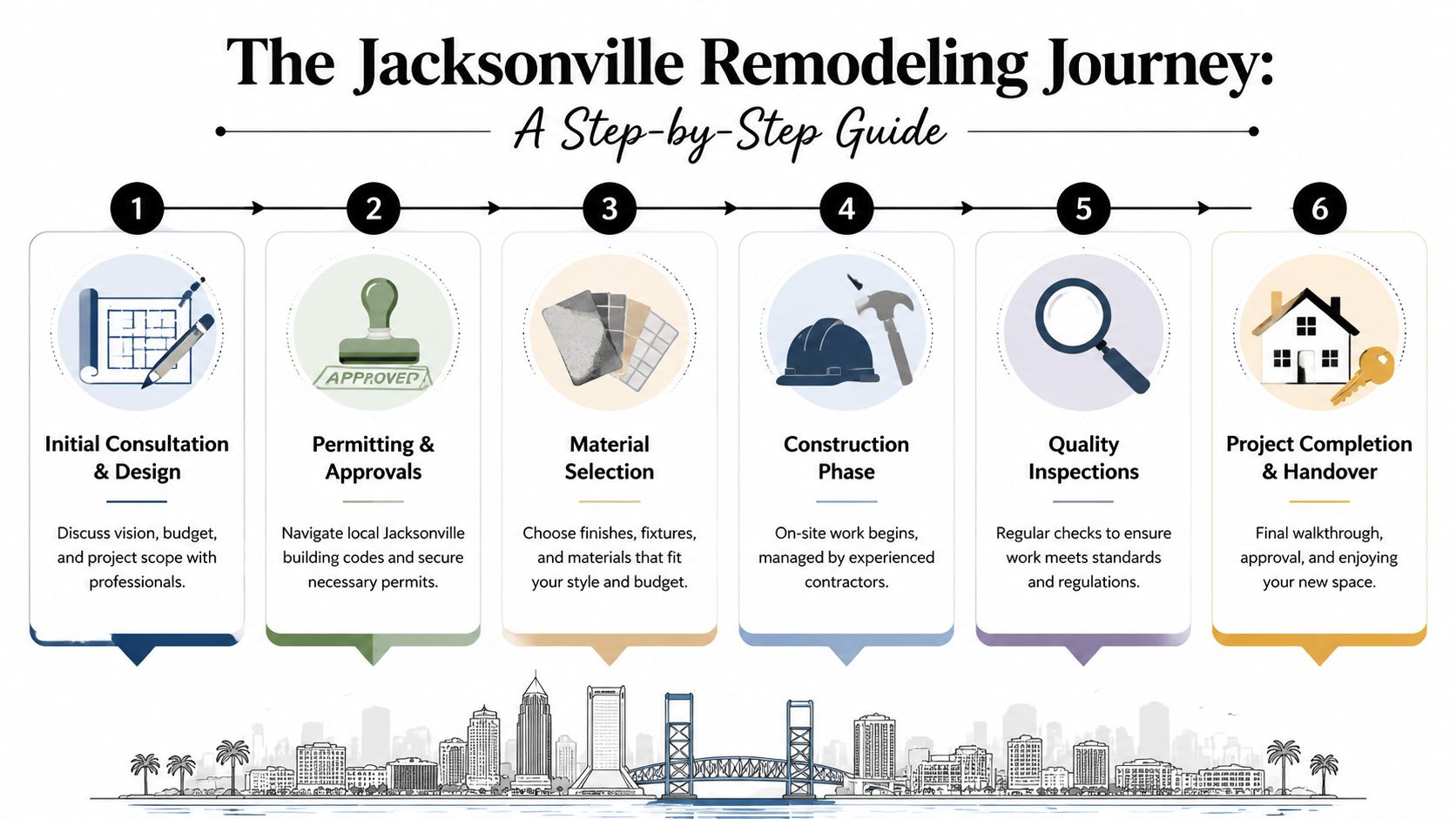
The Jacksonville Remodeling Process and Timeline
Most remodeling problems don't start on the jobsite. They start before demolition, when scope is loose, decisions are delayed, or no one is clearly responsible for budget and sequencing.
Start with scope, not finishes
The first phase is vision, but it needs boundaries. A homeowner may say they want an open kitchen, larger primary bath, or better indoor-outdoor flow. An investor may want a rent-ready turnover or a resale-focused refresh. Those are goals, not scopes.
The usable version of that conversation identifies what's staying, what's moving, and what has to be brought up to current standards. In Jacksonville, that often includes discussions around moisture exposure, storm resistance, older electrical or plumbing conditions, and whether a design change triggers structural review.
A clean early-stage checklist usually includes:
- Property assessment: Existing conditions, visible defects, layout problems, and likely hidden risk.
- Priority ranking: Must-have work versus optional upgrades.
- Use case: Primary residence, rental, flip, or multiyear hold.
- Decision authority: Who approves materials, change orders, and budget adjustments.
Design, engineering, and budget alignment
Once the project intent is clear, design and engineering need to catch up to reality. At this stage, owners either gain control or lose it. If drawings don't match the intended finish level, or if structural changes are guessed instead of engineered, the budget starts drifting immediately.
A good pre-construction phase answers questions before crews arrive. Can a wall come out? Does the slab or framing need reinforcement? Are fixtures available in time? Are the selected materials appropriate for the house and climate? These aren't details to “work out later.”
Good remodeling management is mostly decision timing. Make key choices early, and the build becomes more predictable.
Professional oversight helps here because coordination matters across trades. Construction Project Management in Jacksonville can include contractor coordination, budgeting, scheduling, renovation oversight, and construction supervision for homeowners and investors. That's useful when multiple trades, inspections, and material lead times have to line up.
For owners who want a broader outside perspective on the discipline behind residential scheduling and coordination, this guide to effective project management for homebuilders gives a useful process overview.
A walkthrough of the flow helps put the phases in order:
Permits, procurement, and construction control
After design and pricing align, the project moves into permit prep, procurement, and site planning. This phase is less visible to clients, but it often determines whether the job moves smoothly or stalls. Materials need to be selected in time. Permit drawings need to match the intended work. Long-lead items can't be left until demolition day.
Then construction begins. Demolition is only the first step, not progress by itself. The main work is sequencing rough trades, inspections, framing corrections, waterproofing, installation quality, punch management, and final handoff.
Watch these checkpoints during the build:
- Weekly scope review: Confirm what changed, what didn't, and whether any field condition affects cost.
- Trade coordination: Electrical, plumbing, HVAC, framing, drywall, and finishes need a sequence, not overlap by accident.
- Inspection readiness: Don't close walls before the required approvals are complete.
- Material verification: Check model numbers, dimensions, and finish selections before installation.
- Closeout discipline: Final walkthroughs should produce a written punch list, not a vague promise to “circle back.”
The process feels slower at the start because that's where risk gets removed. On the backend, that usually saves time, money, and conflict.
Analyzing Costs and Maximizing ROI in the Jacksonville Market
A Jacksonville investor buys a 1960s block house near the river, budgets for cabinets, flooring, and paint, then opens the walls and finds framing drift, moisture damage, and an insurance issue tied to older materials. That project goes sideways fast if the budget was built around finishes instead of risk.
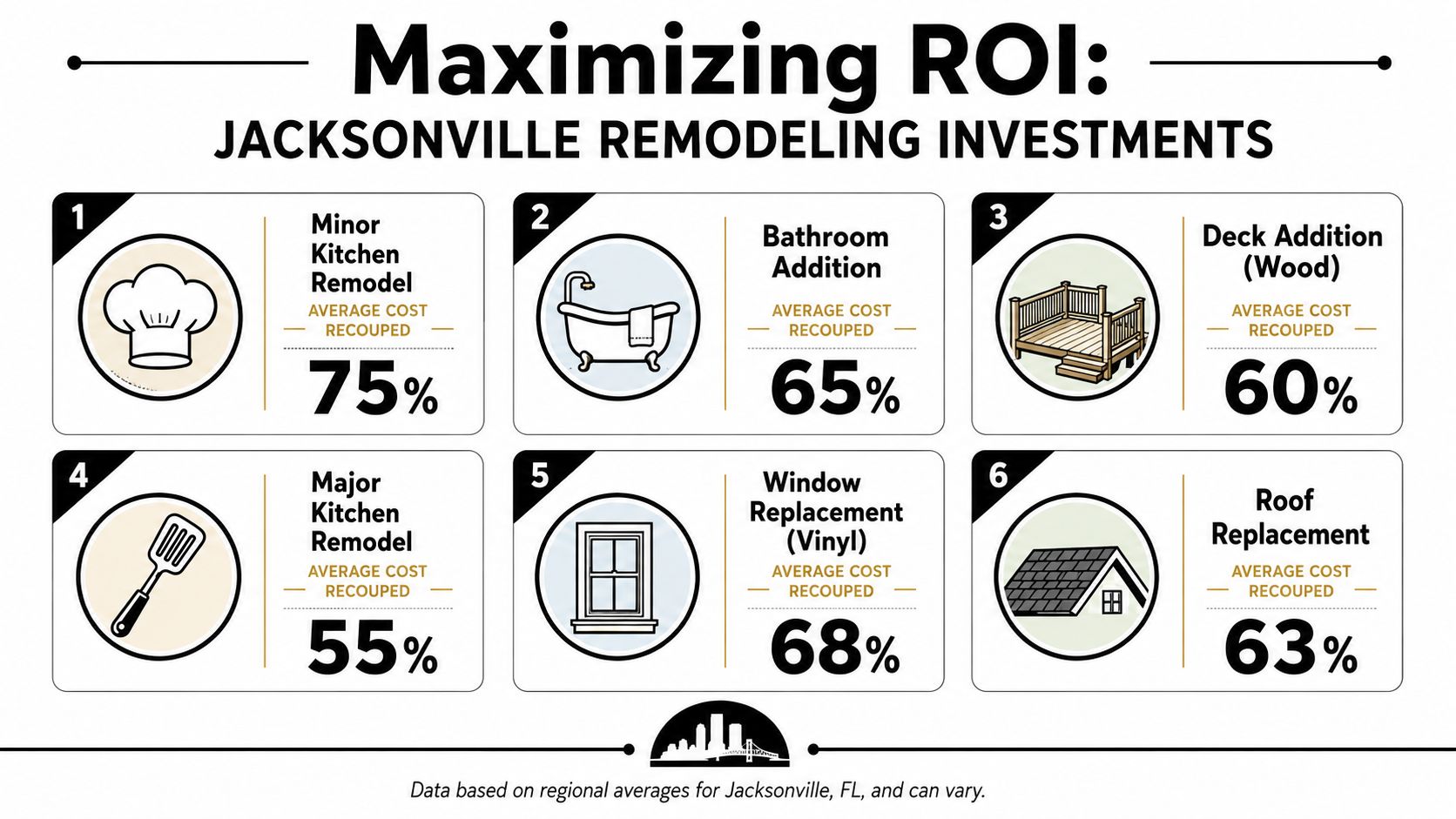
The first ROI decision is not countertops or tile. It is deciding whether the property needs correction work, a controlled value-add, or a full repositioning.
What a full remodel usually costs
For a full home remodel in Jacksonville, the average cost ranges from $25,828 to $37,447, with outliers from $8,398 to $67,190, based on the verified local cost intelligence in the prompt. That spread exists for a reason. Two houses with similar square footage can land far apart once structural repair, water management, finish level, and wind-resistance upgrades are part of the scope.
Jacksonville owners also need to separate cost that protects the asset from cost that only changes appearance. Hurricane-resilient upgrades can raise the budget by 18% to 22%. Premium finish packages push it higher. For a long-term hold, some of that added cost may be justified. For a short resale in a price-sensitive neighborhood, it can cut margin without raising the exit enough to cover it.
I usually break the budget into three buckets:
- Asset protection: Structural fixes, water intrusion repair, framing correction, roofing tie-ins, rough MEP work, and code compliance.
- Resale drivers: Kitchens, baths, flooring, lighting, paint, and exterior appearance.
- Contingency: Reserve for hidden conditions after demolition, especially in older homes and additions built in phases.
That split keeps owners from spending investor money on cosmetic work while the house still has expensive problems behind the drywall.
Which projects produce stronger resale value
Jacksonville resale performance usually favors targeted work over broad, expensive remodeling. According to Jacksonville remodeling ROI data, a garage door replacement is listed at $4,513 cost and $8,751 resale value for 193.9% ROI. Manufactured stone veneer is listed at $11,287 cost and $17,291 resale value for 153.2% ROI. A minor midrange kitchen remodel is shown at $27,492 cost and $26,406 resale value, or 96.1% ROI.
Those numbers do not mean every Jacksonville house needs the same punch list. They show that buyers often pay quickly for visible, practical improvements. They pay less predictably for a full interior overhaul if the layout was already acceptable and the surrounding comps do not support a premium finish package.
That is where structural material choices start to matter financially, especially for investors planning a larger reconfiguration or addition. If the remodel reaches the framing level, the wood-versus-Light Gauge Steel decision affects more than durability. It can affect insurance conversations, maintenance exposure, storm recovery risk, and the kind of buyer confidence the property carries at resale. Many local ROI discussions skip that point and focus only on finishes. In Jacksonville, that misses part of the return equation.
Buyers and appraisers notice expensive work. They also notice whether the work solved the right problem.
For a deeper framework on returns, this page on home renovation ROI planning in Jacksonville is useful when comparing project scope against expected value.
How investors should think about funding and scope
Financing terms shape the job more than first-time investors expect. Draw schedules, inspection checkpoints, holdbacks, and contingency requirements all affect how aggressively a project can move once demolition starts. A thin cash reserve can force bad decisions, such as delaying structural corrections while finish orders are already in motion.
If you're evaluating capital structure before a renovation, this overview of understanding investor renovation loans gives a practical baseline for how rehab financing is typically structured.
On the construction side, Jacksonville remodel work may include kitchen remodeling, bathroom renovations, flooring installation, interior upgrades, and full residential renovation projects managed by licensed contractors. The profitable approach is matching that scope to the property, the neighborhood ceiling, and the hold period. Bigger projects can create stronger returns, but only when the structure, financing, and exit price all support the added risk.
Climate-Resistant Materials LGS vs Wood Framing for Florida Homes
A Jacksonville investor buys a concrete block house with a bad rear addition, plans a fast resale, and assumes the framing choice is a contractor detail. Then the actual numbers show up. Wood costs less up front in many cases, but Light Gauge Steel can reduce future call-backs, storm-related risk, and maintenance exposure that erodes profit.
That trade-off matters most when the remodel goes beyond finishes and into structure.
What changes in a Florida remodel
Jacksonville remodels sit in a hard environment. Humidity stays high, wind loads matter, termites are part of the job, and small moisture mistakes tend to show up later as movement, swelling, or hidden repairs. In a kitchen facelift, none of that may change the framing decision. In an addition, layout change, room conversion, or major structural repair, it should.
A lot of local renovation advice stops at surfaces. That leaves owners and investors without a clear way to judge whether the cheaper framing option is the cheaper project over the hold period.
Light Gauge Steel vs wood framing for Jacksonville homes
The practical comparison is simple. Wood usually wins on initial familiarity and often on labor availability. LGS usually wins on stability, termite resistance, and long-term durability in a wet, storm-prone market.
| Attribute | Light Gauge Steel (LGS) | Traditional Wood Framing |
|---|---|---|
| Structural movement | More dimensionally stable under changing humidity and load conditions | More likely to expand, contract, and move if moisture control is imperfect |
| Moisture response | Does not rot or feed mold the way organic materials can | More vulnerable if water gets in and stays in |
| Termite exposure | Not a food source | Requires active termite management and monitoring |
| Fire resistance | Better material profile for fire resistance | Standard local option, but not the same profile |
| Energy detailing | Can pair well with careful insulation and thermal break detailing | Can perform well, but detailing has to address different bridging conditions |
| Long-term ownership | Lower risk of decay-related framing repairs | Lower upfront cost can be offset by future repair exposure |
| Local labor familiarity | Needs crews who know the system | More widely familiar in many residential remodel crews |
For a closer look at the structural pros and cons, see this comparison of steel frame vs wood frame construction for Florida homes.
When LGS makes more sense
LGS makes financial sense when the project already includes heavy framing work. That usually means rebuilding a failed addition, correcting storm or moisture damage, adding square footage, or reworking a house for a longer hold. In those cases, the framing system affects insurance conversations, durability, punch-list risk, and how often the owner has to revisit the same area after closing or tenant turnover.
I also look at exit strategy. For a flip in an entry-level neighborhood, wood may still be the right answer if the scope is tight, the existing house is already wood-framed, and the buyer will not pay more for the upgrade. For a higher-value remodel, a coastal exposure, or a rental you plan to keep, LGS often deserves a serious pricing exercise because resilience has real value even when it does not show up line-for-line in the appraisal.
Wood still fits plenty of Jacksonville projects. It is easier to source, easier to match in partial remodels, and often faster to price with standard residential crews. The mistake is defaulting to wood without checking what future risk you are accepting to save money today.
In Jacksonville, framing choice affects ROI in two ways. First cost hits the budget now. Durability, repair exposure, and storm resilience affect what the project returns later.
For investors comparing scopes, hold periods, and construction risk, Fix and Flip Renovation Services can include renovation budgeting, contractor coordination, scheduling, and ROI-focused planning tied to the actual structure, not just the finishes.
Navigating Permits and Building Codes in Northeast Florida
Permits frustrate people because they feel like delay. In reality, they protect the project from the kind of problem that shows up during appraisal, insurance review, resale, or a claim after damage.
What usually triggers permits
In Northeast Florida, cosmetic work may not need the same level of municipal review as structural or systems work. Painting, flooring, cabinet replacement, and similar finish updates are often a different category from work that changes walls, electrical, plumbing, mechanical systems, windows, doors, roof components, or occupancy-related safety features.
If the remodel includes any of the following, permit review usually needs to be part of the planning conversation:
- Structural changes: Removing or altering walls, changing openings, reframing, or additions.
- Electrical work: Service changes, new circuits, panel work, rewiring, or substantial fixture relocation.
- Plumbing modifications: Reworking supply or drain lines, moving fixtures, or adding baths.
- Mechanical updates: HVAC replacements, duct changes, or equipment relocation.
- Exterior envelope work: Certain window, door, and roof-related replacements, depending on scope.
Why permit discipline protects the project
Permit compliance helps establish that the work was reviewed, inspected, and documented. That matters when the property changes hands, when an insurer asks questions after a storm event, or when hidden work later fails.
The smoother path is simple. Define the scope accurately, prepare the right drawings, submit consistent information, schedule inspections in sequence, and keep records. Trouble starts when owners treat permit work like a formality and crews build ahead of approvals.
For a clearer view of the workflow, this page on the building permit process in Florida remodeling projects is a useful reference.
A reliable contractor should be able to explain which parts of the job require permitting, what inspections are expected, and what can't be closed up before approval. If those answers are vague, the risk is already increasing.
Vetting and Partnering with a High-Quality Remodeling Contractor
A remodel doesn't fail because the sales meeting sounded bad. It fails because the wrong team got control of scope, schedule, money, or all three.
The quality check starts before you ask for a price. You need to know how the contractor thinks, how they document work, and whether they can manage complexity once conditions change in the field.
What to check before you sign
Use a practical screening checklist, not a gut feeling test.
- License and insurance clarity: Ask for current documentation and confirm who is responsible for the work.
- Relevant project history: A contractor who does small cosmetic turnovers isn't automatically the right fit for a structural whole-home remodel.
- Scope detail: The proposal should identify what is included, what is excluded, and how allowances or owner-supplied items are handled.
- Change order method: If they can't explain how changes are priced and approved, budget conflict is almost guaranteed.
- Communication rhythm: Ask who gives updates, how often, and whether site decisions are documented in writing.
- Closeout process: Find out how punch items, final inspections, and handover are managed.
What a real project partner does differently
There's a meaningful difference between hiring a contractor to perform work and hiring someone to manage the job. The second approach is what protects you when the project gets complicated.
Verified data in the prompt states that projects managed by a dedicated project manager or construction consulting firm are 70% more likely to finish on time and 60% more likely to stay within 5% of the original budget than projects self-managed by the owner, based on a 2025 PMI report referenced in the prompt. Even without repeating that report elsewhere, the lesson is straightforward. Oversight changes outcomes.
Ask direct questions about management, not just craftsmanship:
- Who coordinates trades each week?
- Who checks material deliveries before installation?
- Who confirms inspection readiness?
- Who tracks schedule slippage?
- Who approves field changes against the original budget?
If nobody owns coordination, the owner ends up doing it by default.
A strong contract should also spell out payment schedule, scope boundaries, material responsibilities, and what happens when concealed conditions appear. If the paperwork is thin, the disputes usually arrive later.
Remodeling Success Stories Local Examples from Ofir Engineering
The most useful proof in remodeling is seeing how decisions played out on real jobs.
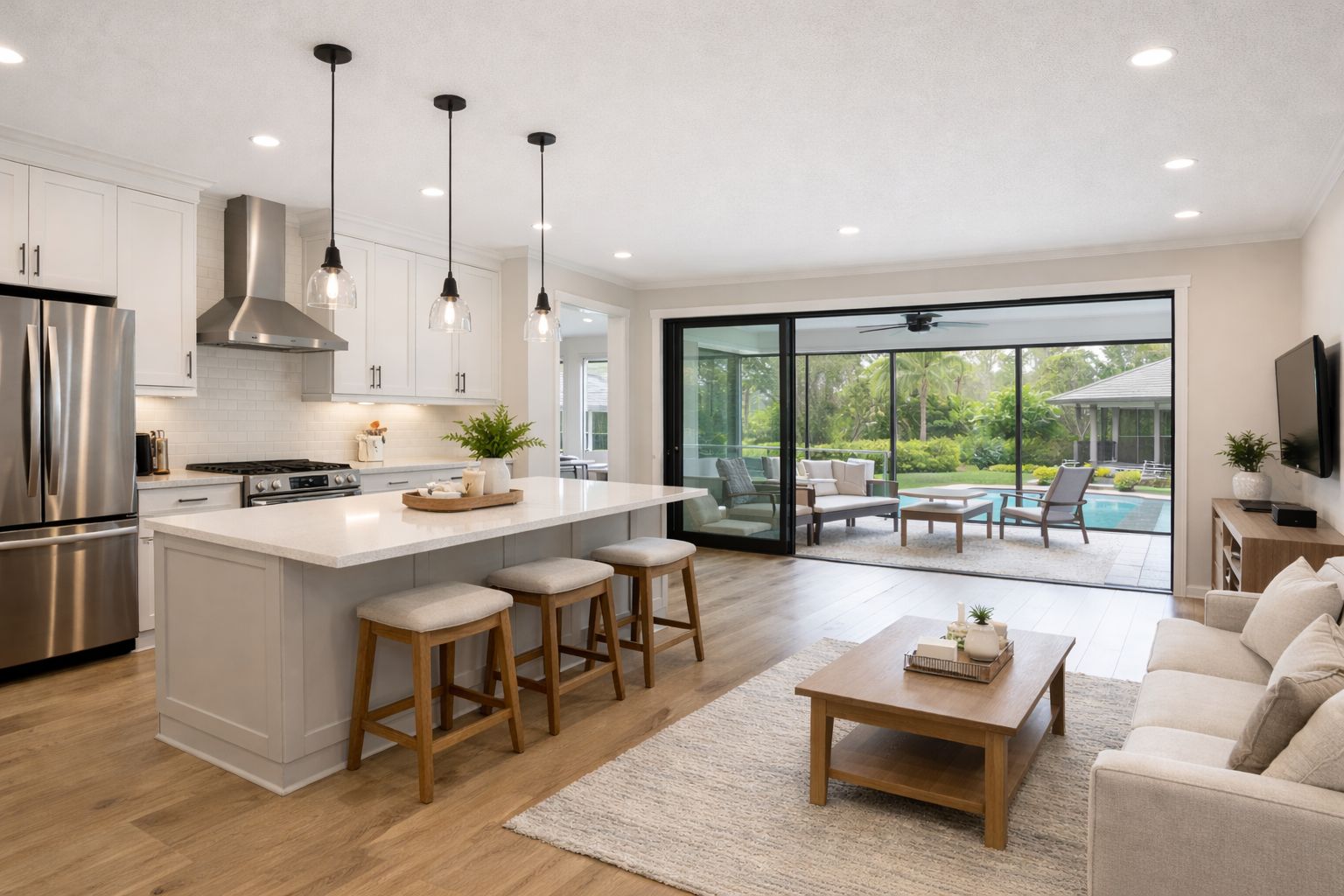
One common Jacksonville scenario is the dated house with a decent footprint but poor flow. In that kind of project, the right move is often selective demolition, better kitchen circulation, updated finishes, and careful coordination of electrical and plumbing revisions instead of a full structural reset. The result is a home that feels substantially newer without carrying unnecessary reconstruction cost.
Another frequent case involves investor properties with hidden risk behind cosmetic wear. These jobs usually need tighter supervision because the visible work moves fast, but actual value comes from correcting what buyers don't want to inherit. Moisture-related repairs, framing corrections, and disciplined finish selection tend to matter more than flashy upgrades.
A third type is the heavier remodel where structural decisions shape long-term value. That's where choices such as LGS versus wood framing stop being technical side notes and become part of the investment strategy. Projects like these benefit from early engineering input, stronger scope control, and fewer assumptions.
Frequently Asked Questions about Home Remodeling in Jacksonville
Is a full remodel always better than a partial remodel in Jacksonville
No. A full remodel only makes sense when the property condition, layout issues, and value target justify it. Many Jacksonville homes benefit more from focused upgrades that solve the main weakness without overbuilding.
What rooms usually deserve priority first
Start with the areas that affect function, condition, and resale confidence. That often means kitchens, bathrooms, exterior presentation, and any problem tied to water intrusion, structural wear, or outdated systems.
Should I choose hurricane-resistant upgrades even if I'm not planning to sell soon
Usually, yes, if those upgrades protect the structure and reduce long-term risk. The key is choosing resilience measures that fit the house and budget, rather than adding every possible upgrade without a return strategy.
Is LGS framing only relevant for new construction
No. It can also matter in major remodels, additions, and structural rework where framing performance affects durability and long-term value.
How do I avoid the biggest budget mistakes
Make major decisions before construction starts, keep the scope clear, document every change, and don't let finish selections outrun the property's value range. Budget problems usually come from late decisions and hidden conditions, not from one expensive tile choice alone.
What should I expect from a remodeling contractor during the job
You should expect regular communication, clear scope tracking, schedule coordination, permit awareness, quality checks, and a documented process for change orders and final punch items. If updates are inconsistent early, they usually won't improve later.
If you're planning a remodel and want a practical review of scope, budget, ROI, and construction risk, contact Ofir Engineering. The team works with homeowners, investors, and property managers in Jacksonville, Florida on renovations, project management, and property improvement strategies built around clear execution.
Related guides: Home remodeling checklist: your organized guide for Jacksonville projects · Whole Home Remodeling Contractors: A Jacksonville Guide
