You're probably here because the project just became real. Maybe it's a kitchen and whole-home remodel in Jacksonville, maybe an addition in Saint Johns, maybe a rental that needs to move from dated to rentable without burning your margin. At that point, hiring a general contractor in Jacksonville, FL stops being a search task and becomes a risk-management decision.
Backed by Florida general contractor license CGC 1540016, the Ofir Engineering team serves clients across Jacksonville, St. Johns, and Clay County.A good contractor doesn't just line up trades. They control scope, sequence work correctly, anticipate code issues, protect the budget, and keep bad assumptions from turning into expensive change orders. In a market like Northeast Florida, where project types range from historic renovations to coastal upgrades and investor turnarounds, the right fit matters as much as the price.
Table of Contents
- Your Pre-Hire Checklist for Finding Jacksonville Contractors
- How to Interview a Contractor and Get the Answers You Need
- Verifying Licenses Insurance and Florida Building Codes
- Analyzing Quotes and Structuring a Protective Contract
- Project Kickoff and Management Success
- FAQs About Hiring a Contractor in Northeast Florida
- Do Jacksonville and St. Johns projects feel the same from a permitting standpoint
- What is the difference between a general contractor and a project manager for an investor
- How should disagreements be handled during a project
- Is the cheapest quote ever the right move
- How do investors choose a contractor differently than homeowners
- What should a first meeting produce
Your Pre-Hire Checklist for Finding Jacksonville Contractors
A Jacksonville owner gets excited about a remodel, calls three contractors, and asks each for a price. One assumes basic finishes. One includes structural work. One leaves permitting vague. The numbers come back far apart, and none of them are comparable. That confusion starts before the first estimate.
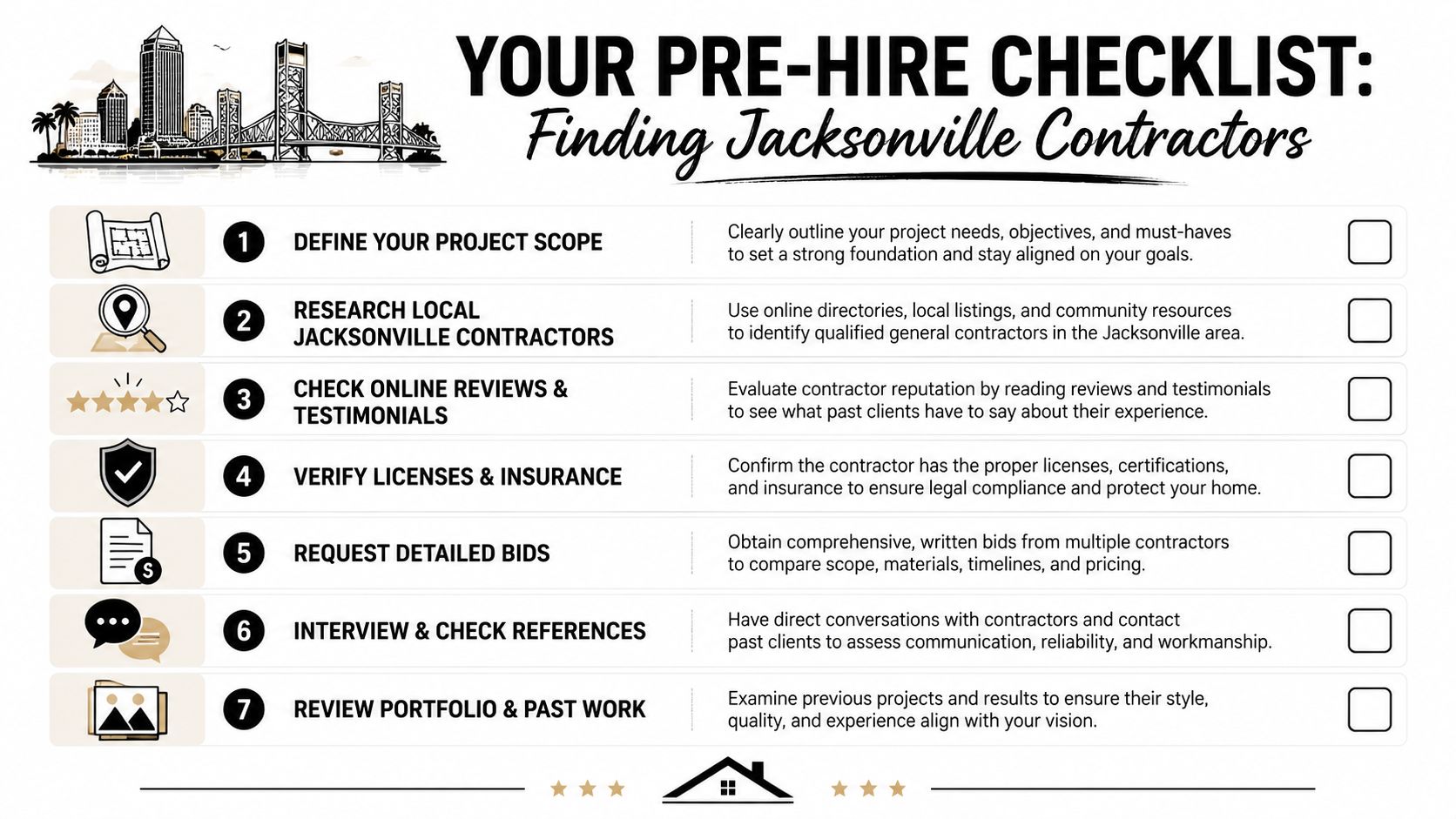
Define the job before you build a shortlist. A bathroom refresh, a Riverside structural renovation, a rental turnover, and a Saint Johns ground-up home require different systems, subcontractors, and risk controls. If the project may involve framing changes, code-triggered upgrades, or moisture-prone assemblies, the right contractor is the one whose process fits that level of complexity.
Start with project clarity, not contractor lists
Write down four things before you contact anyone.
- Project type. Cosmetic remodel, addition, tenant improvement, structural repair, new construction, or investor turnover.
- Decision goals. Lower upfront cost, faster delivery, stronger resale appeal, rental durability, insurance resilience, or long-term operating value.
- Firm requirements. Occupied home conditions, financing deadlines, HOA restrictions, permit timing, flood-zone concerns, or specific material choices.
- Known unknowns. Older wiring, hidden rot, slab or framing corrections, drainage issues, or incomplete plans.
That list changes your candidate pool quickly. A contractor who is efficient on finish updates may struggle on a project with inspections, sequencing, engineering coordination, and tight carrying-cost pressure. Investors especially need to screen for schedule discipline and scope control, not just headline price.
One rule applies on every job: if the scope is fuzzy, the pricing will be fuzzy too.
Build a shortlist that matches the job
Start broad, then narrow hard. Use referrals from architects, engineers, designers, property managers, and local investors who have completed projects similar to yours in Northeast Florida. Search results can help you find names, but they should not decide who gets invited to bid.
Use this screening checklist on each company:
- Local project relevance. Jacksonville experience should match your actual job type. Historic renovation, coastal work, suburban additions, and investor rehabs each come with different execution risks.
- Scope fit. Confirm whether the contractor regularly handles remodeling, additions, structural work, construction management, or plan-driven builds.
- Process visibility. Strong firms explain how they handle preconstruction, scheduling, permit coordination, selections, inspections, and closeout.
- Material judgment. Ask whether they can explain trade-offs clearly, including where wood framing makes sense and where light gauge steel may reduce risk from moisture movement, termites, or long-term maintenance.
- Proof of execution. Look for recent photos, consistent reviews, and examples that show work quality, not just marketing.
- Professional stability. Clear communication, organized estimating, and a current body of work usually signal fewer problems once the job is underway.
In Jacksonville, that material judgment matters more than many first-time owners expect. Wood framing can cost less upfront and remain the practical choice on many residential projects. Light gauge steel can pencil out well on certain additions, investor projects, and builds where straightness, durability, and reduced pest exposure support the long-term return. Ofir Engineering works in that steel-versus-wood decision zone, and it is one of the few areas where an owner can improve durability and lifecycle value before construction even starts.
If insulation or envelope work is part of your remodel, this guide to vetting insulation pros is useful because it shows the kind of trade-specific questions owners should ask before a specialty scope gets folded into a larger contract.
For homeowners who want to organize plans, priorities, and scope before they start calling firms, a practical tool is this Jacksonville home remodeling checklist.
How to Interview a Contractor and Get the Answers You Need
An interview should feel less like a sales call and more like a working session. You're testing whether the contractor can think clearly about your project, communicate under pressure, and manage details after the excitement wears off.
A polished personality can help a project. It can't replace systems. That's why the best questions focus on how the contractor works when conditions change, trades overlap, or the existing house doesn't match the drawings.

Ask questions that reveal process
Use questions that force the contractor to explain workflow, not just promise results.
Ask things like:
- How do you manage communication during the job? Good answers mention a clear point of contact, update cadence, and how budget or scope issues are documented.
- What kinds of Jacksonville or Northeast Florida projects are most similar to mine? You want direct relevance, not a generic “we do everything.”
- How do you handle subcontractors? Listen for established trade relationships, scheduling discipline, and quality checks.
- What usually causes change orders on projects like this? Experienced contractors won't pretend surprises never happen. They'll explain how they identify, price, and approve changes.
- What has to be decided before demolition starts? This question reveals whether they understand sequencing.
- How do you keep owners from slowing down the schedule? A strong contractor has a system for selections, approvals, and decision deadlines.
One factual example of a local service category is General Contractor Jacksonville, which is described as a licensed Jacksonville general contractor providing remodeling, renovation, construction management, and residential construction services throughout Northeast Florida. That's the kind of scope description you want to see from any firm you interview. It tells you what lane they operate in.
Listen for specificity, not charm
The strongest answers sound concrete. The weakest answers sound broad and flattering.
Here's the difference:
| Interview topic | Strong answer sounds like | Weak answer sounds like |
|---|---|---|
| Communication | Named contact, scheduled updates, written approvals | “We stay in touch” |
| Scope control | Clear plans, allowances, selections process | “We'll figure it out as we go” |
| Subcontractors | Repeat trade partners, supervised work, punch review | “I know a lot of guys” |
| Problem solving | Explains a realistic issue and response | “We never have problems” |
A contractor who can't explain their process in a simple conversation usually won't make a complex project feel simple once work starts.
Watch how they talk about risk. If they dismiss moisture issues, permit questions, structural unknowns, or owner selections as minor details, that's a warning sign. Florida projects reward planning. They punish assumptions.
A good interview should leave you with a clear picture of three things: how they think, how they document, and how they respond when the house reveals something nobody could see on day one.
Verifying Licenses Insurance and Florida Building Codes
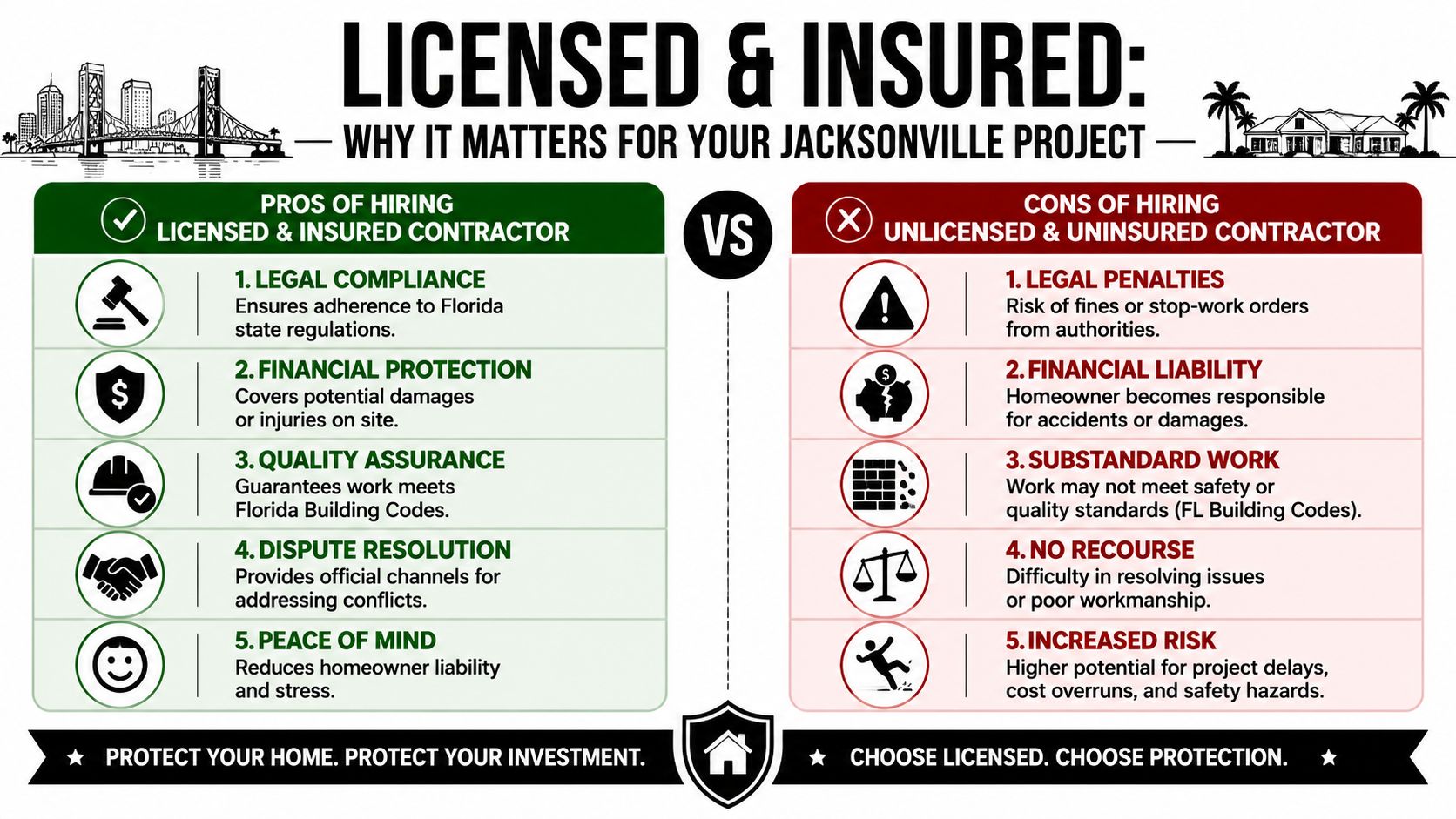
This is the part owners skip when they're in a hurry, and it's the part that causes the most preventable problems. A valid license and current insurance are not paperwork formalities. They're the foundation of legal compliance, financial protection, and accountability.
In Florida, proper credentialing is a real barrier to entry. One exam-prep provider reports a 90% pass rate for its program and notes a minimum fee of $7,000 for the state exam administration in the context cited in this Florida contractor licensing discussion. The practical takeaway is simple: licensing requires real investment, which helps separate established professional operators from people trying to work around the system.
What to verify before work starts
Ask for documentation, then verify it independently.
Check these items:
- License status. Verify the contractor's Florida license through the state database, not just a screenshot or business card.
- General liability insurance. This helps protect against property damage and certain jobsite claims.
- Workers' compensation coverage. This matters if someone gets hurt on the job.
- Business identity consistency. The company name on the proposal, insurance certificate, and license should line up.
- Permit responsibility. The contract should make clear who is pulling permits and coordinating inspections.
If you want a plain-English overview of what liability and workers' comp policies are meant to address, this explanation of liability and workers' comp for contractors is a useful companion when reviewing certificates.
For owners trying to understand the local administrative side before they hire, this guide to the building permit process helps frame what proper permit handling should look like.
Why code knowledge matters in Northeast Florida
Code compliance isn't just about passing final inspection. It affects structural work, life safety, framing details, egress, electrical upgrades, moisture control, and whether a renovation can move efficiently from rough inspections to closeout.
A contractor can be honest and hardworking and still be a poor fit if they don't understand how code requirements shape decisions early. That shows up when plans are incomplete, inspections fail, or field changes get made without proper documentation.
Owner safeguard: Ask the contractor to describe how they handle permit drawings, inspections, correction notices, and code-related revisions. The answer should be routine, not defensive.
In Jacksonville and the broader Northeast Florida market, code knowledge matters even more on additions, structural remodels, whole-home renovations, and any project where old conditions meet new work. That's where weak preconstruction habits usually surface.
Analyzing Quotes and Structuring a Protective Contract
You get two proposals for a Jacksonville renovation. One is $18,000 lower. On paper, it looks like an easy decision. Then the job starts, permits take longer than expected, framing changes show up after demo, and the cheaper bid begins collecting change orders. The original savings disappear fast.
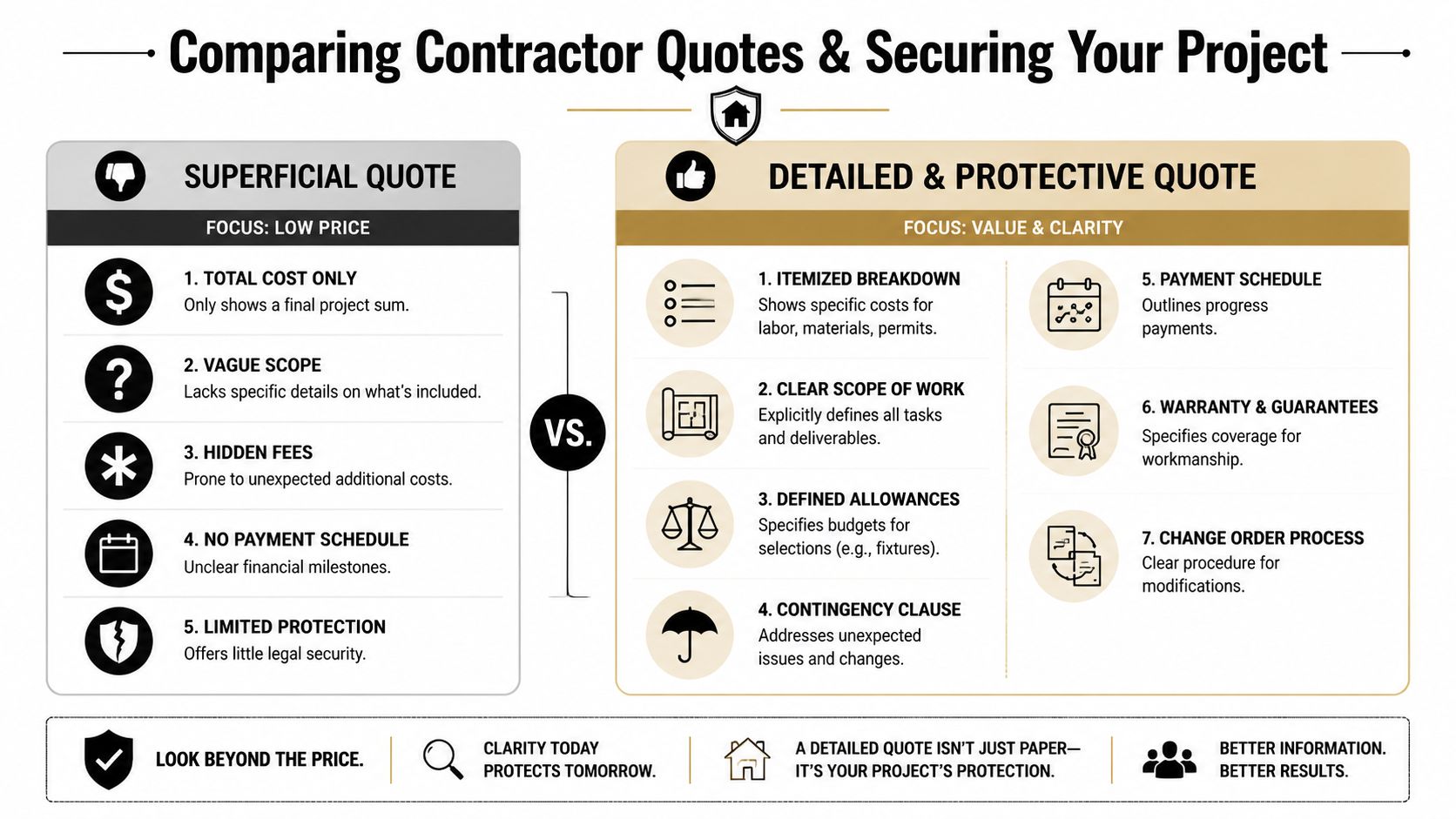
A common mistake when comparing bids is to focus on total price before confirming that each contractor priced the same scope. In Jacksonville, that problem gets worse on older homes, additions, structural remodels, and investor rehabs where hidden conditions are common and speed affects return.
Read the scope before you read the price
Build a simple bid-leveling sheet and compare each proposal line by line. If one contractor includes permit coordination, debris haul-off, and finish installation details while another uses broad language, those are not competing bids. They are different scopes with different risk.
Review these items first:
- Demolition and disposal. Confirm haul-off, dump fees, protection of occupied areas, and site cleanup.
- Permits and inspections. Clarify who is responsible for filing, revisions, reinspection fees, and meeting inspectors on site.
- Materials. Look for actual product descriptions, not generic references that allow major quality swings.
- Allowances. Cabinets, tile, flooring, plumbing fixtures, lighting, and appliances should have realistic placeholder numbers if final selections are not made.
- Subtrade scopes. Electrical, plumbing, HVAC, drywall, paint, flooring, trim, and waterproofing should be visible.
- Structural work. On remodels, identify who is carrying engineering, framing revisions, and any specialty framing decisions such as wood versus light gauge steel.
- Closeout items. Final cleaning, punch work, warranty response, and permit closeout should be stated.
The labor rate by itself does not tell you whether the estimate is complete. A lower number can still produce a more expensive project if allowances are thin, exclusions are buried, or site conditions are pushed back onto the owner.
I tell owners to circle every phrase that creates room for interpretation. "By owner." "As needed." "Per code." "Standard finish." Those are not harmless shortcuts. They are places where cost and responsibility can shift later.
Contract terms that protect your investment
A sound contract sets project mechanics before money changes hands. It should explain what is being built, how changes are approved, when payments are due, and what happens if site conditions differ from the original assumptions.
Look for these provisions:
- Detailed scope of work. Include plans, specifications, finish levels, and any exclusions.
- Payment schedule tied to completed milestones. Tie draws to measurable progress, not calendar dates.
- Change order procedure. Require written pricing and written approval before extra work starts.
- Allowance language. State exactly how overages, credits, substitutions, and supplier delays are handled.
- Timeline structure. Include sequencing, long-lead items, owner selection deadlines, and permit dependencies.
- Unforeseen condition language. Older Jacksonville properties often reveal rot, outdated wiring, plumbing issues, or structural corrections after demolition.
- Warranty terms. Spell out workmanship coverage and the process for requesting correction.
For investors, contract structure affects ROI as much as purchase price. A cheap bid with weak change-order controls can wreck margin on a flip or stretch vacancy on a rental turn. A clearer agreement usually produces better cost control, better scheduling, and fewer disputes over what was included.
Material decisions belong in this conversation too. If framing is part of the scope, ask how the contractor is evaluating wood versus light gauge steel. Wood can be less expensive upfront and more familiar to some crews. Light gauge steel can offer advantages on straightness, dimensional stability, and resistance to moisture-related movement or pests, but it also changes detailing, coordination, and crew requirements. On projects where structure, durability, and long-term maintenance affect the investment, that trade-off should be priced and documented early, not handled casually in the field.
Owners who want tighter oversight during preconstruction often benefit from a contractor with a defined residential construction project management process. The difference shows up in documentation, scheduling discipline, procurement, and how quickly issues get resolved.
If the property will sit vacant during work, include site access and material protection in the contract package. The Overton Security construction site guide is a practical reference for thinking through theft prevention, deliveries, and who controls entry once materials start arriving.
A protective contract does not need fancy language. It needs clear scope, clear pricing, and a written process for the predictable problems that show up once walls are opened.
Project Kickoff and Management Success
Once the contract is signed, the actual job shifts from selection to execution. Owners often think the hard part is over. In practice, the early management phase determines whether the project feels organized or reactive.
The kickoff should establish who approves decisions, how changes are documented, what needs to be selected first, when permits are expected, and how access to the property will be handled. If that conversation is rushed, confusion shows up fast in the field.
What a strong kickoff looks like
A solid start usually includes:
- A pre-construction review. Final scope, plans, finish selections, site conditions, and known risks.
- Role clarity. One client contact, one contractor lead, and a clean approval chain.
- Decision deadlines. Cabinets, tile, fixtures, paint, flooring, and hardware can stall work if owners decide too late.
- Site rules. Access, pets, occupied areas, delivery zones, and work hours should be discussed early.
Security is one more item many owners overlook during active construction. On vacant homes, investor rehabs, and projects with staged materials, this Overton Security construction site guide is a practical reference for thinking through site access and loss prevention.
If you're hiring for oversight as much as labor coordination, this overview of residential construction project management is useful because it frames what schedule control, trade coordination, and quality supervision should include.
Light gauge steel versus wood framing
In Northeast Florida, framing choice can become a major strategy decision rather than a simple material preference. That's especially true for additions, new construction, and structural reconfigurations.
Wood framing is familiar, widely available, and often easier to adapt in conventional residential work. It can be a practical fit when speed of trade familiarity and straightforward detailing are priorities.
Light gauge steel can make sense when owners prioritize dimensional consistency, durability, fire resistance, and a systemized framing approach. It often appeals to clients who want a more engineered assembly and tighter control over structural performance.
Neither is automatically “better” for every project. The right choice depends on design, budget structure, trade readiness, schedule, and how the building will be used. The value of a knowledgeable GC is that they don't treat that as an abstract debate. They weigh the material against the actual project constraints.
The material decision should support the project plan. It shouldn't create a plan the job can't realistically support.
FAQs About Hiring a Contractor in Northeast Florida
Do Jacksonville and St. Johns projects feel the same from a permitting standpoint
No. They may share many construction realities, but the permitting path, review flow, documentation expectations, and administrative rhythm can differ. Owners should never assume that a process from one jurisdiction will transfer cleanly to another. Ask the contractor where they regularly pull permits and how they handle local review comments.
What is the difference between a general contractor and a project manager for an investor
A general contractor is responsible for construction execution, trade coordination, and the contracted scope. A project manager, in the investor sense, may add planning, budget tracking, sequencing oversight, selection coordination, reporting, and broader owner representation. On some projects, one firm can handle both functions. On others, the owner wants separate oversight.
How should disagreements be handled during a project
Put the issue in writing immediately. Then isolate whether it's a scope dispute, quality dispute, schedule issue, or communication failure. Most project conflicts get worse because people argue opinions before reviewing the contract, approved changes, and existing documentation. Written records matter more than memory.
Is the cheapest quote ever the right move
Sometimes a lower quote reflects efficiency or a better subcontractor network. More often, it reflects a thinner scope, weaker documentation, unrealistic allowances, or a contractor who plans to solve budget gaps later through change orders. A lower number isn't automatically wrong, but it needs more scrutiny, not less.
How do investors choose a contractor differently than homeowners
Investors usually care more about schedule discipline, turnover readiness, scope control, and resale or rental fit. Homeowners often place more weight on finish experience, communication style, and how well the contractor handles an occupied home. The best contractor for a personal residence isn't always the best fit for a high-pressure investment renovation.
What should a first meeting produce
At minimum, it should clarify fit. You should know whether the contractor understands your project type, where the likely risks are, what information they need for pricing, and whether their communication style matches the way you want the job run. If the conversation stays vague, the project probably will too.
If you're planning a remodel, addition, new build, or investor renovation in Northeast Florida, Ofir Engineering provides construction, remodeling, and project management services in Jacksonville and surrounding areas. If you want a clear scope, tighter budget control, and a contractor who understands both build quality and ROI, contact Ofir Engineering to discuss your project.
Related service: building a custom home by Ofir Engineering, a licensed Florida general contractor (CGC 1540016) serving Jacksonville and Northeast Florida.
