

A commercial construction contractor is the project lead who turns plans, pricing, and trade work into a finished commercial space, and that role matters even more in a market as crowded as this one. The U.S. commercial building construction market is estimated at $315.5 billion in 2026 with 76,271 businesses competing, so choosing the right contractor is less about finding someone available and more about protecting your budget, timeline, and return.
Ofir Engineering is a licensed Florida general contractor (License #CGC 1540016) serving homeowners and investors across Jacksonville and Northeast Florida.If you're a Jacksonville investor planning a tenant improvement, retail renovation, office build-out, or small commercial retrofit, you're probably facing the same pressure points I see all the time. You need the work done fast, you need permits and inspections handled correctly, and you can't afford a low bid that turns into a stream of change orders once demolition starts. In Northeast Florida, that decision also carries local weight because climate, code requirements, and occupied-space logistics can change a job quickly if the contractor hasn't planned well.
Table of Contents
- Your Guide to Commercial Construction Contractors in Jacksonville
- The Role of a Commercial Contractor From Blueprint to Completion
- Key Services Offered by Commercial Construction Contractors
- How to Vet and Hire the Right Jacksonville Contractor
- Navigating Costs Timelines and Local Florida Factors
- Maximizing ROI An Investor's Perspective
- Frequently Asked Questions
- Partner with Jacksonville's ROI-Focused Construction Experts
Your Guide to Commercial Construction Contractors in Jacksonville
Jacksonville owners usually start looking for commercial construction contractors when a lease is signed, a property closes, or a tenant says, “We need this open as soon as possible.” That urgency is normal. The mistake is treating contractor selection like a simple price-shopping exercise.
A commercial construction contractor manages the full delivery process for a commercial project. That includes interpreting plans, organizing trades, controlling documentation, managing the field, and keeping the owner aligned on cost and schedule decisions. For investors, that means fewer surprises and better control over whether the project still makes financial sense halfway through the job.
The market itself tells you why selection is difficult. IBISWorld's U.S. commercial building construction industry overview estimates the market at $315.5 billion in 2026 and reports 76,271 businesses in the industry. That level of fragmentation means there are plenty of firms willing to bid your job, but not all of them are equipped for a fast-moving tenant build-out, an occupied renovation, or an investor project where every week of delay affects carrying cost and leasing plans.
In Jacksonville, the right contractor adds value in three ways:
- Budget control: They clarify scope early, so pricing reflects actual work instead of assumptions.
- Schedule discipline: They sequence trades in the right order and keep procurement from stalling the field.
- Risk reduction: They account for permits, inspections, weather exposure, occupied spaces, and code compliance before those issues become claims or delays.
Practical rule: Hire for scope clarity and coordination skill first. Price only means something after those two are in place.
That's the frame to use throughout this process. You're not buying labor alone. You're buying project control.
The Role of a Commercial Contractor From Blueprint to Completion
The easiest way to understand a commercial contractor is to think of an orchestra conductor. The conductor doesn't play every instrument. The conductor makes sure the right people come in at the right time, follow the same sheet music, and finish in sync. Commercial construction works the same way.
A contractor coordinates specialists who each own part of the work. Electrical, framing, HVAC, plumbing, roofing, finishes, fire protection, and equipment vendors all move on different timelines. If one group slips, the next group loses access, inspections get pushed, and the owner pays for the drag.
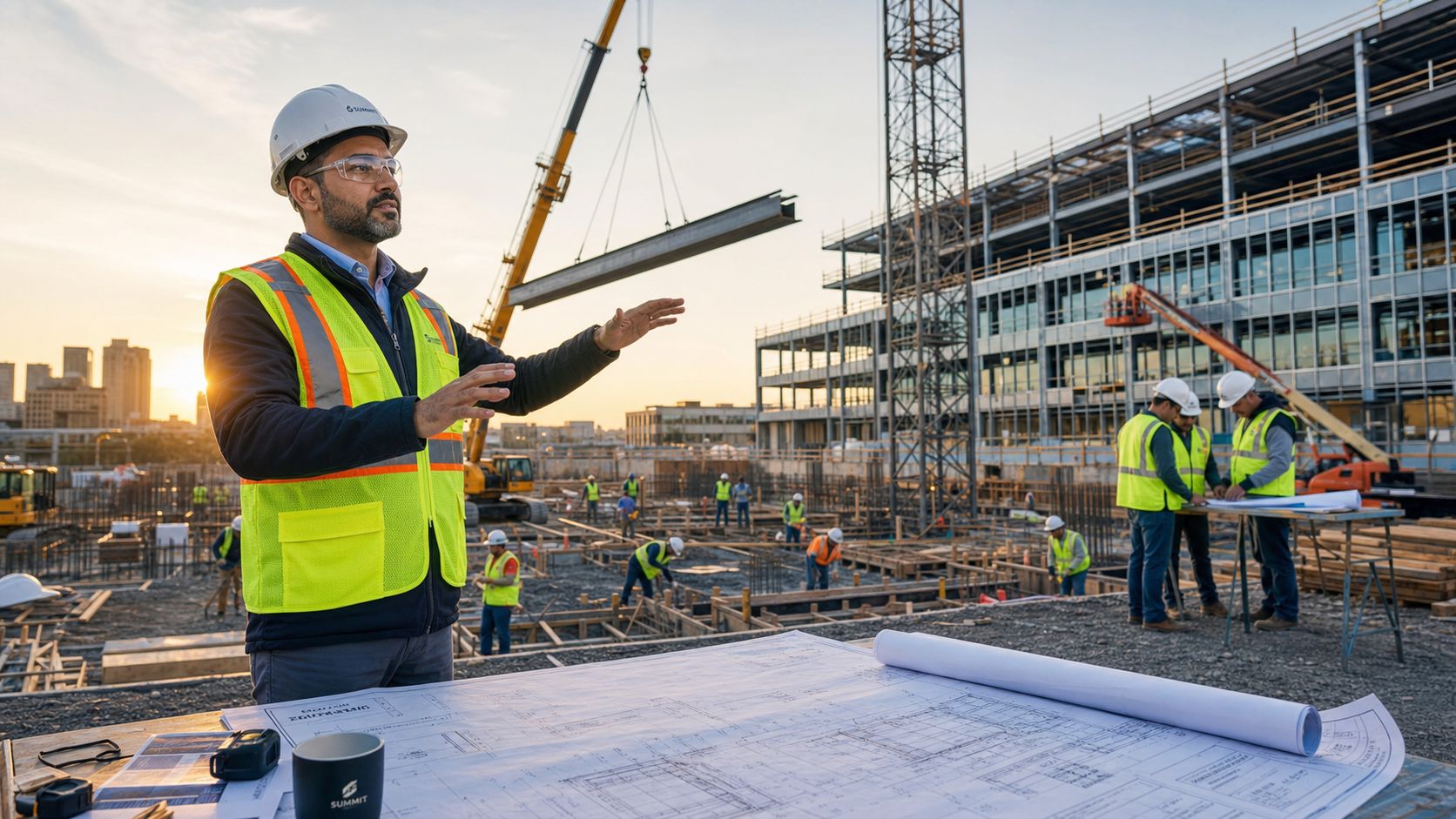
The scale of that coordination is larger than many owners realize. BLS construction industry data shows U.S. construction spending reached a seasonally adjusted annual rate of $2,172.4 billion in April 2026, including $1,639.7 billion in private construction and $729.8 billion in nonresidential construction. The same data also lists 599,700 electricians and 570,980 carpenters, which gives you a sense of how many specialized workers the industry depends on.
Coordination is the first job
Trade coordination is more than making phone calls. It means:
- Sequencing work properly: Framing, rough MEP, inspections, drywall, finishes, and equipment all have dependencies.
- Managing procurement: Long-lead items can hold up the entire schedule if they're approved too late.
- Keeping access clear: One trade working out of sequence can block everyone behind them.
If you're evaluating firms, this is where Construction Project Management becomes relevant in factual terms. It covers contractor coordination, budgeting, scheduling, renovation oversight, and construction supervision in Jacksonville for homeowners and investors.
Quality control is built into the process
Good contractors don't wait until punch list to check quality. They review submittals, inspect work in progress, verify installations against plans and specs, and catch conflicts before walls are closed.
That matters on Jacksonville commercial jobs because many projects are finished on compressed schedules. When owners rush, weak contractors start hiding issues instead of resolving them. Strong contractors surface them early and document the fix.
A subcontractor can do excellent work in one trade. A commercial contractor makes sure all trades produce one buildable, inspectable, occupiable result.
Risk management protects the owner
Owners usually see risk as cost overruns. Contractors see the full stack. Licensing, insurance, trade gaps, access restrictions, scope conflicts, inspection timing, and safety all affect delivery.
That's why the contractor's fee shouldn't be viewed as an administrative layer you can cut. On most commercial jobs, that oversight is what keeps the project from drifting into claims, delay, and rework.
Key Services Offered by Commercial Construction Contractors
Commercial construction contractors earn their value before the first crew arrives. The field work gets most of the attention, but the primary control usually comes from planning, documentation, and follow-through.
Guidance on important commercial construction documents explains why this matters. Professional contractors manage specifications, schedules, work orders, bidding documents, insurance certificates, daily reports, and other technical records that turn scope into enforceable requirements and reduce ambiguity-driven change orders.
Pre-construction services
This phase is where good projects are won.
- Scope review: The contractor looks for missing details, unclear notes, and coordination gaps before pricing is finalized.
- Budget alignment: Early estimates are refined against scope, finish level, and site conditions.
- Permitting prep: Drawings, revisions, and supporting documents are organized for local review.
- Bid packaging: If multiple trades are bidding, the contractor defines what each trade is pricing.
- Value engineering: Owners get options that preserve function while reducing unnecessary cost or complexity.
For owners upgrading common areas or storefronts, products also need to fit code, durability, and maintenance goals. If the project includes guardrails or feature rail systems, reviewing examples of modern commercial railing systems can help clarify design intent before pricing gets locked in.
Construction phase management
Once the job starts, the contractor becomes the control point for execution.
- Trade supervision: Subcontractors are scheduled, directed, and held to scope.
- Schedule management: The contractor updates sequencing based on inspections, deliveries, and field conditions.
- Quality checks: Work is reviewed against plans, specs, and approved submittals.
- Safety administration: Site rules, reporting, and coordination reduce avoidable disruptions.
- Change management: Potential scope changes are documented, priced, and approved before work moves ahead.
A lot of owners underestimate the importance of work orders and daily reports. Those records matter when a dispute shows up over who approved a change, whether a trade had access, or why a completion date moved.
Post-construction and handover
The project isn't done when the crews leave.
- Punch list completion: Remaining defects or incomplete items are tracked to closure.
- Final inspections: The contractor coordinates sign-offs and closeout requirements.
- Turnover package: Warranties, manuals, and record documents are organized for the owner.
- Owner training: Building systems and maintenance expectations are reviewed.
- Closeout discipline: Final payment should follow actual completion, not verbal assurances.
The practical difference between average and strong contractors shows up here. Average firms disappear into loose ends. Professional firms close the loop in writing.
How to Vet and Hire the Right Jacksonville Contractor
Hiring the right contractor in Jacksonville starts with a simple question. Can this company deliver your specific project type under your actual conditions? A contractor may be perfectly capable on ground-up work and still struggle with an occupied medical office renovation, retail refresh, or investor-driven tenant improvement.
Start with verification, then move to fit, then compare proposals.
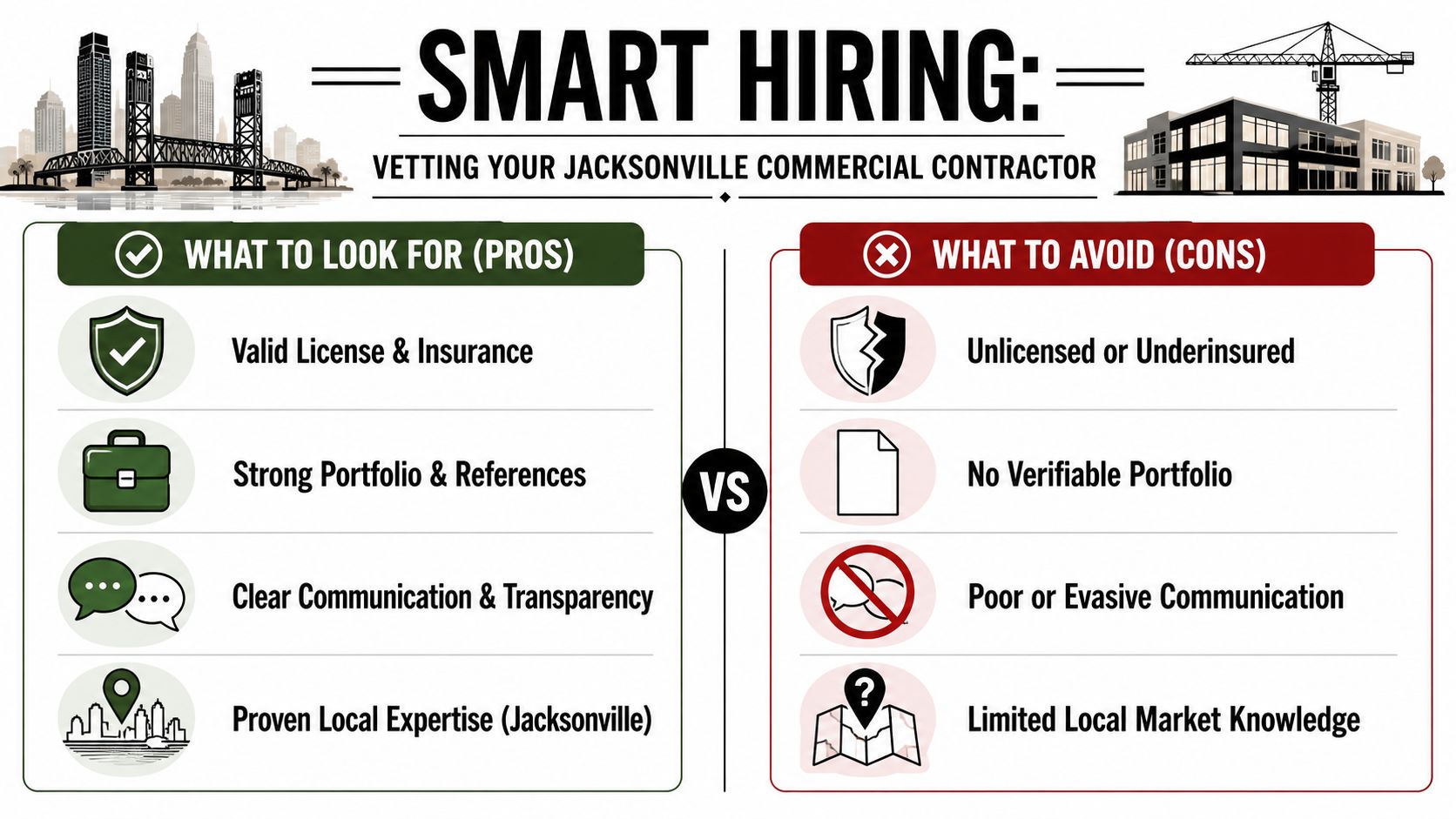
What to verify before you compare pricing
Use this screening checklist early:
- License status: Confirm the contractor holds the proper Florida license for the work.
- Insurance documents: Ask for current liability and workers' compensation certificates.
- Relevant portfolio: Look for similar build-outs, retrofits, or occupied-space projects.
- Local familiarity: Jacksonville permitting and inspection logistics matter.
- Team structure: Find out who will run your job day to day, not just who sold it.
- Reference quality: Ask past clients how the contractor handled problems, not just whether they were “easy to work with.”
If you want a deeper checklist before interviews, this guide on how to hire a general contractor is a useful companion.
A short visual can help frame the decision:
Looking beyond the lowest bid
Many investors lose money by falling into a common pitfall described by Industry commentary on commercial construction obstacles: choosing the lowest bid without normalizing scope, which often leads to expensive change orders later.
Here's what bid normalization means in practice:
- Line up scopes side by side. Don't compare totals until you know each bidder included the same work.
- Check exclusions carefully. Demolition, patching, permits, after-hours work, temporary protection, and finish repairs are often where low bids get thin.
- Review allowances. If a proposal uses vague allowances, you may be carrying hidden cost risk.
- Ask who owns coordination. If the proposal is silent on supervision, submittals, or closeout, the owner usually pays somewhere else.
- Scrutinize unit pricing and change language. Weak front-end scope often turns into aggressive change-order pricing in the field.
Owner advice: A low number with missing detail is not a bargain. It's an incomplete transfer of risk back to you.
Green flags and red flags
| Green flags | Red flags |
|---|---|
| Detailed scope breakdown | Lump-sum proposal with little detail |
| Clear answers about team and schedule | Evasive answers about staffing |
| Local project examples | No verifiable comparable work |
| Organized insurance and license records | Expired or incomplete documentation |
| Defined process for changes | “We'll figure it out in the field” |
A strong interview question is this: “What's most likely to create a change order on my project?” Experienced contractors answer directly. Inexperienced ones say, “Nothing if the plans are good.”
Navigating Costs Timelines and Local Florida Factors
Commercial jobs don't just run on a price and a start date. They run on contract structure, lead times, inspections, weather planning, and how well the contractor sequences trades when conditions change.
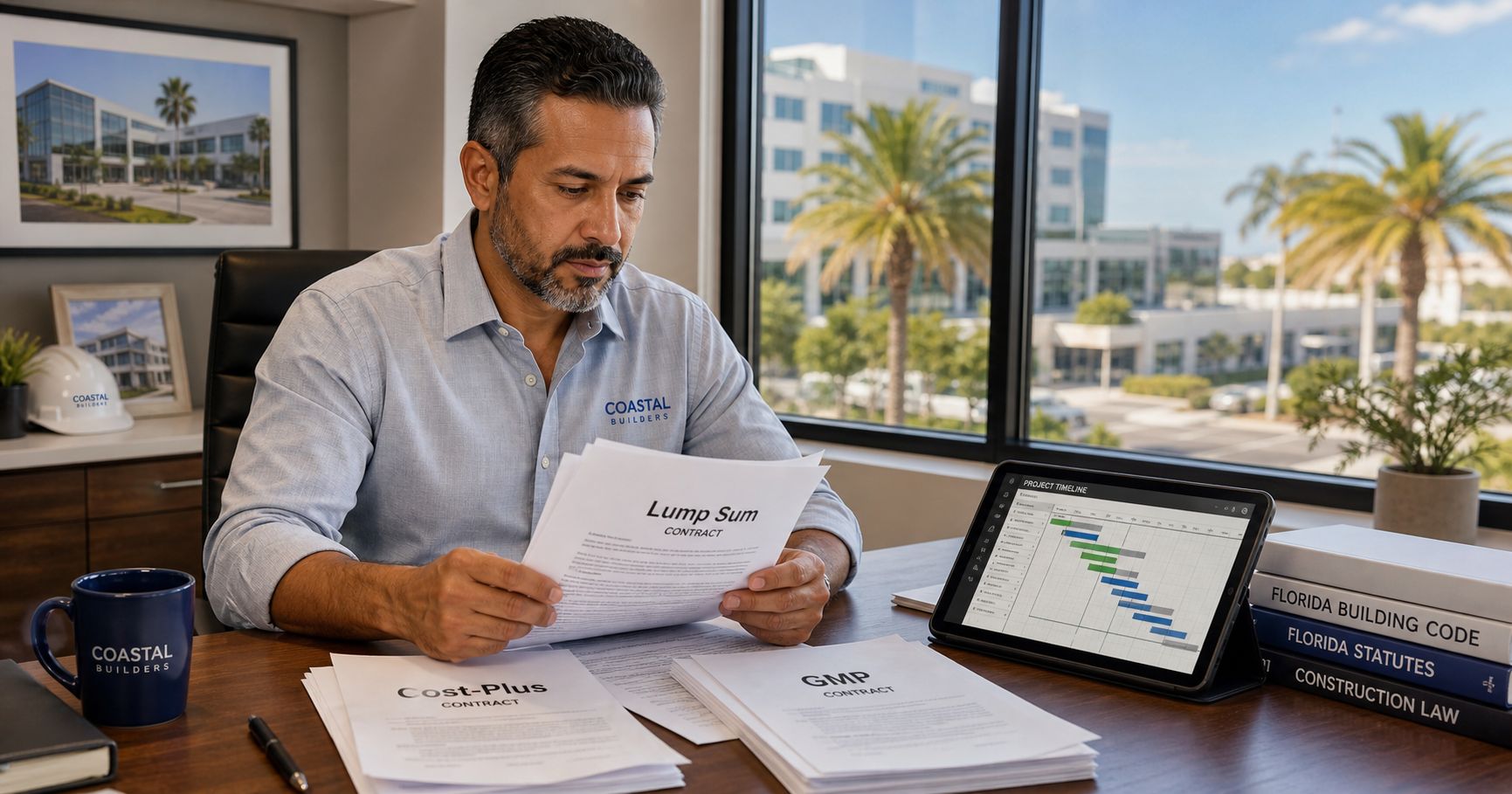
How contract structure changes risk
Owners should understand the basic difference between common contract approaches:
- Lump sum: Best when plans are complete and scope is well defined. The risk is that missing detail turns into changes.
- Cost-plus: Useful when scope is evolving, but it requires strong oversight and reporting.
- Guaranteed maximum price: Often a middle ground when the owner wants more cost protection while design details are still moving.
None of these formats fixes poor planning. They only change where the risk sits when something was left unresolved.
Insurance review also matters, especially in Florida. For owners who want a plain-language overview before contract signing, Professional Insurance Advisors' guide gives a practical starting point for understanding contractor insurance issues.
What affects schedules in Jacksonville and Northeast Florida
Local conditions shape both cost and duration.
- Permitting and inspections: Review cycles and field inspections need to be built into the schedule from day one. This overview of the building permit process is helpful if you want to understand the local workflow before construction starts.
- Hurricane-resistant requirements: Florida code expectations influence detailing, product selection, and installation sequencing.
- Moisture exposure: Northeast Florida humidity affects storage, finishes, drying time, and mold prevention measures.
- Occupied operations: Tenant improvements often have to work around customers, staff, or existing tenants.
- Coastal and soil considerations: Site-specific conditions can change foundations, drainage, and exterior detailing.
Nationwide's general contractors industry overview notes that the U.S. construction sector produces nearly $2.1 trillion in structures annually, and that schedule slippage in one trade can cascade through the entire project. That observation matches what happens on Jacksonville jobs every week. If framing slips, MEP rough-ins shift. If inspections shift, drywall and finishes lose days. If finishes lose days, opening dates move.
Good contractors don't just build a schedule. They defend the sequence that keeps the schedule real.
That's why owners should ask how the contractor handles resequencing after a late delivery, failed inspection, or weather interruption. The answer tells you far more than the original completion date.
Maximizing ROI An Investor's Perspective
Investors shouldn't think of commercial construction contractors as a commodity. The right one acts more like a capital preservation and execution partner. On an investment property, every construction decision affects lease-up timing, rentability, maintenance exposure, and resale appeal.
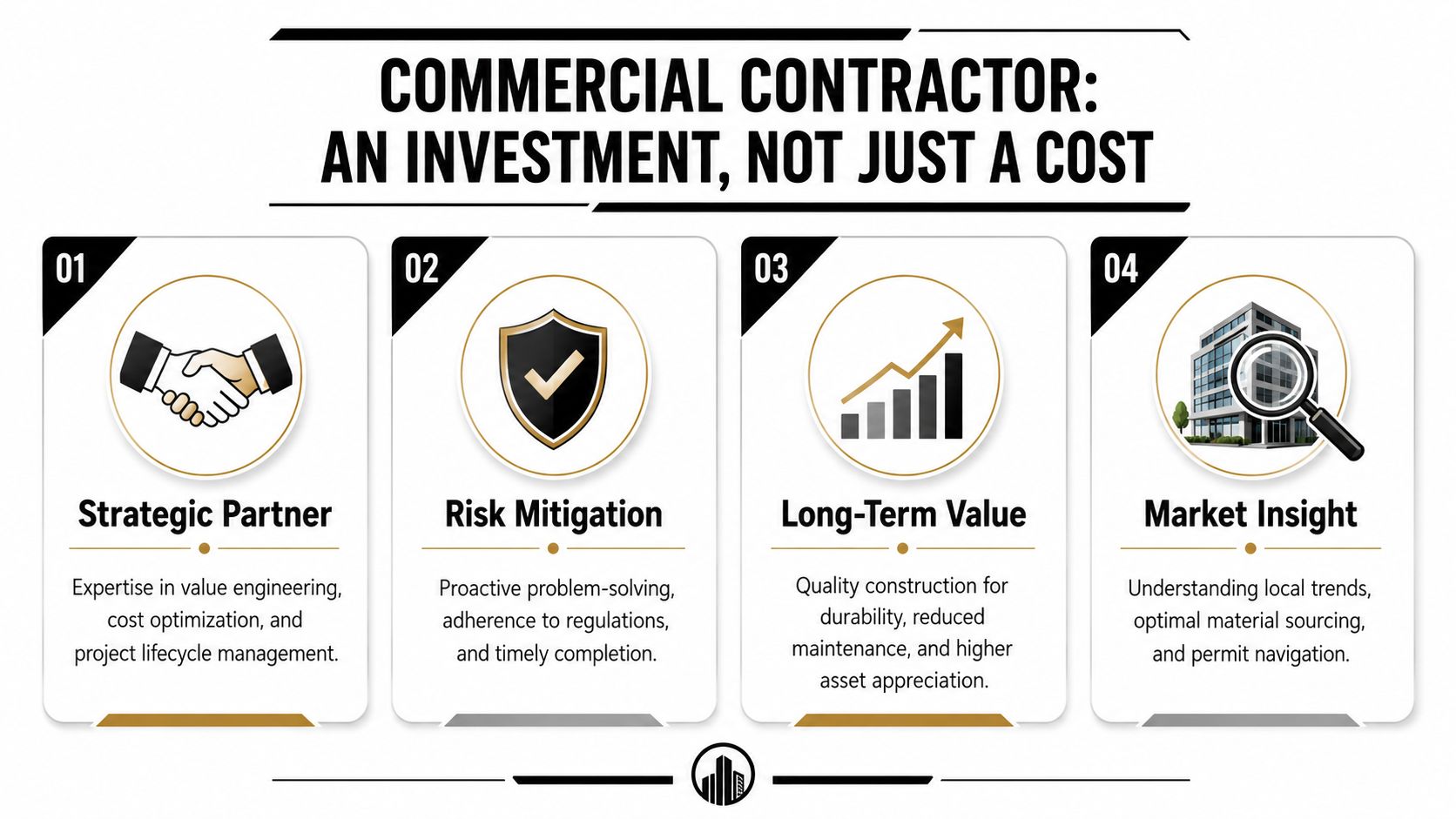
Where contractors create investor value
Investor ROI usually improves through a few specific contractor actions:
- Scope discipline: Better pre-construction review means fewer margin-killing surprises after demolition.
- Value engineering: Materials and assemblies can be adjusted without sacrificing performance or tenant appeal.
- Schedule control: Faster, cleaner execution reduces the time a unit, suite, or storefront sits nonproductive.
- Quality control: Better workmanship lowers call-backs, turnover repairs, and early maintenance headaches.
This is also where construction quality control matters in practical terms. It concerns inspections, standards, and oversight that help owners avoid paying twice for the same work.
What good ROI thinking looks like on real projects
In Jacksonville, I'd separate investor jobs into two buckets. First, projects where speed matters most, like tenant turnovers, retail refreshes, and small office build-outs. Second, projects where durability and reduced future maintenance matter most, like mixed-use common areas, multifamily upgrades, and recurring turnover programs.
For the first bucket, the contractor should simplify approvals, front-load procurement, and reduce handoff gaps between trades. For the second, the contractor should push hard on material compatibility, moisture resistance, maintainability, and clean documentation for future service work.
Owners who analyze markets and tenant demand often pair construction planning with property research tools. For site selection, comp review, or portfolio screening, some investors use CRE data for investors and developers alongside contractor input to decide where improvements are most likely to support leasing or repositioning goals.
One practical point gets missed often. A contractor who says yes to every owner idea is not always helping ROI. Sometimes the better move is to cut low-value scope, simplify a finish package, or redesign a detail that looks expensive to maintain.
Investors make money on the spread between cost, time, and marketability. The contractor influences all three.
That's why the best contractor relationship feels less like order-taking and more like disciplined decision support.
Frequently Asked Questions
Do I need a commercial contractor for a small tenant improvement project
If the job involves multiple trades, permits, inspections, occupied-space coordination, or schedule pressure, yes. Small projects can become messy faster than large ones because owners assume they can be managed informally. That usually works until one missing detail delays inspections or triggers a change order.
What should a commercial contractor proposal include
A useful proposal should clearly define scope, exclusions, responsibilities, change-order process, schedule assumptions, and closeout expectations. If the bid is short on detail, treat that as risk, not convenience. The more compressed the project, the more important written scope becomes.
How early should I bring a contractor into the project
Earlier is usually better, especially for Jacksonville tenant improvements and retrofit work. Bringing a contractor in during planning helps identify permit issues, constructability concerns, material lead times, and gaps in the design set before those problems affect cost and opening dates.
Partner with Jacksonville's ROI-Focused Construction Experts
Selecting among commercial construction contractors in Jacksonville isn't just a construction decision. It's an investment decision that affects cash flow, tenant readiness, risk exposure, and long-term asset value. Owners who choose well usually get tighter scope, cleaner execution, and fewer expensive surprises.
If you're planning a commercial renovation, tenant improvement, investor upgrade, or project that needs tighter budget and schedule control in Jacksonville or Northeast Florida, contact Ofir Engineering to discuss the scope, risks, and delivery strategy before you hire.
