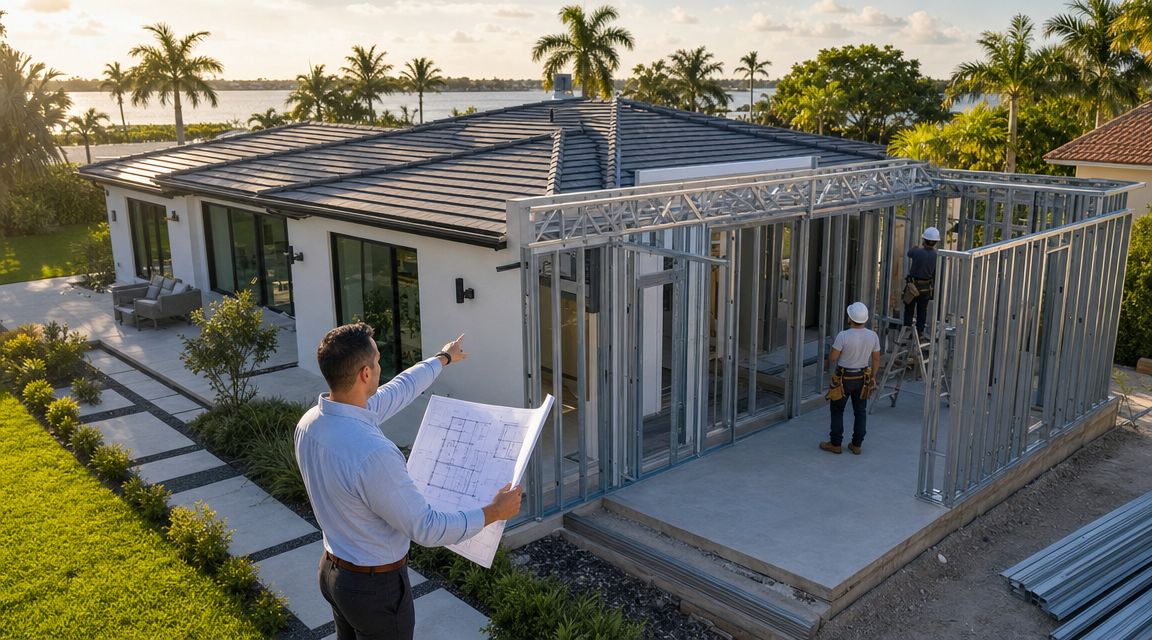
You're probably in one of two spots right now. You either need more space in the house you already like, or you're looking at an addition as a value decision and you don't want the project to drift into a budget and timeline problem. In Jacksonville, that's exactly where choosing the right house extension contractors matters most.
Ofir Engineering — a licensed Florida general contractor (CGC 1540016) based in Jacksonville — pairs real construction experience with investor-focused project management.A home addition isn't just extra square footage. It's a chain of decisions about scope, design, permitting, structural tie-ins, moisture management, subcontractor coordination, inspections, and resale logic. The contractor model you choose, and the way that team manages risk, will affect whether the result feels intentional and performs well in Florida conditions, or ends up looking bolted on.
Table of Contents
- Defining Your Extension's Scope and ROI
- Choosing the Right Contractor Model for Your Project
- How to Find and Vet Jacksonville Contractors
- The Contractor Interview Questions That Matter Most
- Comparing Bids and Deciphering the Contract
- Ensuring a Smooth Project from Start to Finish
- Frequently Asked Questions About House Extensions
- Start Your Jacksonville House Extension with Confidence
Defining Your Extension's Scope and ROI
The best addition projects start on paper, not with contractor calls. If your brief is vague, every quote you receive will be vague in a different way, and that's where budget surprises start.
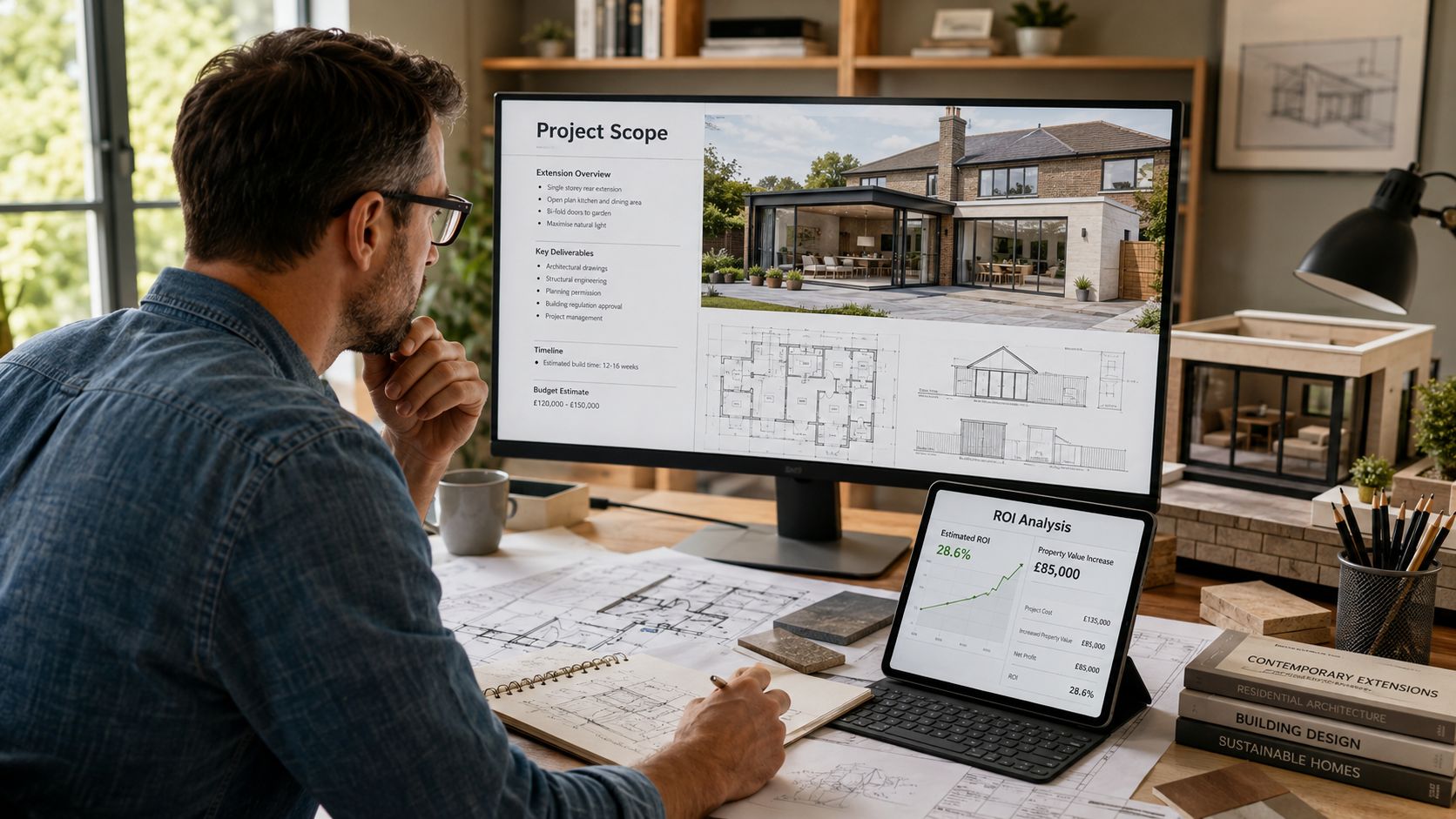
Start with the business case for the space
For homeowners, the first question is simple. What problem is the extension solving? Maybe you need a real primary suite, a larger kitchen, an in-law setup, or a better indoor-outdoor connection for the way you live in Northeast Florida.
For investors, the question is different. You need to know whether the added area improves the asset in a way the neighborhood supports. In Jacksonville, that often means being disciplined about layout, bedroom count, bath count, and functional living space instead of chasing flashy features that don't move buyer interest.
A useful brief should answer these points:
- Use case: Daily living, resale preparation, rental flexibility, or multigenerational living.
- Target outcome: Better flow, more privacy, stronger appraised appeal, or a more marketable layout.
- Non-negotiables: Ceiling height, natural light, storage, bathroom count, entry sequence, and outdoor access.
- Property constraints: Lot setbacks, drainage, existing rooflines, foundation conditions, and utility tie-ins.
Practical rule: If you can't describe the exact purpose of the addition in two or three sentences, you're not ready to ask for a real price.
Build a brief before you request pricing
A solid extension brief in Florida should include more than room size. It should include how the new work ties into the existing structure, whether the addition needs new slab or framing work, and how the contractor will protect the envelope from water and humidity.
It also helps to think through foundation implications early, especially if the site has drainage issues, existing grade challenges, or access limitations. Homeowners who want a better grasp of slab and support decisions should review these concrete foundation types before design moves too far.
Use this short pre-bid checklist:
- Write the scope clearly. State what's being added, what's being renovated around it, and what parts of the existing home must remain functional.
- List finish expectations. Flooring, windows, exterior cladding, roofing match, insulation goals, and interior trim all affect pricing.
- Identify Florida risk points. Humidity, water intrusion, storm exposure, and HVAC sizing need to be considered from the start.
- Set decision rules. Know where you'll spend more for long-term value and where you'll keep the spec simple.
A good brief protects ROI because it keeps the team focused on the work that matters. It also gives you a much better chance of getting comparable bids instead of a pile of numbers that look close but cover different scopes.
Choosing the Right Contractor Model for Your Project
The contractor model is not an administrative detail. It changes who owns coordination, how quickly design conflicts get resolved, and how exposed you are to finger-pointing when something doesn't line up.
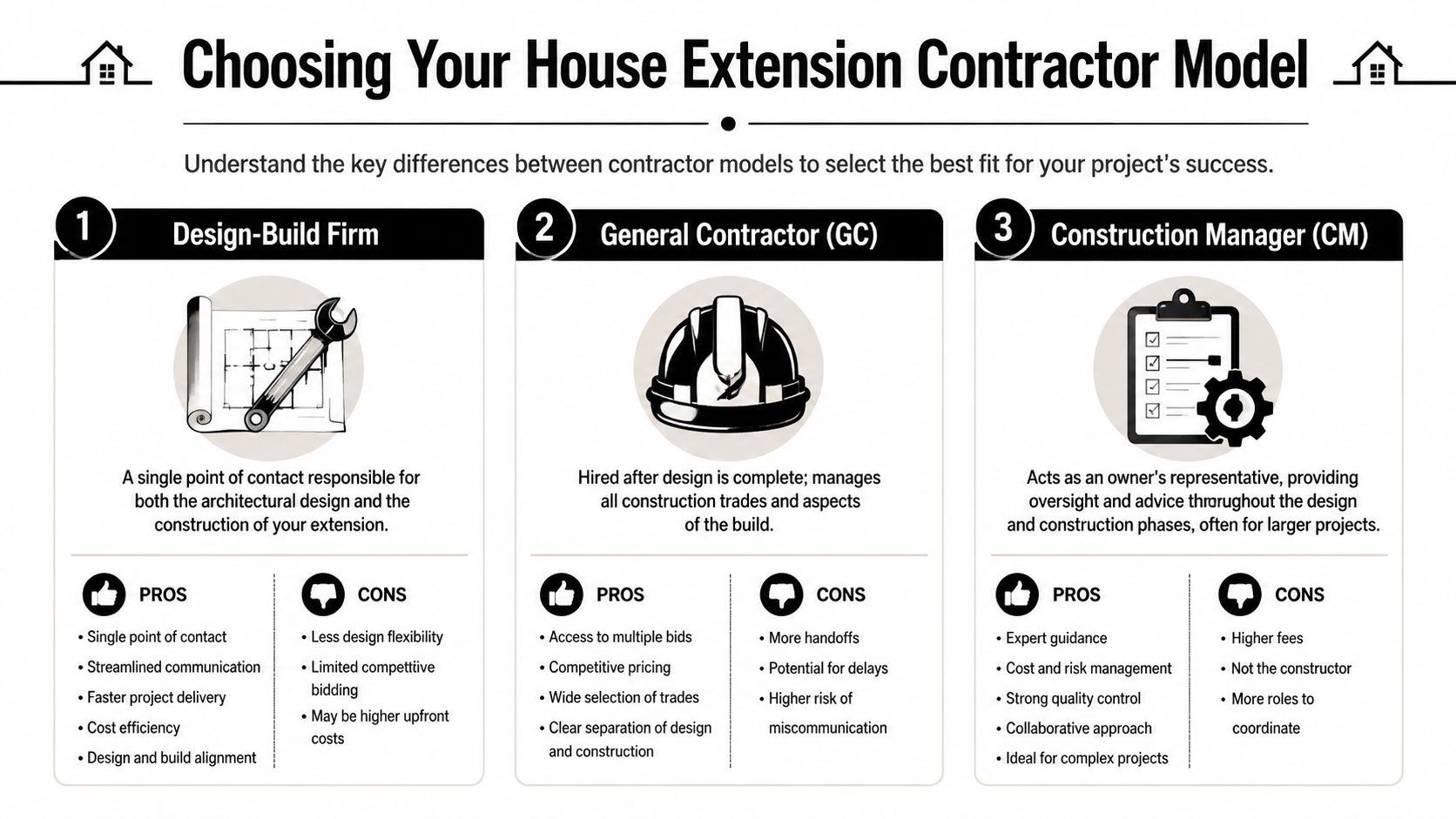
General Contractor versus Design-Build
A General Contractor usually comes in after the design is developed. The architect or designer completes drawings, and then the GC prices and builds the work. This model can work very well when you already have a strong design team and you want separation between design and construction.
A Design-Build firm handles both design and construction under one roof. For many additions, especially where tie-ins, structural coordination, and permit strategy are complex, that single line of accountability can reduce confusion.
Here's the practical difference:
| Model | Best fit | Main advantage | Main risk |
|---|---|---|---|
| General Contractor | Owners with completed plans and a separate design team | Competitive bidding after drawings are done | Design gaps can become field issues if documents are thin |
| Design-Build | Owners who want one team guiding design through construction | Faster coordination and fewer handoff problems | You need to verify the firm is equally strong in design and execution |
The market itself is broad and inconsistent. The U.S. residential building market is highly fragmented, and remodelers made up 56% of residential construction companies in 2025, growing from fewer than 69,000 in 2000 to more than 128,000 according to Harvard's Joint Center for Housing Studies. That matters because most homeowners aren't choosing between a few standardized national firms. They're choosing among very different local operators with very different systems.
A polished gallery doesn't tell you how a contractor handles sequencing, permit revisions, or a wet week that throws off inspections.
When a Construction Manager or specialty builder makes sense
A Construction Manager can be the right choice when the owner wants higher oversight, more reporting, and tighter control over decision-making. That's often more useful on larger homes, investor portfolios, or projects with multiple moving parts beyond the addition itself.
Specialty builders also have a place. In Northeast Florida, some owners explore systems such as light gauge steel when durability, structural consistency, or specific design goals drive the decision. That doesn't automatically make the project better. It just means the team must understand the material, the detailing, and how it integrates with the rest of the house.
Choose the model based on these realities:
- Pick Design-Build if you want fewer handoffs and a single accountable team.
- Pick a GC with outside design if you already trust your architect and want competitive pricing after full drawings.
- Pick a CM approach if the project is larger, more layered, or needs owner-side oversight.
- Pick a specialty builder only if the construction system fits the design and the contractor has real field experience with it.
In Jacksonville, the right answer usually comes down to complexity. The more complicated the tie-in, roof geometry, drainage, and code path, the more valuable clean coordination becomes.
How to Find and Vet Jacksonville Contractors
A lot of bad hires start with a weak shortlist. If you fill your list with whoever appears first in search results or whoever gave a fast rough number, you're already behind.
Build a shortlist the right way
Start local and stay specific. Look for contractors who regularly work in Jacksonville, Saint Johns, and the surrounding Northeast Florida market. The permitting rhythm, inspection expectations, and weather-related jobsite decisions are easier for teams that know the area.
Good shortlist sources include:
- Architect and engineer referrals: These professionals see how contractors handle details, revisions, and field coordination.
- Trade and local network referrals: Ask who communicates well, closes permits properly, and keeps jobs organized.
- Relevant project history: Look for additions, structural remodels, and renovation work that resembles your project in scale and complexity.
- Detailed service alignment: If the job is investor-driven, a team that understands budgeting and schedule control matters more than a team that only sells finishes.
If you want a practical owner-side framework for screening builders, this guide on how to hire a general contractor is a useful starting point.
What to verify before the interview
House extension contractors are really coordinators of many moving parts. In a national survey of home builders, the average project used 22 subcontractors per home, and 77% of construction cost was subcontracted, according to NAHB's analysis reported by Eye On Housing. That's why you're not just hiring someone to build. You're hiring someone to manage sequencing, trade accountability, and quality across many hands.
Before you interview anyone, verify these basics:
- License status: Confirm the contractor is properly licensed for the work they're proposing.
- Insurance: Ask for current proof of general liability and workers' compensation coverage.
- Project fit: Review completed work that matches your addition type, not just generic remodel photos.
- Process maturity: Find out whether they use written schedules, change order documentation, and a defined communication system.
A few red flags show up early:
- They price from a sketch without asking real questions.
- They can't explain who manages the site day to day.
- They talk mostly about finishes and very little about structural tie-ins, permitting, or moisture control.
- They avoid paperwork until “later.”
The strongest contractors usually ask harder questions at the first meeting. That's a good sign, not a sales problem.
Keep the shortlist tight. Three or four serious contenders is usually enough to compare process, fit, and communication style without turning the selection process into its own project.
The Contractor Interview Questions That Matter Most
The interview should test how a contractor thinks, not just how they present. A smooth salesperson can still run a chaotic project. What you want is a clear operator who understands integration, documentation, and Florida-specific risk.
This checklist is a good baseline to bring into the meeting.
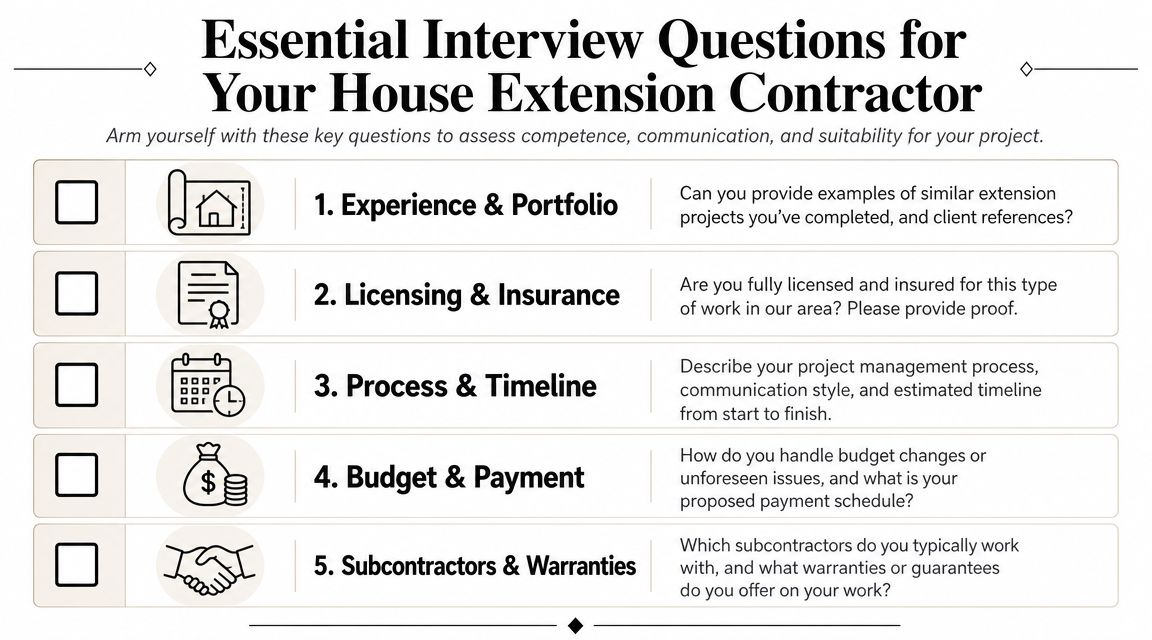
Questions that reveal project management strength
Start with questions that expose systems:
Who is my day-to-day point of contact?
A strong answer names the person, explains their role, and tells you how communication happens.How do you schedule subcontractors and inspections?
A strong answer includes sequencing logic, not just “we handle that.”How do you document changes?
A professional contractor should describe a written change order process with scope, cost, and schedule impact.How do you manage lead-time items and substitutions?
You want evidence that they track procurement early and don't make last-minute field decisions without owner approval.
Here's a useful video to review before interviews:
For investors, this is also where contractor oversight becomes part of the return calculation. Fix and Flip Renovation Services covers renovation budgeting, contractor management, project scheduling, and ROI-focused construction planning for real estate investors in Jacksonville Florida. That's relevant when the addition is part of a larger repositioning strategy rather than a standalone homeowner project.
Questions that reveal design integration judgment
This part gets overlooked all the time. A contractor may be able to build the addition structurally and still deliver something that feels awkward, oversized, or disconnected from the original house.
Ask these instead:
- How would you keep this addition from overpowering the existing house?
- What concerns do you have about rooflines, transitions, and exterior proportions here?
- Where do you see complexity that could be simplified before construction?
- How do you coordinate with the designer when field conditions don't match the drawings?
Professional design guidance warns that poorly integrated additions can dominate a house and create unnecessary complexity, as discussed in Houzz's guidance on home additions and extensions. In practice, that means the contractor should be able to talk intelligently about massing, transitions, drainage, and usable space, not just square footage.
Ask one question that has no easy sales answer: “What would you change in this design before pricing it?” The wrong contractor says everything looks fine. The right one usually sees risk.
In Jacksonville, I'd also ask how they approach moisture, HVAC integration, and storm-conscious detailing. A good answer ties those issues back to assemblies and sequencing, not generic reassurance.
Comparing Bids and Deciphering the Contract
Most owners think bid review is about the bottom line. It isn't. It's about whether the scope, assumptions, and legal terms all describe the same job.
Why bid comparisons go wrong
If one contractor includes demolition, temporary protection, permit handling, insulation details, trim scope, and finish allowances, while another gives you a short lump-sum number, those are not comparable proposals.
A standard home-addition workflow usually includes two to three design iterations before final drawings and tendering, according to this home extension process guide. That matters because cleaner design documents reduce change orders and make pricing more reliable. If you bid too early, you don't get certainty. You get placeholders.
Use a comparison sheet with these columns:
- Scope included
- Exclusions
- Material specifications
- Allowances
- Permit responsibility
- Site protection and cleanup
- Projected schedule logic
- Change order method
What the contract must define clearly
The contract should answer practical questions before the job starts, not after a disagreement.
Look for these core items:
- Detailed scope of work: The drawings and written scope should match.
- Payment schedule tied to milestones: Avoid vague billing language.
- Allowance language: Know what items are estimated and what happens if selections change.
- Change order process: Every change should be priced and approved in writing before the work proceeds.
- Warranty terms: Know what is covered and how warranty requests are handled.
- Lien waiver process: Protects the owner by documenting payment flow through the project.
A short quote can become an expensive contract if the paperwork is loose. The cleanest jobs usually have boring documents. That's a compliment. Clear paperwork makes fewer surprises possible.
Ensuring a Smooth Project from Start to Finish
Once construction begins, the job doesn't run on hope. It runs on communication, sequencing, and disciplined decision-making. That's why project management isn't overhead. It's protection for the schedule, the budget, and the finished product.
How owners protect schedule and quality
The owner's role is not to supervise every nail. The owner's role is to keep decisions timely, insist on documentation, and make sure there's a regular reporting rhythm.
A good operating cadence includes:
- Weekly updates: What was completed, what's next, and what decisions are needed.
- Milestone walkthroughs: Framing, rough-ins, insulation, finishes, and punch work should each have review points.
- Written approvals: Changes, substitutions, and owner-supplied items should never live in text-message ambiguity.
- Inspection awareness: Know when municipal approvals are required before the next phase can proceed.
For Jacksonville owners who want a clearer picture of approvals and timing, the local building permit process is worth understanding before work starts.
Why performance decisions matter in Florida
In Florida, extra square footage is not enough. The addition also needs to perform. Clients increasingly ask about envelope performance, moisture control, and long-term operating costs, as reflected in this contractor services overview discussing insulation, moisture, and performance-focused work.
That shift is healthy. In a Jacksonville addition, practical performance questions include:
- How will the new roof and wall assemblies shed water?
- How are transitions between old and new construction sealed?
- Will HVAC design match the new load and layout?
- How will the team reduce the risk of condensation and moisture problems?
A room that looks good on handover but struggles with humidity, comfort, or water control is not a successful addition.
Owners who stay engaged without micromanaging usually get better outcomes. They approve decisions faster, catch mismatches earlier, and keep the team aligned on what matters most. For investors, that discipline protects holding time and resale timing. For homeowners, it protects livability and long-term maintenance.
Frequently Asked Questions About House Extensions
How do I know if I need a General Contractor or a Design-Build firm?
If you already have complete drawings and want separate competitive bids, a General Contractor can be a good fit. If the project is complex and you want one team handling design and construction coordination, Design-Build is often the cleaner path.
What should I look for first when hiring house extension contractors?
Look at process before price. Verify licensing, insurance, relevant project history, communication systems, and how they handle changes, scheduling, and subcontractor coordination.
Why do addition projects so often go over budget?
The most common cause is incomplete scope before pricing. If drawings, finish decisions, and structural coordination are still loose, the bid is only partially defined.
What matters most for a Jacksonville house extension?
Water management, humidity control, permitting, structural tie-ins, and a layout that feels integrated with the existing house. Florida performance issues should be part of the discussion early, not after framing starts.
How many bids should I get?
Usually three or four serious bids are enough. More than that often creates noise instead of clarity, especially if the contractors are pricing different scopes.
Start Your Jacksonville House Extension with Confidence
A successful addition comes down to clear scope, the right contractor model, disciplined vetting, and steady project management once the work starts. The best house extension contractors don't just build rooms. They control risk, coordinate trades, protect the budget, and make the new space feel like it belongs to the house.
In Jacksonville and Northeast Florida, those decisions carry extra weight because climate, permitting, and building performance all affect long-term value. Whether you're adding space for your family or improving a property for resale, the project usually succeeds or fails long before drywall goes up. It starts with the team structure and the quality of the plan.
If you're planning an addition, remodel, or investor-focused renovation in Jacksonville, Ofir Engineering can help you evaluate scope, contractor approach, project management needs, and construction planning before costly mistakes get built into the job.
Meta title: House Extension Contractors Jacksonville Guide for Homeowners and Investors
Meta description: Learn how to choose house extension contractors in Jacksonville, compare General Contractor vs Design-Build models, vet bids, manage risk, and protect ROI on your home addition.
Focus keyword: house extension contractors
Suggested internal linking opportunities:
- Investors page
- Project Management related service pages
- Home Remodeling Jacksonville
- Building permit process
- How to hire a general contractor
- Concrete foundation types
Suggested image ideas and alt text
Hero image filename: house-extension-contractors-jacksonville-hero.jpg
Alt text: House extension contractors reviewing a Jacksonville home addition plan with project documents
Description: Contractor and homeowner reviewing extension drawings on site in a Northeast Florida residential setting
Recommended size: 1731 x 909 pixelsSecondary image filename: design-build-vs-general-contractor-jacksonville.jpg
Alt text: Design-build versus general contractor comparison for a Jacksonville house extension
Description: Side-by-side visual showing contractor model choices for home additionsSecondary image filename: jacksonville-home-addition-site-walkthrough.jpg
Alt text: Jacksonville general contractor walking a home addition site before construction
Description: Pre-construction field review showing tie-in points, grading, and layout planning
