

You're probably at the point where the kitchen no longer matches the house, the neighborhood, or the price point you want the property to command. Maybe you've outgrown a dated layout in Jacksonville. Maybe you're an investor looking at a kitchen that's functional enough to survive but nowhere close to what a serious buyer expects from a premium renovation. Ofir Engineering — a licensed Florida general contractor (CGC 1540016) based in Jacksonville — pairs real construction experience with investor-focused project management.
High-end kitchen remodeling sits in a different category from a standard update. It isn't just new doors, counters, and lighting. It's layout strategy, specification control, trade sequencing, and finish choices that hold up under daily use and Northeast Florida conditions. That's why the projects that look effortless at the end usually involve the most discipline at the beginning.
The timing is also favorable for owners thinking seriously about a kitchen investment. A January 2025 survey of 2,000 homeowners found 51% planned to remodel their kitchens that year, and for kitchens 200 square feet or more, median spend held at $55,000 for the third year in a row, showing steady demand for larger and more complex projects according to the 2025 Houzz study summary.
Table of Contents
- The Blueprint for a Flawless High-End Kitchen Remodel
- Phase 1 Defining Your Vision and Budget
- Phase 2 High-End Design and Finish Selection
- Choosing Durable Materials for the Northeast Florida Climate
- Phase 3 Project Execution and Management
- Staging and Maximizing ROI for Investors and Homeowners
- Frequently Asked Questions
- How long does high-end kitchen remodeling usually take?
- What causes luxury kitchen budgets to go off track?
- Is custom cabinetry always worth it?
- What matters most for ROI in a Jacksonville kitchen remodel?
- Should investors install the same kitchen they'd want in their own home?
- What should be selected first?
The Blueprint for a Flawless High-End Kitchen Remodel
A Jacksonville owner approves a beautiful kitchen plan, orders premium appliances, and expects a straightforward build. Then the true pressure starts. Cabinet lead times slip, the electrical plan does not match the appliance package, humidity starts shaping material decisions, and the budget gets tested by changes that should have been resolved on paper.
That is the difference between a luxury kitchen that photographs well and one that performs well for years.
The strongest high-end remodels start with operating criteria, not a mood board. Daily traffic, storage capacity, entertaining patterns, service clearances, maintenance demands, and resale position should drive the plan before anyone gets attached to a finish palette. Homeowners usually care about function, durability, and comfort. Investors need those same fundamentals, but filtered through appraisal logic and buyer expectations at the property's price point.
In Jacksonville, this is important because premium remodeling has to hold up under real construction conditions and a humid coastal climate. A kitchen can look expensive and still miss the mark if the ventilation is undersized, the layout creates bottlenecks, or the selected materials require more upkeep than the owner wants to manage.
I have seen expensive kitchens lose value for simple reasons. The island is oversized and disrupts circulation. Paneled appliances force awkward cabinet adjustments late in the job. Decorative choices absorb budget that should have gone to cabinet construction, lighting layers, or proper ventilation.
Practical rule: In high-end kitchen remodeling, plan quality protects the investment more effectively than premium finishes alone.
Early inspiration still has value, but only if it gets converted into measurable decisions. References like Lott's Furniture kitchen ideas can help clarify workflow, storage priorities, and efficiency before final drawings and procurement begin.
Some kitchen remodels also affect structural work, additions, or broader scope coordination. In those cases, it helps to understand how the kitchen fits into larger luxury home construction projects in Jacksonville.
Phase 1 Defining Your Vision and Budget
A Jacksonville kitchen remodel can look headed for success on paper and still lose money in the field. The pattern is common. An owner approves attractive renderings, allowances stay vague, appliance decisions slip, and then the budget starts absorbing change orders that never improved function or resale.
Phase 1 is where that gets fixed. Before design development starts, decide what this project needs to accomplish financially and operationally.
Define the core objective
A primary residence and an investment property should not be scoped the same way. For an end user, the return often comes from better daily use, easier maintenance, stronger storage planning, and finishes that still look right five or ten years from now. For an investor, the target is tighter. The kitchen needs to support the home's price point, photograph well, and avoid highly personal choices that limit buyer interest.
I usually ask clients to settle four questions before they request pricing:
- Who is the kitchen serving: Your household, a future buyer, or a high-end tenant.
- What problem are you solving: Poor circulation, weak storage, dated finishes, low lighting quality, or limited prep space.
- Where does premium quality matter most: Cabinet construction, ventilation, appliances, counters, flooring, or layout changes.
- What can be reduced if costs rise: Decorative upgrades, specialty inserts, custom paint finishes, or other low-ROI features.
That exercise produces a cleaner scope and far better bid comparisons. It also keeps the project from drifting toward expensive preferences that do little for appraisal value.
Luxury budgets need to be grounded early. Published 2025 estimates place many high-end kitchen remodels in the $80,000 to $150,000+ range, with mid-range projects often lower, according to this 2025 luxury kitchen remodel cost overview. In practice, Jacksonville pricing moves with scope complexity, structural changes, lead times, and finish level more than with square footage alone.

Build a budget that can survive construction
The number you share with a contractor should have two parts. A working budget guides selections. A hard ceiling protects the project when hidden conditions, permit requirements, or long-lead substitutions show up. In older Jacksonville homes, I have seen moisture damage, out-of-level floors, and undersized electrical service change the cost picture fast. If there is no reserve, owners start cutting the wrong items.
A strong budget package includes more than a lump sum:
- A written scope of work: Demolition, framing, MEP changes, cabinetry, counters, flooring, appliances, trim, paint, hardware, and disposal.
- A specification sheet: Appliance widths, fuel type, hood strategy, sink configuration, cabinet style, flooring category, and finish direction.
- An allowance strategy: Use allowances only where final selections are still open, and keep them realistic for the level of project.
- A contingency fund: Set money aside for field conditions and owner-driven changes.
- A closeout holdback: Keep a portion unpaid until punch work and final inspection are complete.
One contractor resource recommends holding back 2% on larger projects over $50K and up to 5% on smaller projects until final inspection and punch-list completion, as outlined in these kitchen remodel budgeting and closeout tips.
Flooring deserves early attention because it affects durability, transition details, and maintenance costs long after the project ends. For owners comparing premium surfaces, this guide to stylish kitchen flooring choices is a useful reference point.
A budget without a written scope turns every later decision into a pricing dispute.
If the kitchen is tied to a wider house update, keep that broader scope coordinated from the start. As noted earlier, larger residential renovation work often changes scheduling, permit sequencing, and trade overlap in ways that directly affect kitchen cost and timeline.
Phase 2 High-End Design and Finish Selection
A Jacksonville owner approves beautiful samples, signs off on premium appliances, and still ends up with a kitchen that feels tight, noisy, and harder to use than the one it replaced. That usually happens in Phase 2, when selections get made for appearance before they are tested against layout, climate, and daily use.
Luxury starts with layout
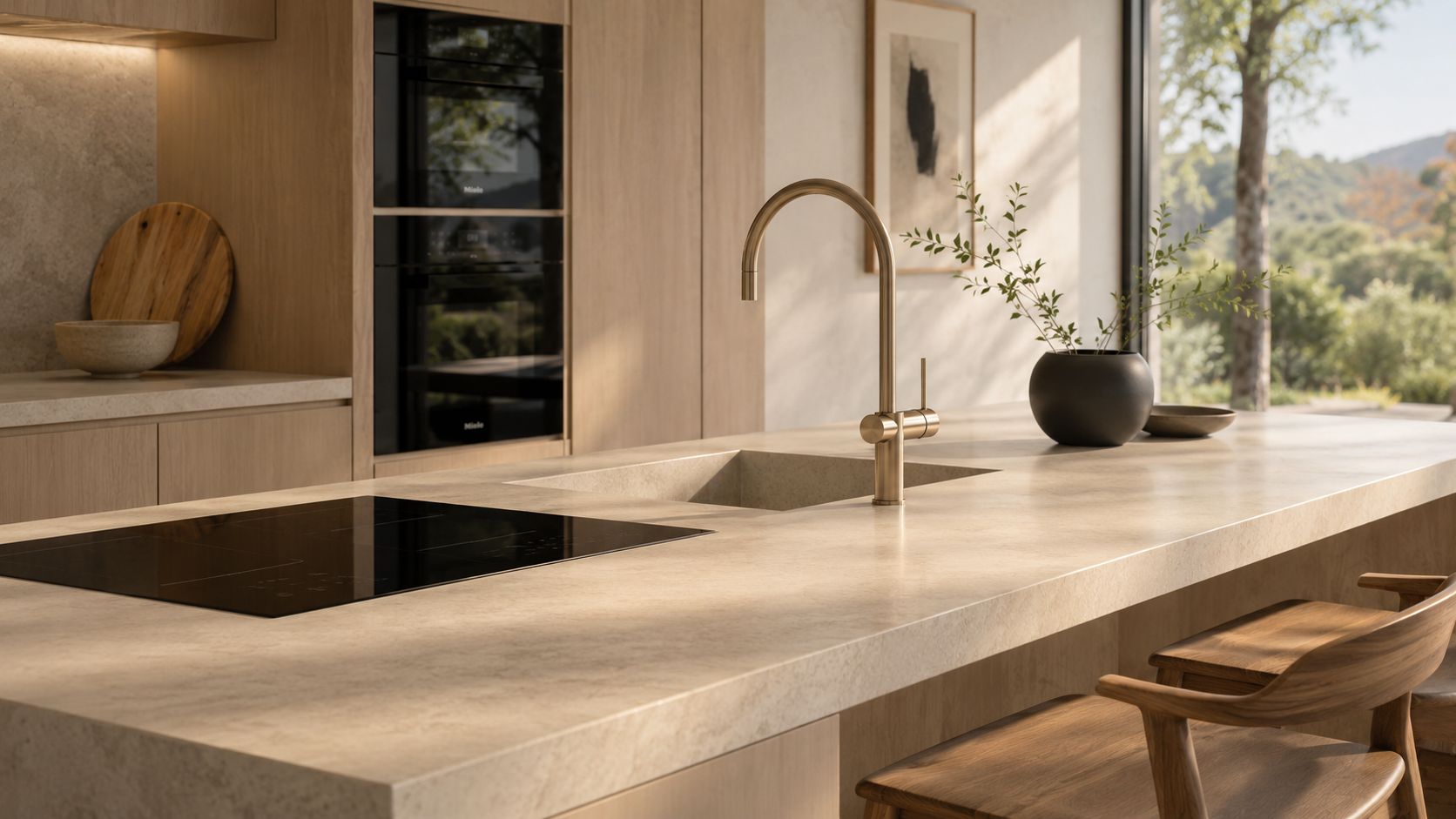
The strongest luxury kitchens feel calm because the room works under real traffic. Prep, cooking, cleanup, refrigeration, and pantry access need enough separation to keep two or three people moving without conflict. Appliance doors, stool placement, and aisle widths matter as much as the finish package.
I advise clients to judge the island by performance first. It should add prep surface, storage, seating, or better circulation. If it narrows walk paths or creates conflicts at the dishwasher, sink, or range, it is costing money without improving the room.
A few design choices tend to shape the whole project:
- Appliance integration: Panel-ready refrigeration and concealed dishwashers reduce visual clutter, but they also affect cabinet depth, ventilation clearances, and service access.
- Ventilation planning: Hood size, duct routing, and makeup air requirements need to be resolved before finish drawings are locked.
- Storage by task: Deep drawers near prep zones, tray storage by ovens, and waste pull-outs at the sink outperform generic cabinet counts.
- Lighting layers: Decorative fixtures matter, but task lighting at counters and islands has more impact on day-to-day use.
Where premium choices pay off
Custom cabinetry earns its cost when the room has unusual dimensions, demanding sightlines, or built-ins that need exact alignment. In a straightforward footprint, semi-custom often delivers better value and shorter lead times. That trade-off matters for investors and for homeowners who care about schedule discipline.
The same discipline applies to stone, metal, wood, and paint finishes. Buyers notice quality. They also notice when every selection is competing for attention. A restrained palette with well-matched tones, grain direction, and hardware usually reads more expensive than a room packed with high-priced materials.
Flooring is a good example. Warm wood tones can improve a luxury kitchen, but only if the species, finish, and maintenance level fit the household. For owners comparing visual impact against upkeep, this roundup of stylish kitchen flooring choices is a useful reference.
Material selection also needs to respect Northeast Florida conditions early, not after orders are placed. Humidity, strong sunlight, and heavy AC cycling affect movement, finish stability, and long-term appearance. Owners who want products suited to that environment should review weather-resistant material options for Florida homes before finalizing the finish schedule.
A short walk-through helps clients see how layout, appliances, and millwork interact in real kitchens:
Handling awkward kitchens without wasting money
Older Jacksonville homes and later additions often leave behind angled walls, soffits, shallow chases, and uneven transitions into adjoining rooms. Forcing a showroom layout into those conditions is one of the fastest ways to waste budget.
The better approach is selective customization. Use custom millwork where the geometry demands it. Use fillers, panel treatments, adjusted appliance placement, or revised zoning where those options solve the problem cleanly for less money. That is how experienced teams protect ROI without making the kitchen feel compromised.
Design guidance on irregular kitchens makes the same point. Luxury comes from function, proportion, and clean resolution of awkward conditions, not from specifying custom work at every cabinet run, as discussed in this article on high-end kitchen design details and awkward layouts.
Good finish selection is not a shopping exercise. It is a coordination exercise that keeps layout, materials, and budget working in the same direction.
Choosing Durable Materials for the Northeast Florida Climate
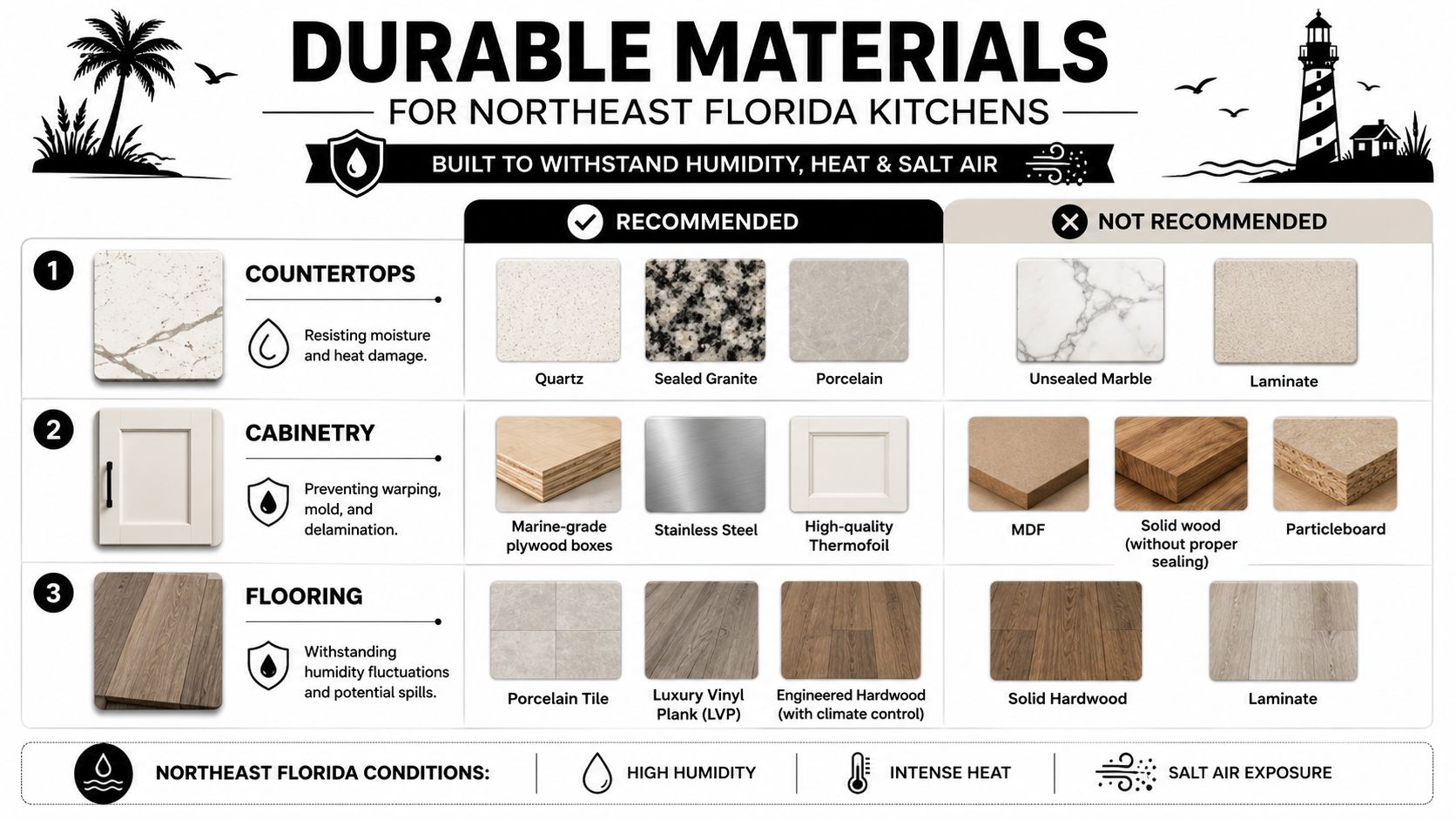
A kitchen in Northeast Florida has to perform in humidity, heat, and the wear that comes with a real household. If a material only looks good in a showroom, it's not a luxury choice. It's a maintenance problem waiting to happen.
Countertops that age well
In premium kitchens, the usual debate comes down to natural stone versus engineered surfaces. Marble has visual appeal, but many owners don't enjoy the ongoing care it can demand in a hard-working kitchen. Quartzite and sealed granite often make more sense when durability is part of the brief. Porcelain also enters the discussion when clients want a clean, contemporary look with strong resistance characteristics.
The right choice depends on how the kitchen will be used. An owner who cooks heavily and entertains often should think past the first impression and ask what the surface looks like after years of spills, hot cookware nearby, and repeated cleaning.
In Jacksonville, durability isn't a downgrade from luxury. It's part of luxury.
Cabinet boxes, finishes, and flooring that hold up
Cabinet construction matters more than many owners expect. Door style gets attention, but box quality, finish consistency, and moisture resistance determine how the kitchen ages. In humid conditions, weak substrates and poorly finished components can telegraph their problems fast.
For flooring, the practical conversation usually narrows to a few categories:
| Material | Why owners choose it | Where caution is needed |
|---|---|---|
| Porcelain tile | Strong durability and moisture tolerance | Hard underfoot if comfort is a priority |
| Luxury vinyl plank | Easy maintenance and good resilience for busy homes | Product quality varies widely |
| Engineered hardwood | Warm look with better dimensional stability than solid wood | Needs thoughtful product selection and indoor climate control |
If you're comparing finish packages for Florida durability beyond the kitchen, this guide to weather-resistant materials for Jacksonville homes is a useful reference point.
Phase 3 Project Execution and Management
A Jacksonville kitchen can look perfect in the showroom and still lose money in the field. The failure usually shows up after cabinets are set, when an appliance spec changed late, a rough-in missed the final plan, or a countertop template happened before the site was properly ready. In high-end work, those mistakes are expensive because every correction touches multiple trades.

Sequence is what protects the budget
Execution needs a controlled order. Design decisions have to be settled before demolition, rough-ins need to match approved drawings, and field measurements for stone should happen only after cabinetry is installed and verified. Good teams respect that chain because one late revision can force new cabinet drawings, shift outlet locations, delay fabrication, and push finish trades off schedule.
The practical risk is simple. Luxury kitchens carry tighter tolerances and pricier materials, so sloppiness costs more here than in a standard remodel.
A disciplined schedule also protects the owner from soft losses that rarely show up in the initial estimate. Extra site visits, rushed fabrication, storage fees, appliance rescheduling, and idle labor can erode ROI fast, especially for an investor trying to keep carrying costs under control.
What needs to be locked before demolition
Before the first day of demo, several decisions should be closed, documented, and distributed to everyone involved:
- Final appliance package: Widths, utility requirements, ventilation specs, and panel-ready details need to match the cabinet plan.
- Permit set and scope: Structural changes, plumbing moves, electrical revisions, and layout updates should align with approved documents.
- Procurement log: Long-lead cabinetry, specialty hardware, slabs, and custom components need tracked delivery dates.
- Change-order authority: One person should approve changes, and every change should be priced and recorded before work proceeds.
- Site meeting cadence: Weekly check-ins keep the owner, contractor, and designer aligned before small issues become costly ones.
Jacksonville owners who want a clearer view of scheduling, approvals, and trade coordination can review this construction project management guide for Jacksonville homes.
Quality control during the build
Site supervision is where a good plan either holds or slips. I look for the problems that get hidden later. Plumbing stub-outs that interfere with drawer boxes, island pendants that miss the visual centerline, hood duct paths that squeeze cabinet heights, and flooring transitions that were never resolved on paper.
Humidity adds another layer in Northeast Florida. Materials need time to acclimate, indoor conditions should stay stable once finishes arrive, and storage on site has to be managed carefully. A premium cabinet finish or wood component can be compromised long before installation if it sits in the wrong conditions.
The last part of execution is presentation. Even before final completion, the kitchen should be photographed and reviewed with resale in mind. Clean sightlines, proper lighting, and restrained styling help buyers read the value of the work. For owners planning a sale or refinance, these effective kitchen staging ideas are a useful reference for showing the finished product clearly.
In premium kitchens, quality is rarely defined by one dramatic mistake. It is defined by dozens of small decisions made correctly, in the right order, with the budget and end value still in view.
Staging and Maximizing ROI for Investors and Homeowners
A finished kitchen still has one more job. It has to communicate value clearly.
For homeowners, that means protecting long-term equity with a room that looks current, works well, and doesn't signal deferred maintenance. For investors, it means showing buyers exactly why the kitchen belongs in the property's price band. Good staging helps close that gap between construction cost and perceived value.
Start with restraint. Clear counters. Keep only a few items that support scale and function, such as a wood board, a simple bowl, or a coffee setup near a beverage zone. Turn on every layer of lighting. Open sightlines to the island, vent hood, or stone splash if those are major design features.
Small details matter in listing photography and open-house presentation:
- Highlight integrated features: Panel-ready refrigeration, concealed storage, and under-cabinet lighting should be visible.
- Name the specific upgrades: If the project includes custom millwork, premium stone, or a better ventilation setup, make sure the listing reflects that.
- Stage for the target buyer: A family home and a design-forward urban property shouldn't read the same way.
If you want a practical reference for presentation strategy, these effective kitchen staging ideas are useful for thinking through layout, styling, and visual emphasis.
The projects that produce the strongest ROI usually do three things well. They solve layout problems, choose durable materials, and avoid construction chaos. Buyers and appraisers may not describe it in those terms, but they can feel the difference immediately.
Frequently Asked Questions
How long does high-end kitchen remodeling usually take?
It often spans multiple months once permitting, product lead times, fabrication, and inspections are included. The actual construction phases can move quickly, but custom cabinetry, appliance coordination, and stone fabrication extend the full schedule.
What causes luxury kitchen budgets to go off track?
Late design changes are the biggest avoidable problem. If appliance sizes, cabinet details, or rough-in locations change after ordering or after walls are opened, rework follows.
Is custom cabinetry always worth it?
No. Custom cabinetry makes sense when the layout is irregular, storage needs are highly specific, or the design depends on exact sizing. In straightforward rooms, semi-custom can be the more efficient investment.
What matters most for ROI in a Jacksonville kitchen remodel?
Layout, durability, and execution discipline. Buyers notice the finish package, but value usually holds better when the kitchen feels easy to use and built for local conditions.
Should investors install the same kitchen they'd want in their own home?
Usually not. Investor kitchens should fit the property, neighborhood, and likely buyer profile. The goal isn't to minimize quality. It's to avoid overspending on personal preferences that won't move the resale outcome.
What should be selected first?
Appliances should be selected early because cabinet sizing, clearances, utility locations, and countertop templating depend on them. When that order gets reversed, costly revisions are much more likely.
If you're planning a luxury kitchen update, a whole-home remodel, or an investor-focused renovation in Jacksonville, Ofir Engineering provides construction and project management support for homeowners and investors who need disciplined budgeting, contractor coordination, and code-compliant execution from planning through final walkthrough.
