
The cost to remodel a room can range from $1,500 to $5,500 for a simple bedroom update and $14,500 to $40,500 for a kitchen remodel, with bigger layouts, better finishes, and more trade labor pushing costs higher. In Jacksonville and Northeast Florida, the actual budget depends on scope, materials, labor coordination, permits, and whether you're doing a dry-room refresh or opening walls and changing systems. Ofir Engineering is a licensed Florida general contractor (License #CGC 1540016) serving homeowners and investors across Jacksonville and Northeast Florida.
If you're pricing a remodel right now, you're probably seeing estimates online that don't match each other. One site gives a low number that sounds too good to be true. Another gives a national average so broad it doesn't help you make a real decision. That confusion is normal, especially when one "room remodel" might mean paint and flooring to one contractor and full demolition, electrical updates, and structural changes to another.
In practice, room remodeling budgets make more sense when you break them into room type and scope. A bedroom refresh is a very different project from a bathroom remodel, and a bathroom remodel is a different animal from a kitchen where cabinets, appliances, plumbing, and electrical all stack into the same budget. In Northeast Florida, local permitting, code compliance, older housing conditions, moisture exposure, and scheduling the right trades in the right order all affect what you pay.
For homeowners, that means protecting your budget before work starts. For investors, it means knowing where to spend for resale, rentability, and inspection-ready results without over-improving the property.
Table of Contents
- Introduction
- Average Remodeling Costs by Room in Northeast Florida
- Key Drivers That Determine Your Final Remodel Cost
- How to Accurately Estimate Your Project Budget
- Investor Focus Maximizing ROI on Room Remodels
- Why Professional Project Management Is Your Best Investment
- Frequently Asked Questions About Room Remodeling Costs
- Is it cheaper to remodel one room at a time or bundle multiple rooms together
- What room is usually the most expensive to remodel
- Why do dry rooms sometimes still cost more than expected
- Should I use square-foot pricing to budget my remodel
- How do I avoid over-improving a rental or flip
- Do permits matter for room remodel budgets in Florida
- What is the biggest budget mistake homeowners make
- Start Your Jacksonville Remodel with Confidence
Introduction
The reason so many people misjudge the cost to remodel a room is simple. They price the visible finishes and miss the work behind them. Paint, tile, cabinets, and fixtures are easy to picture. Wiring changes, plumbing relocation, framing correction, ventilation, and inspections are where budgets usually shift.

A broad benchmark for renovation planning shows that home renovation spending in 2025 typically falls between $19,470 and $88,344, with an average near $52,136, or roughly $15 to $60 per square foot, while luxury finishes and major layout changes can push costs to $150 per square foot or more according to Angi's renovation cost guide. That matters because room-level remodeling sits inside that larger budget picture. A single room can stay modest, or it can become part of a much bigger scope.
Kitchen remodeling costs
Kitchens usually carry the highest room-level budget because they combine cabinetry, countertops, fixtures, appliances, electrical work, plumbing work, finish carpentry, and often flooring in one concentrated area. Even when the footprint stays the same, kitchens require coordination across more trades than most other rooms.
Bathroom remodeling costs
Bathrooms look smaller on paper, but they aren't automatically cheap. Waterproofing, tile labor, plumbing fixtures, ventilation, and inspection requirements all make bathrooms more expensive per square foot than many dry rooms.
Bedroom and living space costs
Bedrooms and living rooms can be straightforward if you're updating finishes only. Once you add recessed lighting, built-ins, new windows, closet rework, or conversion work, the budget changes fast.
Practical rule: If the project touches walls, wiring, plumbing, or layout, don't budget it like a cosmetic update.
That distinction is where many Jacksonville projects either stay under control or drift into avoidable overruns.
Average Remodeling Costs by Room in Northeast Florida
A Jacksonville owner might call for a "simple room update" and mean paint, flooring, and fixtures. After the first walk-through, the primary budget issue is usually scope, not square footage. A kitchen with no layout changes prices very differently from a kitchen that needs panel upgrades, plumbing relocation, and inspection coordination. The same goes for bathrooms, bedrooms, and living areas across Northeast Florida.
National room ranges are a useful starting point, but local planning matters more. Permit requirements, older housing stock in parts of Jacksonville, and storm-related material pricing swings can all change what you spend. If a room remodel is part of a larger repositioning, compare it against a full-property benchmark like this guide to the average cost of a full home renovation in Jacksonville, FL.
| Estimated Room Remodel Costs in Jacksonville (2026) | Basic / Cosmetic Update | Mid-Range Remodel | High-End / Gut Renovation |
|---|---|---|---|
| Bedroom | Lower-cost finish updates | Moderate rework with lighting, flooring, and trim | Can climb fast with conversions, insulation, windows, or HVAC work |
| Living Room | Paint, flooring, and fixture replacement | Built-ins, ceiling work, lighting upgrades, and window replacement | Layout changes, structural work, and custom millwork raise costs quickly |
| Bathroom | Fixture swaps and surface updates | New tile, vanity, plumbing fixtures, and ventilation improvements | Full wet-area rebuilds, plumbing moves, and custom glass drive the budget |
| Kitchen | Cabinet refresh, counters, paint, and appliance swap | New cabinets, tops, backsplash, lighting, and flooring | Full replacement with layout changes, service relocations, and higher-end finishes |
Kitchen remodeling costs
Kitchens usually absorb the most money because so many trades stack into one room. Cabinets, tops, appliances, electrical, plumbing, drywall repair, trim, and inspections all have to line up. In Jacksonville, older homes often add another layer. Undersized circuits, dated plumbing, or out-of-level floors can turn a clean estimate into a change order if nobody checks those conditions early.
The lowest-cost kitchen projects keep the existing footprint and avoid opening walls. Mid-range work often includes cabinet replacement, updated lighting, new counters, and a better appliance package. High-end kitchen budgets rise fast when owners add custom storage, move gas or water lines, or combine the kitchen with adjacent living space.
Good kitchen budgeting comes down to decision discipline. Delaying appliance specs, backsplash selections, or lighting plans usually slows the job and adds labor.
Bathroom remodeling costs
Bathrooms are small, but they are rarely cheap. Waterproofing, tile setting, fixture installation, ventilation, and inspections are concentrated into a tight area where labor efficiency drops.
A hall bath with a same-location tub or shower replacement stays more predictable. A primary bath with large-format tile, custom niches, frameless glass, a freestanding tub, and vanity changes does not. In Northeast Florida, I also watch for moisture damage, subfloor issues, and code-related ventilation fixes, especially in older homes and investor purchases that have been deferred for years.
One practical rule holds up well. If the remodel affects the shower assembly or plumbing rough-ins, budget it as a construction project, not a finish update.
Bedroom and living space costs
Bedrooms and living rooms give owners more control over cost because the work can stay mostly cosmetic. Paint, flooring, doors, trim, and standard lighting upgrades are straightforward if the room use stays the same.
Costs rise when the room function changes. Turning a bedroom into a suite, enclosing space, adding recessed lighting throughout, replacing windows, or building custom storage pushes the job into permit, insulation, HVAC, and electrical territory. That matters for Jacksonville investors because these projects can improve rentability or resale appeal, but only if the finished room matches the rest of the house and the neighborhood price ceiling.
Some properties are poor candidates for repeated room-by-room remodeling. If the scope keeps expanding, owners sometimes compare renovation costs against Custom Home Building Jacksonville as a factual construction category tied to planning, scheduling, contractor coordination, and residential execution in Jacksonville.
Key Drivers That Determine Your Final Remodel Cost
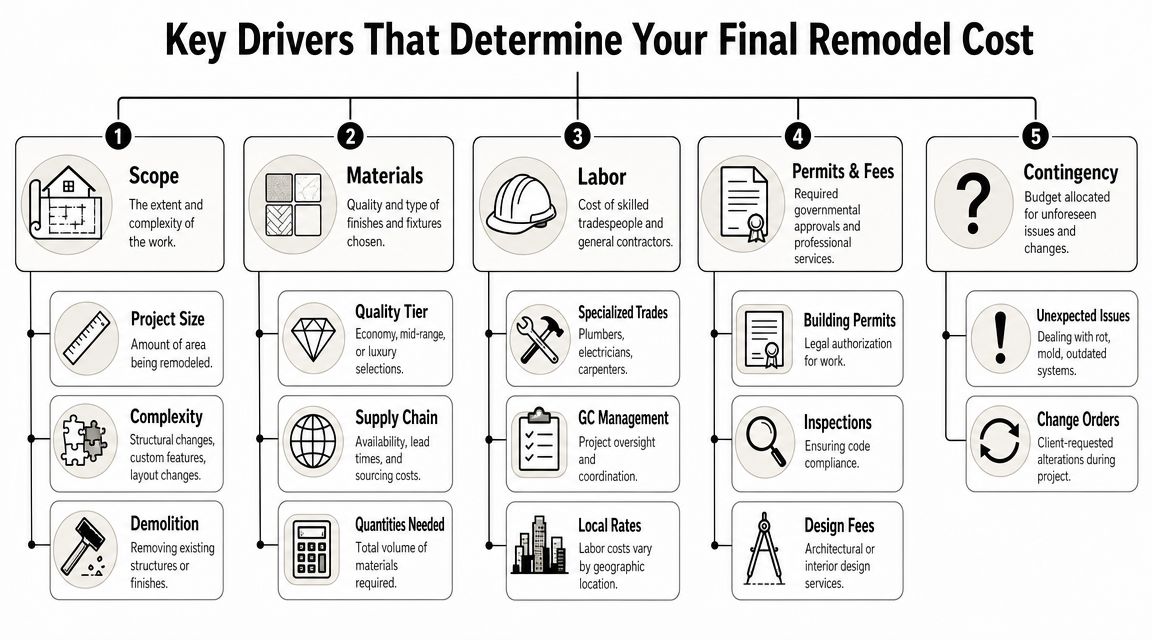
The cleanest way to understand pricing is to stop asking what a room costs and start asking what work the room needs. Published room-remodel pricing commonly falls into tiered per-square-foot ranges of about $50 to $100 per square foot for basic cosmetic updates, $100 to $250 per square foot for mid-range renovations, and $250 to $400+ per square foot for high-end custom work in Block Renovation's room cost guide. Those tiers are useful because they line up with scope, not just room size.
Material and finish levels
Material decisions affect more than procurement cost. They also affect installation time, waste, detailing, and who needs to be on site.
Basic work often means standard flooring, stock fixtures, simple trim, and repainting. Mid-range usually adds better surface materials, upgraded lighting, improved hardware, and more refined finish work. High-end work usually includes custom fabrication, specialty tile patterns, integrated lighting, and details that take more skilled labor to execute.
Labor costs and trade expertise
Labor rises when more licensed trades enter the job or when sequencing gets tighter. A room with flooring and paint is simple to schedule. A room with cabinet installation, electrical rough-in, plumbing relocation, drywall repair, millwork, and finish adjustments takes far more coordination.
Here is where Jacksonville-area execution matters. Even if material selections stay reasonable, a poorly scheduled job creates downtime, rework, and inspection delays.
A useful visual breakdown helps show how these pieces stack together.
Permits and engineering fees
Permits don't hit every room remodel the same way. If you're replacing finishes only, the process is lighter. Once you change electrical, plumbing, framing, or structural elements, the paperwork and review process become part of the budget and schedule.
Owners in Northeast Florida can get caught off guard. They assume they're paying for visible work only, but code-triggered updates and plan review can become part of the job once walls open.
Hidden costs and structural changes
This is the category that causes the most frustration because it's the least visible before demolition. Rotten framing, outdated wiring, old plumbing conditions, unlevel substrates, moisture damage, and previous unpermitted work all sit behind finished surfaces.
- Moving walls: This can trigger framing, drywall, flooring patching, trim work, electrical changes, and sometimes engineering review.
- Changing wet areas: Relocating sinks, showers, or laundry connections adds plumbing complexity fast.
- Correcting old work: Homes with layered renovations often need cleanup before new work can start cleanly.
- Matching existing finishes: In partial remodels, blending old and new can take more labor than starting fresh.
If you're opening walls in an older property, assume the contractor may find conditions that change the work plan.
How to Accurately Estimate Your Project Budget
The most reliable budget method is to estimate by scope level, not by room name alone. A "bedroom remodel" can mean paint and trim, or it can mean a conversion with insulation, electrical, and code upgrades. That's why published guidance on dry-room versus full-gut remodeling is so important. Angi notes that a bedroom remodel may average around $20,000, while a full gut-and-remodel can reach $100,000 to $650,000 depending on scope and house size in this guide on bedroom remodel cost and full-gut budget differences.
Level 1 cosmetic refresh
This is the low-disruption category. Think paint, flooring, baseboards, light fixture swaps, hardware updates, and cosmetic trim work.
This level works well for rental turns, owner-occupied refreshes, and flips where the layout already supports the market. In Jacksonville, this type of work still needs disciplined material ordering and punch-list control, but it usually avoids major permit complications.
Level 2 remodel with layout changes
Many budgets drift if the scope isn't pinned down early. You may be moving a vanity, widening an opening, changing kitchen flow, adding recessed lights, or reworking a closet plan.
If you're comparing room-level spending with a kitchen-specific budget process, a practical outside reference is this guide on estimating kitchen renovation costs, which is useful for thinking through cabinet, finish, and fixture choices before you request contractor pricing.
For local cost control, owners should also think in terms of decision timing. Late finish changes often cost more than the item itself because they affect labor sequencing. A separate planning resource on keeping a renovation project on budget in Florida can help frame that part of the process.
Level 3 full gut and reconfiguration
This is a different class of project. Once demolition reaches framing and systems, the budget has to account for code compliance, trade rough-ins, inspections, and discovered conditions.
In Northeast Florida, timelines can stretch when permit review, product lead times, moisture-related repair, or structural clarification enters the job. Florida homes also demand practical attention to ventilation, material durability, and moisture management. Those are not luxury upgrades. They are part of building a room correctly in this climate.
Budget discipline starts before demolition. Define what stays, what moves, and what must meet current code once the walls are open.
Investor Focus Maximizing ROI on Room Remodels
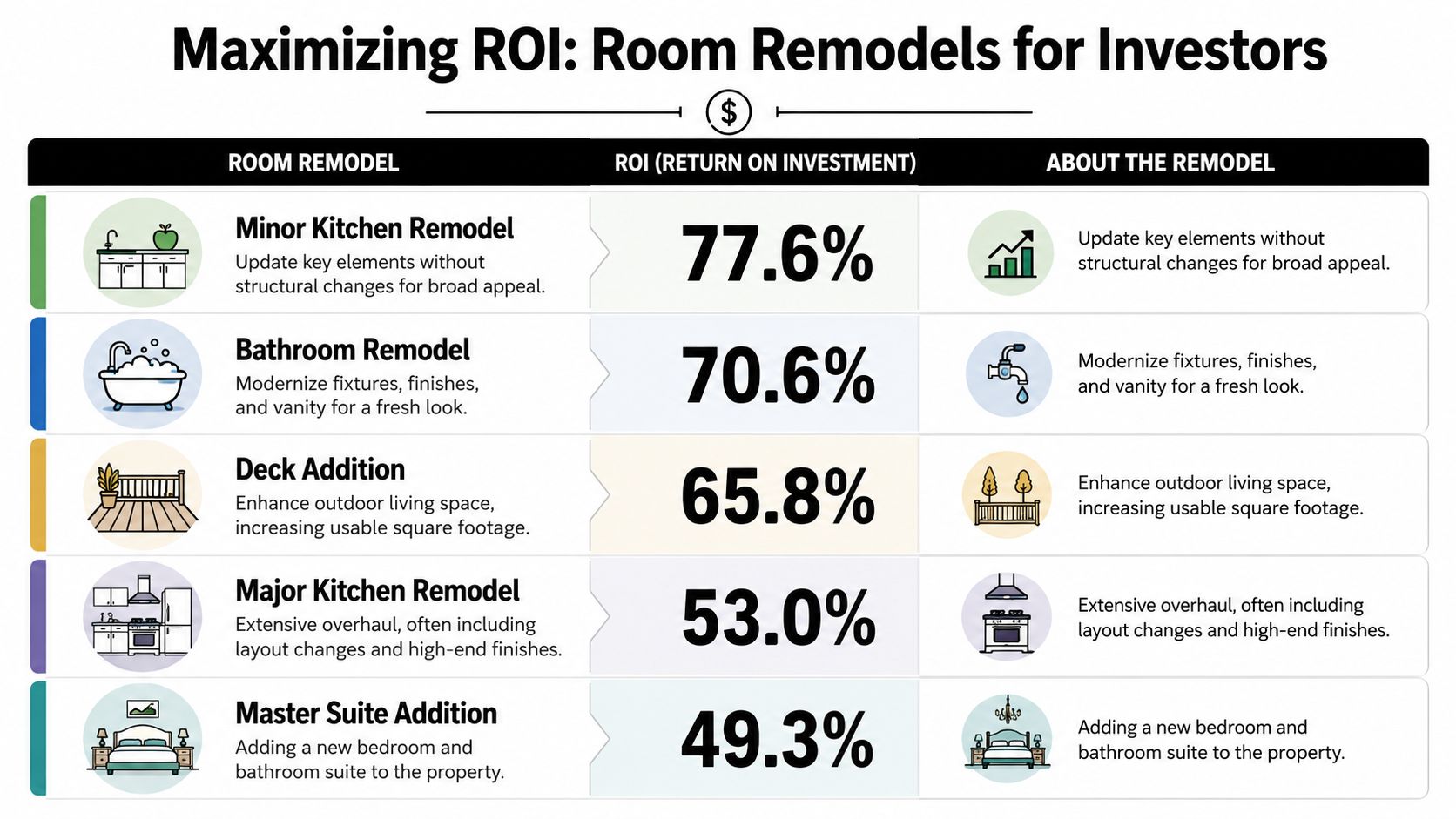
Investors shouldn't ask only what a room remodel costs. They should ask what level of remodel the property can support. National resale data backs up what many of us see in real projects: focused updates usually outperform expensive overbuilds.
The National Association of REALTORS® reports that the median renovation spend increased 60% from $15,000 in 2020 to $24,000 in 2023, and the same source notes that a minor kitchen remodel can recover about 96% of cost, while a major kitchen remodel may return only 38%, with bathroom remodels commonly returning around 74% in NAR's remodeling and cost recovery resource. For Jacksonville investors, that's a strong argument for selective improvement instead of chasing the most expensive finish package.
Where investors usually win
Minor kitchen upgrades tend to make sense because buyers and renters notice them immediately. Cabinet refinishing, durable counters, updated lighting, modern hardware, and clean appliance coordination can shift the perception of the whole property without forcing a full gut.
Bathrooms also perform well when the work improves cleanliness, function, and visual confidence. New vanities, lighting, tile repair or replacement, updated fixtures, and better ventilation usually matter more than luxury features that don't change daily use.
A major kitchen overhaul can still be justified, but usually only when the existing layout actively hurts the property's marketability or the asset is being repositioned at a much higher price point.
Finishes that protect return
Investors make mistakes when they buy for the showroom instead of the turnover cycle. Durable, neutral, easy-to-repair finishes often beat trendy materials that chip, stain, or go out of style quickly.
Flooring is a good example. For rentals and high-traffic properties, this guide on maximizing ROI with rental flooring is useful because it frames flooring as a durability and maintenance decision, not just a design choice.
- Choose repeatable materials: Matching future repairs matters.
- Control custom work: Bespoke details can slow schedules and shrink buyer pool appeal.
- Upgrade what inspections expose: Safety, moisture, and functionality issues affect value more than decorative add-ons.
- Keep finishes market-appropriate: The neighborhood and exit strategy should decide the spec.
Investors usually make more money on disciplined scope than on expensive taste.
Why Professional Project Management Is Your Best Investment
A room remodel fails when nobody is controlling the details. That's usually not because one trade did poor work. It's because no one managed the sequence, verified scope, checked submittals, tracked changes, or tied field conditions back to the budget.
For homeowners and investors in Jacksonville, Construction Project Management is a defined service category that includes contractor coordination, budgeting, scheduling, renovation oversight, and construction supervision. That matters most when multiple trades, permit milestones, and procurement decisions overlap.
What gets controlled when a project is managed correctly
Professional management reduces avoidable mistakes that cost time and money later.
- Scope clarity: Someone confirms what is included before demolition starts.
- Trade sequencing: Electrical, plumbing, framing, drywall, flooring, cabinets, and finish work happen in the right order.
- Budget tracking: Change requests get priced and documented before they snowball.
- Inspection readiness: Work is aligned with permit and code expectations instead of guessed in the field.
- Quality control: Finish issues are caught before final punch becomes expensive rework.
A lot of owners underestimate the cost of poor coordination. Miss one inspection item, install materials out of order, or discover too late that a cabinet plan conflicts with electrical, and the project can stall.
If you want a better sense of the operational side, this article on residential construction project management is worth reading because it breaks down the supervision side that clients don't always see but always pay for if it's missing.
Frequently Asked Questions About Room Remodeling Costs
Is it cheaper to remodel one room at a time or bundle multiple rooms together
It depends on scope. One room at a time can help cash flow, but bundling related work often reduces disruption and avoids reopening the same areas later. If a bathroom remodel will require electrical or plumbing work that also affects an adjacent room, combining the work is often more efficient.
What room is usually the most expensive to remodel
Kitchens are typically the most expensive room because they combine several trades and expensive finish categories in one space. Bathrooms can also become expensive quickly because waterproofing, plumbing, and tile labor are concentrated in a small area.
Why do dry rooms sometimes still cost more than expected
Because the visible finish list isn't the whole job. Once a contractor starts correcting framing, wiring, leveling, trim transitions, or previous patchwork, a dry room can move beyond a simple refresh.
Should I use square-foot pricing to budget my remodel
Use square-foot pricing as a starting reference, not a final quote. It helps compare cosmetic, mid-range, and custom levels, but it won't replace a scope-based estimate that accounts for your room's actual conditions and selections.
How do I avoid over-improving a rental or flip
Match the remodel to the property's exit strategy. Focus on clean kitchens, functional bathrooms, durable flooring, safe systems, and a finish level that fits the neighborhood. Don't spend on features that your target buyer or renter won't pay for.
Do permits matter for room remodel budgets in Florida
Yes. If your project changes electrical, plumbing, framing, or other code-regulated work, permits and inspections can affect both cost and timeline. In Florida, that planning should happen before demolition, not after.
What is the biggest budget mistake homeowners make
They price finishes without pricing scope. Cabinets, tile, or lighting are only part of the budget. The primary cost often sits in labor coordination, wall conditions, system changes, and decisions made after work has already started.
Start Your Jacksonville Remodel with Confidence
A solid remodel budget isn't built from a generic national average. It's built from room type, scope, finish level, permit needs, and how well the work is managed from day one. That's especially true in Jacksonville and Northeast Florida, where climate, code, scheduling, and older property conditions can all affect the final number.
If you're still in the planning phase, it helps to sketch the scope before pricing the work. Tools that help you design your home renovation can make contractor conversations much more productive because everyone is looking at the same layout and priorities.
When you're ready to move from rough ideas to a workable budget, the goal isn't just to lower cost. It's to spend in the right places, avoid rework, and protect long-term value.
If you're planning a room remodel, rental upgrade, or investor renovation in Jacksonville, contact Ofir Engineering to discuss scope, budgeting, project management, and practical construction planning for your property.
