
A build to rent builder draw schedule in Florida differs from a single-home construction loan in one structural way: a BTR community is funded in phases, not as one building, so the lender is releasing money against horizontal infrastructure and multiple vertical units at different stages simultaneously. That complexity is where draws get delayed. Understanding what the lender needs, in what order, and who produces it is what keeps a BTR project’s cash flow ahead of its trade payments. Ofir Engineering is a licensed Florida general contractor (License #CGC 1540016) with 15+ years serving Jacksonville, Ponte Vedra, St. Johns, and Northeast Florida.
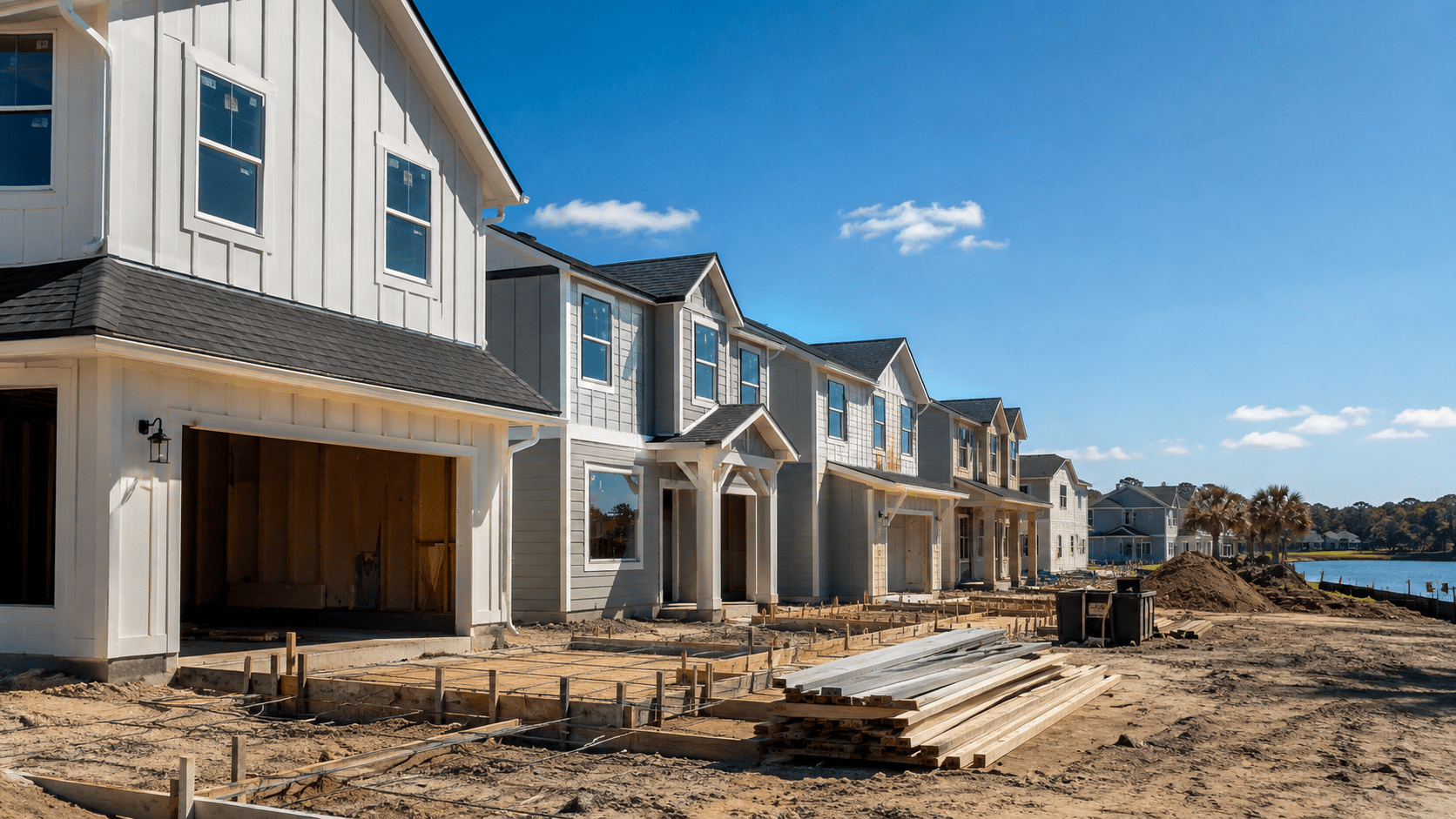
How a Build to Rent Builder Draw Schedule Is Structured
A construction loan does not fund at closing. It funds in increments, in arrears, against work already completed and verified. On a BTR community the increments are organized around two parallel tracks.
The horizontal track covers everything that serves the community rather than an individual home: clearing and earthwork, stormwater ponds and drainage structures, wet and dry utility mains, roads and curbing, and common amenities. This work is heavily front-loaded, consumes a large share of the budget before a single unit is vertical, and is typically funded against engineer-certified quantities of work in place.
The vertical track covers the homes themselves, funded per unit or per building through the familiar milestone sequence: foundation, framing and dry-in, mechanical rough-in, insulation and drywall, interior finish and trim, and final completion at certificate of occupancy. On a phased community, unit 12 may be at drywall while unit 40 is still at foundation and phase three infrastructure is under way — all in the same monthly draw.
Most lenders also require the borrower’s equity to be spent first, or contributed on a fixed pro rata basis alongside each draw. Confirm which structure applies before you mobilize, because equity-first funding means the borrower carries several months of cost before the first dollar of loan proceeds arrives.
What Goes Into a Draw Request Package
A complete package is what gets funded on time. In Florida it generally includes a signed draw request or application for payment showing the schedule of values, the percentage complete for each line, amounts previously funded, the current request and the remaining balance to finish.
Alongside it: conditional lien waivers from the general contractor and every subcontractor and supplier for the current request, and unconditional waivers for the prior funded draw; invoices and backup for the current period; updated photographs or an inspection report; and a title continuation or date-down endorsement confirming no liens have been recorded since the last funding. On the horizontal track, an engineer’s certification of quantities in place is typically required in place of, or in addition to, a percentage-complete assessment.
Two mechanisms reduce what actually funds. Retainage — commonly a percentage held from each payment and released at substantial or final completion — protects the lender against non-completion. Stored materials are treated cautiously: many lenders will not fund materials sitting on site, or will fund them only with proof of purchase, proof of insurance and evidence of secure storage. Both belong in your cash flow projection from day one. Our guide to the construction loan draw schedule on a Florida custom build walks through the single-structure version of the same process.
Florida Lien Law and Why It Governs the Draw
Florida’s construction lien statute is the reason draw paperwork is as heavy as it is. Subcontractors and suppliers who are not in direct contract with the owner preserve lien rights by serving a Notice to Owner, and the owner’s protection against paying twice runs through the lien waiver process at each payment.
The practical rule for a BTR project: never fund a draw without waivers covering everyone who has served a Notice to Owner, and reconcile the waiver list against the notice list every single cycle. Lenders enforce this because their mortgage priority depends on it. A missing waiver from a single supplier stops an entire draw, and on a phased community with dozens of vendors that is a common failure mode. The statutes themselves are published by the Florida Legislature.
What Actually Delays a Draw
The causes repeat with remarkable consistency across projects.
Incomplete lien waiver packages. The single most common cause. One subcontractor slow to return a signed waiver holds the whole request.
Percentage complete disputes. The builder reports a line at seventy percent; the lender’s inspector assesses it lower. The fix is to align the schedule of values with observable milestones rather than abstract percentages, so there is nothing to argue about.
Inspection timing. Third-party inspections are scheduled, not instant. Submitting a draw without allowing for the inspector’s calendar adds a week that was entirely predictable.
Title issues. A recorded claim of lien, even a disputed one, will stop funding until resolved or bonded off.
Phase sequencing. Specific to BTR: lenders often condition vertical funding in a phase on completion of that phase’s infrastructure. Building ahead of the utilities that serve those units creates work that cannot be funded.
Budget line exhaustion. A line item that overruns cannot draw beyond its allocation without a formal budget reallocation, which requires lender approval and its own review time.
How an Experienced Builder Protects the Funding Cycle
The controls are unglamorous and they work. Build the schedule of values around inspectable milestones during pre-construction, with the lender’s agreement, before the first draw. Collect lien waivers continuously rather than at submission — make them a condition of each subcontractor payment, not a request afterward. Submit on a fixed monthly calendar so the inspector, the title company and the lender’s construction administrator all know when the package arrives. Track the Notice to Owner log against the waiver log every cycle. Request budget reallocations early, while the line still has room. Keep photographic documentation weekly so a contested percentage can be settled with evidence.
Above all, sequence the horizontal work so each vertical phase has its infrastructure complete and accepted before those units start. That single discipline eliminates the most common BTR-specific funding delay. For more on the delivery model, see our guide to build to rent construction for Jacksonville investors and our overview of construction loans in Florida. To discuss a specific community, see our commercial construction service or contact us.
Frequently Asked Questions
How is a BTR draw schedule different from a single-home construction loan?
A BTR community funds two tracks at once. Horizontal infrastructure is funded against engineer-certified quantities of work in place, while individual homes fund on milestone inspections, and different units sit at different stages within the same monthly draw. A single-home loan has one linear milestone sequence.
What documents does a Florida lender require for each draw?
A signed draw request with the schedule of values and percentage complete, conditional lien waivers for the current request and unconditional waivers for the prior draw, invoices and backup, an inspection report or photographs, and a title continuation endorsement confirming no new liens have been recorded.
What is the most common reason a draw gets delayed?
Incomplete lien waiver packages. One subcontractor or supplier slow to return a signed waiver holds the entire request, which is why experienced builders collect waivers as a condition of each payment rather than requesting them at submission time.
Will the lender fund materials stored on site?
Often not, or only with conditions. Many Florida lenders require proof of purchase, proof of insurance and evidence of secure storage before funding stored materials, and some decline them entirely. Confirm the policy before ordering long-lead items and plan the cash flow accordingly.
Keep Building With Ofir Engineering
Related discussions & follow us: Facebook · Reddit
Latest & related guides: Explore more Commercial Construction guides →