

You're probably standing in a house that makes sense on paper and feels risky in person. The layout is dated, the finishes are tired, and once you start thinking about moving walls, updating systems, and bringing everything up to current standards, the project stops looking like a simple renovation and starts looking like a major capital decision. That's exactly where experienced whole home remodeling contractors matter most.
As a licensed Jacksonville general contractor (CGC 1540016), Ofir Engineering brings hands-on construction expertise to every project throughout Northeast Florida.For homeowners and investors in Jacksonville and Northeast Florida, a full-house remodel is rarely just about appearances. It's about protecting resale value, controlling scope, and avoiding expensive mistakes that show up after demolition starts. The opportunity is real. The U.S. remodeling market reached an estimated $603 billion in 2024, and Harvard's Joint Center for Housing Studies says the market remains about 50% above pre-pandemic levels, as noted in the NARI 2025 Remodeling Impact Report. That scale tells you something important. Whole-home renovation is not a fringe category. It's a major part of residential construction, and in markets like Jacksonville it supports steady demand for coordinated, multi-trade projects.
Table of Contents
- Your Blueprint for a Successful Whole Home Remodel
- Phase One Define Your Scope and Maximize Your ROI
- Phase Two Master Your Budget and Plan for the Unexpected
- Phase Three Handle Permits and Codes in Northeast Florida
- Phase Four Vet and Select Your Whole Home Remodeling Contractor
- Phase Five Secure the Contract and Finalize the Timeline
- Phase Six Manage the Project and Ensure a Successful Handover
- Frequently Asked Questions About Home Remodeling
- Do I need a whole-home remodel or just targeted upgrades
- How many contractor bids should I get
- What should I worry about most before demolition starts
- Can I live in the home during a major remodel
- What does a good whole home remodeling contractor actually do
- When should I consider rebuilding instead of remodeling
Your Blueprint for a Successful Whole Home Remodel
A whole-home remodel fails early, not late. It fails when the owner hires too fast, prices too loosely, or treats design decisions and construction decisions like separate problems. Good projects in Jacksonville usually share the same pattern. The scope is defined before demolition. The budget includes room for hidden conditions. The contractor understands local permitting, sequencing, and inspection risk.
That's the role of strong whole home remodeling contractors. They don't just send crews. They coordinate planning, pricing, permits, trade sequencing, and quality control across a single scope that may involve structural work, kitchens, baths, electrical, plumbing, finishes, and exterior envelope issues at the same time.
Practical rule: If your contractor can't explain scope, sequencing, and change-order handling in plain language before demo, the project is not ready.
In Northeast Florida, that discipline matters even more because local conditions can shift the work fast. Wind exposure, moisture issues, flood considerations, and Florida code compliance can change what looks like a cosmetic job into a much deeper one. For investors, that affects holding cost and resale strategy. For homeowners, it affects livability, insurance, and long-term maintenance.
The safest approach is to treat the remodel like a managed construction project, not a collection of upgrades. That means every decision should answer the same question. Does this improve function, protect the asset, and support the value of the property?
Phase One Define Your Scope and Maximize Your ROI
A Jacksonville investor buys a dated house, budgets for finishes, then finds panel issues, plumbing repairs, and a layout that still does not work after the cosmetic updates. That is how profit disappears. Scope has to start with the asset, the resale target, and the work required to make the house perform well in this market.
Start with the property, not the wish list
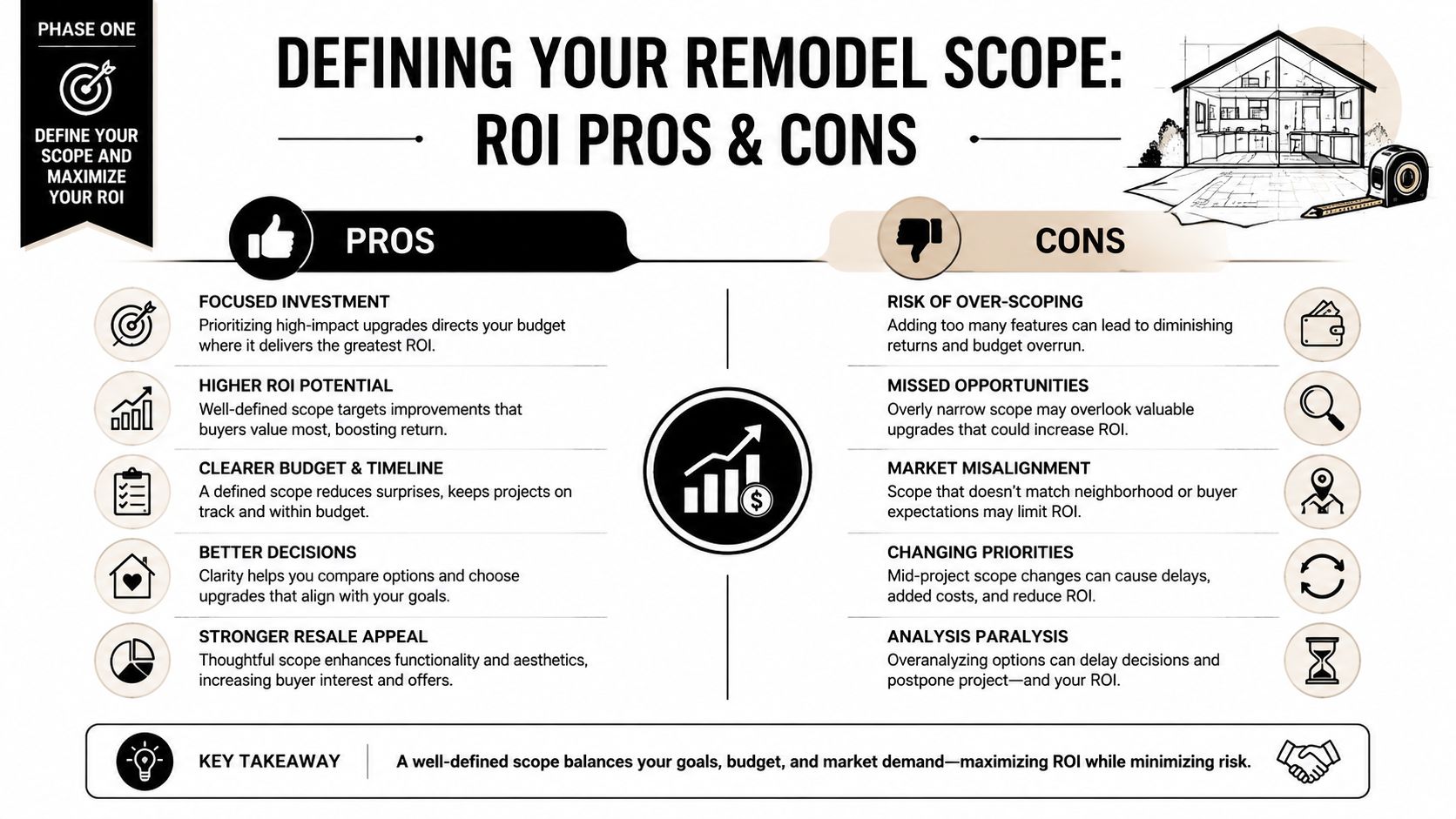
The first call is strategic. Does this house need a true whole-home remodel, or will a narrower scope produce a better return with less exposure?
That answer depends on three things. How the house functions today. What the neighborhood will support on resale. How much risk the owner can carry if hidden problems show up after demolition.
A lot of owners over-scope early. They price custom finishes before they have confirmed whether the floor plan, core systems, and building condition justify that level of investment. For an investor, that can kill margin. For a homeowner, it often leads to spending heavily on appearance while leaving behind the items buyers, inspectors, and insurers care about.
A full remodel usually makes sense when:
- The layout is fighting the house: Poor circulation, undersized baths, closed-off living areas, and an inefficient kitchen all point to coordinated work instead of piecemeal updates.
- Multiple systems are aging at once: Electrical, plumbing, framing repair, windows, insulation, or HVAC changes overlap enough that opening the house one time is cheaper than repeating labor later.
- The after-repair value supports the spend: The neighborhood, school district, lot, and buyer profile can carry the upgraded product.
Targeted or phased work often makes more sense when:
- The floor plan already works: The house needs modernization, not a reset.
- The resale ceiling is real: Overspending in a modest neighborhood rarely comes back at closing.
- The property needs to stay income-producing: Rental owners and short-hold investors often need faster turns and tighter scopes.
One more point gets missed early. Scope is tied to permit path. If you are moving walls, changing structural elements, upgrading service, or altering major plumbing runs, review the likely building permit process for residential remodel work before you finalize design decisions. In Northeast Florida, permit requirements can change cost, sequence, and timeline long before the first cabinet is ordered.
Where whole-home scope makes sense
Large remodels are common, but they still need discipline. The National Association of REALTORS® reports that 51% of renovating homeowners spent $25,000 or more on renovations in 2023, up from 37% in 2020. The same NAR resource highlights reported resale returns for selected projects, including garage door replacement, steel entry door replacement, and minor kitchen remodels, in its remodeling guidance and project return data.
The practical lesson is straightforward. Owners do not get paid back for touching every surface. They get paid back for fixing the right problems in the right order.
In Jacksonville, that usually means ranking scope like this:
- Structural and building envelope repairs
- Electrical, plumbing, HVAC, and code-triggered corrections
- Kitchen and bath layout and function
- Finish consistency throughout the house
- Exterior presentation that supports appraisals and buyer interest
That order protects return. It also helps avoid a common mistake I see on investor jobs. Money gets pushed into tile, lighting, and trim while the house still has deferred work that will show up in inspection, punch the appraisal, or force a price reduction.
Good scope definition is less about ambition and more about fit. The house has to work. The budget has to match the exit. The finish level has to make sense for the block, not just the mood board.
Phase Two Master Your Budget and Plan for the Unexpected
A Jacksonville investor buys a house with a clean-looking interior, a dated kitchen, and a plan to update finishes in eight weeks. Demo starts. Then the crew finds old branch wiring, a leaking shower pan that rotted subfloor, and plumbing that needs to be brought up to current standards once the walls are open. The deal does not go bad because problems were found. It goes bad because nobody priced the risk before work started.
Most budget failures start there. A low number on page one means very little if the quote does not spell out scope, allowances, labor, permit responsibility, and the rules for extras. If those items are vague, the budget is vague.
Build the budget before demo
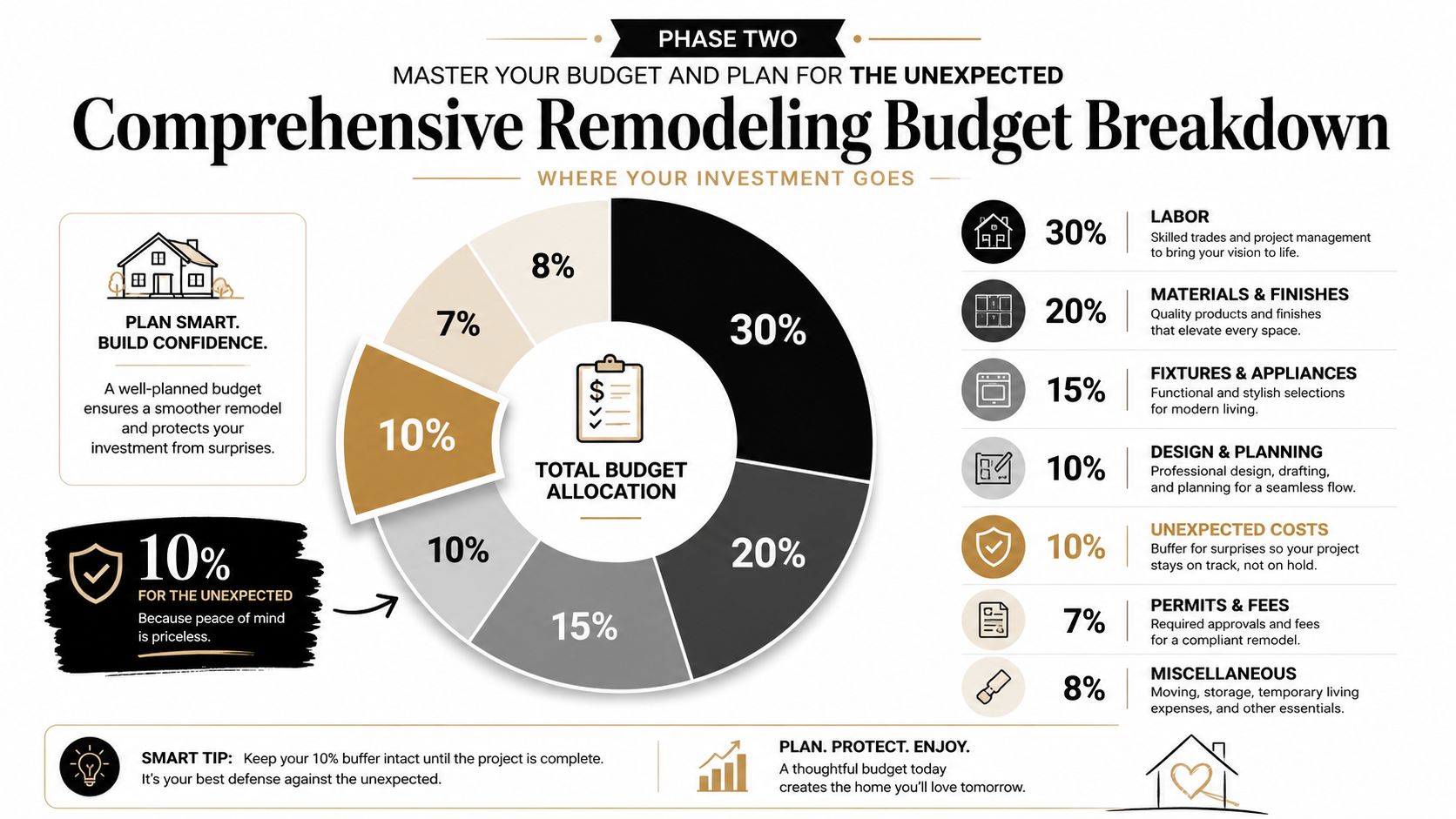
Owners usually ask for a total number. The better question is what can change once finishes come off and what money is set aside when it does. Guidance from this whole-home remodeling budgeting article recommends carrying a significant contingency, especially on older homes and projects where scope expansion can trigger additional corrections.
In Northeast Florida, that reserve protects against predictable surprises:
- Behind drywall and flooring: damaged framing, past leak repairs, outdated wiring
- At plumbing tie-ins: corroded supply lines, bad drain connections, relocation costs, and the benefits of licensed home plumbing when code compliance and inspection approval are on the line
- At service upgrades: panel changes, HVAC revisions, and work that forces coordination across trades
- At the exterior shell: window and door replacement details, flashing errors, moisture intrusion, and other water-management fixes
Florida remodels punish underbudgeting fast. Once walls are open, you either fund the correction or stop the job.
That is why contingency belongs in the original plan, not in a last-minute scramble for cash. Before approving demolition, review this guide on handling unexpected Florida renovation costs and decide how much risk the property can carry without hurting your exit.
What belongs in a serious remodeling quote
A real quote is a control document. It should show what is included, what is excluded, which selections are still allowances, who is pulling permits, how change orders are priced, and when payment milestones are earned. Advice in this remodeling mistakes and budgeting article lines up with what I see in the field. Trouble starts when owners compare bottom-line prices instead of comparing scope line by line.
Use this checklist before signing:
| Budget item | What to verify |
|---|---|
| Materials | Brand, model, finish level, quantity |
| Labor | Scope covered, trade responsibility, rate structure |
| Permits and fees | Who pulls them and whether they are included |
| Allowances | Exact dollar allowance and what happens if selections change |
| Change orders | Approval process and pricing method |
| Schedule | Milestones tied to actual work, not vague promises |
For investors, Construction Services For Investors refers to construction and remodeling services in Jacksonville and Northeast Florida focused on renovation management, project coordination, budget control, and protecting return on the project. That matters when the job is large enough that poor sequencing, loose allowances, or weak trade supervision can eat profit even if the house sells.
Unpriced hidden work is what destroys budgets.
Phase Three Handle Permits and Codes in Northeast Florida
You buy a Jacksonville house that looks like a clean cosmetic flip. Then the walls open up. A prior owner moved plumbing without approval, closed off a window that was part of a bedroom egress path, and tied new wiring into an old panel the wrong way. What looked like a six-week remodel now needs revised plans, permit corrections, and inspection signoff before the job can move. That is how profit disappears.
Permits and code compliance affect the numbers on a whole-home remodel. In Northeast Florida, they influence scope, schedule, insurance exposure, appraisal support, and resale. If the work changes structure, mechanical systems, openings, layout, or life-safety conditions, treat permitting as part of preconstruction, not an afterthought.
Local code knowledge protects ROI
Northeast Florida has its own constraints. Wind loads, flood zones, moisture control, energy code requirements, and product approval rules can all change what gets installed and how it gets detailed. A plan that works on paper can stall in review if the window package is wrong for the exposure, the structural notes are incomplete, or the scope triggers upgrades the owner did not budget for.
That is why local experience matters. A contractor working this market should know when an engineer needs to review structural changes, when a municipality will ask for more detail, and how inspection sequencing affects subcontractors in the field. If you want a clearer view of how approvals typically work, review this breakdown of the building permit process for Florida renovation projects.
Investors should pay close attention here. Permit delays do not just push dates. They increase holding costs, extend financing costs, and can throw off the resale window.
Where projects go sideways
The risky contractor usually makes permitting sound optional. You will hear versions of the same pitch. We can start now and file later. The inspector will not care. Engineering is only needed if someone asks. That approach exposes the owner, not the contractor.
Common consequences include:
- Stop-work orders: The building department can shut the project down until plans, fees, and corrections are resolved.
- Open-wall rework: Drywall, tile, cabinetry, or exterior finishes may need to be removed so rough work can be inspected.
- Insurance and closing problems: Unpermitted work can create issues during claims, refinancing, and buyer due diligence.
- Lower resale confidence: Appraisers, inspectors, and buyers notice mismatched records, incomplete finals, and obvious shortcuts.
I tell owners the same thing on major remodels. Cheap permit advice is expensive jobsite advice. If a contractor is casual about code, expect the same attitude with waterproofing, structural details, and final punch work.
A well-run project handles permits early, confirms what drawings are required, and builds the inspection sequence into the schedule before demolition gets too far ahead. That discipline protects the budget and keeps the remodel financeable, insurable, and easier to sell.
Phase Four Vet and Select Your Whole Home Remodeling Contractor
A Jacksonville owner gets three bids on a whole-house remodel. One is far lower than the others, one looks polished but vague, and one asks hard questions about permits, lead times, and who is buying fixtures. The third contractor usually causes the fewest problems because they are pricing the actual job, not selling a number to get the deposit.
The contractor you choose will affect schedule control, inspection results, resale confidence, and how much of your budget survives to the finish line. Analysts at the Harvard Joint Center for Housing Studies found that more than half of general residential remodeling businesses operating in 2007 were no longer operating by 2012 in this JCHS analysis of contractor failure rates. For an investor, that matters beyond inconvenience. A contractor failure in the middle of a project can burn months of holding cost and force expensive rework under a new team.
Check business stability, not just craftsmanship
Good finish photos prove very little by themselves. Whole-home remodels in Northeast Florida need a contractor who can run sequencing, supervise trades, pass inspections, and keep paperwork clean enough for appraisal, insurance, and resale.
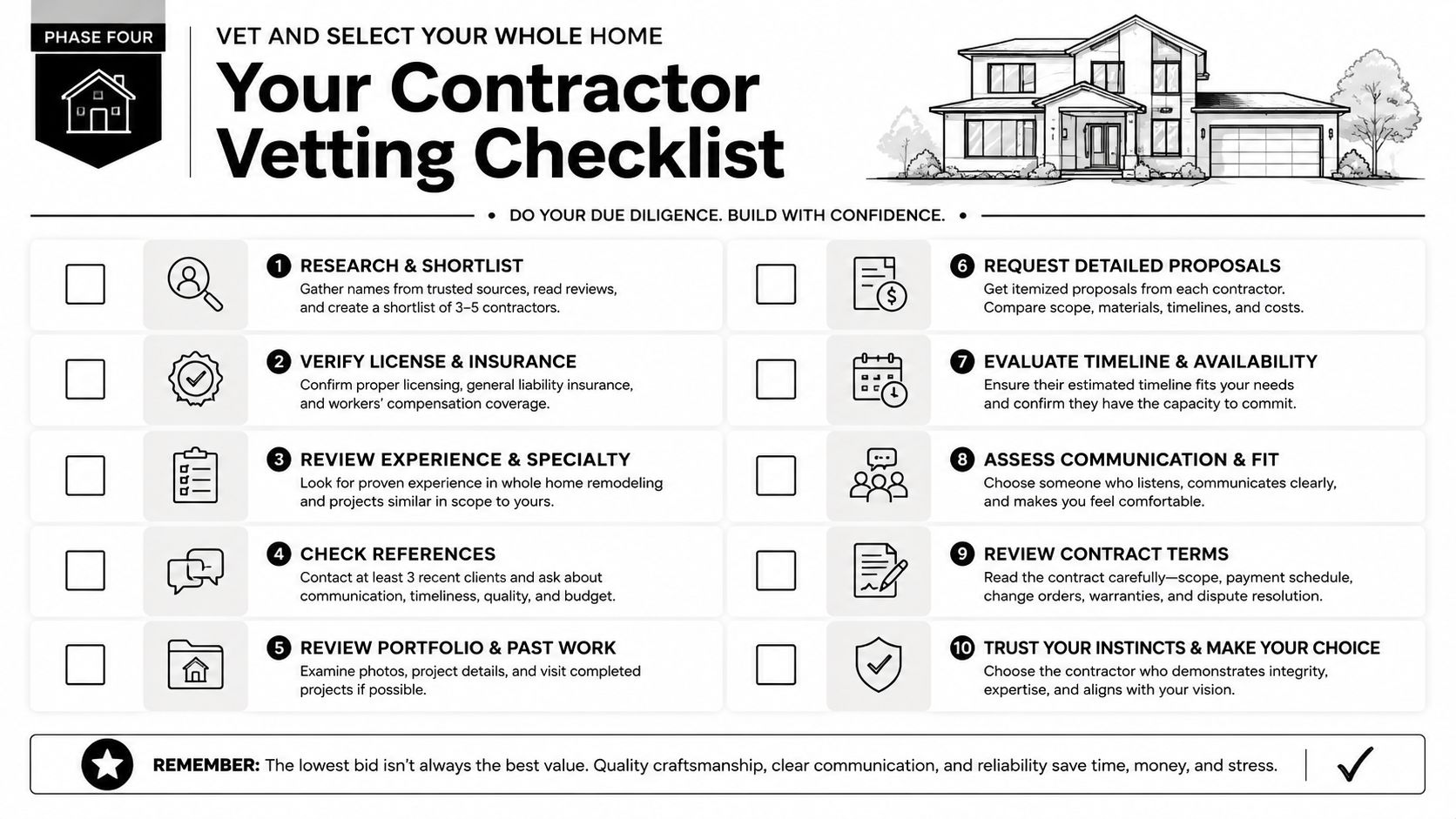
Start by verifying the basics, then push deeper:
- Licensing and insurance: Confirm the license fits the scope. Ask for current general liability and workers' comp documentation, not verbal assurances.
- Relevant project history: Look for jobs with similar age, layout, and level of reconstruction. A contractor who does cosmetic kitchen updates is not automatically the right fit for a full reconfiguration with structural, mechanical, and code work.
- Reference quality: Call recent clients and ask how the contractor handled budget changes, delays, and punch work.
- Subcontractor standards: Find out who is doing plumbing, electrical, HVAC, roofing, and structural repairs, and whether those trades are licensed where required.
- Site supervision: Ask who is on site daily and who has authority to make decisions when conditions change behind walls.
If the remodel includes system replacements, licensed trades protect the asset. Homeowners trying to understand the practical value of code-compliant specialty work can review the benefits of licensed home plumbing as one example of why trade qualification affects long-term outcomes.
Ask former clients questions that expose how the job was run:
- Were change orders priced and approved before extra work started?
- Did the original allowances reflect real finish levels, or did selections blow up the budget?
- Was the site staffed and supervised consistently?
- Did the contractor handle failed inspections and corrections quickly?
- Did the final cost land close to the original expectations for a project of that size?
- Would you trust the same contractor on another full-house project with your own money on the line?
Here's a useful video overview to pair with that checklist:
How to compare bids the right way
Bid review is where owners and new investors lose margin. The low number often comes from missing scope, weak supervision, unrealistic allowances, or optimistic labor planning. Those gaps do not stay cheap once demolition starts.
Compare bids line by line against the same scope sheet. If one proposal includes drywall repair, insulation replacement, permit coordination, debris hauling, and rough-in corrections while another does not, the cheaper proposal is not the better deal. It is a different job on paper.
Use this filter:
- Vague scope: Short proposals create expensive assumptions later.
- Heavy allowances: Large placeholders shift price risk to the owner.
- Missing trade detail: If it is unclear who handles specialty work, coordination problems usually follow.
- Weak scheduling language: Long jobs need milestone discipline, not broad promises.
- Thin contingency thinking: On older Jacksonville housing stock, hidden damage, outdated wiring, and plumbing surprises are common. A serious contractor plans for that reality.
A practical screening step is to use a structured checklist such as this guide on how to hire a general contractor and score each bidder the same way.
Good whole home remodeling contractors price enough detail up front that you can judge risk before demolition begins. That is how owners protect ROI instead of chasing the cheapest number into a costly rewrite later.
Phase Five Secure the Contract and Finalize the Timeline
A lot of remodels go sideways after the contractor is chosen, not before. The owner is relieved, the contractor is ready to start, and everyone wants to get moving. That is the moment bad paper gets signed.
For investors and homeowners in Jacksonville, the contract is where margin protection starts. If the language is loose, disputes over scope, payment, delays, and substitutions usually show up later as change orders, downtime, or finish work that does not match expectations.
Key Contract Terms to Scrutinize
The contract should read like a job plan, not a sales summary. On a whole-home remodel, that means clear responsibility for demolition, framing changes, MEP rough-ins, insulation, drywall, trim, flooring transitions, fixture installation, debris removal, permit pickup, inspections, and final cleanup. If a task is not assigned, it often becomes the owner's problem.
Pay close attention to these terms:
- Payment schedule: Tie draws to completed work and verified milestones, not arbitrary dates. Deposits and early payments should match procurement needs, permit activity, and mobilization.
- Allowances: List each allowance with a dollar amount, product category, and approval process. Loose allowances are one of the fastest ways to lose control of finish costs.
- Change orders: Require written pricing and written approval before extra work starts. Verbal approvals create expensive arguments.
- Material substitutions: Set rules for what happens if a specified product is delayed or unavailable. Equal substitutions should still require owner approval.
- Warranty terms: Confirm what is covered, how long coverage lasts, and who handles service calls for subcontracted work.
Deposit size needs context. A contractor ordering windows, cabinets, tile, or HVAC equipment may need upfront funds to secure materials and hold the schedule. The risk is not the existence of a deposit. The risk is paying too much too early without a matching paper trail for procurement and progress.
Timeline language should be specific
A usable timeline does more than name a start date and an estimated finish date. It should spell out the conditions required to start, the major phases of work, the inspection points, and the owner decisions that can hold up the job. That matters in Northeast Florida, where permit timing, utility coordination, and older-house surprises can shift sequencing fast.
A solid schedule usually includes:
- Defined start conditions: Signed contract, permit submission or approval status, financing readiness, and major selections completed
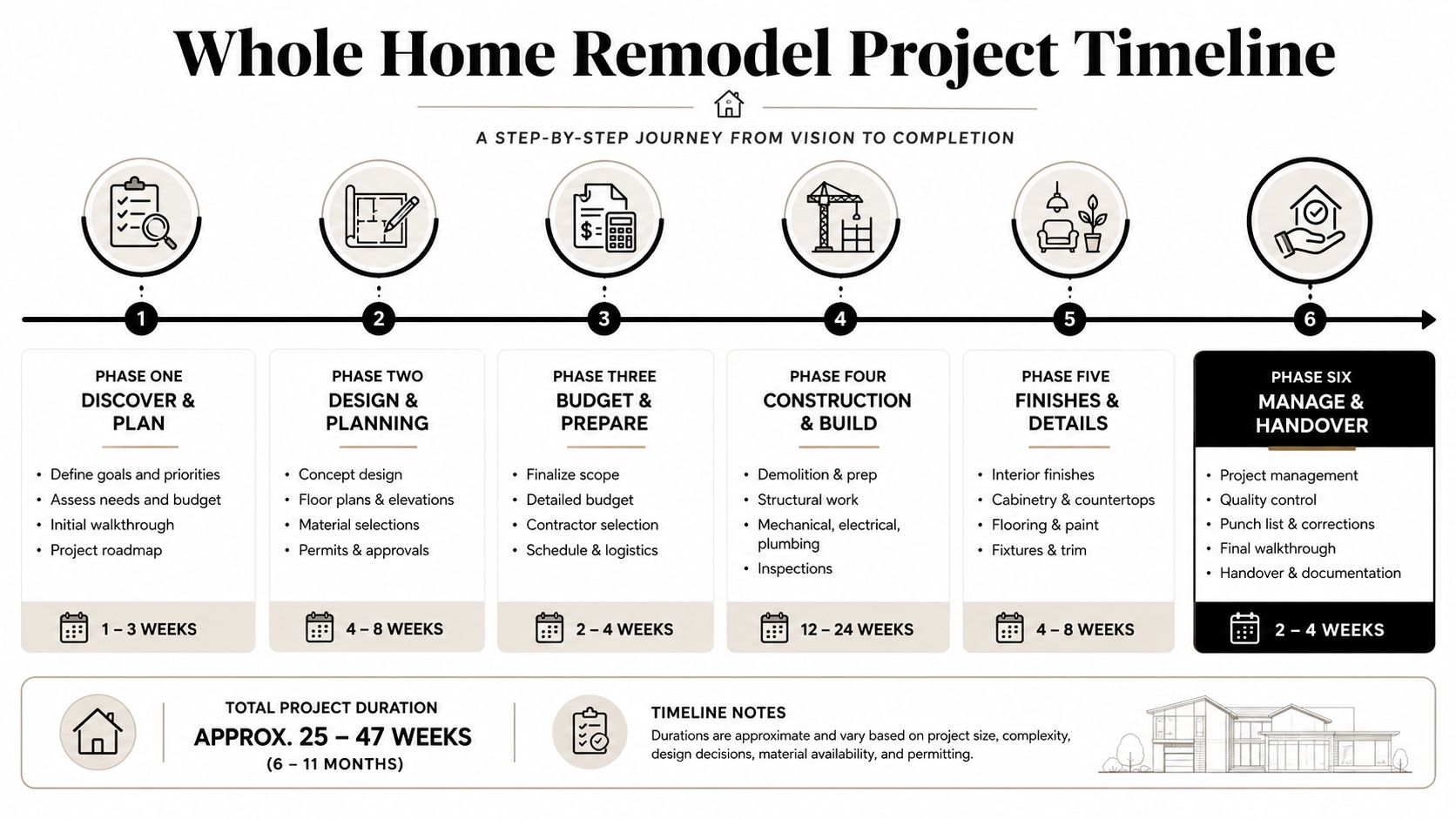
- Phase milestones: Demo, rough framing, rough MEP, inspections, insulation and drywall, cabinets, trim, flooring, punch list, and final completion
- Owner deadlines: Dates for tile, plumbing fixtures, lighting, paint colors, and other finish selections
- Delay language: Rules for weather, permit comments, hidden damage, owner changes, and long-lead materials
Do not accept vague phrases like "project will be completed in a reasonable time." For a full remodel, the better question is what could stop progress, who is responsible when it happens, and how that time gets documented.
The strongest contracts also address what happens if the house opens up and reveals termite damage, outdated aluminum branch wiring, drain line failure, or structural corrections. In older Jacksonville housing stock, those are not rare events. They are known risks, and the contract should explain how they are priced, approved, and scheduled so ROI does not get eaten up by confusion.
Phase Six Manage the Project and Ensure a Successful Handover
Hiring well doesn't remove the need for active management. It changes what management looks like. Once construction starts, the owner's job is to maintain decision clarity, document changes, and keep communication tight enough that small issues don't turn into rework.
Run the job with structure
The best projects usually have one communication lane. That may be a project manager, superintendent, or lead contractor contact. What matters is consistency. If owners text different trades directly, decisions get fragmented and accountability disappears.
Use a simple operating rhythm:
- Weekly review: Progress, open issues, upcoming decisions, and pending inspections
- Written approvals: Selection changes, added work, and revised pricing
- Site walk notes: Confirm what was discussed and what happens next
- Photo documentation: Especially for items that will be covered later
Visit the site to verify progress, not to redesign the job in real time.
During walkthroughs, look for cleanliness, material staging, protection of completed work, and whether installed items match approved selections. You don't need to supervise trades. You do need to notice drift early.
Close out with a real punch list
The final stage is where discipline pays off. Before final payment, conduct a punch-list walkthrough and document every incomplete or deficient item clearly. This isn't the time for vague comments like “touch up a few things.” List the exact location and issue.
Good punch-list items usually cover:
- Finish defects: paint, trim, tile, hardware alignment
- Function checks: doors, drawers, fixtures, switches, appliances
- Incomplete details: missing accessories, sealants, plates, transitions
- Closeout documents: warranties, manuals, permit sign-offs, and final approvals
A smooth handover means the property is complete, documented, and ready to live in, lease, or sell without open questions.
Frequently Asked Questions About Home Remodeling
Do I need a whole-home remodel or just targeted upgrades
If the layout, major systems, and finish consistency all need attention at once, a whole-home remodel may be the right call. If the home functions well and the goal is better resale efficiency, targeted upgrades can be the smarter move. Investors should judge scope against neighborhood value, hold period, and buyer expectations.
How many contractor bids should I get
Get at least three bids when possible. That helps you compare scope completeness, allowances, pricing logic, and communication quality. The goal isn't to chase the lowest number. It's to identify the proposal that is the clearest and most buildable.
What should I worry about most before demolition starts
Incomplete pricing, vague allowances, and weak change-order rules. Those are the issues that create conflict once the house is open. You also want clarity on permits, lead times, and who is supervising the site day to day.
Can I live in the home during a major remodel
Sometimes, but it depends on how invasive the work is. If the remodel affects kitchens, baths, electrical, plumbing, and multiple living areas at the same time, living in place can slow the job and create daily friction. For some owners, temporary relocation is the cleaner decision.
What does a good whole home remodeling contractor actually do
A real whole-home contractor coordinates the entire build. That includes preconstruction planning, scope definition, budgeting, permit handling, trade sequencing, inspections, quality control, and closeout. They are not just hiring subs and forwarding invoices.
When should I consider rebuilding instead of remodeling
Consider that conversation when the property has deep structural issues, major code exposure, or a layout that can't be corrected efficiently through renovation. The right answer depends on the house condition, local constraints, and whether the finished value supports the scope.
If you're planning a major renovation in Jacksonville or Northeast Florida, Ofir Engineering can help evaluate scope, budget risk, project management needs, and the right path for an investor-focused or homeowner-led remodel. Reach out to discuss whole-home renovations, contractor oversight, construction planning, or property improvement strategy before the project moves from idea to demolition.
Meta title: Whole Home Remodeling Contractors in Jacksonville Guide
Meta description: Learn how to hire whole home remodeling contractors in Jacksonville, Florida. Get practical advice on ROI, budgeting, permits, contracts, and project management.
Focus keyword: whole home remodeling contractors
Suggested internal linking opportunities
- Investors page
- Project management page
- Home remodeling related service pages
- Blog article on handling unexpected Florida renovation costs
- Blog article on how to hire a general contractor
- Resource on the building permit process
Suggested image ideas and alt text
- Hero image filename: whole-home-remodeling-contractors-jacksonville-florida.jpg
Alt text: Whole home remodeling contractors reviewing a Jacksonville Florida renovation project
Description: Contractor and property owner walking through a full-house remodel planning site in Northeast Florida - Image filename: whole-home-remodel-budget-planning-jacksonville.jpg
Alt text: Whole home remodeling budget planning for a Jacksonville renovation
Description: Budget worksheet, plans, and finish selections for a major home remodel - Image filename: whole-home-remodel-permit-code-review-florida.jpg
Alt text: Florida permit and code review for whole home remodeling contractors
Description: Permit set and project plans prepared for a Northeast Florida remodel - Image filename: contractor-vetting-checklist-home-remodel.jpg
Alt text: Checklist for vetting whole home remodeling contractors in Jacksonville
Description: Homeowner reviewing contractor proposals, licenses, and references before hiring
Hero image size recommendation: 1731 x 909 pixels
